How to Build a Winning Franchise Development Strategy for Home Service Brands

Key takeaways:
Building a successful franchise development strategy for your home services business is essential for consistent, sustainable growth.
- Establish a clear, repeatable process. Define how you attract, vet, and support franchisees—from lead generation through onboarding and ongoing support—to ensure scalable growth and brand consistency.
- Attract and qualify the right franchisees. Identify your ideal owner profile and implement careful screening methods, such as discovery calls, reference checks, and discovery days, to bring in committed partners.
- Implement effective marketing strategies. Use a blend of targeted online ads, SEO, a dedicated franchise website, email campaigns, and success stories to reach and engage quality prospects.
- Monitor performance with key metrics. Track KPIs like lead volume, conversion rates, onboarding time, and cost per lead to measure and refine your development efforts.
- Avoid common pitfalls. Don’t rush expansion, neglect lead tracking, or compromise on franchisee quality—these mistakes can harm long-term growth and your brand’s reputation.
For more actionable business tips and franchise growth strategies, sign up for the Jobber Newsletter. Subscribe here.
Growing a franchise is exciting, but it comes with real challenges. As a franchisor, you’ll need to build a sales pipeline full of qualified leads so you can keep expanding into new regions.
A clear franchise development strategy helps the business grow consistently—with the help of franchisees who care about your brand and want your franchise business to succeed.
This guide will help you attract strong franchisees and grow your system in a structured, repeatable way. Get the essentials of franchise development and learn how to keep your business running smoothly as you scale.
Learn more about franchise development strategies:
-
What is a franchise development strategy?
-
Why franchise development matters for growing home service brands
-
What does an effective franchise development strategy include?
-
How to build a franchise development pipeline
-
How to pick the right franchisees for your brand
-
Marketing strategies to help drive franchise expansion
-
Common mistakes that limit franchise growth
-
Franchise development KPIs to track
What is a franchise development strategy?
A franchise development strategy is a clear plan for growing your franchise system. It describes how you attract potential franchisees and move them through the sales process.
A good strategy looks at the full buying journey, from lead generation to signed agreements to location openings. You need to focus on building a repeatable process, not just selling as many franchises as possible.
This helps you (the franchisor) grow at a pace you can maintain—all while you keep standards consistent across locations and plan ahead to avoid operational problems later on.
Why franchise development matters for growing home service brands
Franchise development is essential for growing your business because it provides a structured way to scale. A strong franchise development plan helps you:
- Find and attract the right franchisees who will strengthen your brand.
- Expand faster and reach new customers by opening in new areas.
- Boost brand visibility and create demand for your services.
- Build customer loyalty and word-of-mouth referrals, which helps all franchisees in all regions.
- Save money across locations through bulk purchasing and shared marketing.
When you focus on these areas, franchise development helps your brand grow while maintaining the quality that your business is already known for.
What does an effective franchise development strategy include?
An effective franchise growth strategy gives you a clear plan for scaling the business by finding and selling to potential franchisees—not waiting for them to approach you.
The most effective franchise development strategies include:
- Lead generation tactics: To attract qualified franchisee leads, learn where your best franchisees come from and focus your efforts there. For example, this can include your website, paid ads, franchise brokers, referrals, or industry events. It could even include a growth program that trains your best employees to one day run their own location.
- Franchisee criteria: What makes a potential franchisee qualified to join your franchise? Define criteria like their finances, business or management experience, willingness to follow systems, and expected owner involvement. This helps you screen out anyone who won’t be a fit for your franchise brand.
- Repeatable sales process: Build a process for selling franchises with consistent steps and timelines, including introductory calls, discovery days, meetings with current franchisees, and territory reviews. You can inform potential franchisees about the steps and timeline needed to buy into your business. This helps set expectations and prevents them from dropping out of the sales process.
- Franchise Disclosure Document (FDD): The FDD is a required part of franchise development. It explains fees, obligations, risks, and expectations for how the franchise relationship works. This helps reduce issues or delays later on.
- Franchisee training: New franchisees need structured training on operations, marketing, systems, and brand guidelines. Develop a training curriculum with regular refresher courses to ensure every franchisee is following the same process.
- Launch support: Create a plan for helping franchisees with launching their new franchise unit. This should include site selection, employee hiring, and local marketing so each franchise location can open on schedule and is ready to run from day one.
- Ongoing support: Long-term franchise success depends on continued guidance after launch. This includes operational support, marketing assistance, performance tracking, and regular communication, all of which help franchisees stay aligned with the brand and keep their franchise locations running smoothly.
When these pieces are in place, franchise growth is easier to manage—and it’s less likely you’ll run into problems as the system gets bigger.
If you’re sloppy small, you’re sloppy big.

How to build a franchise development pipeline
Here’s how to build a franchise development pipeline that helps you attract qualified franchisees and move them through the sales process, creating predictable and manageable growth:
- Define your ideal franchisee by experience, financial resources, and mindset so you can focus on the right prospects.
- Generate leads consistently using marketing tactics like your website, online ads, franchise listing sites, broker networks, referrals, and industry events.
- Qualify leads early by screening candidates with applications, calls, and discovery conversations to make sure they meet your requirements.
- Engage prospects with a repeatable sales process that has clear steps and timelines, including follow-ups to keep prospective franchisees moving toward a decision.
- Track leads and progress using a field service CRM to monitor each prospect in the pipeline and keep them from dropping out of the sales process.
- Keep candidates interested over time with regular updates, resources, and check-ins until they’re ready to move forward to the next step.
How to pick the right franchisees for your brand
Finding the right franchisees is one of the most important parts of growing your franchise. Each franchisee represents your brand in their region, so they need to be the right fit for the job.
Follow these tips to screen every prospective franchisee before they move too far down the sales pipeline:
- Define the qualities of an ideal franchisee, including financial resources, experience, and how involved they’ll be in day-to-day operations.
- Use discovery calls and interviews to discuss candidates’ goals, values, work style, expectations, and business mindset.
- Check references, both professional and personal, to confirm candidates are reliable and good to work with.
- Host discovery days so candidates can meet other franchisees and see how the franchise operates.
It’s also important to be patient. Finding the right franchisees takes time and effort, but it’s worth it. Good owners create better customer and employee experiences, which makes your company stronger.
I want to know that you are willing to learn how to do it the way we do it.
Marketing strategies to help drive franchise expansion
Franchise marketing plays a big role in helping you build brand awareness and grow your business. The most effective franchise marketing strategy blends corporate and local advertising, so all franchisees benefit.
These are just a few ways to grow your business through marketing:
- Targeted online ads: Use paid search and social media advertising to reach people who are actively looking for an investment or franchising opportunity.
- Franchise website: Create pages on your website that explain your franchise model, support, training, investment details, and success stories.
- Strong SEO: Optimize your site for search terms that prospective franchisees use (e.g., “service franchise for sale” or “home service franchise opportunities”) so you show up earlier in their research.
- Owner success stories: Share testimonials, case studies, and videos from real franchise owners talking about their experience with the brand.
- Email campaigns: Send automated email campaigns to keep potential franchisees interested, answer common questions, and move them through your pipeline.
- Info sessions: Schedule regular webinars or Q&A sessions where potential franchisees can ask questions and learn more about your franchise model.
Common mistakes that limit franchise growth
Careful franchise development keeps your brand strong and helps your business grow. During your franchise strategy development, try to avoid common mistakes like:
- Recruiting the wrong franchisees who don’t have the knowledge, experience, or financial support to run the business properly
- Not tracking leads or keeping your prospects interested, causing them to drop out of your sales pipeline
- Ignoring brand standards around customer service and messaging, which can affect service quality and damage customer trust
- Not exploring the right marketing channels or investing enough budget to reach your ideal franchisees
- Not tracking your sales metrics (e.g., lead sources, cost per lead, timelines) so you can accurately plan for growth and keep sales efficient
- Rushing to expand without the right systems and training in place, which can be frustrating for franchisees and customers
One of my mentors told me to slow down to speed up. It is some of the best advice I’ve ever gotten.

Avoiding these mistakes helps your franchise system grow sustainably—and helps your brand maintain a strong reputation.
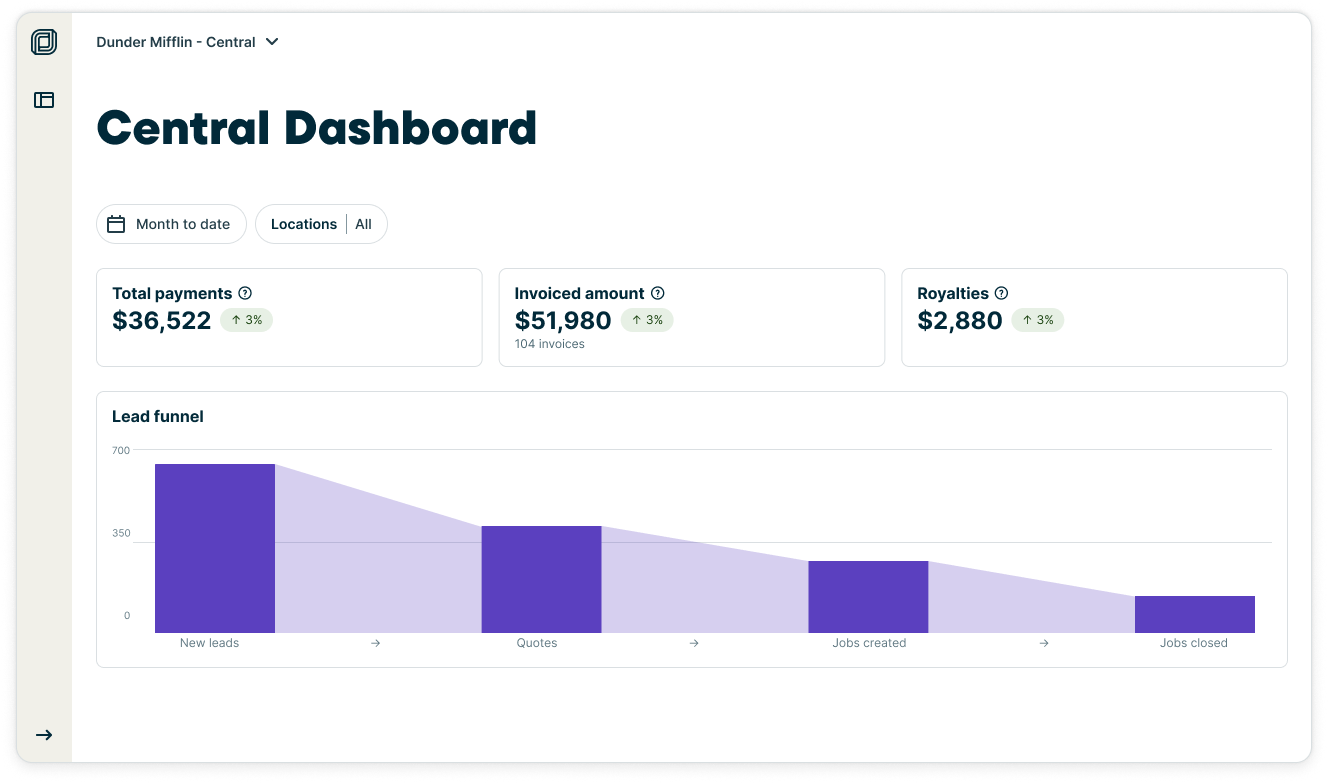
The best franchise management tools, like Jobber, help you grow your franchise network while avoiding some of these hurdles. Here’s how Jobber can help your franchise scale more easily:
- Monitor the entire franchise in real time using reports and dashboards so you can spot issues faster and make smarter decisions that help your franchisees.
- Maintain a consistent customer experience across every location with standardized software, pre-made accounts for new franchisees, and branded workflows.
- Streamline key workflows like lead distribution, financial reporting, royalty calculations, and data exports, so your team can focus on growth—not admin.
- Get unlimited tech support for yourself and your franchisees, including 1-on-1 product coaching, a dedicated account manager, and a custom training manual.
Franchise development KPIs to track
Tracking the right KPIs helps you understand how well your franchise development efforts are working and where to improve. These metrics should include:
- Lead volume: Number of potential franchisees who enter your pipeline at once
- Lead quality: Number of leads that meet your criteria for an ideal franchisee
- Conversion rate: Number of qualified leads who sign a franchise agreement
- Sales cycle: Time taken to guide a lead from the first phone call to a signed franchise agreement
- Franchisee onboarding: Time taken to complete training and launch a location
- Franchisee performance: Revenue and customer satisfaction
- Cost per lead: Cost of bringing in a new qualified lead
- Cost per conversion: Cost of turning a qualified lead into a successful franchisee
- Pipeline activity: Number of active candidates at each stage of the sales process
Build your franchise development strategy
Use the strategies in this article to build a scalable system and find franchisees who will help grow your business and expand into new regions.
Franchise management software like Jobber makes it easy to manage operations, support franchisees, and maintain consistent service across every location.
Frequently Asked Questions
-
Franchisors can find franchisees in a few different ways:
• Use targeted online ads to send leads to their brand website.
• Create profiles or get featured on franchise listing sites.
• Work with franchise brokers who bring in qualified potential franchisees.
• Get referrals from existing franchisees or past customers who know the brand.
Once you have a lead, set up a phone call to make sure they have the right experience and budget to run a successful franchise. Qualified candidates can then fill out your application form and continue through the sales process.
-
The franchise development process takes 3–12 months, depending on whether you’re building a system from scratch or recruiting new franchisees into an existing system.
If you’re turning a business into a franchise, it can take 6–12 months to create documents, develop training programs, and file the legal paperwork needed to start selling franchises.
If your system is ready and you’re starting franchise recruitment, it takes 3–6 months to turn a sales lead into a franchisee. Motivated and qualified leads might close the deal faster. -
Expanding a franchise system costs around $41,000 to $160,000 in the first year for most small to mid-sized franchise brands. This covers the work needed to legally launch your franchise, recruit your first franchisees, and support them as they open.
Below is a rough breakdown of approximate costs. Your exact costs will vary based on your goals, marketing tactics, and the support you provide to franchisees.
• Creating a franchise disclosure document (FDD) with a lawyer: $15,000–$45,000
• Developing an operations manual: up to $30,000
• Preparing financial statements: $2,500–$5,000
• Registering your FDD and Incorporating/trademarking: $1,000–$4,500
• First-year sales and marketing (website, ads, materials, events): $22,500–$75,500 -
Franchise development is the process of growing your franchise as a whole. It includes defining your ideal franchisee, building your sales and marketing systems, creating legal documents, developing training programs, providing ongoing support, and more.
Franchise sales is just one part of that process. It focuses on recruiting, qualifying, and signing agreements with individual franchisees, but it doesn’t include any of the planning that comes before or after the sale.
-
The first steps in building a franchise development strategy should be:
1. Make sure your business is ready, including operations, systems, and training.
2. Decide how many locations you want to open, where, and when.
3. Prepare your franchise disclosure document (FDD) with a franchise lawyer.
4. Incorporate the business, file a business name trademark, and register your FDD.
5. Define your ideal franchisee (e.g., skills, experience, budget, involvement).
6. Build a marketing plan for reaching potential franchisees.
7. Lay out your sales process from the first email/phone call to location launch.
8. Create a training and launch plan for new franchisees.
9. Figure out how you’ll support franchisees and track performance to ensure growth.