HVAC Email Marketing: Tips and Templates to Drive Repeat Business

Key takeaways:
Email marketing is a powerful way for HVAC businesses to stay top of mind, drive repeat business, and fill their schedule during slower months.
- Keep your business visible and relevant. Email marketing helps maintain relationships with previous customers, so they think of you when they need HVAC services again, especially with timely reminders and maintenance updates.
- Cost-effective and easy to automate. Unlike expensive ads, email marketing lets you reach your own list at a low cost, automate routine messages, and easily fill out slow seasons or shoulder months.
- Use targeted content and segmentation. Sending relevant messages—like tune-up reminders before the busy season, review requests after jobs, and maintenance renewals—ensures your emails are helpful, not ignored as spam.
- Field-tested templates save time. Use simple, customizable email templates for common situations such as seasonal maintenance, renewal reminders, review or referral requests, and follow-ups to increase engagement with minimal effort.
- Track what matters: revenue and retention. Measure which emails drive bookings, renewals, and reviews, and adjust your strategy to get more business from existing customers.
Want more practical tips to grow your HVAC business? Sign up for the Jobber Newsletter.
As an HVAC company, you’ve already done jobs for homeowners. Those customers know your name. And yet, when their system acts up again, there’s no guarantee they’ll call you.
Email marketing fills that gap, keeping your business in front of customers. It nudges them at the right time, like just before their maintenance plan is about to expire, so they’re more likely to ask for your services.
This guide will show you how to set up and run HVAC email marketing in a way that fits your day-to-day operation. Get practical strategies, templates you can copy and send, and methods to measure what’s working.
Your guide to email marketing for HVAC companies:
Why HVAC email marketing works
Most homeowners only think about their HVAC system when there’s a problem with it. And when something is wrong, they call an HVAC contractor they’re familiar with.
An email marketing strategy is a simple way to keep your company top of mind for customers, until eventually, you’re the one they call. Here are a few reasons why email is an important part of your HVAC marketing strategy:
- You own your audience. While you can get leads by running Google Local Services Ads or Facebook ads, costs are high and competition can be tough. Email, on the other hand, is low cost and low competition. You own your list of email addresses, and you don’t have to pay for HVAC leads who may or may not answer the phone.
- You can fill up the slow months. You’re probably busy in the summer and winter, but the phones might be quiet in the in-between months. That’s your opening for a well-timed email like “Fall furnace check before the first cold snap” or “Maintenance plan reminder: don’t lose your spot.”
- Email is cost-effective. If you don’t have the budget to reach new customers with HVAC ads, you could instead use an email platform to keep past customers coming back. Existing customers are easier to sell to and cost you less to win back.
- Email can position you as a trusted advisor. When you send emails like “3 signs your AC is struggling before it fails” or “What that furnace smell actually means,” you become the HVAC pro who truly helps customers. They’ll feel more comfortable calling before there’s an emergency.
- Email is easy to automate. Once you’ve set up your email campaigns, they can all run in the background of your operations. Welcome sequences, seasonal tips, and maintenance reminders go out automatically without adding more to your plate.
Put it all together, and HVAC email marketing keeps your business relevant and fills gaps in your schedule. And it all happens with low effort and low cost.
If you’re not emailing your customers, you’re losing money.
The power of email marketing is staying in front of your customers.

How to get started with HVAC email marketing
Email marketing works best when you keep it simple and tie it directly to how your HVAC business already runs.
You just need a clean list of email addresses, the right email marketing tool for content management and distribution, and a few automations that handle the heavy lifting in the background.
1. Build a customer list
Before anything else, you need a customer list. You likely already have email addresses for the customers you’ve worked with before, but they might be scattered. Here’s how to fix that:
- Pull everything into one place. Round up addresses from paper invoices, QuickBooks, phone contacts, old spreadsheets, etc.
- Let your system do the work. Tools like Jobber can automatically capture emails when you create a quote or book a job.
- Make sure you have permission to use email addresses. If someone has done business with you, you’re usually fine. But still follow guidelines like the CAN-SPAM Act so you don’t run into issues.
READ MORE: How to create an email list for your service business
2. Pick a tool that fits how you operate
Here’s where some HVAC companies go wrong. They sign up for a generic email platform and then wonder why it feels clunky or doesn’t meet their business needs.
That’s because most tools weren’t built with service businesses in mind. Email marketing for HVAC requires a seamless connection to your workflow. Platforms like Jobber combine scheduling, invoicing, and digital marketing so your team isn’t juggling five different systems.
With Jobber’s software, 80% of campaigns lead to new work being booked. You can use Jobber Campaigns to:
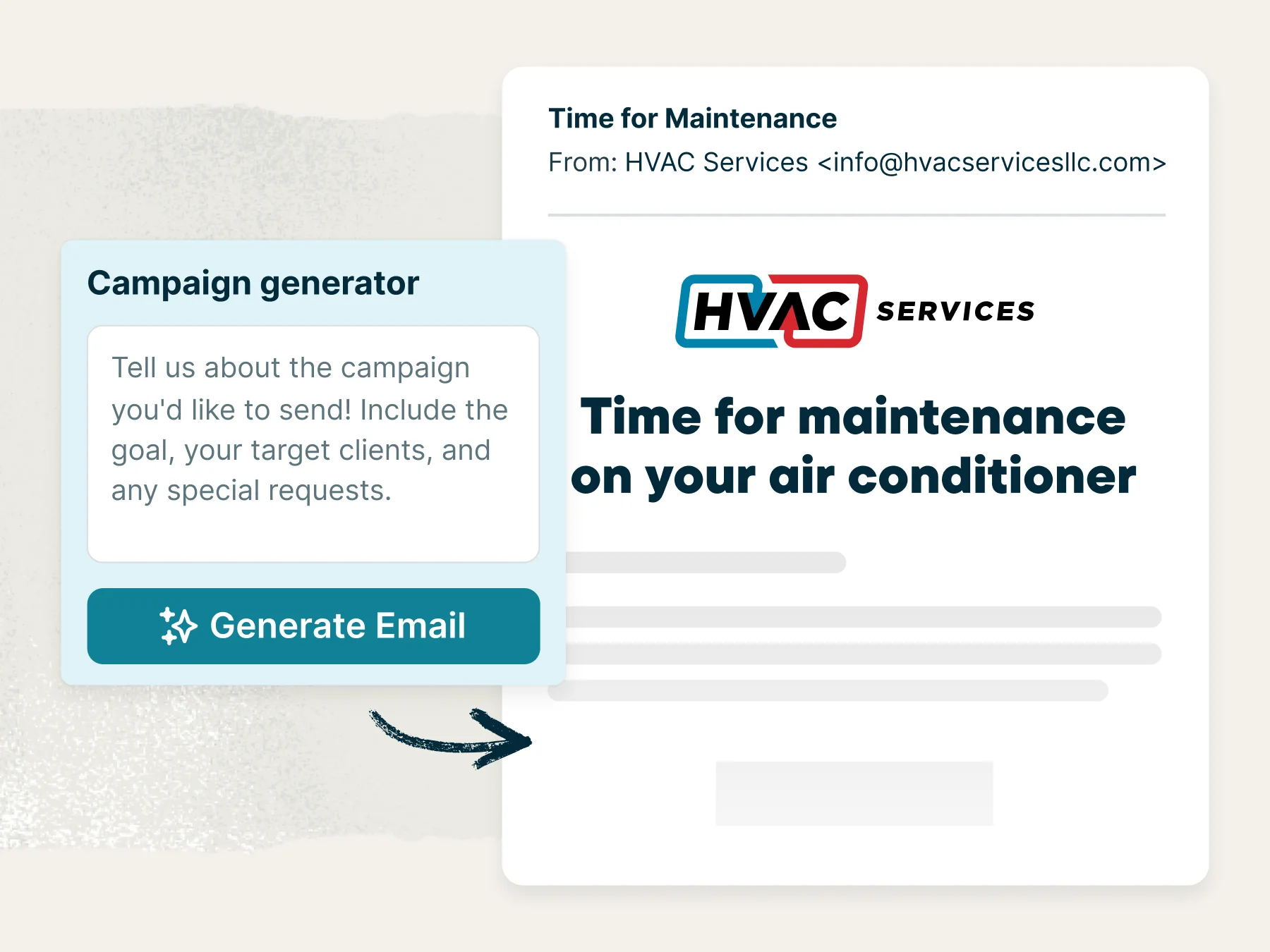
- Get started fast: Easily create email marketing campaigns in no time. Just describe what you want to do, and Jobber will build a polished email campaign that’s ready to send.
- Send targeted content: Reach the right customers with the right message using client and job details already found in Jobber. No need to export and upload CSV files every week.
- Automate campaigns: Send the right message at the right time by automating campaigns based on a contact meeting specific criteria.
- Track revenue: Open rates are nice, but you want to see your HVAC email campaigns turn into booked jobs. See which campaigns drive the most customer engagement and revenue for your business with in-depth reporting.
Our first campaign turned into $25,000 worth of revenue in just 1 week! We’ve now sent four or five campaigns and each time we do, we see a big jump in revenue.

3. Segment your list
When it comes to email, relevance beats volume. Sending the same email to everyone is how you get ignored or even marked as spam.
Instead, send the right message to the right HVAC customers. Here’s how:
- Group by equipment or service history. Break your list into practical segments, like “AC vs. furnace” or “recent install vs. older system.” This allows you to sharpen your messaging. A customer with an old AC is more likely to respond to an email about preventing breakdowns in the summer than a customer with a newly installed AC would.
- Wake up dormant customers. Pull a list of anyone who hasn’t booked in the last year and send a re-engagement email with a subject line like “It’s been a while”. These people are warm leads since you’ve already done business with them. Winning them back is faster and cheaper than finding new customers.
- Separate the maintenance customers. Keep your maintenance agreement members in their own segment, separate from one-time customers. You’ll avoid awkward, irrelevant messaging (like asking them to “join now”), and instead reinforce the value they’re already paying for.
4. Use field-tested templates to save time
You don’t need to be a wordsmith or designer to send emails that work. In fact, an email that’s too polished can feel a bit off (like you’re trying too hard). All you need to do is:
- Design for smartphones. Homeowners might skim emails between errands or on the couch. Make buttons big and easy to tap.
- Use HVAC-specific templates. Tools like Jobber Campaigns come with pre-built emails for tune-ups, follow-ups, and seasonal promos.
- Try plain-text emails. It’s not uncommon for a simple message to get more replies than a long, glossy newsletter.
And you won’t have to start from scratch. In this guide, the section “HVAC email marketing templates” has real examples you can try.
5. Start with low-hanging fruit
If you do nothing else, set up these three simple automations. The goal is to let your systems quietly support your business while your team focuses on calls and getting through the day.
- Post-service follow-up: After a job closes, send a quick thank-you and ask the customer to submit a review.
- Quote reminders: Nudge customers who haven’t approved an estimate yet. This one alone can help you earn more revenue instead of leaving it on the table.
- Seasonal maintenance reminder emails: Schedule reminders for spring and fall ahead of time so you’re not scrambling later.
HVAC email marketing templates
The reason for contacting a past HVAC customer depends on what you have to say. The most common times to send an email are when:
- A maintenance plan is about to expire (and you don’t want that recurring revenue slipping away).
- You’re heading into heating or cooling season and want to fill the schedule early.
- A job just wrapped up and it’s the perfect moment to ask for a review.
- You’re looking to generate referrals without spending more on ads.
- It’s been a while since a customer last booked.
Use these free, customizable email marketing templates to get in touch with old customers and grow revenue.
Seasonal tune-up / maintenance reminder
This email template is how you get ahead of the rush of peak season. A seasonal reminder helps customers take action before their system is under pressure. It also positions you as proactive—not just the company someone calls when there’s an emergency.
Homeowners might know they should schedule maintenance, but they don’t think about it until it’s too late. This is your nudge.
Subject line: Is your AC ready for the heat, [Customer Name]?
Hi [Customer Name],
It’s [Your Name] from [Company Name]. With [spring/summer] around the corner, now’s a good time to make sure your [AC system/furnace] is running the way it should before the busy season hits.
A quick tune-up can help:
- Catch small issues before they turn into expensive repairs
- Keep your system running efficiently (lower energy bills never hurt)
- Reduce the chances of a breakdown
We’re starting to fill up our schedule for the season. If you’d like to get ahead of the rush, you can book your tune-up here: [Booking Link]
Or give us a call at [Phone Number] and we’ll get you on the calendar. It’s a lot easier (and cheaper) to handle this now than during the first [heatwave/cold snap].
Talk soon,
[Your Name]
[Company Name]
[Contact Information]
There are all these people sitting in your database—prospects and customers that already know, like, and trust you—and you can cross-sell them different services.

Maintenance renewal
Maintenance plans are one of those “set it and forget it” things, which is great for both you and the customer. But when renewal time comes, the customer might not remember to re-sign..
This email template fills that gap. Chances are the customer wants to renew but just isn’t aware of when their plan expires. A well-timed reminder reinforces the value of staying on the plan, like cost savings and fewer breakdowns, while protecting your recurring revenue.
Subject line: Your maintenance plan is about to expire, [Customer Name]
Hi [Customer Name],
It’s [Your Name] from [Company Name]. Just a quick heads up that your HVAC maintenance agreement is set to expire on [Expiration Date].
We wanted to reach out before that happens so you can keep your benefits active without any gaps. As a member, you’ll continue to get:
- Priority scheduling (including during peak summer and winter months)
- Discounted repairs and service calls
- Regular tune-ups that help prevent breakdowns
If you’d like to renew your plan, you can do that here: [Renewal Link]
Or feel free to call us at [Phone Number] and we’ll take care of it for you. Let us know how you’d like to proceed!
Thanks,
[Your Name]
[Company Name]
[Contact Information]
Pro Tip: If you want to tighten this up even more, add a soft deadline (“Renew by [Date] to avoid interruption”) or a small incentive. Give people a reason to act now instead of later.
Review request
Timing arguably matters more than anything else in email marketing for HVAC contractors.
Right after a job wraps up, the experience is still top of mind for the customer. Hopefully, they’re either relieved or satisfied that things are handled.
The longer you wait, the more that feeling fades. This is why sending a post-service review request works so well. It catches customers when leaving a review feels easy.
Subject line: Quick favor, [Customer Name]?
Hi [Customer Name],
It’s [Your Name] from [Company Name]. Thanks again for trusting us with your recent [service type]. We appreciate the opportunity to help.
If you have a minute, would you mind sharing your experience in a review? Your feedback helps other homeowners feel confident choosing a company they can trust.
You can leave a quick review here: [Review Link]
If there’s anything about your visit that didn’t meet expectations, feel free to reply directly to this email or call us at [Phone Number]. We’d always rather make it right.
Thanks again,
[Your Name]
[Company Name]
[Contact Information]
Pro Tip: To improve your odds of getting a response, send your request within a few hours of job completion. If your tech had a great interaction with the customer, mention their name in the email for a personal touch.
Referral request
Starting a new customer referral program also gives you a reason to reach out to past clients.
It’s an opportunity to not only win back past customers, but also generate new potential customers with little effort on your part.
Use this email template to tell them how your referral program works, what they get from joining, and how to start using it.
Subject line: New referral program from [Company Name]
Hi [Client Name],
It’s [Your Name] from [Company Name]. It’s been a while since we worked together and we wanted to let you know about our new referral program.
For every referral that we get, we’re offering past clients a discount of [X%]. That means that you could save up to [$X] on your next [AC repair, furnace tune-up, etc.].
All you have to do is:
- Let your friends, neighbors, and family members know about us
- Tell them to let us know who sent them when they book us for a free quote
After we complete a job for them, you can take advantage of your discount!
You can find more details about our referral program by visiting our website: [link to web page explaining your referral program]
If you have any questions, please send us an email at [email address] or give us a call at [phone number]. We hope to work with you again soon!
Thanks,
[Your Name]
[Company Name]
[Contact Information]
Furnace filter or “next visit” reminder
Customers rarely think about their air filter or routine service unless it’s urgent. A simple reminder with this email template every couple of months (for filters) or annually (for service) keeps customers on track.
This is a perfect example of HVAC email marketing doing its job quietly in the background. No big promo—just a low-pressure reminder that turns into booked calls.
Subject line: Quick reminder to check your air filter, [Customer Name]
Hi [Customer Name],
It’s [Your Name] from [Company Name]. Just a quick reminder that it might be time to check or replace your HVAC air filter.
A clean filter helps:
- Keep your system running efficiently
- Improve airflow throughout your home
- Reduce strain on your equipment (and avoid unnecessary repairs)
If it’s been a while, we’re happy to take care of it for you. You can schedule your next service here: [Booking Link]
Or give us a call at [Phone Number] and we’ll find a time that works.
Talk soon,
[Your Name]
[Company Name]
[Contact Information]
HVAC email marketing best practices
HVAC email marketing is most effective when it feels like a natural, timely extension of your service.
These email marketing tips will help you stay helpful and relevant, without bombarding inboxes with spam.
Lead with service, not sales
If every email is a promotion, people will tune out. Instead, think about solving, explaining, or preventing something.
- Teach simple wins. Offer practical advice, like “How to check your air filter” or “Why your outdoor unit needs space.”
- Prevent headaches. Frame emails as “here’s how to avoid a breakdown” rather than “book with us now.”
- Do a gut check. If it sounds like it would be pushy to say in person, it’ll feel worse in an email.
A good rule of thumb—if the email helps the customer, even if they don’t book, you’re on the right track.
Find your rhythm
You’ll likely find your sweet spot (while not overdoing it) by keeping things simple. Start by doing what you can, and add to it over time as you notice new opportunities to connect with customers.
- Stick to 1–2 emails per month. This is usually enough to stay visible without becoming noise that gets ignored.
- Lean into the seasons. Ramp up your emails in spring and fall when maintenance is top-of-mind. Ease off when you’re slammed in peak months.
- Trigger emails are better than batch sends. A reminder six months after a repair feels personal. A weekly newsletter feels skippable.
If you have some nurturing sequence, like an email every single month, or if it’s a quarterly blast of a special or something like that, you’ll stay top of mind.
Write subject lines people want to open
No pressure, but an email’s subject line determines whether the customer will open it or just delete it. The good news is that simplicity usually works.
- Keep it local. A line like “Quick note for [City Name] homeowners” feels more relevant than a generic promo.
- Create honest urgency. Saying “Your furnace warranty may be at risk” is highly specific and will resonate with the customer better than “ACT NOW!”
- Keep it short. Under 50 characters is a safe bet so the subject line doesn’t get cut off on mobile devices.
If the subject line sounds like something you’d say to a customer in person, then it’s probably solid.
Personalize beyond just a first name
“Hi John” is fine, but it’s not very memorable as an introduction. The real impact comes from showing that you remember who the customer is and what services they’ve had done in the past.
- Reference their system. “How’s your new air conditioning unit holding up?” hits differently than a generic check-in.
- Use service history. Tailor messages based on past jobs or tune-ups, showing you remember them and they’re important to you.
- Send from a real person. “Mike from [Company Name]” feels human. “[email protected]” feels automated.
This is where tools like Jobber Campaigns come in handy. With personalization tools, it’s easy to send a customized message without needing to dig through all kinds of notes.
Design for mobile devices
People read emails on their phones—and while multitasking—so your email has to be easy to understand and act on in that moment.
- Make buttons easy to tap with big, clear “Book Now” links. Don’t use tiny text.
- Keep layouts clean. Too many images can slow things down.
- Get to the point fast. If the recipient has to scroll far to figure out what you want them to do, you’re going to lose them.
Pro Tip: As a test, send the email to a friend. Can they book a service with you in 10 seconds max? If not, tighten up your messaging and CTAs.
Make it easy to leave
This sounds backwards, but being able to opt out matters to people. (It’s also a legal requirement.) Include a clear unsubscribe link, which builds trust and keeps your emails out of spam folders.
And it’s not a complete loss when someone wants to opt out. A smaller, engaged list will outperform a larger, irritated one.
How to measure HVAC email marketing results
While email platforms will show charts and percentages, your job is to connect those numbers back to real work on the schedule.
Here’s how to track what counts.
Look past vanity metrics (but don’t ignore them)
Open rates and clicks are helpful, but they’re not the finish line. Think of them as early signals rather than the outcome.
- Open rates: Aim for an open rate of 20–30%. If you’re below that, your subject lines might not be hitting the mark, or your name isn’t recognizable.
- Click-through rates: 2–5% is solid, which tells you if people are taking the next step.
- Unsubscribes: Keep it under 1%. A few people dropping off is normal—the average rate is 0.14%—but a spike could mean you’re sending too often or being too salesy.
Track conversions
Every email you send should lead to an action, and ideally one that turns into booked work.
- Watch bookings. How many people clicked your email and scheduled a tune-up or repair right away?
- Track phone calls. Use a dedicated phone number in your emails so you know which calls came from an email marketing campaign versus a Google search.
- Use coupon codes. If you’re running a “Spring Tune-Up Special,” for example, track how often the code for that gets mentioned.
Connect emails to revenue
People clicking is good, but you want to know what that click turned into.
- Follow the job lifecycle. An email marketing service like Jobber lets you track everything from the sent email to the booking, to the completed job, to the paid invoice.
- Compare job values. Email-driven jobs often come from existing customers, which means higher margins (no acquisition costs).
- Look for patterns. Are maintenance emails leading to bigger repair tickets? That’s a valuable insight you can use to plan future email campaigns.
Measure customer retention
Not every marketing tactic brings immediate results, but HVAC email marketing helps build customer relationships that pay off over time.
- Track maintenance renewals. How many customers renew after getting reminder emails?
- Watch your review count. Post-service follow-ups should steadily increase your Google and Facebook reviews.
- Monitor repeat business. Are more customers coming back to you after one job? That’s a sign your communication is working.
Evaluate your shoulder season fill rate
A simple way to measure the success of your email marketing efforts is to look at your calendar. Here’s what to watch out for:
- Check April and October. Are those “in-between” months starting to fill up before the weather shifts?
- Look for early bookings. Are customers scheduling maintenance before the rush?
- Measure effort vs. return. If your office manager spent 20 minutes creating and sending an email that booked 10 jobs, that’s a win.
Start making targeted campaigns in Jobber
With your client details ready to use, you can hit the ground running with pre-built campaign templates and easy audience filtering in Jobber.
Plus, you can create email campaigns that automatically send to customers as soon as they meet the conditions you set, like “6 months after a job ends.” Then you’ll be able to track results, book more jobs, and keep delighting customers.
Frequently Asked Questions
-
Roughly 80% of the emails you send should be useful. So, for HVAC businesses, this might include maintenance tips, quick filter reminders, or giving a heads-up before a heatwave. The other 20% can be promotional, like offering tune-up specials or discounts for installs. When you lead with value, customers are more receptive when you do make an offer.
-
Start by segmenting your list so your messages match the customer’s service history and needs. Then send timely, practical content (like a pre-summer AC checklist) and include a next step (like a “Book Now” button). To see what’s working, track which emails turn into real jobs using Jobber Campaigns.
-
Consistency matters more than volume. For the average home service business, one or two promotional emails per month is the sweet spot, sending seasonal reminders and quick updates. From there, you can layer in automated emails based on timing or activity, like post-service follow-ups or renewal reminders.
-
Focus on the customers you already have (or almost had). Reconnect with inactive customers by sending a simple “we miss you” email to anyone who hasn’t booked in a year. Follow up on open estimates, since a quick reminder could nudge someone to schedule a job.
You can also ask for referrals. Happy customers are usually willing to recommend you. Sometimes they just need a little encouragement or a special offer in exchange.