 25 Minutes
How She Turned $43 into a $5M/Year Business
With Doni Jones


-
Adam (00:26):
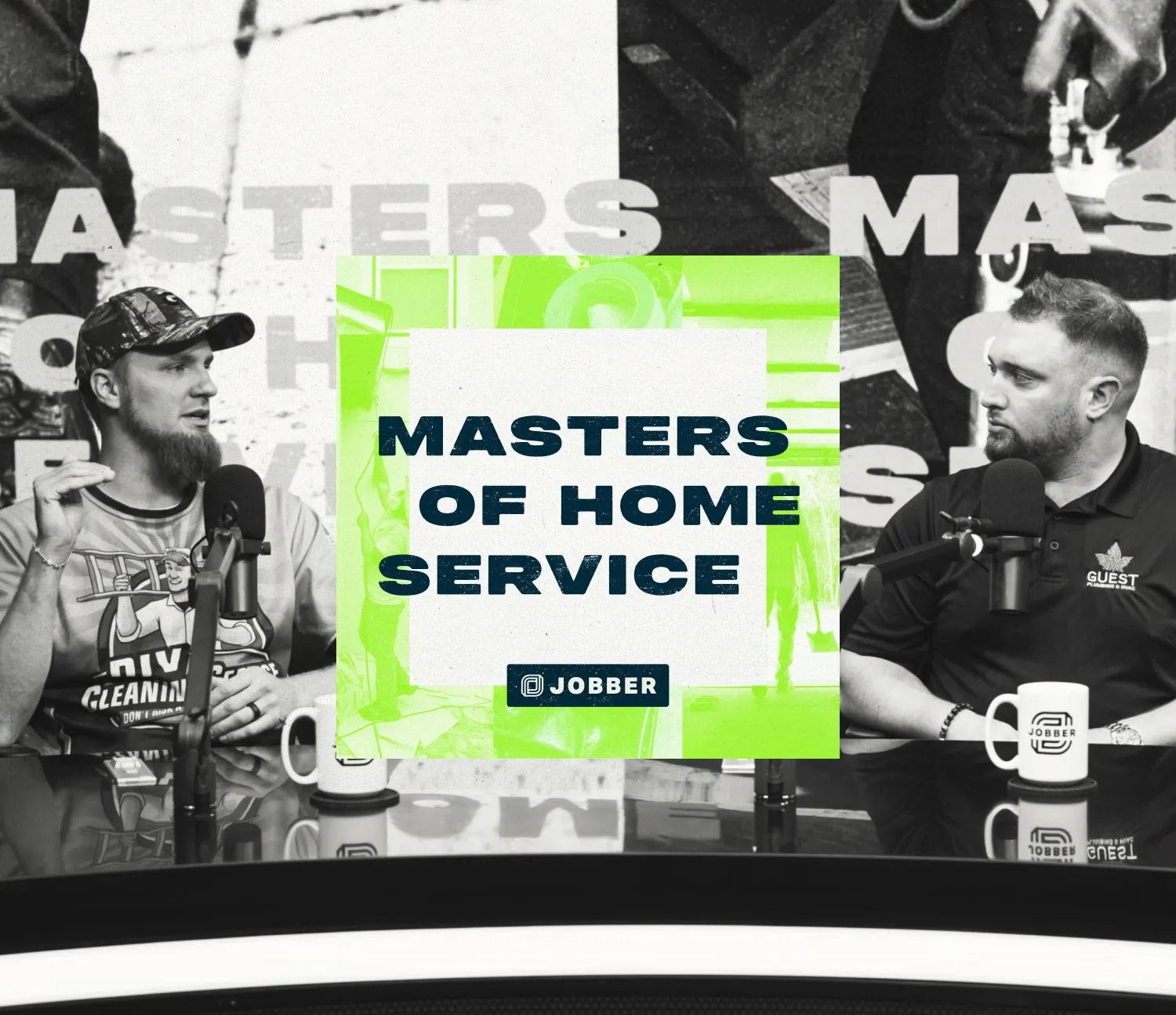
Welcome to Masters of Home Service, the best podcast for home service pros like us. I’m your host, Adam Sylvester, and I want you to crush it in business. If you’ve been feeling down lately, business is hard. If you’re feeling like just nothing’s working, trucks are breaking down and clients are upset and people are leaving, and clients are waiting a long time to get your work, and you got one star view last week, and business is just hard. If you’re feeling that way, then today is the day for you, because we’re going to bring you some inspiration. We’re going to give you some ways to feel better about what you’ve got and to keep fighting, to keep going in business. If it was easy, everybody would do it. And you’re a fighter, and we’re going to bring some of that fight out of you today with this great story.
(01:09)
I’ve got Doni Jones with me, and she’s the owner and founder of Don’s Tree Service in Atlanta, and she’s been in business for 25 years, but it hasn’t always been roses. We can get into that. And Doni, here’s the thing. You’re crushing it, and I’m just so inspired by you. And I think that you’re the backbone of the economy. You are employing people. It’s a family business. Your daughter works with you, your husband works with you. It wasn’t always easy. We’ll get to that. Not much money, not much leads, not many trucks. It’s business. You’re doing it, and it’s so inspiring and so I’m just grateful to share the mic with you today.
Doni (01:42):
Thank you. I really appreciate you. I’m appreciative to be here. I’m honored to be here. So thank you for what you do. And honestly, a lot of our success over the last five years is due to what you do with Jobber for real, because that was a game-changer for us, which was the importance of putting in systems. And I think for us growing and going through ups and downs, one of the soft spots we had was putting in systems. And so Jobber’s been a really great addition to the company, so I appreciate that.
Adam (02:09):
I’m glad to hear that. I really do. So 25 years ago, you start this business with $43, $43 in a dream and a lot of uncertainty and a lot of fear and unknown, but you had a dream. And so you start this business with no leads, no trucks, nothing. Right? Basically.
Doni (02:27):
Absolutely
Adam (02:27):
No partner to lean on until you met your husband a few years later, marry him. And you guys have been building a business ever since. Take us back to what it was like in those early days where it’s just your friends didn’t understand what you were doing. What was it like?
Doni (02:40):
Well, luckily, I actually grew up in the tree care industry, and so people that knew me from way back in the day were like, Oh, okay. Of course, she would start a tree service. But when I was younger, the thing I loved about the tree care industry when being with my dad was that he seemed happy when he was working and when he was at home, it was a little bit of a monster. It was a little challenging dealing with him, but I noticed how nice it was being out in the field with the guys and around trucks and equipment. So I fell in love with that. But when I got out on my own and started working in other industries like sales, marketing, network marketing, et cetera, I thought that was what I wanted to do until one day I woke up depressed and was like, I just didn’t want to do that anymore. And so I went for a long drive and just was like, man, what am I going to do? And I literally had only $43 to my name, and I just looked out over the horizon. I was like, man, there’s a lot of trees in Atlanta. And I decided to start a tree service. I remember the last time I was really happy was when I was working with my brother
(03:39)
And my dad in the tree care industry, and I really started with nothing, but I had a dream. And one thing I did learn in those companies and those sales companies was that thoughts are things, and if you can think about it, you can bring it into fruition. And so even though I was broke, I said, well, I can at least afford to get some business cards.
(03:59)
So I went to, what was the Kinko’s then to get my business cards. And the guy behind the counter was like, well, they’re $88, but I’ll take your $43, come back and get ’em. I decided to leave the Kinkos, go down the street, and I was like, if I’m starting a tree service and I don’t have any money, I’m probably going to have to get used trucks and I’m going to have to get those trucks painted. I saw a paint store on the side of the road, and I went in there and I told the guy I needed a truck painted. And he said, well, what’s a little lady like you doing with a truck like that? He had a Jamaican accent, and I was like, I have a tree service. And he goes, well, how much would you charge to cut those four trees down? And I was like, we’re a little busy right now. I was like, but I can do it for whatever it was like 500 bucks. They were really small trees. And I said, but I can get you on the schedule for next Saturday. And it was a Tuesday, and my brother had called me out of the blue, like an hour or so after I had made this decision. And after I met this guy and he’s like, Hey, you’re not going to believe this. I know I haven’t seen you in a while, but I’m going to come visit you in Atlanta. Well, my brother’s in the tree care industry.
(05:01)
And I said, well, you’re not going to believe this. I started a tree service. I need somebody to cut these trees down. So that’s how I started. And then the gentleman that eventually became my husband saw me chugging along and trying to get things going, and he was also coming out of the network marketing industry and wasn’t happy with the results that he was having there and wasn’t sure what he wanted to do next. And I asked for his help, and we started to slowly build the tree service and we would do jobs, take a little money, get a truck, take a little bit more money, start bringing in people. We were just hustling.
(05:35)
And it grew into what it is right now, which we’ve got 40 team members right now, and we have an incredible culture in our company, and we are now seeing another generation of people join our company, not just my daughter, but the sons of some of the guys that work for our company are wanting to be part of the company. And it is just been amazing. It really has, but it’s been hard. And so think for me, I was really going off a gut and grit for the longest time, but at some point I realized I’ve got to put in systems and I’ve got to tighten up the loose ends.
Adam (06:08):
I do want to get to some of those things that you changed.
Doni (06:12):
Absolutely.
Adam (06:12):
But for that though, there’s some by listening out there, who’s about to quit.
Doni (06:16):
Yeah, don’t quit.
Adam (06:17):
Don’t quit. Is that what you were telling? Yeah. Was there a point that you almost quit? What was the closest you got? Can you think back? I feel like we all have a story like that where we had a choice either continue going or just peel off and pull over.
Doni (06:32):
Yeah. Yeah. Actually, probably one of the, I’ve got two stories that really were tough for me, and this is why I talk about mindset and what you put in your brain. Being in the other industries that we’re in, sales, we read a lot of motivational books, inspirational books, and stuff. So I knew to just stay focused and just keep trying to be positive. But we just literally had no money in the beginning. And I remember coming to a job site, I’m looking at one of the chainsaws that’s on the ground. The guys were putting oil, gas and mix in it, and I see duct tape around the saw, and I was like, what’s going on here? And they said, well, Doni, we know you didn’t have the money to fix the saw, so we just kind of fixed it. It’ll last for a little bit until we can afford to get a new saw. I was like, oh. So my people not only know that we’re struggling, they know we’re broke, so broke that they tried to fix a saw with duct tape. Interestingly enough, the guy that told me that is actually still with our company 15 years later
Adam (07:36)
And I’m guessing that’s not what you set out to do.
Doni (07:40):
No
Adam (07:41):
You don’t want anybody fixing sauce with tape.
Doni (07:42):
No. I mean, I thought that if you start a business, you just go get rich. It doesn’t work like that. And I know there are people that start companies and they make good decisions and they save 10, 20% of their income and they set it aside and they’ve got the money for the taxes and they do all the right things. That was not me. I learned the hard way. So what I tell people is if you could avoid making those mistakes, avoid them. But even if you avoid making those mistakes in business, you’re going to have something that’s going to…
Adam (08:09):
Trip and fall on something.
Doni (08:10):
You’re going to trip and fall on something, even if you’re good with money and you’re good with making sure your taxes are paid and you’re good with making sure that there’s a maintenance schedule for your equipment. Your issue might be people. Are you good with working with people? Luckily, I’m blessed to have good people skills, so that wasn’t the thing. But for me, it was the management of the money. And I think as far as when was I closest to quitting, it wasn’t so much closest to quitting. It was questioning myself whether I was smart enough to do this because I just was juggling things and things were falling through the cracks and one night because we just financially were not where we needed to be. One night I get a knock on the door and it was like two o’clock in the morning and this guy is asking for the keys to my truck.
Adam (08:58):
Who was it?
Doni (08:59):
It was the repo man. I remember thinking, because my husband went down to answer the door, obviously, I’m a girl. He’s not going to let his wife answer at 2 o’clock in the morning. So he answers the door and he is like, Doni, I think you need to come down here. Because it wasn’t the boogeyman. It was like this guy repoed our truck. And the guy’s like, yeah, I don’t want to cause any problems. Just anything that’s yours that you need to get out of the truck. You get out of the truck. At the time we had our lot was actually at our house. I had a little small farm, and we used to keep our trucks in the back, and so they knew where the truck was. And so I remember I told my husband, I was like, give him the keys.
(09:41)
And I went back to bed and I slept like a baby. I can’t explain it. It makes no sense. But I just was done. I was like, I give up, Lord. I’m too stupid to do this. I’m so stupid. I don’t even know how to manage our money so that our trucks don’t get repossessed. And so I told my husband, I was like, I don’t know what I’m going to do tomorrow. I was like, but I can’t live like this anymore because my husband’s very detail-oriented, and I’m more of the people person. So in my mind I’m like, I don’t know how I’m goint to do tomorrow, but I’m done. I just was done.
(10:16)
So I don’t think I was necessarily in that moment going to quit, but I just didn’t have anything left in me. I got up the next day and people are calling me about stuff. Trucks need to be fixed. I got jobs. Life was going to do it. I was like, Oh, so I got to go to work.
(10:31)
So I just went back to work. I explained to the guys, yeah, we’re down a truck, because Doni couldn’t take care of things in a timely manner. And honestly, I feel like our guys locked in and was like, no, we’re doing this.
Adam (10:44):
Humility always galvanizes. Always.
Doni (10:46):
It does. It does.
Adam (10:47):
One thing I heard John Maxwell say, I love this is he said, the lack of momentum makes us look worse than we are. And a lot of momentum makes us look better than we are.
Doni (10:57):
That’s so true. So true.
Adam (10:59):
And so if our listeners right now have no momentum, you’re probably not as bad as you think you are. It just feels that way and it looks that way and hey, and when you start getting that momentum again and you start, you’re don’t get too much of an ego because It makes you look better than you are too.
Doni (11:14):
Exactly. But, also you got to make sure you have momentum in the right direction. So for me, I needed to find somebody that could help me manage the money, or I needed to be better at managing the money. Just honestly, just be honest with myself. And so we did some Dave Ramsey with our company and with our personal finances, and honestly, I will not sit up here right now and say that we’re where we need to be. I mean, we’re definitely way better than we were, but I have dreams that are even bigger
(11:43)
Than where I am right now. So even for right now, as successful as we’ve become, I want to go even further. So going back to what you were talking about with John Maxwell, we actually have one of our team leaders, actually the vice president of our company, Ehud Gonzalez, who’s actually leading a training right now using the 21 Irrefutable Laws of Leadership. And he’s doing that with all of our team leads. And that was the other thing I had to learn is to be able to let go and let the people that are really good in my company do what they do best.
(12:15)
I don’t have to hang on for dear life because I’ve got good people, but somebody watching this just getting started might go, well, how do you get good people? It starts with you being a good person. And be honest.
Adam (12:28):
The first law is the first law of his first laws is law of the lid. And the organization is dependent on how good of a leader is leading it. And if your lid is low, you’re not a good leader, you’re not have good organization. So it is look in the mirror is the first law.
Doni (12:44):
Absolutely. And I think that’s one of the reasons why as a company, we are a company of leaders because we like to nurture leaders. And I had to learn that, like you said, the law of the lid, I had to get out of my own way, but while getting out of my own way, I had to get better.
(13:00)
One of my old mentors used to say, in order for things to change, I have to change in order for things to get better, I have to get better. And that’s what I’ve had to do, and I’m continually doing it. I’m watching content online. I’m taking classes online and going to seminars and webinars because I want to be a better leader. I don’t know what it’s like to build a hundred million dollar company, but I’m watching people that have already done it and learning, okay, this is what I’m going to need to do to navigate this company in that direction.
Adam (13:29):
Doni, this is a great conversation and I want to pause for a minute to talk about Jobber because you’ve been using Jobber in your business for over five years now.
Doni (13:37):
Yeah, absolutely.
Adam (13:37):
And you’ve said it is changed everything. Tell us about that.
Doni (13:40):
Well, I don’t want to be redundant. It keeps saying it’s a game changer, but it really is, and not only that, it puts things in place. There’s a lot of times with business people, we talk about invoicing, we talk about accounts receivables, we talk about our estimates, you talk about keeping your crews and knowing where they’re at. All of that can be done in Jobber. All of that’s in Jobber. And we actually used to use another software prior to Jobber, and it was just primarily just for writing estimates and invoicing. And then of course, our admin team would keep track of expenses. But with Jobber, you got it all right there. And it’s such a simple interface.
(14:19)
A simple program to master. It really is. And each one of our team leads uses Jobber. All we do is get them set up, give them a little bit of information, a few tutorials, and they’re on their way. And that helps me feel better because I know I’ve got a system that is almost plug and play for the most part.
Adam (14:38):
Yeah technicians pull their phone out, see what’s on the schedule and go, and it’s that simple.
Doni (14:43):
That’s what my day-to-day is
Adam (14:45):
Yeah
Doni (14:45):
Pull your phone out and go. Even with our leads, with our estimator, our salespeople, and our technicians both use Jobber to run their day-to-day.
Adam (14:54):
Yeah. Awesome. I’m glad it’s worked for you well.
Doni (14:56):
It’s worked well.
Adam (14:58):
It will work well for you, too. If you feel like you’ve got estimates over here and jobs here and payments here and invoices here and quotes, none of that. Yeah, bring it all in-house. Bring it under Jobber one roof. It’ll make your life so much easier. So go to jobber.com/podcast deal, get the exclusive discount and start using Jobber right now.
(15:17)
So once you got out of the worst part, what were some of those nuts and bolts? What are some things that you did, maybe run the money, maybe around operations, managing people? What were some of those things that you did that really made a difference?
Doni (15:29):
Organizing myself. Literally organizing myself, organizing my day, writing things down. Honestly, writing things down and also learning who I am. There are just some things I’m really good at, and there are other things I’m not good at. Once again, the managing of the money was not necessarily my strong suit. So guess what? I have to have somebody that manages the receivables, manages collections.
Adam (15:55):
Invoices
Doni (15:56):
So I can make some money and stuff like that, but I need somebody that actually sits at a desk and goes, okay, these are all the open invoices. Let me reach out to those people. Once again, Jobber actually makes that easier because you get all these automated responses that you could send to people.
Adam (16:11):
So, was cash flow a problem in the beginning?
Doni (16:13):
Yeah.
Adam (16:13):
Oh my goodness. You do the work, not get paid, spend too much money. Well, here’s the thing, you’re not the only one. And that’s what we’re having this conversation because there’s many more just like you who struggle with that in the beginning.
Doni (16:27):
Well, cash flow was an issue, but also, there was an issue with me not realizing who my customer was. We’ve been blessed to have really good people almost from the beginning. The initial group of people we had not so great, but as we went on in time, we’ve got better and better in people. Well, if you get better people, you’ve got to pay them better and charge more, and you charge more, right? I was just so concerned about filling up the schedule that I’m putting people on the schedule that maybe they can’t afford us, or maybe they don’t value us in order to pay their invoices on time. And so then you run around chasing people. So I had to really learn, well, who is our client? I had to learn, my client isn’t the guy that’s looking for the cheapest price that if somebody opens the door and be like, I hope you’re cheap. I be like, okay, I’m not the tree service for you. Then you give your competitor his name and being okay with saying no.
(17:19)
Because if you say no to this, you’re saying yes to something else. I always say, if you say no to this, you’re saying yes to that. So that’s what we really try to focus on is making sure we’re attracting our customers and going back to doing the hard work. And what I see with a lot of entrepreneurs is that they don’t want to do, they don’t want to look in the mirror and just say, I’m not good at this and I need help. I love asking for help. My ego is like this as far as wanting a bigger business and all those kinds of things. Yeah, big ego there, but as far as the day-to-day little ego, why? Because if I let my ego lead, I’m not going to open myself up to get the help that I need, but also know that I’ve got something to bring to the table and that it’s my job to bring something to the table for my team and for my customers, and that I need to walk in that.
Adam (18:09):
It’s okay to have a big dream and have humility too.
Doni (18:12):
There you go.
Adam (18:14):
You can have both. So you start getting some team members in place, and you’re starting to get some momentum, a little bit, maybe once you hit a million or two or something like that. What were some of the things that you did in terms of accountability, team culture? How does that all play into your success?
Doni (18:29):
Well, Traction has also been a game changer for us. If people aren’t familiar with that, it’s a book by Gino Wickman. We actually started utilizing traction in our business, all that kind of stuff. Yeah, absolutely. So that’s been very helpful. But going back to being a small business organization, branding, making sure that the simple things, making sure all of our guys have red shirts, our color, making sure our people look good when they show up on the job site. Now in the tree care industry, obviously, at the end of the day, we’re going to be sweaty and our shirt might get ripped…
Adam (19:01):
You got to start off strong, start the day looking fresh.
Doni (19:06):
Exactly. Start the day looking fresh. And then also, a lot of times, business people don’t want to have those hard conversations. Sometimes you have to tell somebody you’re just not the right fit.
Adam (19:17):
Let’s talk about the hard conversations, because for me, that’s been part of my journey too. How did you get over being a pushover? Were you a pushover? I was a pushover. Okay, let’s talk about it.
Doni (19:27):
Okay. Real quick. Sorry. When I was in retail, I had a mentor that she was actually a district manager for one of the stores that I worked for. And she said to me, she goes, Doni, you’ll go far in life, but what’s going to stop you is you have no tact. And what had happened was one of the guys that was my assistant manager at one of my stores, he had body odor. So instead of pulling him aside and saying, Hey, you have a little, is there a problem? I’ve noticed a little bit of odor. I didn’t say that. I was like, Hey, you stink.
Adam (19:59):
Smell that.
Doni (19:59):
And it hurt his feelings. And he went and told my district manager, and then she comes to the store, she’s like, listen, I want to see you go far in life, but you’ve got to learn some tact. So that’s been a problem for me from the beginning is having tact.
Adam (20:11):
It’s possible to say the right thing the wrong way.
Doni (20:13):
Exactly, exactly. So I had to learn tact. I also had to learn different personality traits just because I want to hear it straight. If I’ve got something in my teeth, I want you to say, You got something in my teeth. If I smell bad, I want you to say, Doni, you stink. Most people are not cut out that way. So I really had to learn how to manage people. That was a big part of my journey, was learning how to manage people.
Adam (20:40):
For me, it was not assuming the worst of people, giving people the benefit of the doubt. Hey, why did you do that? You want to clobber them? Why did you do that? Well, because X, Y, and Z. Oh. And then you’re like, oh, that makes sense. I was about to clobber you, but now that I found out the rest of the context and understand why you did it actually makes perfect sense now. And that communication is so important to business, and asking questions, not assuming the worst, giving the benefit of the doubt, not cutting people off
Doni (21:10):
To a certain extent, to a certain extent, because I did go through a phase where I held onto people too long. We literally had a driver that we should have let go a long time ago. He would have a little mistake here, a little mistake there, but instead of learning from the mistakes, there was always an excuse. It was always somebody else’s fault.
Adam (21:27):
Oh yeah.
Doni (21:27):
Until one day he took my grapple truck and he ripped the power lines down a whole street. Whatever wire was hanging low, he took it down. So I started getting calls.
Adam (21:43):
It’s your fault.
Doni (21:44):
It’s your fault
Adam (21:44):
It’s not my fault.
Doni (21:45):
And what’s funny is my daughters at the time were like eight and 10 years old, and they were like, could you please fire him? Mommy. Needless to say, that person’s no longer with us anymore, but I used to hang on people a little bit too long.
Adam (22:01):
Haven’t we all?
Doni (22:02):
Exactly.
Adam (22:03):
It’s so much easier to keep people out than to get ’em out later.
Doni (22:06):
Yeah, absolutely.
Adam (22:07):
And so if you can just make sure that you do your due diligence, parade these new people in front of your current people, and they’ll tell you, that guy’s not going to cut ’em in, not hire that guy.
Doni (22:17):
And our people will do that. We actually are like gatekeepers of the culture, the company, and that’s a beautiful thing to watch. And actually, I don’t do the first interview anymore. So we have one of our team members, Fatima, she’s our HR manager. She will do the first interview, and if they can get past her, then they could see me or either Ehud to get another interview. One of the things we love to talk about is radical honesty, and we got that from Ray Dalio. He has a book called Principles that is a must read for anybody out there that wants to scale and grow their business or just understand really important principles in life and in business. What he talks about is radical honesty. And so for us, I’d rather have the hard conversation now as opposed to sweeping something under the rug or making it too soft. And a person is like, Oh, it’s not that bad. And I’m like, no, it really is.
Adam (23:04):
I’ve got three takeaways here I want to share with the audience that I think will inspire them. Number one is don’t quit. Setbacks are part of the journey. Failure, feeling a fraud, feeling like you’re just not going to good enough. We’ve all been there. It’s part of the journey. So don’t quit. Keep going. Press on. Number two is self-awareness. Look in the mirror and say, who do I need to be to be a good leader? How can I take this business to the next level? It starts with me. I am the lid of my organization, and so if I don’t like where the lid is, I need to improve. I need to get better. Number three is communication. I don’t think there’s anything more important than communication in an organization. Making sure that you communicate with people in an effective way. Listening, well, two ears and one mouth, making sure that you don’t assume the worst of people. Give them benefit of the doubts and communication will galvanize, humility will galvanize an organization around a common goal. Ineffective communication is just a great way to make everything rot. So Doni, thank you so much for being here. I really appreciate it.
Doni (23:57):
Oh, you’re welcome. And thank you for having me. I think this has been incredible, and I love what you guys do. I love the difference you guys have made in our company, so I’m actually honored to be here, and I appreciate it.
Adam (24:06):
There is someone out there who’s about to quit, speak to ’em, encourage ’em. What would you say to them?
Doni (24:11):
First of all, don’t quit. And we talked about having hard conversations, and one of the hardest conversations you can have is with yourself and a lot of people that we have these big dreams that we have these big goals, but then we get in the mire of everything and we think, oh, I must be doing something wrong because it’s hard and actually hard is part of the journey. Sometimes the best thing that I can do is have a hard conversation with myself and go, Hey, what are my habits, rituals, and routines? Are my habits supporting what that big dream is? Do a self-assessment and realize that you can do it. Don’t quit and get the information you need to be the best you that you can be.
Adam (24:52):
The only people who get hurt on a rollercoaster are the ones who jump off.
Doni (24:55):
There you go.
Adam (24:55):
Yeah,
Doni (24:56):
That’s right
Adam (24:56):
Doni, thanks for being here. How do people find out more about you?
Doni (24:58):
Well, you can find out more about me by going to our website, www.donstree.com. And me specifically, you can hit me at The Tree Lady on Instagram, or you can find us on Instagram at Don’s Tree Service Atl
Adam (25:12):
Awesome. Well, thanks for being here. I really appreciate it.
Doni (25:14):
I appreciate you having me
Adam (25:15):
And thank you for listening. I hope you’re inspired by Doni’s story in her business. She’s crushing it. I hope that you go crush it as well. I’m your host, Adam Sylvester. You can find me at adamsylvester.com. Your team and your clients, and your family deserve your very best. So go give it to ’em.
About the speakers
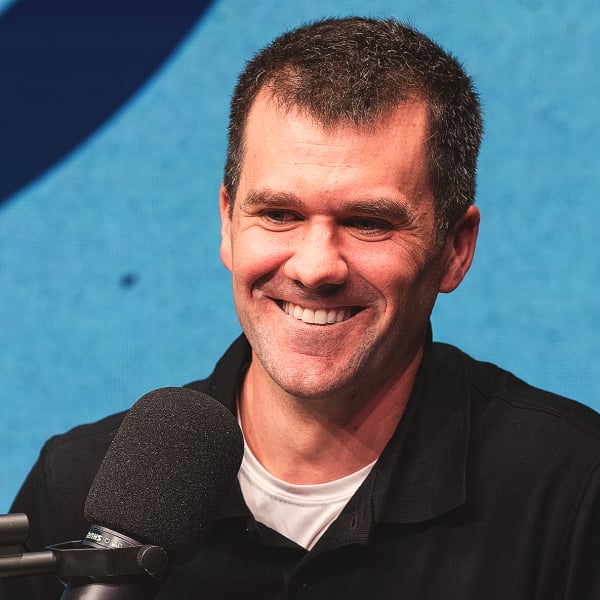
Adam Sylvester
CHARLOTTESVILLE GUTTER PROS AND CHARLOTTESVILLE LAWN CARE
Website: adamsylvester.com
Adam started Charlottesville Lawn Care in 2013 and Charlottesville Gutter Pros in the fall of 2020, in Charlottesville, VA. He likes to say, “I do gutters and grass! When it rains the grass grows and the gutters leak!” He got into owning his own business because he saw it as a huge opportunity to generate great income while living a life that suited him. He believes that small companies can make a serious impact on their communities and on every individual they touch, and he wanted to build a company that could make a big difference. His sweet spot talent is sales and marketing with a strong passion for building a place his team wants to work. Adam values his employees and loves leading people. While operations and efficiency is not something that comes naturally to him, he is constantly working to improve himself and his business in these areas.
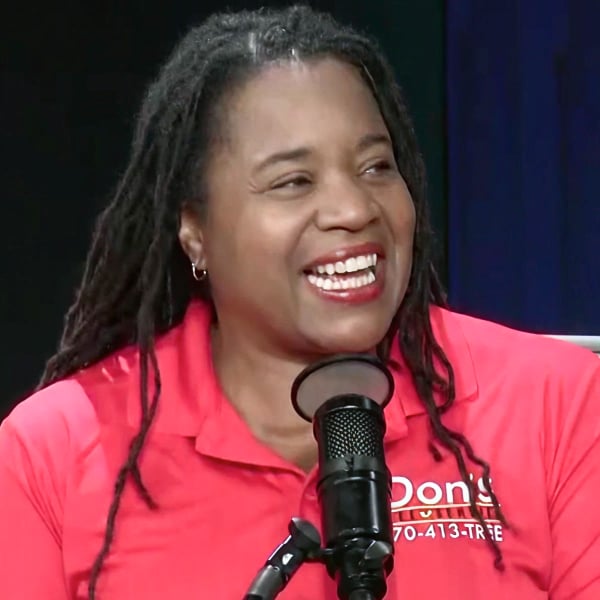
Doni Jones
Don’s Tree Service
Instagram (Business): @donstreeserviceatlanta
Instagram (Personal): @thetreelady
TikTok: @donstreeservice
LinkedIn: linkedin.com/in/doni-jones-b1060056
Doni Jones is the founder of Don’s Tree Service, a premier tree care company serving residential and commercial clients in the Atlanta area since 2000. Her team specializes in tree removal, trimming, stump grinding, storm cleanup, and arborist consulting—with a focus on safety, quality, and community trust.
Doni started the business to fill a gap in honest, high-integrity tree care, and has since built a legacy rooted in service and excellence. With a passion for team culture, digital marketing, and personal branding, she continues to grow the business while empowering others to feel proud of their homes and properties.
SIGN UP FOR PODCAST UPDATES
Get email updates on new episodes and podcast news.
You don’t want to miss out!
Interested in being a guest on the show?
Are you a home service professional eager to share your insights and experiences? Apply to be a guest on the Masters of Home Service Podcast, and join a community of experts committed to helping others level up through knowledge.
Other Podcasts We Love