
On average, an electrical contractor in the United States can earn anywhere from $39,430 to $106,030 per year. These salary estimates apply to both residential and commercial electricians.
Apprentices tend to earn wages on the lower side of that scale, while established electrical contractors can earn much more. It all depends on the work you’re doing, where you operate, and how many years of experience you have.
This guide will walk you through the average electrician salary, including benefits, and how to increase that salary throughout your career. Let’s get started.
Breakdown of electrician income
Electricians are highly regulated in most states. You’ll need to start your career as an apprentice, then get certified as a journeyman electrician. You can decide whether you’d one day like to get certified as a master electrician.
Keep reading to find out how much money electricians make per year, month, week, and hour:
How much do electricians make a year?
The median salary for an electrician in the United States is $62,350 a year, according to the U.S. Bureau of Labor Statistics in 2024. This amount is before taxes and other deductions.
There are three factors that influence how much electricians make a year:
- Work Experience: When you start as an electrician apprentice, you’ll most likely earn around $39,430 a year. Becoming a journeyman or a master electrician will help you earn raises or get higher-paying jobs. At that point, you could earn over $106,030/year.
- Location: If you live in a major city with high demand, you’ll be able to charge much higher rates for your services. That said, your rates will probably be lower if you work in a rural area with fewer customers.
- Specialization: You can charge higher rates for specialty services, like installing home automation systems, electric vehicle charging stations, and solar panels. If you get into consulting, you could earn even more without having to do any electrical installation yourself.
How much do electricians make a month?
You can make $3,285.33 to $8,835.83 a month as an electrician, depending on your experience, location, and specialization. If you earn the median salary of $62,350 a year, you’ll make $5,195.83 per month before taxes.
Keep in mind that some months will be busier or quieter than others. However, electrical work can be pretty steady if you’re working indoors, since you may not be restricted by the weather.
How much do electricians make per week?
If you work 40 hours a week, 52 weeks a year, your weekly income will be around $1,199.04 a week before taxes. This can vary if you work more or fewer hours in a week.
For example, you might work 50- to 60-hour weeks during the busy season. If you’re making time-and-a-half for overtime, you could make an extra $449.70 to $899.40 per week.
How much do electricians make per hour?
You can expect to make around $29.98/hour before taxes if your annual salary is $62,350. This assumes you work 40 hours a week. Your hourly income could vary if you work shorter or longer hours.
Hourly income also varies depending on your experience and what state you’re working in.
Geographic impact on electrician salaries
As we mentioned earlier, your salary as an electrician will vary based on where you’re working. Local demand and cost of living make a big difference when it comes to your wages.
Highest paying U.S. cities for electricians
If you have the flexibility to move to a higher-paying area, consider moving to one of these cities where electricians are paid the highest wages in the country:
| City/State | Hourly Wage | Annual Salary |
|---|---|---|
| San Jose, CA | $42.61/hour | $88,620/year |
| San Francisco, CA | $42.44/hour | $88,280/year |
| Mount Vernon, WA | $42.33/hour | $88,040/year |
| Seattle, WA | $41.03/hour | $85,330/year |
| Richland, WA | $40.54/hour | $84,330/year |
| Chicago, IL | $40.17/hour | $83,550/year |
| Urban Honolulu, HI | $39.50/hour | $82,160/year |
| Bellingham, WA | $39.35/hour | $81,840/year |
| Portland, OR | $37.88/hour | $78,790/year |
| Decatur, IL | $37.76/hour | $78,530/year |
Source: U.S. Bureau of Labor Statistics
Some of these cities have a high cost of living, like San Jose and San Francisco. That means electricians need to earn higher salaries to cover their expenses.
Average salary by state
Your electrician salary will vary depending on the state where you live and work. These are the five highest-paying states for electricians, with Washington in the top spot at $88,620/year:
| State | Hourly Wage | Annual Salary |
|---|---|---|
| Washington | $42.61/hour | $88,620/year |
| Hawaii | $42.44/hour | $88,280/year |
| Illinois | $42.33/hour | $88,040/year |
| Oregon | $41.03/hour | $85,330/year |
| California | $40.54/hour | $84,330/year |
In comparison, here are the five lowest-paying states for electricians. Arkansas pays the least with an annual salary of $49,800:
| State | Hourly Wage | Annual Salary |
|---|---|---|
| Idaho | $26.56/hour | $55,240/year |
| Alabama | $26.20/hour | $54,490/year |
| North Carolina | $25.78/hour | $53,610/year |
| Florida | $25.18/hour | $52,380/year |
| Arkansas | $23.94/hour | $49,800/year |
Source: U.S. Bureau of Labor Statistics
How much do electricians make in California?
On average, electricians in California earn $40.54/hour or $84,330/year. California has a large population and a high cost of living. This means there’s significant demand for services, and you need to charge higher rates to cover expenses.
READ MORE: How to become a certified electrician in California
How much do electricians make in Texas?
The average electrician in Texas earns $27.09/hour or $56,350/year. While this isn’t one of the higher salaries in the U.S., Texas has a lower cost of living than many states, which balances out your lower rates.
READ MORE: How to become an electrician in Texas
How much do electricians make in Florida?
The average salary for an electrician in Florida is $25.18/hour or $52,380/year. This is one of the lowest salaries you can make as an electrical contractor in the U.S.
Educational impact on electrician salary
Your level of education will affect how much you make as an electrician. That said, you don’t need a Master’s degree to become an electrician, although some contractors have one.
Many electricians have a two-year degree or diploma from a vocational college, while others have a bachelor’s degree. These can help you get your first job, but the most important thing on your resume is your years of experience.
- An apprentice electrician just starting will make $21,000–$56,000 a year. You’ll need to pay for certain essential expenses in your early career, like your electrician license (if required) and electrical tools. This will cut into your first year’s salary, but it is well worth the investment.
- As a journeyman electrician, you have 4 to 8 years of experience, passed a qualifying exam, and earned the right to work independently without supervision. With that level of experience, you’ll start to make more money—around $43,000 to $71,000 a year.
- Master electricians have 8 to 12 years of electrical experience, can train apprentices, and often have their own businesses. At this point in your career, you can make $48,000 to over $90,000 a year. You can earn even more if you work in a specialized field or in certain states, like Washington, Hawaii, or Illinois.
You’ll also earn more if you belong to a union like the International Brotherhood of Electrical Workers. According to the IBEW, union workers make more than $10/hour than non-union technicians.
Electrician salary by industry
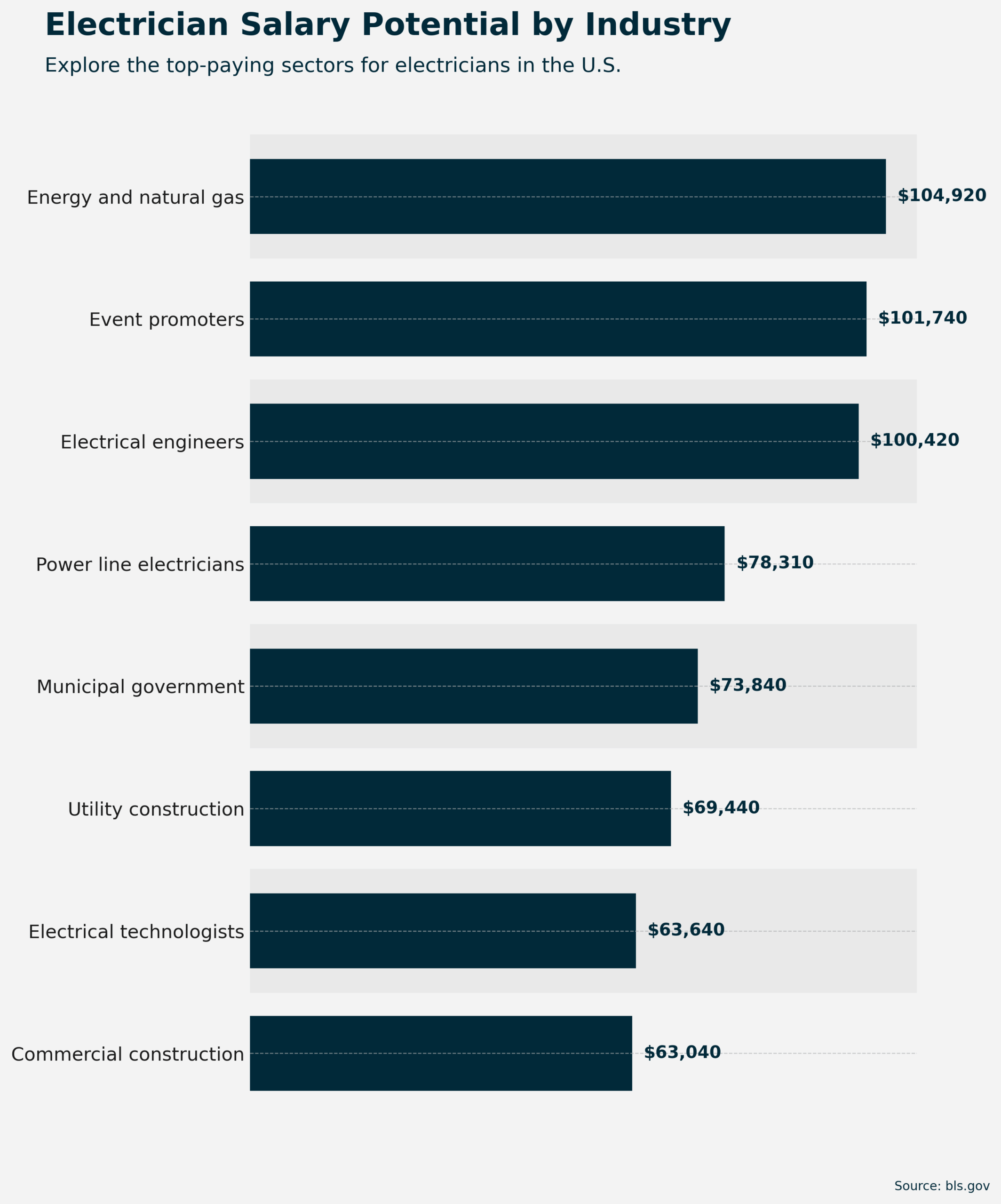
Electricians can work in a wide range of industries, from utilities and construction to manufacturing. Some electricians even specialize in repairing electrical equipment in hospitals and other medical settings.
Electrician salaries vary depending on the sector. These are just a few job opportunities and annual salaries to consider within the electrical industry:
- Energy and natural gas: $104,920/year
- Event promoters: $101,740/year
- Electrical engineers: $100,420/year
- Power line electricians: $78,310/year
- Municipal government: $73,840/year
- Utility construction: $69,440/year
- Electrical technologists: $63,640/year
- Commercial construction: $63,040/year
Other electrician job benefits
As a qualified electrician, there are upsides to every job in addition to your salary. Consider these benefits when you’re looking at employer job postings and thinking about applying:
- Health, dental, and vision insurance
- Retirement plans, 401(k) options, and contribution matching
- Profit sharing and other employee loyalty programs
- Paid vacation days, sick days, and personal days
- Room to take on new responsibilities and grow your career
Income potential for electrical business owners
To make the most money possible as an electrician, you should consider starting an electrical business one day. It takes hard work, but it can be incredibly profitable long-term.
As a business owner, you can make anywhere from $60,000 to $150,000 a year. And that’s your personal salary—the business itself could make more than $500,000 a year, depending on your workload and expenses.
You can boost your company revenue even more by adding new revenue streams and expanding your services to include plumbing, HVAC, and other skilled trades. With these in place, you’re a one-stop shop for residential and commercial service needs.
Another must-have is electrician software like Jobber. Use it to schedule work, manage employees, organize job details, communicate with customers, send quotes and invoices, and collect payment.
READ MORE: How to run a successful electrical business
Build a profitable career as an electrician
Your salary as an electrician will depend on how much you work, where you work, what services you provide, and how many years of experience you have.
With the potential to earn $39,430 to $106,030 per year as a commercial or residential electrician, there’s plenty of opportunity to build a long-term career that’s both challenging and profitable.
Frequently Asked Questions
-
According to ZipRecruiter, the highest-paying electrician jobs are:
Certified electrician: $74,000–$143,500
Electrical systems designer: $86,000–$104,500
Electrical superintendent: $63,000–$95,000
Maintenance electrician: $56,000–$66,500
Service electrician: $51,000–$66,000
Traveling electrician: $52,000–$66,000
Construction electrician: $49,000–$60,500
Wiring technician: $38,000–$52,500
Your salary may vary depending on your location, specialization, skill level, and experience level. -
On average, a residential electrician in the U.S. makes $28.73/hour, or roughly $59,758.40/year. A commercial electrician earns slightly less—$27.81/hour or $57,844.80/year.
As with any electrical contractor’s salary, this amount varies depending on your geographic area, specialization, and years of experience. -
Arkansas offers the lowest average salary for an electrician at $23.94/hour, which is around $49,800/year. Arkansas has a lower cost of living than some states, making it a little more affordable to be an electrician in certain areas.
-
Electricians in Washington earn the highest salary on average at $42.61/hour, which adds up to about $88,620/year. This salary is offset by a higher cost of living, especially if you live and work in a major city like Seattle.