



Key takeaways:
Here’s how contractors can use SEO strategies to get found online and grow their business effectively.
- Leverage local SEO and directory listings. Claim your Google Business Profile, set up a Facebook business page, and get listed on key directories like Angi and Thumbtack to boost visibility in your service area.
- Gather and showcase customer reviews. Proactively ask for reviews, especially on Google, to build trust with future clients and improve your search rankings—tools like Jobber can automate this process.
- Target the right keywords and create valuable content. Use industry-relevant keywords naturally in your website copy and share helpful articles or FAQs to attract more web traffic and position yourself as an expert.
- Optimize your website structure and technical elements. Organize your site by service pages, use clear title tags and meta descriptions, and ensure your site is user-friendly and secure for the best results.
- Earn quality backlinks to increase authority. Collaborate with local businesses, participate in community events, and get your business mentioned in directories or local press—focus on genuine links for long-term SEO benefits.
- Measure your SEO performance regularly. Track your website traffic, keyword rankings, customer leads, and Google profile insights to see what’s working and where you can improve.
Stay ahead in the contracting industry with proven SEO tips, expert advice, and growth strategies—sign up for the Jobber Newsletter for regular updates. Sign up for the Jobber Newsletter.
Originally published in November 2024. Last updated on August 18, 2025.
You’re an expert in your contracting field. But when it comes to getting found online, do you know how to make your business stand out?
That’s where SEO comes in. Done right, SEO marketing helps your business be found by more people, so you can grow your visibility and your customer base. It’s a marketing strategy that requires a bit of upfront work, but pays off in the long run as your website becomes a 24/7 lead generating machine.
In this guide, you’ll learn everything you need to know about SEO for contractors to help you grow your brand and win more business.
What is SEO for contractors?
SEO (search engine optimization) is a type of marketing that makes your business easy to find on Google and other search engines.
An SEO strategy includes using certain words (known as ‘keywords’), improving your website’s content, and making sure it’s fast and easy to use.
For field service contractor businesses, a simple SEO strategy could include:
- Setting up a Google Business Profile and a website
- Using certain words (known as ‘keywords’)
- Making your website load faster
For example, if you are a plumber in Boston and include the above criteria in your SEO strategy, you should pop up as one of the top search results as seen below:
Benefits of using contractor SEO techniques
Simply put, the benefit of doing SEO is that if customers can’t find your website or reviews, they’ll likely go elsewhere.
With SEO, you can:
- Be found online and attract more visitors to your website
- Become visible to a new audience of online customers
- Grow brand trust through reviews and business listings
- Gain an edge over competitors and capture more market share
SEO takes time and consistent effort, but when done right, it delivers steady growth, more customers, and higher profits.
When you set up SEO, it may take three months to have a website rank, but once it’s ranking, you’re good. That initial spend saves you money in the long run.
Different types of SEO for contractors
There are several kinds of SEO, each serving a different purpose. Understanding them will help you choose the right tactics for your contracting business.
Local SEO
Local SEO helps customers in your service area find you. It focuses on location-specific keywords and business listings so you appear when people search for services nearby.
For example, if you’re a plumber in Boston with a well-optimized site, you could rank at the top when someone searches “Boston plumber for leaky faucet.”
Pro Tip: Keep your business name, address, phone number, and website consistent across all listings. Inconsistent information can confuse potential clients and hurt your search engine rankings.
On-page SEO
On-page SEO involves optimizing individual web pages with the right keywords, title tags, meta descriptions, and headings so search engines (and people) understand your content.
Technical SEO
Technical SEO involves improving behind-the-scenes factors like site speed, mobile-friendliness, and security to ensure your site runs smoothly and ranks well.
These techniques are more advanced and require constant monitoring but can contribute to the overall success of your SEO efforts.
Off-page SEO
Off-page SEO involves making your website more trustworthy by getting other websites to link to you (hence, it’s happening ‘off’ of your webpage.)
This usually involves asking other websites to link to yours through partnerships, or getting listed on industry review sites to boost your online reputation.
Image SEO
Image SEO is when you optimize images on your website with descriptive file names, alt text, and condensed sizes so they load faster and can appear in Google Images search results.
Other types of SEO—such as voice, video, mobile, or e-commerce—exist but usually aren’t priorities for contractors. Focus on the essentials first to build a strong SEO foundation and develop the right strategy.
With these types of SEO in mind, let’s check out some strategies for contractors looking to grow their business.
6 SEO strategies for contractors
Now that you have an understanding of several types of SEO, you can use them to create strategies that drive more visitors to your service website.
1. Boost your local SEO presence
A strong local SEO strategy makes it easier for customers in your service area to find you online.
Here are the top steps to take:
- Claim your Google Business Profile listing (formerly Google My Business): This free listing puts your business front and center in Google search results with details like your name, phone number, hours, photos, reviews, service area, and website link. A complete, optimized profile can dramatically increase calls and quote requests. Better yet, add high-quality photos and respond to reviews to boost engagement.
- Create a Facebook business page: A free Facebook page gives you another way to show up in local searches and engage with customers. You can share updates, post project photos, collect reviews, and respond to inquiries.
- List your business on major search directories: Platforms like Thumbtack, Angi, and Houzz double as both lead generators and trusted search directories that Google uses when ranking results. If you’re already considering one of these services, the added SEO benefit makes them even more valuable.
2. Ask for reviews
Want a quick way to build trust and show up higher on Google? Get more reviews.
Reviews show future customers you’re the real deal and tell search engines your business is worth showing off. Google Reviews are especially useful, considering that most of your customers would find you there.
If you want more reviews, you have to be ready to ask for them. Check out these ready-to-use review request templates to get started.
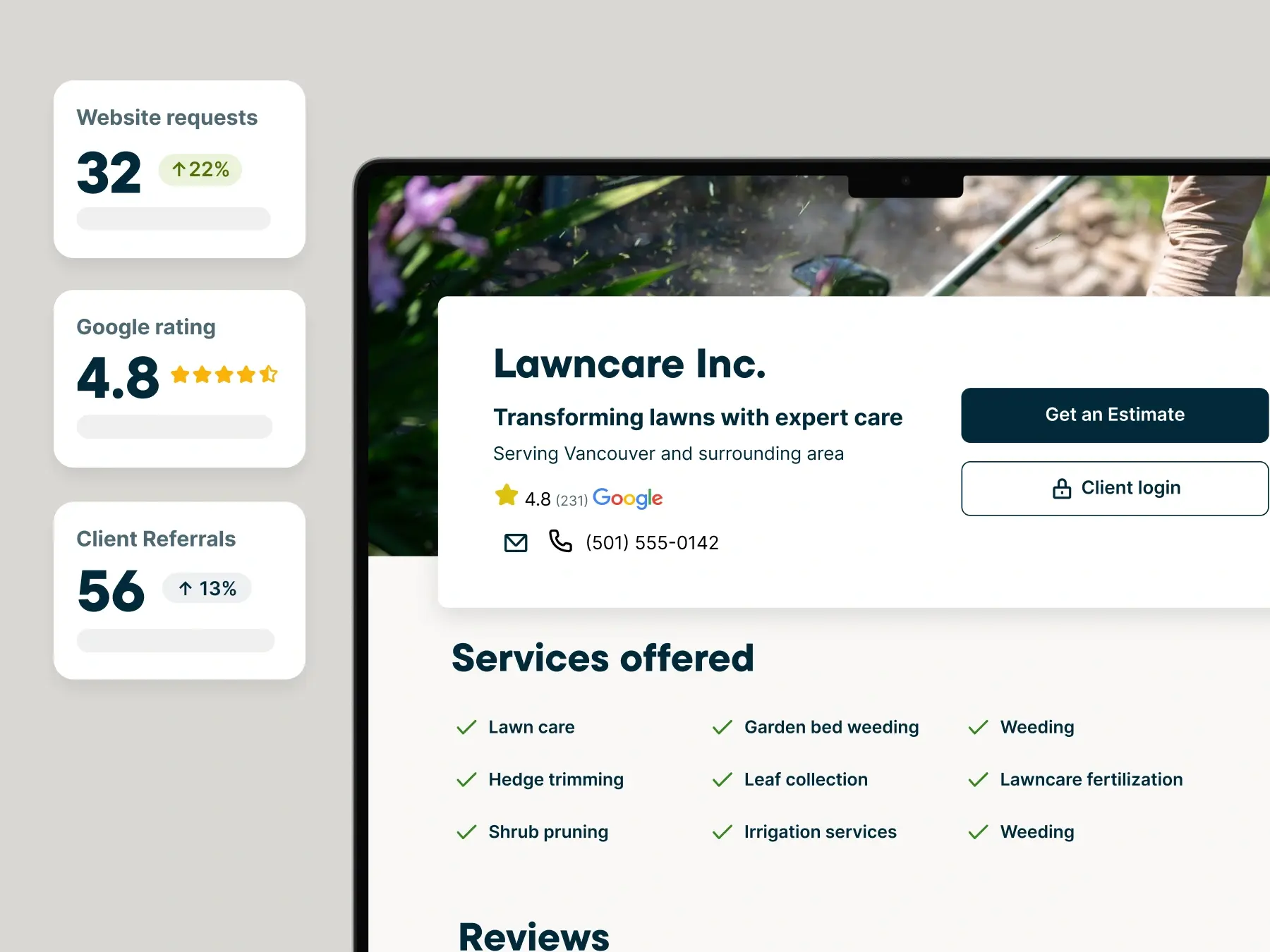
Short on time? With Jobber, you can set up automatic review requests after an invoice is sent, making it effortless to collect feedback while keeping jobs moving. From there, you can keep tabs on your Google rating and new reviews from within Jobber.
3. Target the right keywords
Keywords are the words people type into search engines to find your services.
For contractors, keywords are typically related to the industry you work in and what you offer.
For example, a landscaper might target keywords like:
- Lawn care
- Mowing
- Garden design
- Landscaping services
- Sod installation
- Mulching
- Weed control
Here are some best practices for using keywords in your SEO content:
- If you aren’t sure what the relevant keywords are for your industry, you can use a free keyword tool such as Google Keyword Planner as a starting point.
- Write your content first, then review it to see where keywords naturally appear
- If you need to add more, integrate them smoothly into the flow of your writing
- Focus on natural usage—avoid “keyword stuffing” where terms are awkwardly repeated
Here’s what keyword stuffing with the keyword “lawn care” looks like:
Lawn care is a great choice for clients who need lawn care done. Our lawn care services include lawn care like mowing and trimming. Reach out for a lawn care quote today.
This is annoying to read and it hurts your SEO. Instead, write in a way that’s helpful, natural, and easy to read.
4. Start writing
Now that you have a website with your most important pages, keywords, and business information, you can start to publish articles and tips that position you as the expert you are. This isn’t just for an ego boost — it’s called content marketing, and is a key part of SEO marketing.
That’s because content marketing helps you target more keywords and show up in searches for a wider range of topics.
You may be thinking: ‘But I’m a contractor, not an author!’ SEO content doesn’t need to belong or be formal to work. Start by answering a few frequently asked questions from your customers, and write the way you speak. You can use free tools like Grammarly, ChatGPT, or even a family member to give you feedback. You’ll get better and more confident the more you do it.
For example, HVAC contractors could write posts such as:
- “How to Tell if You Need Air Duct Cleaning”
- “Cost to Install a New Furnace in [Your City]”
- “5 Signs Your Air Conditioner Needs Repairs”
Answering common questions positions you as an expert, builds trust, and keeps your business top-of-mind when customers are ready for your services.
Finally, don’t forget about image SEO when creating your content. Add relevant images to posts and be sure to include alt text for additional visibility.
5. Organize your website
If you’ve made it this far in your contractor SEO journey you’ve already done a lot!
From here, we’ll turn to a few more technical tips for optimizing your website so that your business can have the best shot of being found online.
First up, you need to organize your service website into multiple pages, each with a clear purpose and title.
If you’re not very familiar with your website, this may take some learning up front, but many website building tools make it easy even for beginners.
Here are the top tips to start with:
Make different web pages
Create separate pages on your website for each service that you offer so you can target more keywords and provide detailed information.
For example, most of the websites on our best HVAC websites list include separate pages for heating, cooling, installation, special promos, and more.
Have a contact page
The goal of SEO for contractors is to encourage website visitors to contact your business and inquire about your services.
Make sure to have a dedicated contact page with your name, address, phone, email, and an online booking form to convert visitors into leads.
Optimize title tags
A title tag, or title link, is the headline you see in Google search results and what users click on to get to your website. A simple “Welcome to our website” is too short and says nothing about your business.
Optimize your title tags with keywords, location, and service type:
[Business Name] | Reliable Plumbing Services in [Your City].
Write meta descriptions
Meta descriptions, or snippets, are made up of the text that goes below a title link in search results. They should be clear, relevant, and concise.
For the most success, write meta descriptions that summarize the page, include keywords, and prompt action:
We provide emergency repairs, installations, drain cleaning, remodeling, and more. Contact us today for your free quote!
6. Get links to your website
When another website links to your website, this is called a backlink. Backlinks are great for SEO, because they tell Google ‘Look, another website trusts me.”
In general, the more backlinks a page has, the more organic traffic it gets from Google. However, 95% of pages do not have backlinks, so working on this simple step can put you miles ahead of your competition.
To get others to link to your website, you can:
- Get your business listed on directories, like Thumbtack and Angi
- Partner with local businesses or organizations
- Sponsor or participate in community events
- Offer expert commentary for articles or blog posts
- Host charity initiatives that get media coverage
Pro Tip: Never pay for backlinks. Paid links can hurt your search rankings and impact your website’s authority. Focus on real connections and credible sources—quality beats quantity every time.
DIY SEO vs outsourcing to an agency
Like any other skill, SEO takes time and practice to learn. When it comes to implementing the strategies you need to be visible on search engines, you have two choices:
- Optimize your website on your own
- Hire someone to do the work for you
Optimizing for SEO on your own
56% of small business owners manage their local SEO themselves. But handling SEO yourself means wearing several hats—you’ll need to manage website updates, understand website design basics, monitor analytics, and create performance reports.
While SEO is learnable by anyone, it can be time-consuming and requires a certain level of technical comfort. Be prepared to invest consistent time and effort to see results.
Hiring SEO agencies
If you prefer to leave SEO to the experts, hiring a digital marketing agency or a SEO expert with knowledge in your field can save you time and deliver professional results. They’ll create and execute an effective SEO strategy, track progress, and handle ongoing updates.
An SEO agency may also provide technical SEO services that require additional time that you might not have, such as monitoring site speed, mobile-friendliness, and website security.
When choosing a contractor SEO agency, look for:
- Proven experience with SEO for contractor websites in your specific industry, such as construction SEO
- An ability to keep up with SEO trends
- Testimonials or case studies from other field service contractor clients
- Regular performance reports (weekly, biweekly, or monthly) showing results
- Web design expertise or close collaboration with web designers to implement changes
- A mix of short-term fixes and long-term SEO strategies to grow your business
Pro Tip: Want to find a vetted SEO agency? Ask THE Community for home service professionals — with members from all industries with all levels of experience, they get your challenges and want to celebrate your wins. Visit The Home Service Community now.
How to measure SEO performance
SEO isn’t a “set it and forget it” strategy—you need to track results to see what’s working and where to improve.
Here’s how to measure your SEO efforts:
- Watch your Google Business Profile insights: Your Google Business Profile shows how many people found you in local search, clicked for directions, visited your website, or called you directly from the listing. Increases here often translate to more local customers.
- Track website traffic: Use Google Analytics to see how many visitors are coming to your site, which pages get the most views, and where your visitors are coming from (Google, social media, directories, etc.). A steady increase in organic (search) traffic means your SEO efforts are paying off.
- Monitor keyword rankings: SEO tools like Google Keyword Planner can show where you rank for specific keywords (e.g., “plumber in [your city]”). Rising rankings for your target terms means more visibility in search results.
- Track leads and conversions: Measure how many calls, quote requests, or bookings come from your website by using online forms with built-in analytics or simply asking customers how they found you. If traffic is up but leads aren’t, your site may need some tweaking.
Pro Tip: Review your SEO metrics monthly, or use our free get noticed score, to make small, consistent improvements—rather than waiting until performance drops to make changes.
Mastering SEO for contractors takes time, but the payoff is worth it—more visibility, more leads, and more booked jobs. Whether you handle it yourself or hire a pro, consistent SEO efforts will keep your contracting business competitive and growing for years to come.