How Much to Charge for House Cleaning: A Guide for Pricing Your Services

Key takeaways:
Setting the right prices for your house cleaning services can boost your profitability and help you stay competitive in the market.
- Choose a pricing structure that fits your business and clients. House cleaners often charge by the hour, flat rate, room, or square foot—each with its own pros and cons depending on the job and client preferences.
- Factor in all costs and desired profit margin. Be sure to include wages, overhead, operating expenses, and market rates in your calculations to ensure your prices cover expenses and deliver a healthy profit.
- Offer specialty services and use bundling to increase job value. Adding extra services or creating packages can encourage upselling and give clients more choices, helping you stand out and make each job more profitable.
- Regularly review and adjust your prices. As costs change or your business grows, raising rates can protect your bottom line, while occasional discounts may help retain loyal customers or attract new ones.
- Avoid common pricing mistakes. Don’t simply copy competitors, ignore overhead, or forget a minimum job rate—take a tailored approach to ensure long-term business sustainability.
For more helpful business tips and insights like these, sign up for the Jobber Newsletter. Subscribe here.
The average house cleaner in the US charges $40–$55 per hour, with homeowners spending $174–$256 per visit. These numbers offer a solid starting point, but the rates you charge for your cleaning business depend on your crew, costs, and customers.
Learn how much to charge for house cleaning to make a profit, stay competitive, and win jobs with the practical tips and pricing strategies in this guide.
House cleaning price guide:
How much to charge for residential cleaning services
How much you charge for residential house cleaning services varies based on several factors, but most house cleaners in the US charge between:
- $20–$100 per hour
- $100–$800 for a flat rate
- $100–$175 per room
- $0.05–$0.50 per square foot
For example, average house cleaning prices can differ based on the service and pricing structure, as shown in this pricing chart:
| Cleaning Task | Hourly Rate | Flat Fee | Room Rate | Sq Ft Rate | Key Considerations |
|---|---|---|---|---|---|
| House cleaning | $20–$50/hour per cleaner | $100–$200 | $100–$150+ | $0.05–$0.16/sq ft | Frequency, home size, crew experience |
| Deep cleaning | $40–$100/hour per cleaner | $200–$400 | $125–$175+ | $0.13–$0.17/sq ft | Level of detail, home condition |
| Move-out cleaning | $40–$100/hour per cleaner | $300–$400 | $125–$175+ | $0.13–$0.20/sq ft | Services required, add-ons |
| Construction cleanup | $30–$50/hour per cleaner | Up to $800 | $125–$175+ | $0.10–$0.50/sq ft | Debris, types of material, property condition |
Factors that impact your cleaning prices
Although averages are helpful, they’re just a starting point. Your prices for professional cleaning service will depend on a variety of factors, such as:
- Your pricing structure: Most cleaning companies charge either an hourly rate, flat rate, room rate, or by the square foot. How you price your services directly impacts how much you will make.
- The size of the home: The bigger the space, the more you can charge. You can calculate the size of the home either by its square footage or by the number of rooms.
- The property’s condition: Some properties will only need basic cleaning services, while others will require a deep clean. Price services based on the amount of time and effort required to complete the job.
- Cleaning frequency: When you clean a home more often, you can charge less per visit because there won’t be as much time for dust and dirt to build up. On the other hand, you’ll need to charge more for irregular cleaning because there will be more to clean.
- Where the home is located: If the property is far away, you should incorporate additional costs into your pricing, such as fuel and driving time.
- Competitor pricing: You need to price your services based on local competition and demand to ensure you aren’t under- or over-charging.
- Ideal clients: The customers you want to target directly impact rates. For example, are you looking to attract budget-conscious homeowners or clients with larger homes in need of premium services?
- Cleaning service: Time-consuming or specialty services, like a move-out clean, are often priced higher than straightforward jobs, like recurring weekly maintenance.
- Experience level: Someone with a lot of experience and training can charge more than a new house cleaner.
Each home and client is different. Adjusting prices to reflect the service, costs, effort required, and value you provide will help ensure you’re charging fairly and keeping your business profitable.
House cleaning rates for specialty services
On top of standard cleaning services, you should also price out extra services to increase the potential for every job. Use this chart to see the most common add-ons house cleaners offer, along with the average house cleaning price for each one.
| Add-on house cleaning service | Average price per job |
|---|---|
| Laundry | $5–20 per load (added fee for folding and putting away) |
| Changing bedding | $10–$40 per bed |
| Appliance or oven cleaning | $25–$35+ per appliance (more if it’s in bad shape) |
| Cleaning blinds | $2–$6 per window |
| Floor buffing | $0.04–$0.12 per square foot |
| Tile cleaning | $0.12–$0.21 per square foot |
| Carpet cleaning | $0.16–$0.28 per square foot |
| Polishing, waxing, or stripping floors | $0.30–$0.50 per square foot |
| Furniture upholstery/curtain cleaning | $100+ per hour (depending on size, type, and condition) |
| Green cleaning supplies | $5–$10 per cleaning job |
| Sanitization or odor removal services | $75–$100 per hour |
| Ceiling and wall (paint) cleaning | $0.50–$0.60 per square foot |
| Disaster or emergency restoration cleaning (i.e., water damage) | $1,000–$4,000+ |
| Window cleaning | $4–$10 per window |
| Baseboard cleaning | $25–$75 per job |
| Organizing cabinets | $20–$50 per cleaning job |
| Dusting | $10–$30 per visit |
| Pet-related cleaning | $10–$40 per room |
Price bundling and service packages
The most effective ways to let clients know about these additional services are to offer them in bundles and include them as optional add-ons in quotes.
With price bundling, you can either roll standard services and add-ons into single packages or try out tiered pricing.
For example, a standalone cleaning bundle might include a regular cleaning plus dusting, window cleaning, and oven cleaning at a discounted rate.
Good, better, best pricing is similar, but instead of a single bundle, customers can choose from several packages at increasing levels of service and price points, such as:
- Good ($100): Standard house cleaning plus dusting
- Better ($175): Standard house cleaning plus dusting and window cleaning
- Best ($250): Standard house cleaning plus dusting, window cleaning, oven cleaning, and changing linens
A client would request a house and window wash, and we’ll offer them a luxury bundle and quote everything.
We’ve taken an $1800 request and converted it to a $4500 request… We’re able to do this through our quoting software.
With Jobber, you can recommend service packages and bundles directly in your quotes.
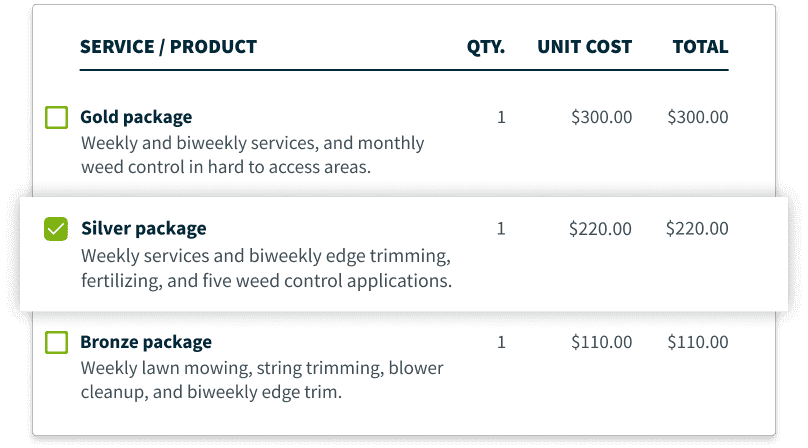
Or you can include suggested optional line items directly in your quotes, so clients can choose add-ons based on their budget and needs.
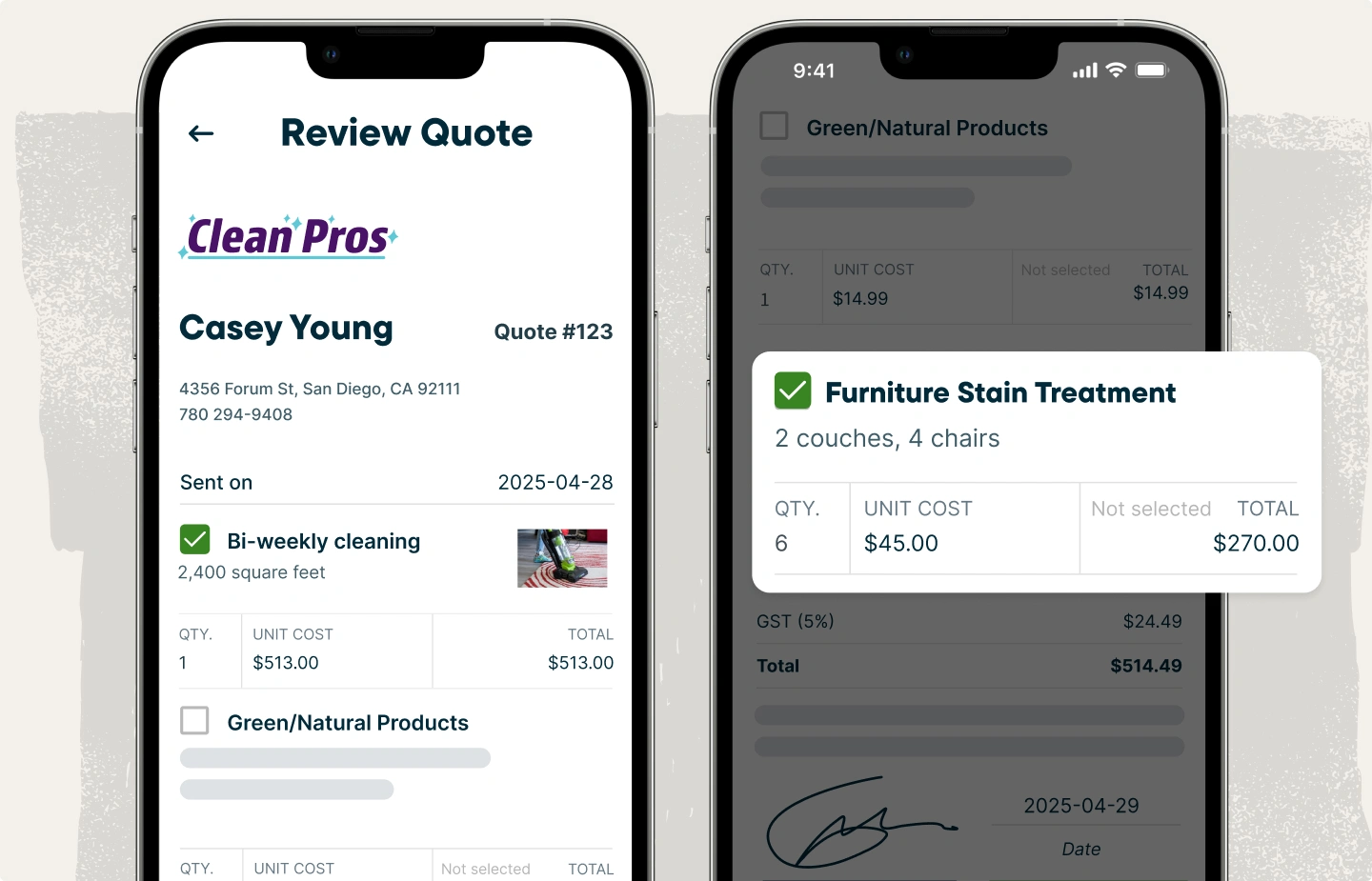
It’s an easy way to upsell your services while giving clients the flexibility to customize their cleaning experience.
How to price house cleaning services
When it comes to setting prices for professional cleaning services, you have a variety of options to choose from:
- Hourly: A rate per hour that can differ between staff members.
- Flat rate: An all-in fee that covers the entire house cleaning cost.
- Per room: A charge based on the number of rooms in a home.
- Per square foot: An amount calculated using the square footage of an entire property or specific area.
Most home cleaning businesses use a mix of pricing strategies to reflect their jobs and clients. This chart shows which methods work best for different house cleaning services.
| Pricing method | Best for | Not ideal for |
|---|---|---|
| Hourly | First-time or unpredictable jobs and new staff members | Fast jobs or clients who want fixed pricing |
| Flat rate | Standard jobs and recurring work, like weekly cleaning, as well as experienced cleaners | Unpredictable or time-intensive jobs or new cleaners |
| Per room | Smaller homes or partial cleaning jobs | Deep cleans or heavily cluttered spaces |
| Per square foot | Large homes or quick estimates | First-time jobs with unknown scope |
No matter which pricing method you use, you’ll need to make sure it covers:
- Overhead costs such as cleaning supplies, uniforms, and gas.
- Operating expenses like office rent and employee training.
- Profit margin, which should be 10–30% to ensure your business makes money.
- House cleaner wages, which are typically between $25 and $50.
To use any of these pricing models, you’ll need to know your overhead and operating costs for every hour of work. Here’s how to calculate overhead:
- Overhead rate per hour = total monthly overhead costs / total billable hours per month
- Overhead percentage = total overhead costs / total sales x 100
Pro Tip: Review your numbers regularly to stay on top of market trends like rising costs so you can make adjustments before they impact your bottom line.
1. How to calculate an hourly rate for house cleaning
An hourly pricing model is when you charge customers a set rate for each hour of work you do. It’s an effective way to ensure you’re compensated for your time and labor, no matter how complicated or time-consuming the job is.
Then use this formula to calculate house cleaning prices per hour with a 25% profit margin:
Hourly rate = (Wages + overhead + operating expenses) x 1.25
For example, if you pay staff $30 an hour, and your overhead and operating costs are $10 an hour, your calculation would look like this:
($30+$10) x 1.25 = $50 per hour
To adjust the formula for a different profit margin, change the amount you multiply your rate by. For example, for a 20% profit margin, multiply by 1.20, or for a 30% profit margin, multiply by 1.30.
Charging per hour protects you from surprises, such as a client booking you for four hours if you go to the home and then you find out that the shower is going to take you four hours to clean. It’s a lesson learned.
2. How to calculate a flat rate for cleaning services
A flat fee is when you estimate the amount of time it will take to complete a job and use it to provide an upfront rate. It’s useful for standard cleans and recurring work, like similar condos in the same building or repeat customers.
To calculate it, use this formula:
Flat rate = (Estimated hours x wages + expenses) x (1 + profit margin)
If you estimate the job will take 4 hours, pay staff $30 an hour, add in $10 per hour to cover costs, and want a 25% profit margin, your calculation would be:
- Wages + expenses: $30 + $10 = $40
- Multiply by estimated house: 4 x $40 = $160
- Add 25% profit margin: $160 x 1.25 = $200 flat rate
3. How to calculate cleaning prices by square foot
Square footage pricing charges clients based on the size of their home or the area they want cleaned. For an accurate estimate, you’ll need to either get the measurement from the homeowner or measure the area yourself.
To calculate it, use this formula:
Square footage rate = (wages + expenses) x (1 + profit margin) / square footage cleaned per hour
For example, let’s say:
- Your wages and expenses are $40 per hour.
- You want a 25% profit margin.
- The home is 1000 sq ft.
- You can clean 250 square feet an hour.
To find your rate per square foot, you need to:
- Add your profit margin to your costs: $40 x 1.25 = $50
- Divide that by the square footage cleaned per hour: $50 / 250 = $0.20 per sq ft
So, for a 1000 sq ft home, you would charge a total of $200.
4. How to calculate per-room pricing
Per room pricing charges clients based on the number and types of rooms they need cleaned. It’s an easy way for them to pick and choose services based on their needs, like if they only need the bathrooms or kitchen cleaned.
To calculate it, use this formula:
Price per room = ((wages + expenses) x (1 + profit margin)) x cleaning hours per room
If your wages and expenses are $40, you want a profit margin of 25%, you’d calculate your rate as follows:
- Add wages and expenses ($40)
- Multiply by your profit margin: $40 x 1.25 = $50 per hour
- Multiply the hourly rate by the number of cleaning hours per room
Per-room pricing is based on pre-determined services per room. That allows you to roll multiple services into a single rate, making more per job than you would by charging per hour.
For instance, if a client wants a bedroom cleaning, you might include vacuuming, dusting, window cleaning, and changing sheets, plus an additional fee for an en suite bathroom. If you estimate the space will take two hours to clean, you’d charge $100.
Make a cleaning service price sheet for faster quotes and estimates
Having a price sheet prevents you from having to calculate the rate for standard jobs every time you get a call. Not only is it an effective reference for you, but it can quickly show clients what you offer and how much you charge.
Here’s an example of a residential cleaning price sheet based on home size:
- Studio apartment (1 BD/BA): $75–$150
- Single-family home (2BD/2BA): $150–$200
- Single-family home (3BD/3BA): $200–$300
- Single-family home (3,500+ sq ft): Custom quote upon request
Free cleaning cost calculator
Instead of calculating rates and fees manually, use Jobber’s free cleaning cost calculator to set prices. Simply enter job details, like visit type, number of rooms, and any add-ons, and it will provide a competitive price range to charge your customers.
Cleaning Cost Calculator
Calculation is based on:
Estimated Job Cost:
Total:
$150 – $220
$50 – $150
Try Jobber for free
Put those prices into action. Start sending unlimited, professional-looking, quotes and invoices today.
Start Free TrialWhen to adjust your cleaning prices
Rates can change as your business evolves and markets change. Adjusting cleaning prices is often necessary to make sure your business stays profitable.
You may want to increase your house cleaning prices if:
- A job is outside of your normal scope of work. For example, a client has a mold or mildew problem that requires additional materials or more extensive cleaning procedures.
- The property is outside of your service area and requires more fuel and travel time.
- Your cleaning costs have increased, like materials, supplies, software, or office rent.
- You want to expand into commercial cleaning and need to upgrade to industrial equipment or get specialized certificates, like biohazard cleaning certification.
We raised our prices this year alone [by] 15% because we wanted to keep up with the credit card transaction fees and things like that.

On the other hand, you may want to decrease your prices when you want to:
- Offer group rates to a specific neighborhood, or apartment or condo building.
- Give discounts or special rates to repeat clients.
- Reward customers as part of your referral program.
Common house cleaning pricing mistakes
When setting prices for your cleaning company, it’s important to avoid mistakes that can negatively affect profitability, such as:
1. Copying competitor pricing
Competitor pricing can give you a baseline for what to charge, but it doesn’t account for your actual costs or profit goals. For all you know, your competitors could be underpricing and struggling to cover expenses.
Instead, use competitor pricing to gauge the market, but take the time to calculate profitable rates for your business based on real numbers.
2. Ignoring overhead costs
Many cleaners forget to include overhead in house cleaning costs, only covering labor and supplies. But you still need to pay for insurance, fuel, software, taxes, and marketing. If you don’t factor those into your cleaning prices, you’ll have to cover them out of pocket.
Calculate either a percentage or an hourly fee to add to your rates to make sure overhead is always covered using one of these formulas:
- Overhead rate per hour = total overhead costs / total billable hours
- Overhead percentage = total overhead costs / total sales x 100
3. Not having a minimum job rate
If you offer professional house cleaning, you should have a minimum job rate to prevent low payments from small jobs.
For example, if your hourly rate is $50 and a job only takes you 30 minutes, you won’t make much profit after driving time, fuel costs, and overhead are factored in.
Set a minimum hourly rate based on the types of jobs you typically get and what you need to make to cover expenses. Some cleaners calculate it based on a 2- or 3-hour minimum, while others have a flat rate minimum, like $100.
That way, no matter the size of the job, you’ll still make enough to cover costs and make a profit.
4. Undercounting crew labor
Labor isn’t just made up of wages. It also includes payroll taxes, workers’ compensation, training, and travel time, which can add another 25–40% to your total labor costs.
If you don’t consider these costs when setting prices, you’ll end up underpricing jobs and eating into profit.
5. Not raising prices regularly
Even if you start out with healthy rates, your profit margin will shrink as expenses grow. Costs for insurance, wages, and supplies rise regularly based on inflation and market changes.
Increasing costs by as little as 3–5% a year can be enough to preserve profit margins and give you room to grow.
Pricing cleaning jobs for profit
A cleaning business can be profitable, as long as you factor in costs, pay your team fairly, and include a healthy profit margin. It’s also helpful to use a variety of different pricing strategies based on job type, client needs, and the scope of work.
Once you set rates, review them regularly and make adjustments to prevent undercharging, keep up with rising costs, and protect your bottom line.
Originally published June 2023. Last updated on March 31, 2026.
Frequently Asked Questions
-
Most standard house cleaning jobs range from $174 to $256 per visit. Services like deep cleaning can be priced higher, usually between $125 to $175 per room.
-
Hourly pricing works well for unpredictable or first-time jobs, while flat rates are a good option for repeatable jobs and standard cleanings. Many house cleaners use different pricing strategies for different jobs.
-
You should raise rates at least once a year to account for inflation and market changes. You may also want to raise rates when you add new services, experience cost increases, or offer new packages or bundles.
-
For a standard house cleaning in a 3-bedroom home, most professional companies charge between $120 and $300 per visit. The rate depends on the size and condition of the home, which services are included, and the location.