HVAC Referral Program: How to Build One That Actually Generates Leads

Key takeaways:
Building a strong HVAC referral program can turn your satisfied customers into a steady source of high-quality leads and long-term growth.
- Referrals are your most valuable leads. Customers trust recommendations from people they know, so referrals convert faster, at higher rates, and tend to be less price-sensitive compared to ad-generated leads.
- A simple, tiered incentive structure works best. Reward size should match the job value—smaller incentives for service calls and larger ones for installs—keeping your program motivating and margin-friendly.
- Use dual-sided and practical non-cash rewards. Incentivize both the referrer and the new customer for best results, and consider perks like priority service or maintenance credit as effective alternatives to cash.
- Make your program easy to understand and promote. Keep messaging clear and memorable so technicians and customers can quickly grasp how it works, when rewards are earned, and how to participate.
- Automate tracking and reward fulfillment. Use tools and software to track referrals, identify top customers, and ensure timely payouts—removing manual errors and making the program scalable as your business grows.
Stay ahead with more tips to grow your HVAC business. Sign up for the Jobber Newsletter. Sign up here.
As an HVAC business owner, you might already know that referrals are your best leads, but you may not have a system in place to earn them consistently.
A good HVAC referral program creates repeatable word of mouth. Instead of hoping customers recommend you, you create a process that creates referrals through technician conversations, automated follow-ups, and customer incentives.
In this guide, we’ll break down how to build a referral strategy that creates new customers. You’ll get ideas for referral rewards, customer referral scripts, timing strategies, and measuring success.
Why HVAC referral programs work
Your best leads usually come from word of mouth. A homeowner hears from a neighbor that your business did a great job, and suddenly the HVAC sales process feels easier with people coming to you.
An HVAC customer referral program turns this naturally occurring process into a repeatable source of leads you can scale. Here’s why structured referral programs work so well:
- Referrals close at a higher rate than paid leads. Referral leads convert 30% better than leads from any other channel, because trust is already established before the first call. That translates into fewer wasted estimates and higher win rates.
- A structured program lowers the customer acquisition cost (CAC) while improving ROI. Instead of spending $300–$500 just to generate a lead through ads, you only need to pay out $50–$300 in rewards after a referral converts.
- Referred customers tend to generate higher revenue. Referrals are usually less concerned about pricing and more likely to approve major repairs or sign up for maintenance agreements. They already trust your company in some capacity since they trust their friend who referred them to you.
- Referral leads move through the sales process fast. Since referred customers already feel comfortable with you, there’s less selling involved. Your quote isn’t competing against quotes from other HVAC businesses.
- Referral programs create compounding growth over time. One successful install can lead to more future jobs through neighbors and family members. A consistent system creates a repeatable process—do great work, ask for referrals, reward customers, repeat.
- Referrals create a more stable lead flow than paid ads. The success of your HVAC ads fluctuates with seasonality and local competition. Referrals are tied more closely to customer satisfaction, customer retention, and the consistency of your services, which you manage. That means you have more control over this lead source.
- Your best customers become a sales channel. Even a single loyal customer can generate a significant number of referrals. With tracking in place, you can identify and nurture these top referrers instead of relying only on your techs.
- A referral program turns passive word-of-mouth into a scalable growth channel. Without a system, referrals happen randomly. With a formal program, you can control referral requests, standardize the rewards, and measure your success. A program becomes a source for HVAC leads, which helps support the growth of your business (like having the funds to upgrade from two trucks to five).
This strategy is gonna help you build a sales army out in your local community to send you leads.

HVAC referral program ideas
It’s easy to overcomplicate referrals by creating huge rule sheets with a complex reward system. Then the technicians forget to mention it to customers, and the whole thing falls through the cracks.
The best referral program for HVAC companies usually keeps things simple. Ask for referrals in quick conversations, like talking with a homeowner while handing them an invoice. If your tech needs a full presentation to explain the program, it’s too complicated.
A simple program matches the incentive to the job size while protecting your margins. Here are some HVAC referral program ideas to consider.
1. Offer tiered incentives based on job type
A plumbing company might offer the same referral bonus for every job. That doesn’t work as well for HVAC, though, when your average ticket can swing from a $159 tune-up to a $15,000 system replacement.
A smart referral program scales the referral reward based on job type. Here’s a practical tiered incentive structure:
| Referral Type | Reward | Why It Works |
|---|---|---|
| Service call referral | $25–$50 | Low friction, easy to promote, and helps generate consistent referral volume from existing customer sources. |
| Maintenance plan signup | $50–$100 or 1 free tune-up | Encourages recurring revenue while helping grow current customer relationships. |
| Repair over $500 | $75–$150 | Large enough to feel worthwhile without eating too much into margins. |
| Full system install | $250–$500+ or roughly 2–5% of job value | Still far cheaper than the marketing cost of acquiring customers for installs through paid ads. |
Pro Tip: If you’re already spending $1,500 or more in marketing costs to land a replacement job, a $300 referral reward looks pretty reasonable. Keeping the incentive below 5% of revenue usually keeps margins healthy for residential jobs.
2. Use dual-sided incentives
Homeowners love sharing deals where both sides get something. That’s why dual-sided programs tend to outperform one-sided referral offers.
A classic example is “Give $100, get $100.” The referring customer gets a bonus, and the new customer receives a credit or discount for an install. This approach works well for:
- Full system replacements
- Heat pump installations
- Maintenance memberships
- Indoor air quality (IAQ) upgrades
3. Provide non-cash options that still feel valuable
Everyone loves cash. But some homeowners respond even better to perks that feel practical, and these perks can sometimes cost you less than a straight cash payout. These are a few HVAC-specific ideas:
- Free maintenance visits
- Priority scheduling during peak season
- Complementary filter delivery subscriptions
- IAQ upgrades
- Smart thermostat add-ons
- Extended labor warranties
Priority service can become especially valuable if your service area gets lots of emergency calls in the summer. Homeowners remember waiting five days for a contractor to show up, so getting exceptional service right away feels premium.
4. Send gift cards for easy fulfillment
It’s easy to get stuck on logistics when you’re planning a referral program. For example:
- How do you pay customers for referrals?
- What if your bookkeeper forgets?
- Do you have to add postage costs to the program?
Gift cards (like to Amazon or Home Depot) make the process easier. Everyone instantly knows the value and they’re easy to send digitally.
Even better, they feel a little more like a “thank you” than a transactional payout, which fits referral marketing nicely.
5. Use seasonal promos to create urgency
If you’re already thinking seasonally about your marketing efforts, referral campaigns should work the same way.
Before summer hits, some contractors increase the install bonus to create urgency, like: “Refer a friend before June 1st and receive a $500 install referral bonus.”
That works well because homeowners start thinking about replacement systems right before it gets hot.
On the flip side, shoulder seasons like fall and early spring are the perfect times to temporarily increase bonuses.
You might even double the referral payout during slower periods to keep your crews busy. This can help fill up your install schedule without relying entirely on big discounts.
6. Make the incentive simple and memorable
If a technician can’t explain your referral program in about 10 seconds, they won’t remember it—and neither will the customer. Instead, a customer should understand what they get, when they get it, and how to qualify.
| Include | Avoid |
|---|---|
| Simple referral rewards customers can understand immediately | Complicated payout formulas |
| Easy-to-explain incentives technicians can describe in seconds | Multi-step redemption processes |
| Clear instructions for how customers submit referrals | Confusing eligibility rules |
| Straightforward rewards like “Refer a friend, get $100” | Long blocks of fine print |
| Simple referral methods such as mentioning a customer’s name or sharing a referral link | Overly complex “if/then” reward structures |
| Fast, consistent reward fulfillment | Delayed or unclear payout timelines |
| One call to action (CTA) repeated consistently across invoices and emails | Multiple competing referral offers that confuse customers |
READ MORE: 15 brilliant customer referral program ideas (with examples)
It can be as simple as a thank you note, you know, a bottle of wine, box of chocolates, giving them a call to tell them how much you appreciate it.

How to get HVAC referrals
Do you get referrals but don’t have a reliable process behind them?
A strong referral program fixes that by building referral requests directly into day-to-day operations. And HVAC is uniquely positioned for referrals because of how emotional service calls can be. When somebody’s AC turns on again during a heat wave, people remember that.
Those moments create trust, which can turn into customer loyalty, driving referrals long after the job is done. Here’s when and how to tap into those moments to get referrals:
When to ask
The best time to ask for a referral is when customer satisfaction is at its highest. Here are the moments that can get the best referral response rates:
- Right after a successful job: This is usually the moment when you’re most likely to earn a referral. This is especially the case after a system installation or an emergency call. Think about any repair that restores comfort quickly, and make a special point of asking for a referral after it’s done.
- Immediately after a 5-star review: If someone takes the time to leave a great review on Google, they’re already advocating for your business publicly. That’s the perfect time to trigger a “thank you” message that includes a referral ask.
- Right after an invoice is paid: Higher-ticket customers who just paid for repairs or an install are often still thinking positively about the experience. You’re also sending a confirmation that their invoice has been paid, so why not include a referral ask at the same time?
- During recurring maintenance visits: Customers with maintenance agreements already trust you. They become ideal referral sources because the relationship feels ongoing rather than a one-off transaction. Remind them every so often that your business thrives on referrals and you would appreciate the support.
- During the “you saved us” moments: Restoring heat during a cold snap creates an emotional moment of relief or gratitude. It increases the likelihood that a referred customer comes from that home later.
How to ask
The best referral ask feels casual and conversational. Rather than selling the program, a technician just needs to mention it naturally. Here’s how to do that:
- Ask casually in person at the job site. Trust is strongest when you’re speaking to a customer face-to-face. Say something simple, like: “If any neighbors or family need HVAC help, we’ve got a referral program that gives you both a bonus.”
- Send a follow-up within 24 hours. An email or text follow-up reinforces the referral ask while giving the customer an easy next step. For example, a shareable referral link or code, simple instructions, and direct contact information.
- Add referral reminders to invoices and receipts. A small reminder like “Refer a friend and receive $100 after their install” keeps the program visible without creating friction.
- Use leave-behind materials. Referral cards and fridge magnets work well for HVAC customers because they tend to hold onto contractor information for years, just in case they need it later.
- Reduce friction as much as possible. The best-performing programs use simple systems, like just having the referred individual mention the person who referred them to you when they call. You can also try personalized referral links, unique customer referral codes, or QR codes on invoices or magnets.
- Build referral asks directly into operations. This is what separates a real system from random word of mouth. Every completed job should trigger A) the tech to mention the program, B) an automatic follow-up email or text, or C) a referral reminder in future communications.
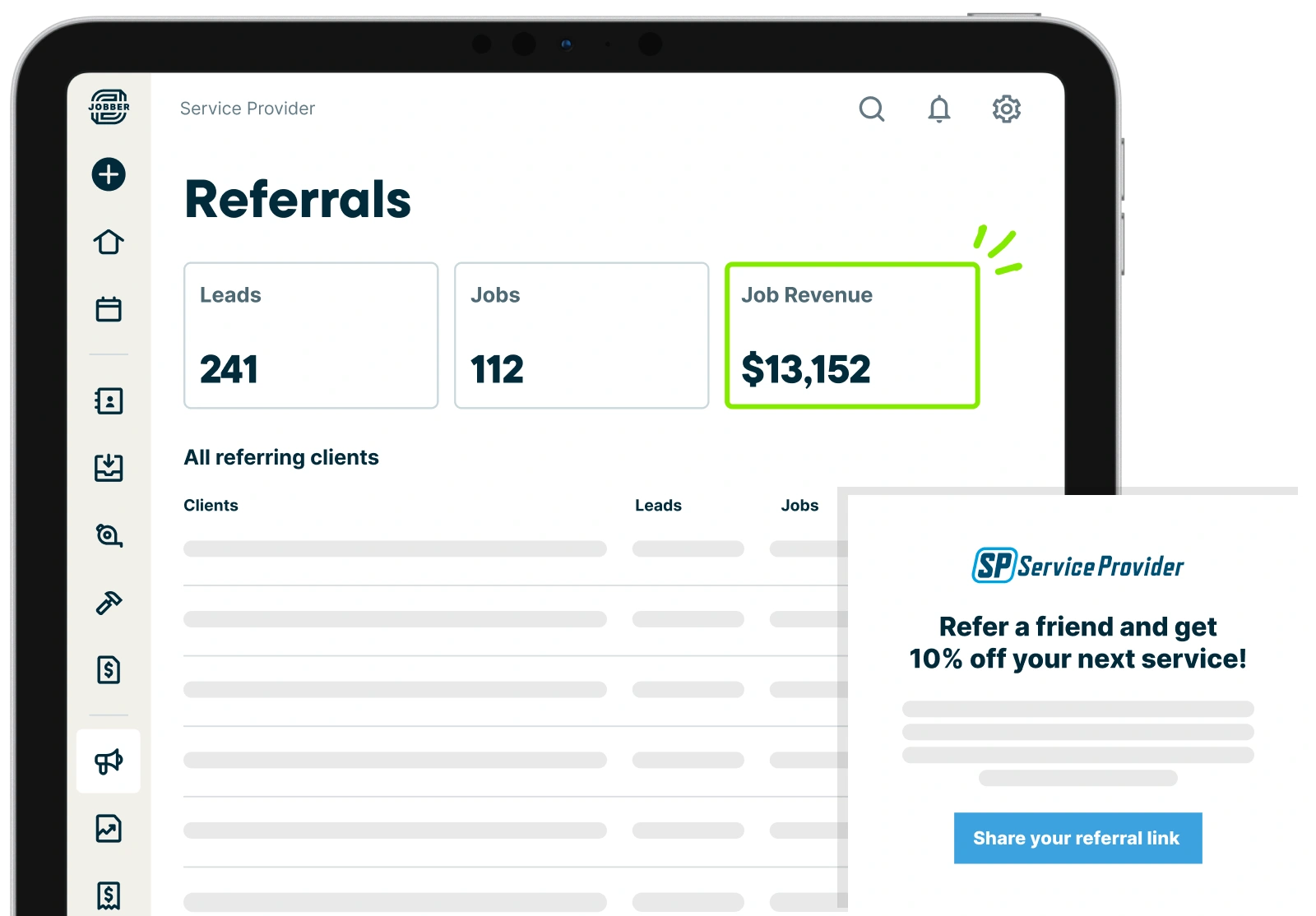
Jobber’s referral feature automates the ask so your team doesn’t have to remember. After each completed job, a referral prompt goes out automatically with a unique tracking link. Customers share the link with friends, and every referral is attributed back to the source.
Each customer gets their own referral link they can share by text, email, or social media. When someone uses the link to request a quote, Jobber records who referred them and tracks the referral through to a booked job.
I pretty much guarantee that if you install [a referral program] in your business, there’s no way that you are not gonna get new clients and grow your business.
Sample HVAC referral scripts
The best referral scripts feel conversational and easy to remember. Still, don’t think of these examples as specific statements to repeat exactly. Each one is more like a practical HVAC referral program template your team can naturally adapt to their personality.
Technician (in person) referral scripts
The best moment to ask is usually right after the job when the customer says something positive, like “Thank you so much” or “You guys are a lifesaver.” Here are a few examples to try:
Script 1
“Glad we got that taken care of for you. If you have neighbors or friends dealing with HVAC issues, we’re always happy to help. We actually send a $100 thank-you when someone you refer books a service with us.”
Script 2
“A lot of our work comes from customers like you. If anyone you know needs help, just have them mention your name when they book a service. We’ll take care of them and send you a referral bonus.”
Script 3
“If anybody in the neighborhood needs a second opinion on their system, feel free to pass our info along. We’ve got a referral program that gives you a bonus if they book with us.”
Notice the tone isn’t aggressive or pushy. The tech is simply informing the customer that the program exists, without getting into an unnecessary level of detail.
Post-job text/email referral scripts
Most homeowners won’t refer someone on the spot. Life is busy, and they may not know of someone who needs HVAC service right away. That’s why a follow-up message matters so much.
A quick text or email within 24 hours keeps the momentum alive while making referrals easy to act on later. Shorter usually works better. Here are a few examples you can try:
Simple script
“Thanks again for choosing [Company Name]! If you know anyone who needs HVAC help, refer them and we’ll send you $30 when they schedule a consultation. Just have them mention your name or use this link: [link]”
Relationship-focused script
“We grow through referrals from great customers like you. Send a friend our way and earn a $50 referral bonus when they book and complete a job: [link]”
Seasonal install-focused script
“Beat the summer rush! If you refer someone for a new AC install before June 1st, we’ll send you a $100 referral bonus after the installation is completed: [link]”
Jobber lets you send professional referral campaign emails to your entire customer list in a few clicks. Each email includes the customer’s unique referral link, and you can see who opens, clicks, and refers.
This makes it easy to run seasonal referral pushes as HVAC email marketing campaigns, without having to build anything from scratch.
How to track and measure your HVAC referral program
When it’s time to measure results, your business needs data. How much referral revenue came in last quarter? Which customers are sending the best leads? How do referrals compare against paid advertising?
Tracking doesn’t need to be an enterprise-level reporting project. A few steps make a big difference:
1. Define what counts as a referral
Each referral should connect back to a specific person. That means every referred customer should be tied to:
- A customer name
- Phone number
- Referral code
- Referral link
- Technician attribution
- Or another identifiable source
2. Track the core referral metrics
You only need a handful of metrics to understand whether your referral program is working. Start with these:
- Number of referrals per month: This shows whether referral activity is growing consistently. Note periods with high and low referrals so you can plan for resources accordingly, or plan limited-time incentives for slower months.
- Referral lead close rate: This is one of the biggest advantages of HVAC referrals. The close rate (expressed as a percentage) should be higher than that of paid ad leads.
- Revenue generated from referrals: This tells you the actual dollar value attached to your referral program. The amount should increase over time.
- Cost per referral: This is usually the total referral incentives or payouts associated with converted jobs. A reasonable target is $50–$100 for routine service calls and $200–$400 for closed equipment replacements.
- Referral ROI: Divide referral revenue by referral cost to see how much your business is growing as a result of the referral program. You should be making money, not losing it.
3. Identify your top referrers
You might realize that a small group of customers are generating more referrals than others. Maybe they’re:
- A local realtor
- A property manager
- A neighborhood Facebook group admin
- A long-term maintenance customer
- Somebody who constantly recommends contractors to friends and family
Once you identify them, you can prioritize them with higher-tier referral rewards, VIP priority service, maintenance perks, or seasonal thank-you gifts.
READ MORE: How to Build a B2B Referral Program That Brings Steady Leads (+ Free Scripts)
4. Attribute referrals automatically
Manual spreadsheets can break or become messy once your company grows. Techs forget to log referrals or credits get missed. Customers might even complain they never received their rewards.
Automation fixes a lot of that. Instead of relying on people’s memory to manage your program, customer referral software like Jobber can automatically track:
- Who referred the customer
- When the referral happened
- Which referrals turned into paying customers
- Total revenue connected to each referral source
- Outstanding referral rewards or payouts
In a single dashboard, Jobber’s referral reporting shows you:
- Which customers are your best referral sources
- How many referrals converted to booked jobs
- How much revenue those referrals generated
You’ll know whether your program is worth $5,000 or $50,000 a year without building a single spreadsheet.
Referral credits are applied automatically to the referrer’s next invoice—dollar or percentage-based, your choice. No manual tracking, no forgetting to pay out incentives, and no awkward conversations with customers to admit you owe them a credit.
5. Measure referral performance against paid advertising
Comparing lead sources is where the business case for referrals usually starts to make the most sense. Let’s say your HVAC company generates the following in one month:
| Metric | Referral Program Example | Google Ads Example |
|---|---|---|
| Leads generated | 15 | 15 |
| Closed referral jobs | 10 | 3–4 |
| Close rate | 66% | 22% |
| Revenue generated | $47,000 | $14,000–$19,000 |
| Costs | $3,000 in referral incentives | $4,500–$7,500 in ad spend (assuming $300–$500 per lead) |
Now compare that against your paid advertising channels. Referral close rates are 3x higher than ads, and you might spend thousands of dollars on Google Ads or Local Service Ads, just to generate the same number of leads with lower close rates.
The ROI of a customer referral program becomes more appealing. You’d need to spend $13,500–$18,000 on ads to close 10 leads, compared to just spending $3,000 on referral incentives.
HVAC referral program examples
It’s one thing to talk about referral strategies. It’s another to see how real HVAC companies do it. Here are several examples of HVAC referral programs in the wild.
Tier incentive
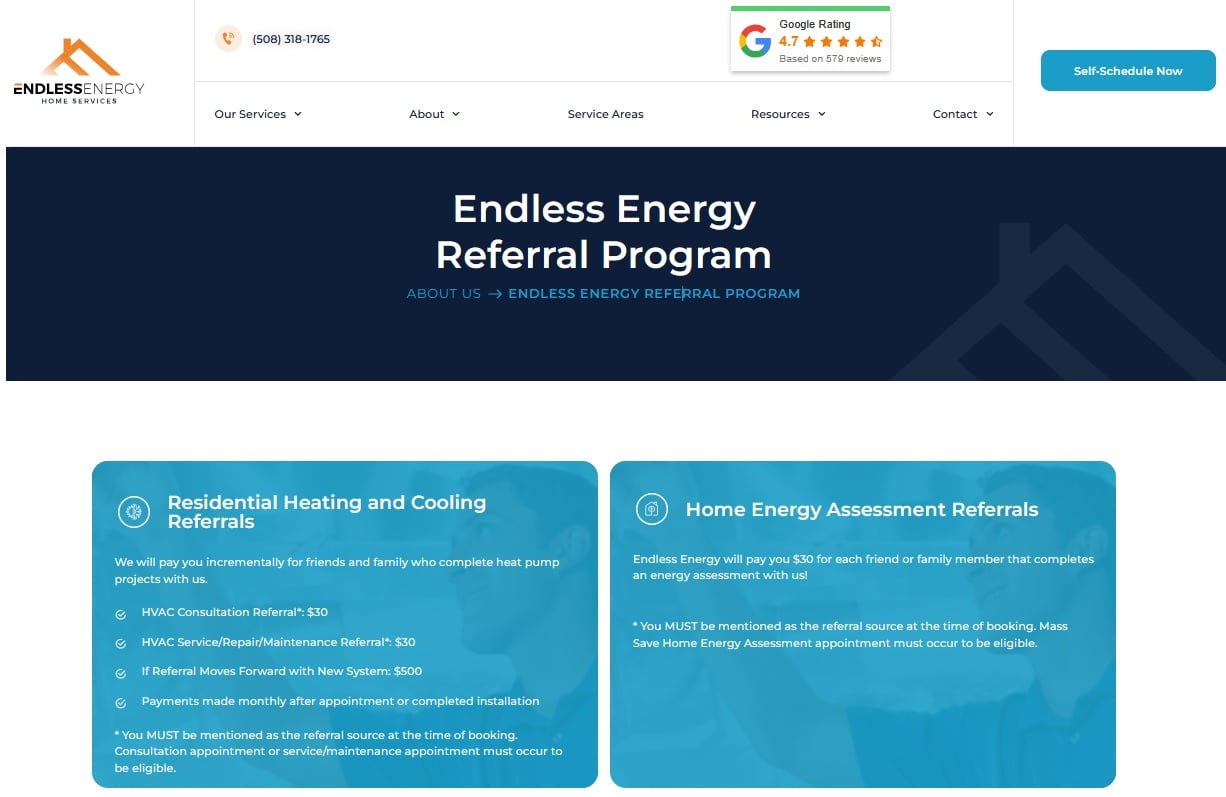
Endless Energy’s referral program offers incentives based on job type—$30 for a service or repair and $500 for a new system.
The tiers are low friction and easy to promote. This method is far cheaper than the marketing cost of acquiring customers for installs through paid ads.
Dual-sided incentive
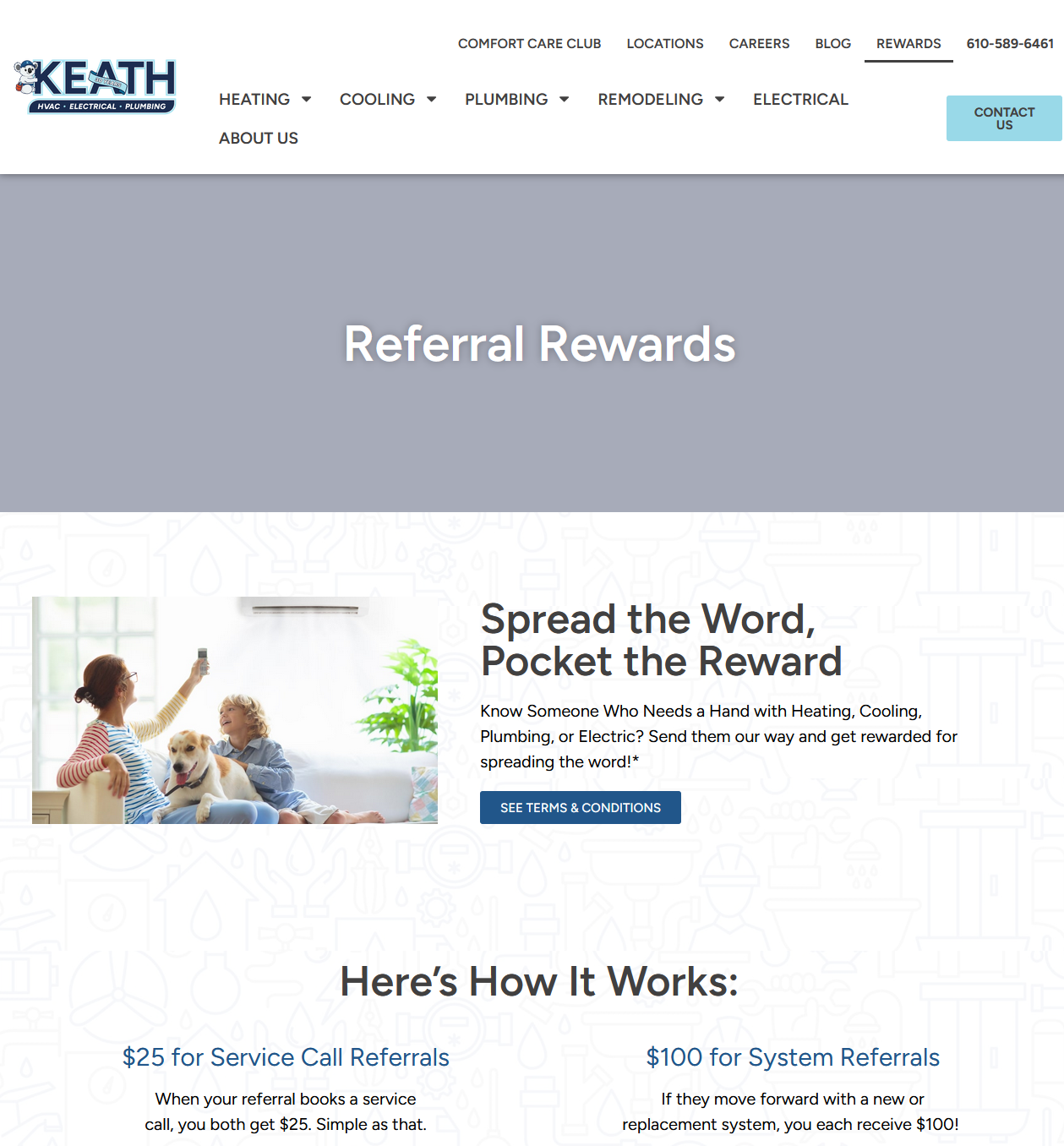
KEATH’s referral program is a double-sided offer, where both parties receive $25 for a service call and $100 for a new or replacement system referrals.”
This is a classic example of “give $X, get $X.” The referring customer gets a bonus, and the new customer receives a credit. Both sides get something.
Cash
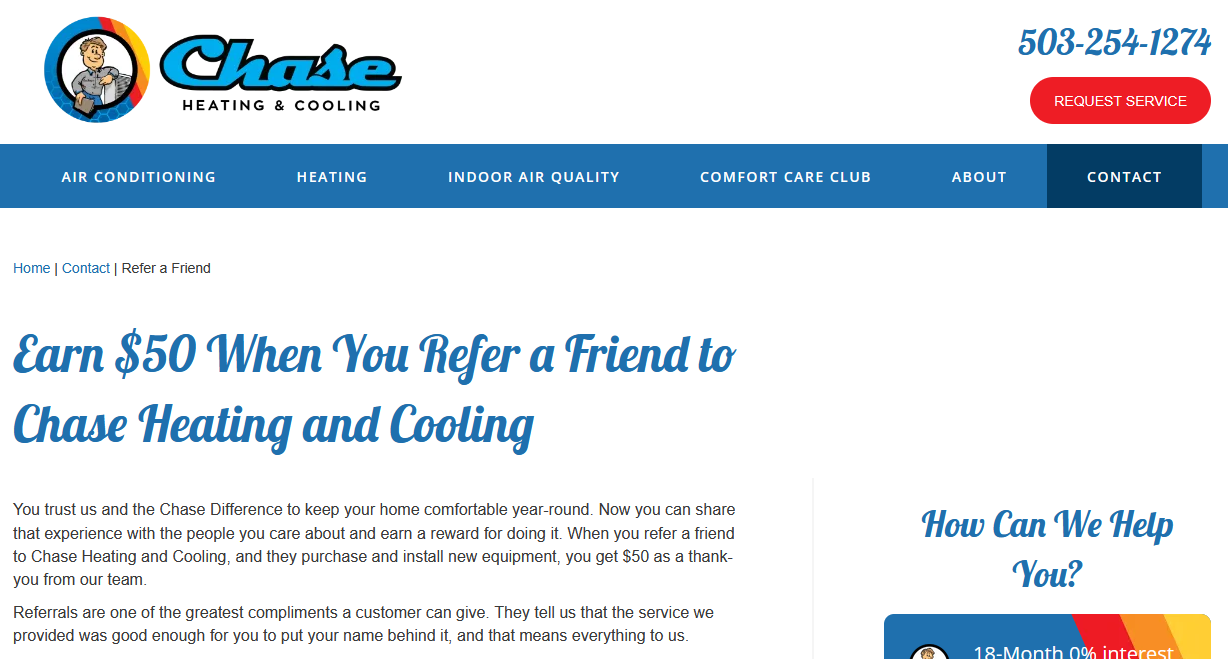
Chase Heating & Cooling’s referral program simply offers $50 when a referral buys and installs new equipment.
Everyone knows the value of money, and cash makes the process easy. This method even feels a little more like a thank-you than a transactional payout.
Non-cash option
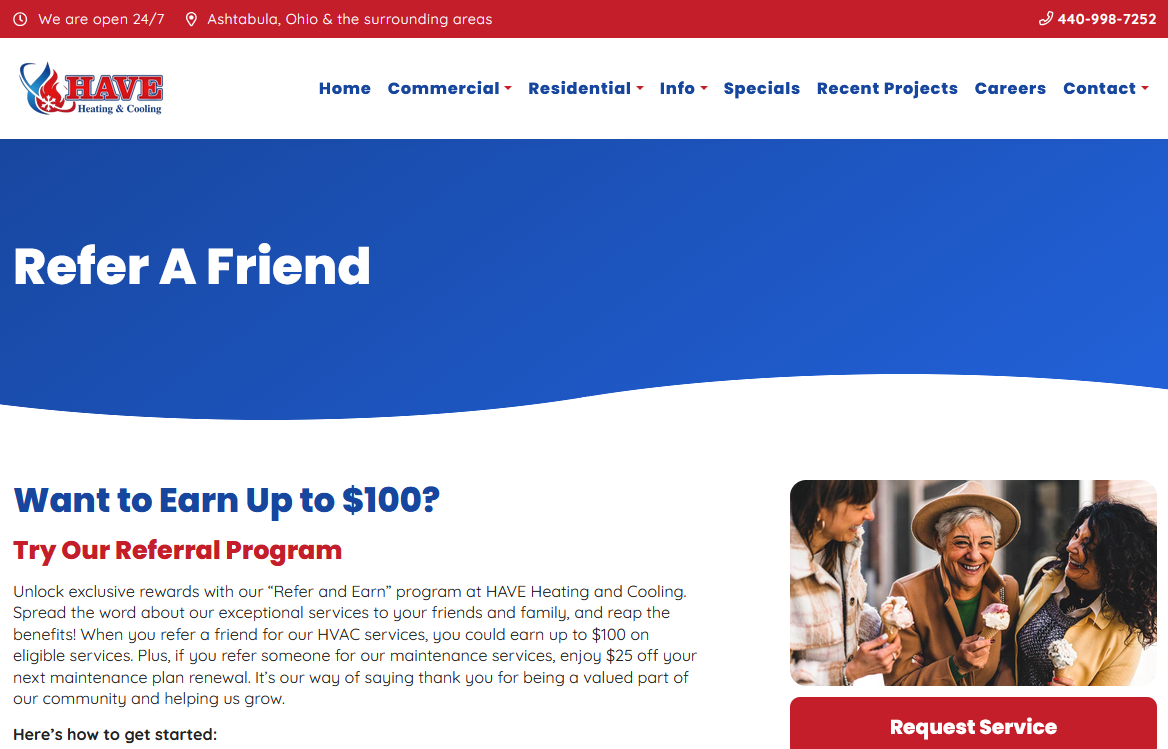
HAVE Heating & Cooling’s referral program gives $25 off a maintenance plan renewal when someone refers a new customer for maintenance services.
Some homeowners respond better to perks that feel practical. This is an example of an incentive that can cost you less than a straight cash payout.
Want even more HVAC referral tips?
In this video, you’ll hear four experienced business owners share their referral program success stories. Watch now and learn the best ways to start earning referrals from your customers.
A successful referral program gives you a repeatable, low-cost way to build your customer base without depending on ad algorithms or pricey lead-gen sites.
With a simple process and incentives, you can grow your HVAC business faster, only paying referral rewards when you get a new customer.
Frequently Asked Questions
-
Referral incentives should scale with the job size. Here are some practical referral rewards to offer that protect your margins:
• $25–$50 for service call referrals
• $50–$100 for maintenance plan signups
• $75–$150 for larger repairs
• $250–$500+ for full system installs -
The best time to ask an HVAC customer for a referral is immediately after you provide them with a positive experience, especially after a successful install or emergency service. You could also do this after receiving a 5-star review. A satisfied customer is more likely to refer your company to a friend or family member right after a completed job.
-
Track referrals using customer names, referral links, phone numbers, or referral codes. Customer referral software like Jobber can automatically track referring clients, new leads, referral revenue, and payouts owed.
-
Yes, HVAC referral programs are very effective. Referral leads typically close at higher rates than paid leads because a level of trust already exists before the first call. As a result, referred customers can be less price-sensitive and more likely to approve larger jobs or maintenance plans.
-
Both cash and service credits can be effective incentives for customer referrals. Cash or gift cards usually create the strongest response—65% of consumers prefer cash. Service credits, maintenance visits, or priority scheduling can feel more valuable to long-term customers. Some HVAC companies use a mix of both, depending on the job type.
-
The number of referrals you receive will depend on your customer base, the quality of service, and how consistently your technicians ask for referrals. Even a small HVAC company can generate several high-quality referrals every month when the program is naturally part of your day-to-day operations.
-
Yes, you can run a referral program for B2B and contractor referrals. Realtors, property managers, builders, electricians, plumbers, and other contractors can become strong referral partners for your HVAC company. You might find it’s a good idea to create separate referral incentives or VIP perks just for those relationships.