
Key takeaways:
Winning recurring landscaping contracts is essential for steady business growth, predictable revenue, and long-term client relationships.
- Understand contract types. Identify the best fit for your business among residential, commercial, and government contracts, as well as distinguishing between design, maintenance, and seasonal agreements.
- Sharpen your approach to finding and bidding on contracts. Define your ideal clients, build a professional portfolio, standardize your services, secure required documentation, and seek out contract opportunities through property managers, public portals, and networking.
- Develop competitive and sustainable pricing strategies. Clearly define scopes of work, calculate all service costs, and standardize pricing to ensure profitability and accommodate for potential long-term cost increases.
- Master the bidding process for recurring work. Read bid packages thoroughly, review project scopes, conduct site visits, gather all necessary documentation, and submit organized, timely bids to maximize your chances of winning.
- Include key contract details to set clear expectations. Comprehensive contracts should outline services, schedules, locations, licensing, insurance, payment terms, and change procedures to avoid misunderstandings and disputes.
Stay updated with more strategies and insights—sign up for the Jobber Newsletter for business tips delivered straight to your inbox. Sign up here.
Landscaping contracts are agreements between landscaping companies and clients for recurring or seasonal services, securing regularly scheduled work and more predictable revenue.
While bidding requirements can take time, these contracts create long-term relationships and stable schedules that help your landscaping business to grow.
This article explains how landscaping contracts work, where you can find the right opportunities, how to compete more effectively when bidding, and how to win contracts that support steady growth.
Everything you need to know about landscaping contracts:
Types of landscaping contracts
Landscaping contracts come in several forms, depending on the client and property type. Understanding the different types of landscaping contracts can help you focus on opportunities that match your company’s size, crew capacity, and growth goals.
Broadly, there are three main types:
- Residential: Ongoing maintenance or seasonal services for homeowners, HOAs, or multi-unit residential properties, often focused on lawn mowing and cleanup.
- Commercial: Recurring services for offices, retail centers, institutions, and other large outdoor spaces that have detailed scopes of work for grounds maintenance.
- Government: Contracts issued by local, state, or federal agencies for public properties such as parks, schools, roadsides, and municipal buildings.
Government contracts tend to be awarded to service providers through a structured bidding process. Commercial contracts may be granted under an RFP (request for proposal) process.
The different types of contracts can also be broken down by the kinds of landscaping services you’ll provide:
- Design and installation: Project-based agreements for landscape construction, upgrades, or large installations that may lead to ongoing maintenance contracts.
- Maintenance: Long-term agreements focused on routine landscaping and lawn care services like mowing, trimming, irrigation checks, fertilization, and seasonal cleanups.
- Seasonal/annual services: Contracts covering specific timeframes or services, such as snow removal, spring and fall cleanup, or planting seasons.
How to get landscaping contracts
To find and win landscaping contracts, you’ll need to have the right systems in place. Potential clients look for clear pricing and proof that your landscaping company can handle ongoing work at scale.
The steps below outline how most successful landscaping professionals get their contracts:
- Define your ideal client. Decide whether you want contracts with residential, commercial, or government clients, or a mix of all three. Each has different requirements, so narrowing your focus helps you prepare and bid more effectively.
- Build a portfolio. Clients want proof you can manage properties like theirs. Document completed work, recurring maintenance accounts, property sizes, and service frequency. Include photos and descriptions with measurable results to show your credibility.
- Standardize your services. Create clear service packages for maintenance and seasonal work. Standard pricing templates and defined scopes make it easier to respond to landscaping bids and negotiate clear contracts.
- Prepare business and compliance documents. Many clients require landscapers and other service providers to have a business license, business insurance, bonding, safety plans, and other documentation. Having these ready ahead of time speeds up the bidding process.
- Find contract opportunities. Commercial contracts can come from property managers, HOAs, and facility management companies. Government contracts are posted on public procurement portals, which have strict submission deadlines, so check them often.
- Submit competitive bids. Winning bids clearly follow instructions, match the requested scope, and include accurate pricing. Avoid underbidding just to win the contract, since you’ll need to stick to that pricing long-term and still make a profit.
How to price landscaping contracts
Pricing is one of the most important parts of any landscaping contract. Your prices need to be competitive, but you need healthy profit margins so you can reinvest in your business.
Follow these tips for pricing your landscaping services:
- Define the scope of work. The contracting officer or commercial property owner will likely tell you the scope of work, including services, visit frequency, property size, response times, and any special requirements. If the scope isn’t clear, ask questions to avoid underpricing.
- Calculate your service costs. Factor in costs like labor, equipment, fuel, materials, and overhead. For recurring and ongoing contracts, account for year-round costs, not just peak season labor.
- Standardize your pricing. Creating pricing models for common property types and service levels helps you respond faster to bids and maintain consistency across contracts. It won’t work for all contracts, but it cuts down on bidding time for simple jobs.
- Set realistic prices. To avoid getting locked in at a too-low price that doesn’t cover your expenses, calculate how much it costs to provide the right level of service for the contract you’re bidding on. Cost isn’t the deciding factor for many clients—and the ones who care most about pricing may not be clients who will help your business grow.
- Plan for long-term service. With longer contracts, your pricing may need to stay the same for the full landscape contract length. Make sure this pricing accounts for increases in your business expenses, like employee wages, fuel, and materials.
Pro Tip: Look for clauses that allow or prevent annual price increases and scope changes. Pricing should support long-term service quality, not just the first contract year.
Don’t match your competitors’ pricing. You need to know your numbers. You need to know what you want to make.
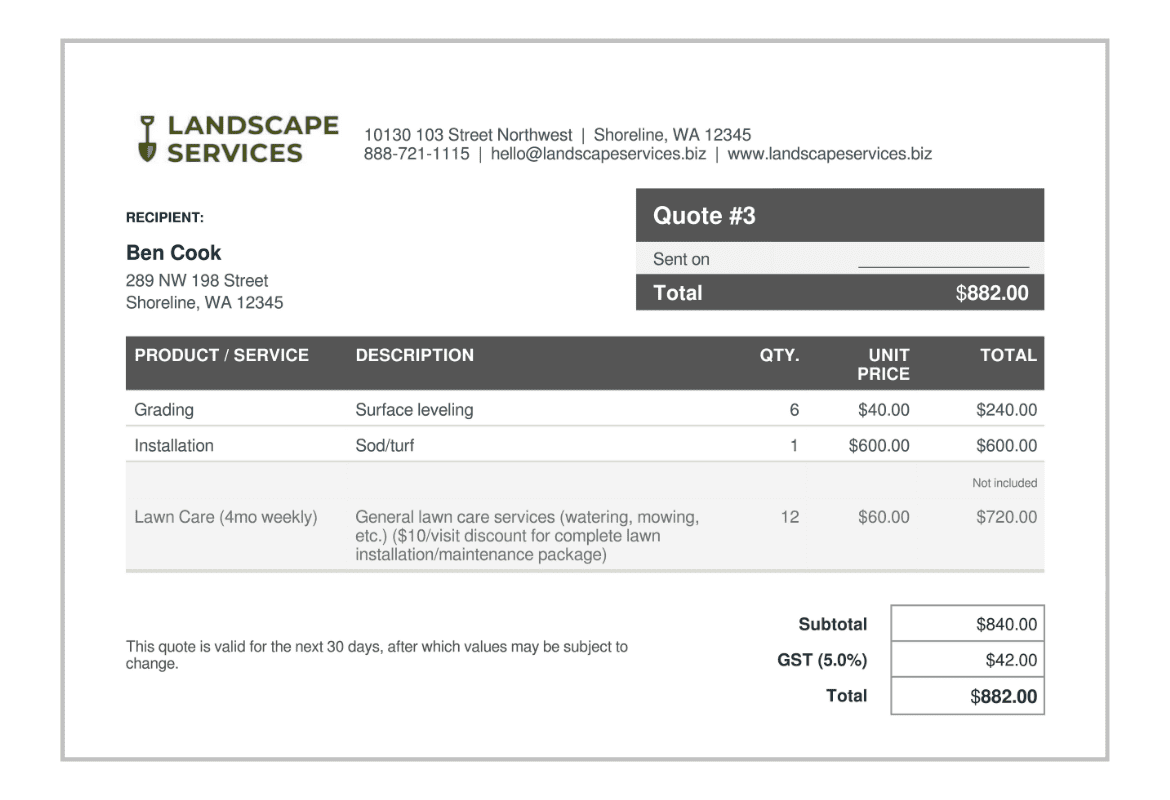
With quoting software like Jobber, you can quickly turn landscaping bid requests into professional quotes that describe your services and pricing. Create custom bids and win contracts faster with:
- Advanced quote customization with photos, file attachments, and Google reviews.
- Add-ons and markups to keep your pricing competitive and close high-value deals.
- Automated follow-ups that remind clients to approve your quote without any extra effort.
- Approvals and deposits through a self-serve portal that lets clients secure jobs.
- Automatic drafts created through Jobber AI using your past work and templates.
- Alerts for high-value quotes so you can do a personalized check-in with the client and win the work.
How to bid on landscaping contracts
Once you’ve identified landscape contracting opportunities, follow these steps to move through the bidding process:
- Read the entire RFP or bid package, noting deadlines, required documents, submission format, and how bids will be evaluated.
- Review the scope of work, including listed services, service frequency, performance standards, and landscaping agreement length.
- Conduct a site visit to confirm property size, access points, obstacles, irrigation systems, and any conditions that affect labor and equipment needs.
- Ask any questions by the provided deadline to avoid making assumptions that could affect your pricing.
- Prepare your pricing based on the confirmed scope and your cost structure.
- Include all supporting documents, including forms, certificates, and references.
- Review for accuracy and double-check calculations, attachments, and submission instructions.
- Submit the bid early to avoid technical issues or delivery delays.
- Be available for follow-ups in case the client has questions or wants to meet with you.
- Be ready to sign the contract, schedule crews, and begin service according to the contract start date.
In the beginning… bid everything so long as you’re tracking, and you know exactly where your leads are coming in.
What to include in a landscaping contract
A well-written landscaping contract sets clear expectations for both parties and helps prevent disputes during the contract term. All of your landscaping contracts should include:
- Service description, including tasks, service frequency, and quality standards.
- Service schedule with expected days and response times.
- Property location and service areas with address(es) and boundaries clearly defined.
- Contract term and timeline with the start date, end date, and renewal options.
- Guidelines for using subcontractors with approval requirements and responsibility for the quality of their work.
- Proof of insurance with required coverage types, limits, and deductibles.
- Proof of business license and any other necessary documents that the client requires.
- Compliance and safety requirements, including environmental regulations and any property-specific rules.
- Pricing and payment terms, including total contract value, billing schedule, payment methods, and late payment terms.
- Change order and scope adjustment guidelines defining how additional work or changes to services will be priced and approved.
- Cancellation and termination policy with conditions for termination, notice requirements, and any associated penalties or fees.
- Dispute resolution guidelines stating how disagreements will be handled, like mediation or legal action.
- Signatures of authorized representatives with the contract execution date.
Start winning landscaping contracts today
By focusing on the right landscaping contracts and pricing accurately, your business is better positioned to bid landscaping jobs with confidence and consistency.
Quoting software like Jobber also makes it easy to create detailed quotes, send them quickly, and turn approved quotes into scheduled work so you can grow your landscaping business.
Frequently Asked Questions
-
Finding landscaping contracts takes a mix of online research and local outreach. Commercial and government contracts are often publicly listed, while others come from your professional relationships.
Try these ideas to find landscaping business opportunities:
• Search SAM.gov, the main portal for federal landscaping contracts tied to government buildings, facilities, and public land.
• Check state, county, and city procurement websites, as many local governments post landscaping bids on their own sites.
• Use bid listing platforms like ConstructConnect and Construction Bid Source to find government and commercial landscaping projects.
• Connect with property managers and facility managers who manage office parks, retail centers, HOAs, schools, and healthcare facilities.
• Monitor local Chambers of Commerce and business associations, which often have information about upcoming developments and public landscaping project opportunities.
• Become a registered vendor with large organizations, as some commercial clients require vendors to be pre-approved before they can bid on landscaping contracts.
• Build relationships with general contractors who will subcontract landscaping services as part of larger construction or renovation projects.
• Use lead generation sites like Thumbtack, Angi, and HomeAdvisor to fill gaps in your schedule with residential clients or small commercial work, especially when you’re first building a portfolio. -
Finding and winning commercial landscaping contracts involves preparation and a clear approach to bidding. Here’s how to get commercial landscaping contracts:
• Identify the types of commercial properties you want to serve, like office parks, retail centers, schools, or healthcare facilities.
• Build a portfolio that highlights relevant experience, including property sizes, services provided, before-and-after photos, and client testimonials.
• Standardize your services and create clear pricing templates or lawn maintenance contract packages. This makes it easier to respond to bids and present professional proposals.
• Get any business licenses and insurance that commercial clients may require, along with any other certifications or documentation.
• Network with property managers and general contractors who oversee commercial sites, since personal connections often lead to contract opportunities.
• Monitor bid postings on local government websites, commercial property sites, and construction and procurement platforms.
• Submit complete, accurate bids that follow the client’s instructions and meet the scope of work with competitive, sustainable pricing.
• Provide consistently great service and clear communication once you win contracts, as happy clients are more likely to renew their contracts with you. -
To win government landscaping contracts, you’ll need to understand the formal bidding process and meet compliance requirements. Here’s how to get government landscaping contracts:
• Identify the level of government you want to work with (e.g., local, state, federal) and focus on properties that match your capabilities.
• Register your small business with relevant government portals like SAM.gov for federal contracts, or check state and local procurement websites for bidding opportunities.
• Ensure your business has all required licenses, insurance, and bonding, as well as any certifications needed for government work.
• Review RFPs or invitations to bid, paying attention to deadlines, submission formats, required content, and necessary documentation.
• Conduct site visits if offered to understand the property and accurately estimate labor, materials, and equipment needs.
• Prepare detailed, accurate bids that include your scope of work, pricing, and supporting documents.
• Respond promptly to any follow-up questions or requests for clarification from the government agency.
• Provide reliable service once you win a contract, as past performance is a major factor in securing future government contracts. -
The amount landscaping contracts pay varies widely based on property type, scope of work, and service frequency, but industry data gives a useful range you can expect when bidding or setting your own rates:
• Commercial landscaping contracts typically range from $2,000 to $50,000+ per year. Basic services tend to be priced lower, with larger corporate campuses and complex properties paying more.
• Government landscaping and mowing contracts range from $45,000 to $250,000, depending on the size of the landscaping job and the type of government. State or local contracts are on the lower end, while federal or agency-level work is on the higher end.
• Residential maintenance contracts average $600–$650 annually per client, making them less profitable than commercial contracts. However, having multiple residential contracts in one neighborhood can help you provide services more efficiently.
These figures are broad averages and can differ based on local market conditions, service complexity, and your pricing strategy.
-
It generally takes 12–24 months of registration and preparation to be awarded a government contract. Actual times vary by agency, contract agreement size, and your level of experience.
This lengthy timeline is due to multiple review layers and slow, structured procurement cycles. However, you could win local contracts faster by targeting smaller agencies or subcontracting on larger projects. -
There isn’t one single landscaping license you need to bid on government contracts at the local, state, or federal level. Requirements vary by location, government level, and the services you provide.
Check the RFP requirements before submitting a government landscaping bid. Many government RFPs will list requirements like:
• Federal business registration on SAM.gov
• A landscaping contractor license
• Specialty state licenses (e.g., pesticide application)
• General business operating license
• Valid insurance (e.g., general liability, workers’ compensation, bonding)