8 Types of Pressure Washing Ads That’ll Help You Win More Contracts

Key takeaways:
Pressure washing ads can help you win more contracts and grow your local business by using the most effective advertising channels.
- Explore a variety of ad channels. From Google and Facebook ads to vehicle wraps, website pop-ups, lead generation sites, door-to-door flyers, Yelp, and print ads, each format offers unique ways to target different customer types and local markets.
- Craft compelling and clear ad copy. Use straightforward messaging, highlight your services and pricing, showcase local trust, and include customer testimonials or before-and-after photos to make your ads stand out.
- Tailor your approach for each platform. Make sure your ads match the best practices of each channel, such as using visuals in Facebook ads, adding promo codes to flyers or door hangers, and emphasizing reviews in Yelp or Google Local Services Ads.
- Track results and measure ROI. Monitor actions that lead to real bookings—such as calls, quote requests, or online bookings—and use tools like promo codes, call tracking, and tagged landing pages to discover which ads perform best.
- Start small and scale up. Choose one or two ad types, set a clear budget, and analyze your results before expanding your marketing efforts for maximum impact and value.
Level up your pressure washing business with even more marketing and advertising tips—sign up for the Jobber Newsletter today. Subscribe here.
Pressure washing ads can help you attract local customers and generate new leads fast, whether you’re starting a business or have been running one for years. According to LocaliQ’s analysis of 3,211 U.S. home service campaigns, search ads converted 7.33% of clicks into leads on average in 2025.
The key is choosing the right advertising channels for your business. In this post, we’ll explain how to advertise your pressure washing services and help you decide which ads are worth your budget.
Try these pressure washing advertising ideas to grow your business:
What are pressure washing ads?
Pressure washing ads are the paid and promotional messages you use to put your pressure washing business in front of local homeowners and property managers who need exterior cleaning.
They run across channels like Google Ads, Facebook ads, lead generation sites, Yelp, vehicle wraps, door-to-door flyers, and print. The goal is simple: turn local attention into booked jobs.
1. Google Ads
Google is one of the most popular places to run search engine marketing. Here are a few examples of how to run pressure washing Google ads:
Local Services Ads
Use Local Services Ads (LSA) to attract new, local customers and to get more pressure washing jobs in your area.
Local service ads appear at the top of a search engine results page when a potential customer searches for local power washing services. Here’s what they look like for the keyword “pressure washing company near me”:
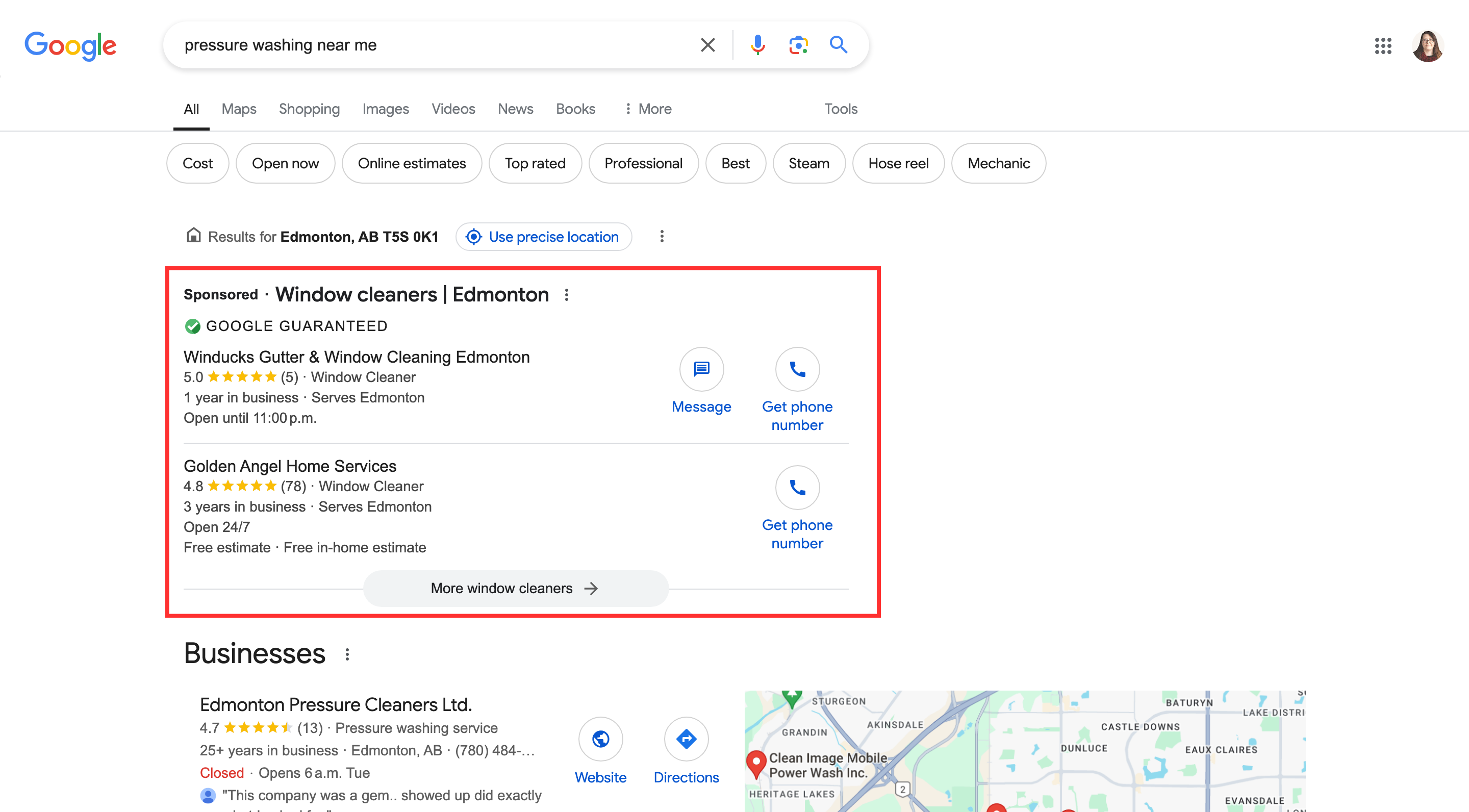
Local Services Ads run on a pay-per-lead model, which means you’ll only pay when a customer contacts you for work.
This type of Google ad is easy to create because it doesn’t require any graphics or text. It looks professional with very little effort, which is great for a busy pressure washing business owner like you.
Your Local Services Ad should include:
- Your pressure washing business name
- Google Verified badge (if you have one)
- Your Google review star rating
- Number of years in business
- Your business hours of operation
Make sure you have a Google My Business listing and get that verified.
The verification is important because it lets customers know that you’re a legitimate business.
Search ads
Search ads appear at the top of Google search results for potential customers in your service area. These are very simple text-based ads that don’t require much effort to create.
Here’s what a Google search ad looks like in action:
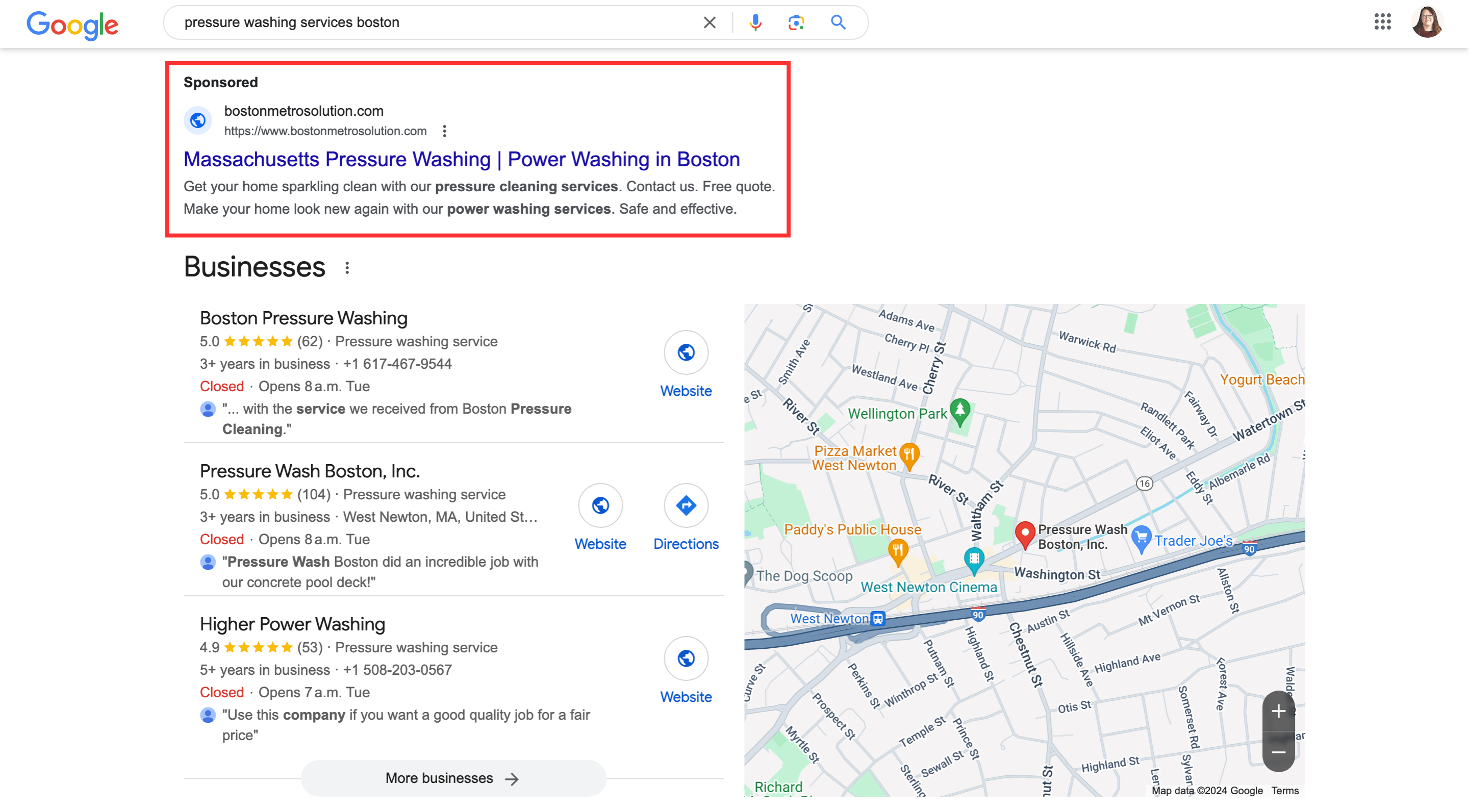
Your search ads should include:
- A website link for a page that’s relevant to the ad (e.g., online booking)
- Your business name and service area
- A simple headline describing your services (e.g., roof cleaning, driveway cleaning)
- A brief description outlining why customers should pick your pressure washing services
When you’re setting up these ads, most of the work involves finding and bidding on the keywords that your ideal customers are searching for (e.g., “pressure washing services [CITY]”).
Find the keywords that are driving the most traffic.
Primarily, it’s gonna be your geographic location plus the service.

Display ads
Display ads appear on pressure washing websites that are part of Google’s display ad network. That means when someone googles a keyword that you’re bidding on, they could see your ads in certain areas of participating websites.
This is one example of what a simple display ad could look like:
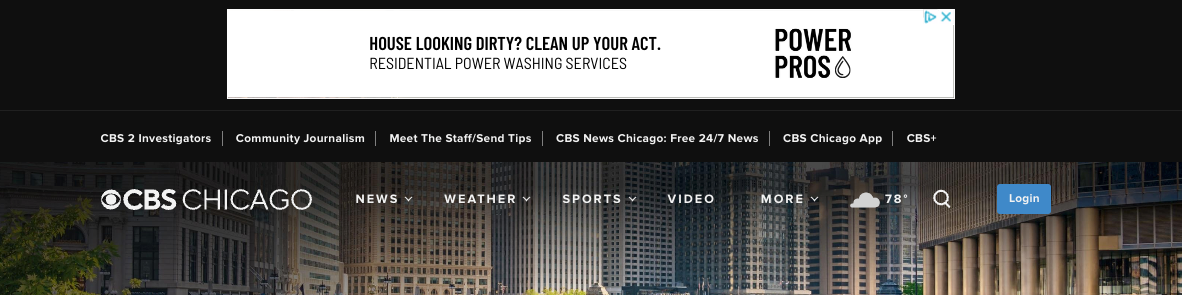
Your display ads should include:
- Your business name and logo
- A clean, simple design with minimal text and imagery
- Catchy pressure washing advertising slogans
- A brief description of your services
Pro Tip: You can also try Yahoo ads, Bing ads, and other search engine advertising methods.
2. Facebook ads
Pressure washing Facebook ads help you connect with new customers who live in your pressure washing service area, based on their age and interests.
You can use these social media ads to send targeted promotions to your ideal customers and build awareness for your business.
Your pressure washing Facebook ad should include:
- Your pressure washing company name
- Several lines of text describing why customers should choose your business
- An attention-grabbing visual, like a photo or video
- A call to action that tells the customer what to do next (e.g., call, send a message)
Here are three Facebook pressure washing ad examples to inspire your own ads:
Video ads
Create a video ad that shows the answers to commonly asked questions or addresses specific problems for your customers. For example, maybe they want to know how to clean vinyl siding or brick walkways.
These types of videos are incredibly satisfying to watch, so you can expect lots of video views from a wide range of ideal customers.
Boosted posts
You can boost a Facebook post—that is, pay to promote one of your posts—to spread your message to a larger group. This works well for ideal customers who would enjoy your regular posts but don’t know about them yet.
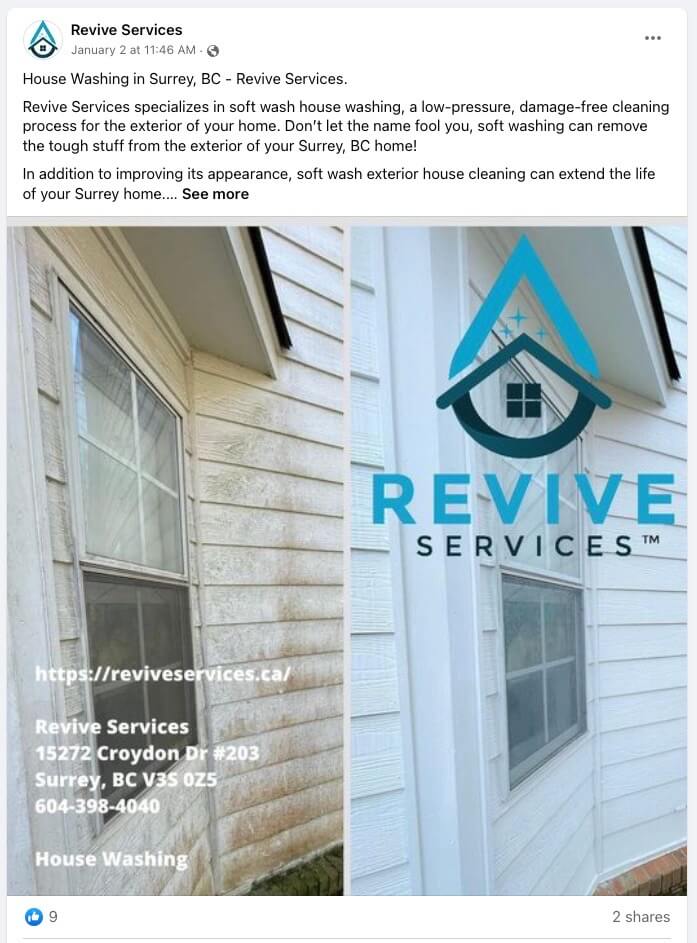
All you have to do is pick a pressure washing Facebook post and set a budget. For best results, consider using before and after images to show off a pressure washing job well done.
This is a great example of social media marketing using a boosted post:
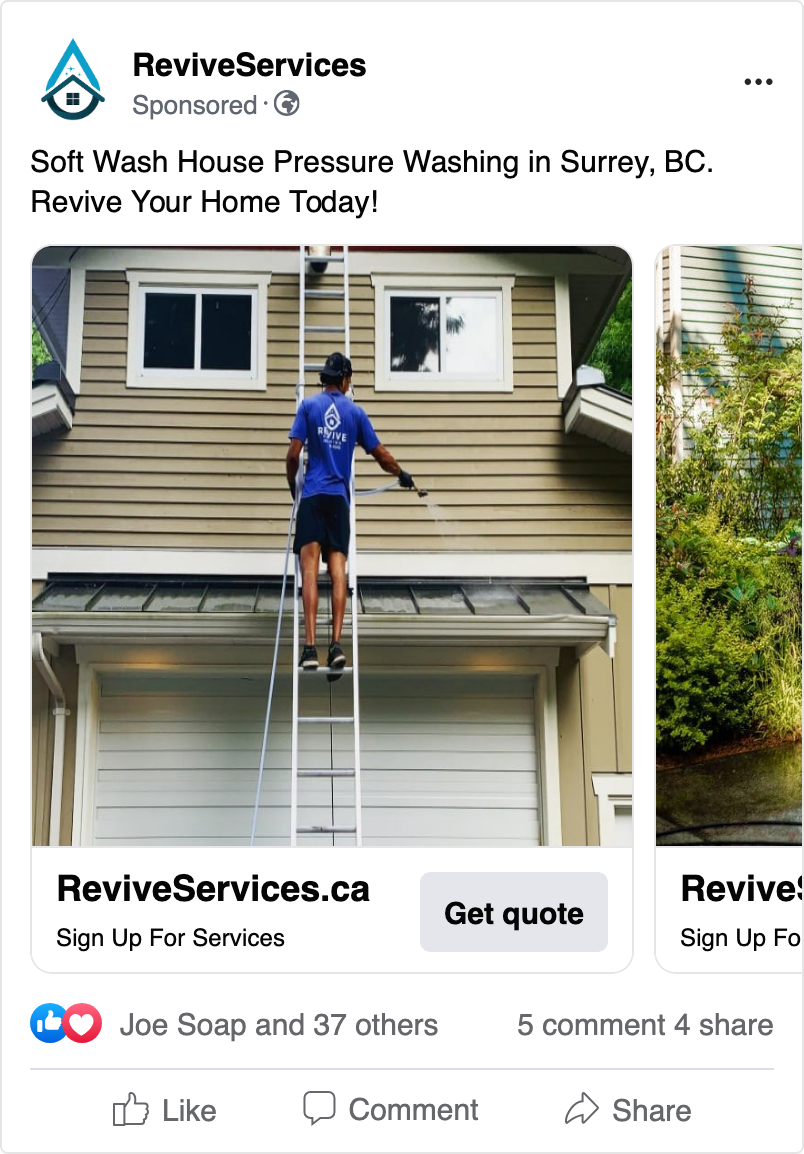
Carousel ads
Carousel ads let you combine up to ten images and videos in a single ad. This is helpful for ideal customers who want lots of information about your power washing business, all in one place.
Use a carousel ad to show off images of completed jobs, along with reviews from happy customers. Your carousel could look something like this:
3. Lead generation sites
Lead generation websites for contractors—like Thumbtack, TaskRabbit, and Angi—help you reach customers who are looking for pressure washing services online.
New customers can contact you through these sites to request a pressure washing service. Depending on the platform, you’ll either pay a monthly rate or be charged per pressure washing lead.
Here’s what a pressure washing ad looks like on Thumbtack:
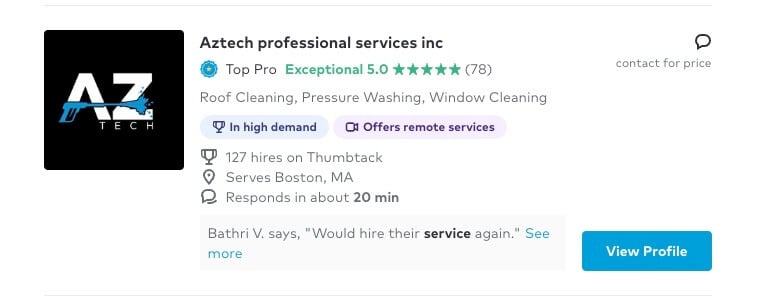
The exact content of your ads will vary depending on which platform you’re using. That said, your lead generation ads should include:
- Your company name
- A list of your pressure washing services
- A description of your service area
- A star rating that’s specific to that platform
Your ad may also include a customer testimonial, your response time, and the number of times you’ve been hired through that lead generation site.
4. Website pop-ups
Pop-ups might not be the first thing that comes to mind when you’re thinking about pressure washing ads. But they can work like an ad, and sometimes even better. No doubt you’ve seen one while browsing the web.
Let’s say someone visits your site because they’re thinking about getting their patio cleaned up before a big summer BBQ. Before they scroll too far, a pop-up appears that reads “Get 10% off your first pressure wash. Get your coupon via email.”
At this point, you’ve got their attention and possibly a new lead.
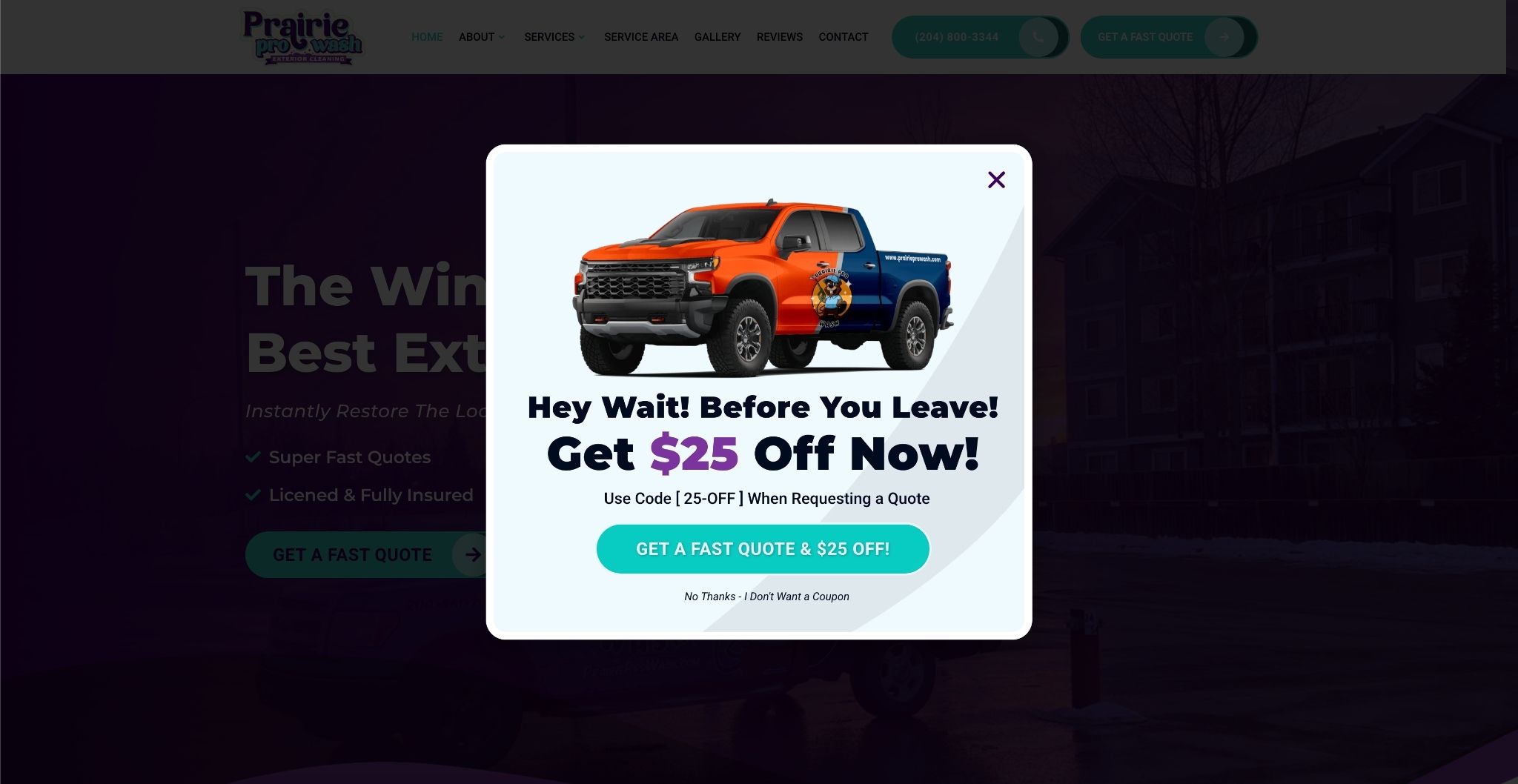
You can use pop-ups to:
- Offer exclusive discounts to first-time visitors
- Push seasonal promos like fall gutter clearing or spring roof cleaning
- Encourage sign-ups to your email list so you can follow up later
- Drive direct bookings for your most popular services
Don’t go overboard, though. You don’t want to annoy people. Try just one pop-up, and time it so it appears 10-15 seconds after someone lands.
Not convinced website pop-ups are for you? Check out these pros and cons:
Pros
- They convert. If someone’s already on your site, a pop-up gives them a reason to stick around and book that patio job they’ve been putting off.
- They build your email list. Getting email addresses means you can send follow-up promos and seasonal service reminders.
- They’re targeted. You can set pop-ups to only appear for new visitors or just on certain pages (like a service page).
- They’re cost-effective. Unlike some ads that eat away at your budget every time someone clicks, pop-ups are a one-time setup with long-term value.
Cons
- They can be annoying. Too many pop-ups, or ones that show up instantly, can frustrate people. You’ve probably hit the “close” button a few times yourself.
- They don’t replace real ads. Pop-ups only work after someone has landed on your site. They won’t bring in new visitors like Google or Facebook ads can.
- They need to look good. A poorly designed pop-up can feel scammy. Keep it clean and aligned with your brand.
5. Vehicle wraps
When you’re out and about pressure washing decks, driveways, and gutters all over town, your vehicle might as well be working too. A professional vehicle wrap can turn your work van or truck into a mobile ad that never stops hustling.
This kind of pressure washing advertising doesn’t wait for clicks. It puts your business, services, and contact info in front of potential customers, whether you’re parked in a driveway or stuck at a red light.
There are different types of wraps:
- Full wraps cover your entire vehicle from bumper to bumper, totally transforming how it looks. It’s ideal if you want maximum impact and consistency across your fleet.
- Partial wraps can highlight the sides, rear doors, or hood, showing off your branding without covering the whole vehicle.
- On a budget and just want a logo and phone number? Spot wraps are decals and individual graphics that can be done quicker than other wraps, but still look sharp.
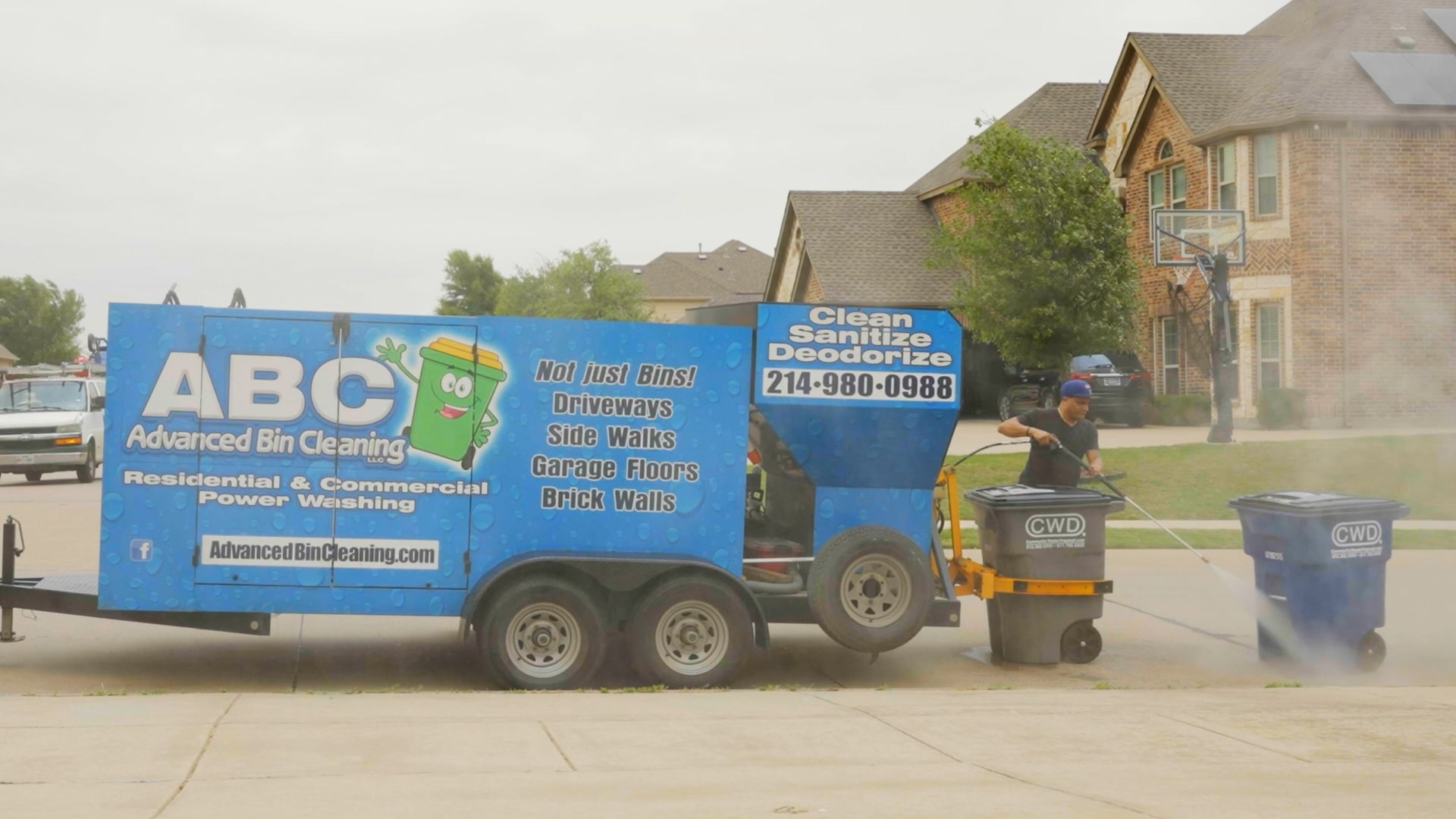
Try to be bold without being too “busy.” Keep your business name big and your contact info should be readable from 30 feet away. High-contrast colors help too, especially when you’re pressure washing on a cloudy day and someone drives by wondering who to call for their own house.
Advanced Bin Cleaning is a great example of smart wrap design. They follow wrapping best practices while making sure their business stands out.
6. Door-to-door ads
Delivering door hangers, flyers, or postcards is an effective way to build brand awareness and get new customers in a neighborhood.
Pressure washing flyers
Flyers are an affordable way to introduce your services to potential customers in your neighborhood. Just drop them in the mailbox or on the customer’s front step.
You can ask to hand out flyers at local events to drum up new business or deliver flyers to surrounding houses after a job is complete.
[A 5-around is] a printed flyer or business card.
If you’re doing one house right here, do the neighbors. To the left, across the street, and then you go to the right side. That’s five around. And if we need more work, we’ll do a 10-around.

Your pressure washing flyer could look something like this:
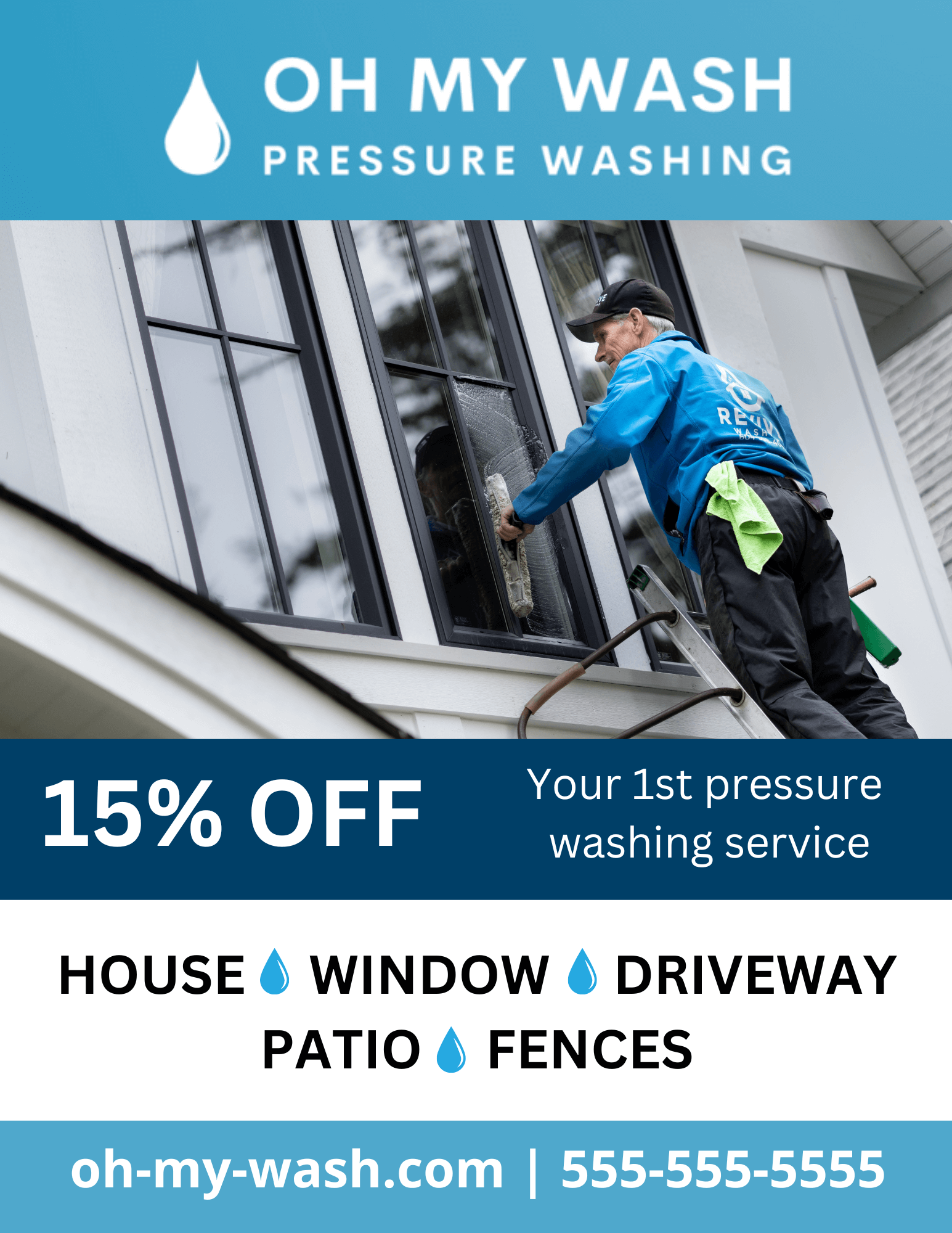
Your pressure washing flyer should include:
- Your business name and logo
- A catchy slogan or headline
- A brief description of your pressure washing services
- Contact details (e.g., phone number, website URL)
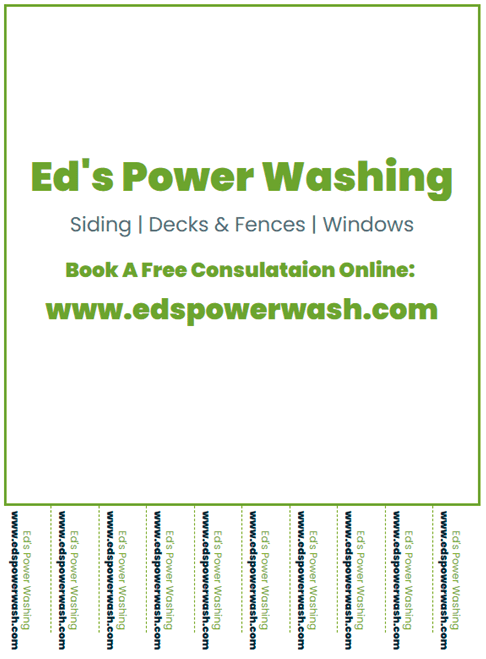
You can also create simple tearaway flyers like the example below. Put them up on community bulletin boards in your local grocery store, gym, public library, or community center.
Pressure washing postcards
You can use postcards to send promotions, provide seasonal reminders, or send thank-you notes to customers.
This type of print advertising is a handy way to reach both new and existing customers. The only requirement is that you send it to customers who live in one geographical area.
Revive Washing personalizes their postcards with a neighbor’s name, pricing, and clear booking instructions. They also include positive customer reviews to encourage homeowners to book their services.
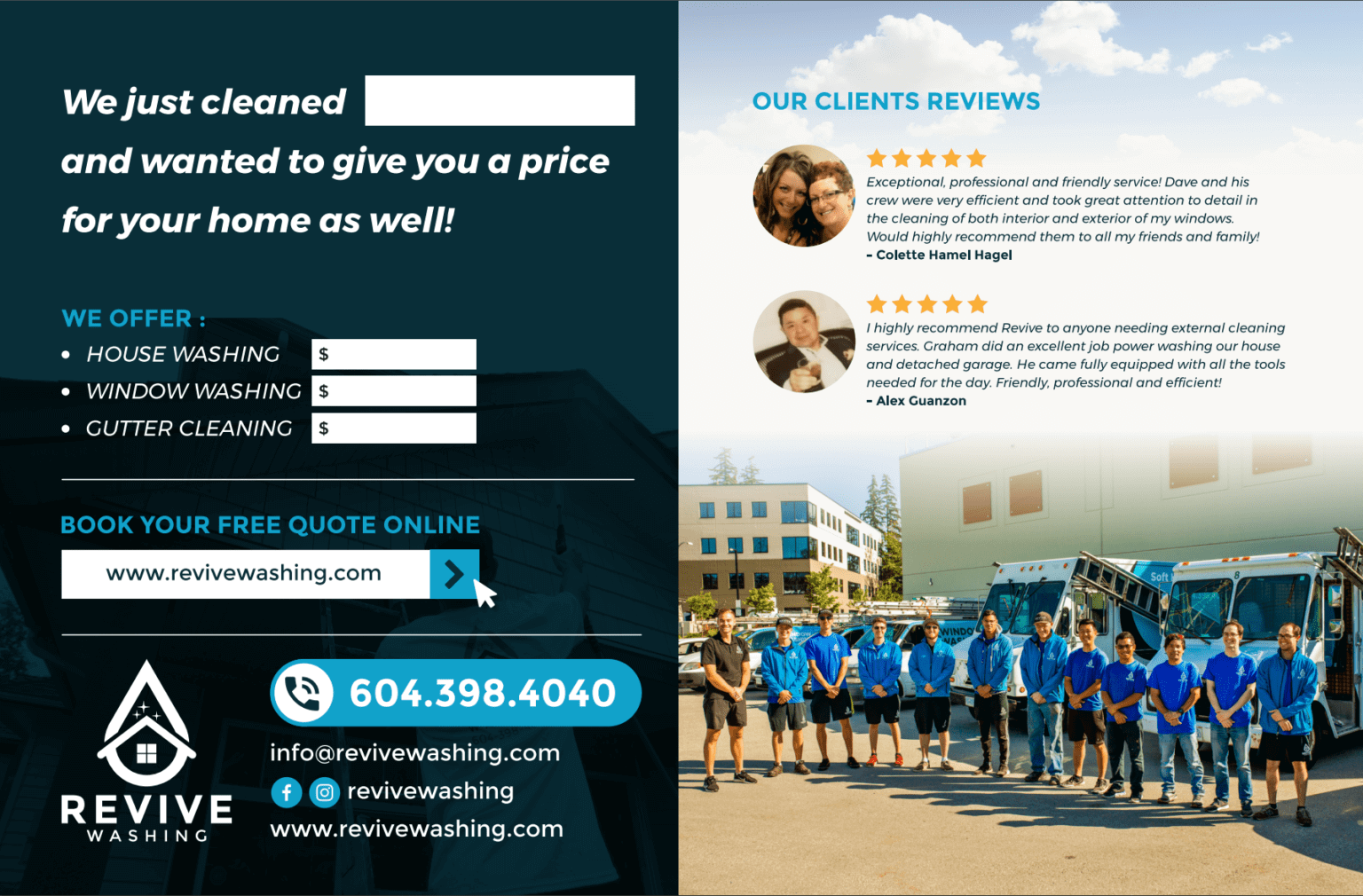
Your pressure washing postcard should include:
- Your company name, logo, and branding
- A message explaining why the homeowner is receiving the card
- A list of your services and pressure washing prices
- Your business contact details (e.g., phone number, email address, website URL)
- Customer testimonials praising your services and employees
Pro Tip: Connect Mailchimp to your Jobber account to create professional-looking postcards and mail them to your customers in bulk.
Door hangers
Door hangers are effective because you can hang them directly on a potential customer’s front door knob. That way, they’re impossible to miss when a resident goes to open their door.
Here’s what a door hanger could look like:
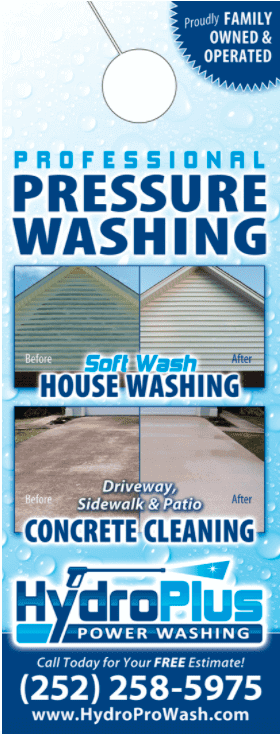
Designing a door hanger can be a little tricky because you need to leave room for the knob. But otherwise, there’s plenty of room for useful content.
Your door hanger should include:
- Your pressure washing name, logo, and branding
- Contact details (e.g., phone number, email address, website URL)
- A catchy headline telling the customer what you offer
- Testimonials, before-and-after photos, or other content that tells customers what you can do for them
Door knocking is one of the most effective ways to get leads.
It’s also one of the hardest. People don’t like knocking on doors.

Pro Tip: Include a promo code that customers can use to receive a special offer. Just count the number of promo codes redeemed, and you’ll know how many new customers learned about you through door hangers.
7. Yelp ads
Running a power washing ad on Yelp puts your business above the organic listings and right where the people’s eyes go first. Think of it like jumping the line ahead of your competitors. When homeowners search “house washing in [city],” your business can show up first.
Even better? Yelp ads are tailored for high-intent searches as people are actively looking for someone to book.
A typical ad might include:
- Your pressure washing business name and location
- Star rating and total reviews
- A “Yelp Guaranteed” badge (if eligible, as it adds trust)
- Snippets from customer reviews (like “fast” or “professional”)
- Average response time
- A “Request a Quote” button to encourage fast action
Pro Tip: If your company responds quickly to inquiries and follows up fast, you’ll stand out even more. Yelp highlights those businesses, and customers will notice.
8. Print ads
Everything feels digital these days, but don’t sleep on the power of paper. A pressure washing ad in a newspaper or magazine can still catch attention. Especially in neighborhoods where people like to keep their driveways and patios spotless.
As homeowners are flipping through their reading material, your ad could be right next to that weekend weather report.
You could run power washing ads in:
- Local home and garden magazines
- Monthly community bulletins sent by HOAs and neighborhood associations
- The hometown paper, especially in spring and fall, when people are booking outdoor cleanups
Then there’s direct mail. It’s old-fashioned, but it’s hyper-local. Reach residents in your service area with USPS Every Door Direct Mail (EDDM). This service lets you send flyers and postcards to specific neighborhoods, and you don’t need a mailing list. Get your business in mailboxes and land right on people’s kitchen counters.
Use a bold headline with a limited-time offer for something like $25 off gutter cleanings for first-time customers. And you could have people saying, “You know what, let’s book it.”
Pressure washing ad copy and slogan examples
Good ad copy leads with a clear offer and a reason to call you today. Your headline has one job: get a busy homeowner to stop scrolling and book. Below are pressure washing slogans and headlines you can adapt to your own services and prices.
- “Driveways from $79. Book online in 2 minutes.”
- “Grimy siding? We’ll make your home look new again.”
- “Free quote today, sparkling home this week.”
- “[Your city]’s top-rated pressure washing crew.”
- “House washing, driveways, and decks. One visit, one price.”
- “Don’t repaint. Pressure wash and save.”
- “Patio and deck cleaning specials from $99.”
- “Satisfaction guaranteed, or we re-clean it free.”
Swap in your own city, services, and pricing so every line feels local and true. Numbers like $79 and $99 are examples, so use the real prices you can stand behind.
What makes pressure washing ad copy convert
Most pressure washing ads say the same thing: “professional service, free estimates, satisfaction guaranteed.” Homeowners scroll past it because it tells them nothing about price, proximity, or whether you’re any good. To get your ideal customers to stop and click, try these three things:
- Lead with a clear offer or price anchor. A line like “Driveways from $79” tells homeowners exactly what they get and roughly what it costs, which filters out tire-kickers before they call.
- Make it local. Naming your city or neighborhood in the ad builds trust and signals you’re nearby, which matters when someone wants the job done this week.
- Back it up with proof. Star ratings, review counts, before-and-after photos, and a simple guarantee turn interest into a booked job. This works on Google Ads, Facebook ads, and pressure washing flyers alike.
How to measure the ROI of your pressure washing ads
If you can’t tell which ads bring in paying customers, you’re guessing with your marketing budget. Measuring return on investment (ROI) means tracking what each channel costs and how much booked work it brings back. Here’s how to do it without a marketing degree.
1. Track the actions that lead to booked work
Start by counting the actions that turn into revenue, not just clicks or likes. For most pressure washing businesses, that’s four things:
- Phone calls from homeowners
- Form submissions on your website
- Quote requests
- Booked jobs
Write these numbers down every week. Once you see them side by side, you’ll know which ads drive real pressure washing leads and which ones just spend money.
2. Attribute each lead to the right channel
Next, figure out where each lead came from. A few simple tools make this easy:
- Call tracking numbers: use a different phone number in each ad so you know which one rang.
- UTM links: add tracking tags to your website links so you can see which ad sent the visitor.
- Dedicated landing pages: send each campaign to its own page to measure sign-ups separately.
- Promo codes: give each ad its own code, like WASH79, so callers tell you where they saw you.
You can also ask every new caller one question: “How did you hear about us?” It’s low-tech, but it works.
3. Calculate cost per lead and cost per job
Now do the math. Two numbers tell you almost everything.
- Cost per lead is your ad spend divided by the leads it brought in. Say you spend $500 on Google Ads and get 25 leads. That’s $20 per lead.
- Cost per job is your ad spend divided by the jobs you booked. If five of those leads become paying jobs, your cost per job is $100. Compare that to your average job value to see if the channel earns its keep.
4. Keep it all in one place
Tracking this by hand gets messy fast, especially in peak season. Online booking software helps here.
With Jobber, you can tag every new request with its lead source, send quotes, and see which channels turn into paid work, all in one place.
That way your next round of pressure washing advertising puts more money behind the ads that actually book jobs.
Grow your business with ads
Paid advertising is just one part of your pressure washing marketing strategy. But it’s also a proven way to increase your brand awareness, get new customers, and grow your business.
Start by picking just one of the power washing advertising channels above. Set a budget, track performance, and see which ads work best for your business.
From there, you can increase your budget to make the most of your ad campaign.
Want even more expert tips to make your brand shine and drive growth? Check out this video:
Originally published in January 2023. Last updated on September 17, 2025.
Frequently Asked Questions
-
Use short, powerful quotes from happy customers in your ads, especially those that mention the job’s results, like “Made our driveway look like new.” Pair testimonials with before-and-after photos or a star rating.
-
Only you know the budget that’s right for your business and your marketing needs. Start small, no more than $50 a day for online ad campaigns, and see what results you get.
From there, you can increase your ad spend to keep generating pressure washing leads. -
A pay-per-click (PPC) ad means you’re only charged when someone clicks on your ad, which is great for driving traffic to your site.
Pay-per-lead (PPL) ads charge you only when a potential customer contacts you. These are ideal if your goal is to book more jobs directly.
Pay-per-impression (PPM) ads cost you for every 1,000 times your ad is seen, which works best if you want to boost brand visibility in your local area.
If you’re focused on winning contracts now, PPL is probably best. If you’re building awareness, PPC and PPM are good choices. -
Measure success by tracking:
• Phone calls
• Contact form submissions
• Quote requests
• Bookings
To ensure you’re getting the data associated with ads (as opposed to organic traffic), use call tracking, UTM links, and special landing pages. Pay attention to which ad platforms bring you the most leads. -
Use Google Ads or LinkedIn ads with commercial-focused keywords, like “building exterior cleaning” or “fleet washing services.” The messaging should mention things like reliability, insurance coverage, and experience with large jobs.
-
Don’t clutter your ad with too much text. Use simple messaging instead of jargon. Make sure your contact info is easy to find. If your ads don’t have a clear call to action or proof of results (like reviews or photos), prepare to fall flat.
-
You’ll want to do keyword research to determine which terms are popular and have the right search intent. But in general, you should focus on keywords like:
• Pressure washing near me
• Power washing in [city]
• House washing
• Driveway cleaning
• Soft washing
• Roof cleaning
For commercial jobs, use keywords like “building cleaning” and “storefront power washing.” -
Use call tracking numbers, quote form submissions, or booking software with source tracking. If you’re running direct mail or print ads, use a unique promo code or a dedicated phone line to see what works.
-
The best pressure washing slogans are short, clear, and local. Lead with a benefit or proof—the result you deliver or your star rating—and work in your city so nearby customers know you’re close. Keep it under seven words so it fits on a truck, flyer, or ad.
Try these pressure washing slogans and adapt them to your business:
• Driveways that look brand new
• Grime gone in one visit
• 5-star house washing, done right
• [City]’s trusted pressure washing pros -
Measure ROI by tracking the actions that lead to booked work: phone calls, form submissions, quote requests, and bookings. Then tie each lead to its ad using call tracking numbers, UTM links on your website, and promo codes on print or direct mail.
Once you know the source, do the math. Divide your ad spend by the number of leads to get your cost per lead. Divide spend by jobs booked to get your cost per job. Compare that to what each job earns to see which ads pay off.
Booking and quoting software like Jobber can tag each lead’s source automatically, so you’re not guessing where your work comes from.