
Key takeaways:
Pricing Christmas light installation requires careful planning to ensure profitability and help you win more bids, faster.
- Conduct thorough site assessments. Carefully inspect each property, document measurements, assess potential challenges, and discuss client preferences to build accurate and customized proposals.
- Estimate all material and labor costs. Account for lights, decorations, tools, labor hours, repairs, and even seasonal weather conditions when preparing your bids.
- Factor in overhead and add markup for profit. Calculate your monthly business expenses like insurance, marketing, and management tools, then set markup to cover your desired profit margin.
- Price competitively but strategically. In 2025, holiday light installation costs $442 on average in the U.S. Use industry benchmarks as a guide but tailor your prices based on the unique requirements and complexity of each job.
- Create fast, professional, and detailed bids. Use templates, offer financing when possible, set clear terms, and send bids promptly. Then, follow up to help secure more work.
- Deliver excellent customer service. Staying responsive and organized sets your business apart, builds trust, and keeps clients coming back year after year.
Stay ahead in your seasonal business. Get expert insights and business tips delivered to your inbox by signing up for the Jobber Newsletter.
Originally published in October 2024. Last updated on October 23, 2025.
If your business offers seasonal work like snow removal or landscaping, starting a Christmas light installation business is a great way to stay profitable during the slower winter months.
In this guide, you’ll learn how to price your Christmas light installation services for profit and present professional, work-winning bids to your customers.
Here’s how to charge for Christmas light installation:
Are Christmas Light Installation businesses profitable?
Yes, with the right price estimate process, Christmas light installation can be a very profitable endeavour, especially if you run a seasonal business like lawncare or landscaping, and want to earn more during the off-season.
“My lighting division runs close to 40% net profit.” says Dave Moerman, in How to Make $1k per Job with Christmas Lighting in the Off-Season. “The profitability per job is twice what it is from the washing side of my business.”
1. Conduct a site assessment
A site assessment is essential for understanding the project and accurately bidding on Christmas light installation. This helps you evaluate irregular property details or safety hazards that could increase the cost.
Follow these steps during your assessment:
- Evaluate the property layout. Every home or business is different, and the property’s layout affects how you install Christmas lights. To determine the best areas to decorate, look at the building’s size and all visible areas, including the roofline and landscaping. These features affect the complexity of the design and the materials you’ll need.
- Find the power sources and outlets. Check if outdoor outlets are easily accessible or if you’ll need to run extension cords from inside the building. If the property doesn’t have enough outdoor power, this might limit the size of the display. For commercial properties, check the building’s electrical system and keep your load within its amperage rating to avoid tripping a circuit. Double-check your load using a lighting load calculator.
- Measure rooflines, windows, trees, and other features where holiday lights will be installed to calculate the number of lights you’ll need. Always round up slightly to account for extra footage at corners and connectors.
- Assess any challenges or safety concerns. Identify any hazards that could pose a risk to your team or the property during Christmas lights installation. You’ll need ladders or lifts for steep roofs, tall trees, and uneven ground. Consider whether there are any obstacles (such as overhanging branches) that could make the job more difficult.
- Discuss the client’s preferences. Talk with the client about their goals for the display. Do they want a simple, elegant look? Or a bold design with specific colors? Knowing what they want will help you customize the installation to meet their expectations.
Document everything you learn and observe during the assessment so that you can build an accurate, detailed proposal. Using a job management app, you can document notes and photographs, share them with your crew or office, and refer to them as the job progresses.
2. Estimate material costs
To ensure your bid covers the full Christmas light installation cost, list the equipment and materials you’ll need to complete the project. Include the average cost of each item, like:
- Lights: The biggest expense of any holiday light installation project is the lights themselves. Costs vary by bulb type and quality. For example, LEDs cost more than incandescent lights but last much longer.
- Other decorations: If your display includes projectors, inflatables, wreaths, artificial greenery, or other decor, include all of it in your estimate.
- Accessories: Add costs for extension cords, clips, timers, stakes, and power adapters. These items can add up quickly, especially for larger homes or complex displays.
- Installation tools: You need to rent or buy reliable tools to install Christmas lights safely and efficiently, like ladders, lifts, roof clips, light hangers, cherry pickers, or scaffolding.
- Replacement and waste: Build in a small allowance (typically 5–10%) for broken or burned-out bulbs, extra clips, or product waste.
- Maintenance and replacement: Lights can burn out at any time of the season. If you offer maintenance services, factor those additional cost requirements into your pricing.
- Shipping: If you provide specialty lighting or custom decoration options that the client asked for, don’t forget to factor in any shipping costs.
- Storage: If you’re offering a leasing model, you’ll need to store the lights and decorations once the season is over. Include storage costs in your pricing model.
3. Calculate time and labor costs
Labor accounts for up to 65% of your holiday lighting project expenses, so it’s important to estimate your labor hours accurately. The goal is to cover your team’s time and add your target markup while keeping your pricing fair and competitive.
- Predict total hours for the job. Use your site measurements and job notes to estimate how long installation and takedown will take. Include setup, travel, and cleanup time.
- Set your hourly labor rate. Base your rate on what you pay your crew, plus payroll taxes, insurance, and benefits. Don’t forget your own time for scheduling, quoting, or on-site supervision.
- Consider skill level and safety needs. Experienced installers may work faster and safer, but at a higher hourly rate. If the job requires roof work or special safety certifications, factor that into your labor cost.
- Account for seasonal conditions. Cold weather, snow, or wind can slow down work. Add extra time if you’re installing in poor conditions or plan for longer days during peak season with tight schedules.
- Include takedown and storage time. If your service includes removing and packing lights after the holidays, include that time in your total cost or as a separate line item in your estimate.
- Review and adjust after each season. Track your actual labor hours compared to estimates every winter. Use that data to refine your future quotes and improve accuracy over time.
4. Factor in overhead costs
Overhead costs are the ongoing expenses needed to run your business, and they play a role in determining how to price your services. In addition to the labor costs outlined earlier, you’ll need to account for overhead expenses like:
- Employee wages for any office staff who aren’t professional installers
- Equipment maintenance costs that can’t be billed under a specific job
- Vehicle expenses like gas, maintenance, and mileage
- Insurance to cover accidents, property damage, business liability, etc.
- Business software for invoicing, scheduling, and project management
- Marketing and advertising costs to help you find new customers
To calculate your overhead rate, total all these costs for a given month and divide by your total sales for the same month. Multiply by 100 to get a percentage.
For example, if your monthly overhead is $1,500 and you make $12,000 in sales, the formula looks like this:
($1,500 ÷ $12,000) x 100 = 12.5% overhead rate
So if you’re charging $1,500 for a holiday light installation job, you should add another 12.5% to cover overhead. This brings your total to $1,687.50.
5. Add markup to keep your work profitable
Markup is the additional amount you charge on top of your other costs so you make a profit. The percentage you add for markup helps determine your profit margin.
For example, say your goal is a 30% profit margin. The costs you calculate for labor, materials, and overhead should account for 70% of the total price you charge.
Here’s how the formula works:
Labor + materials + overhead + markup = total price for the job
Say your labor, materials, and overhead add up to $2,000 and you want a 30% profit margin. Use this formula to calculate the overall cost of a professional Christmas light installation job:
Total price = $2,000 ÷ (1 – 0.30) = $2,857
This means the holiday light installation costs $2,857, if you want it to cover your costs and earn your business a 30% profit.
How much should you charge for holiday light installation?
In 2025, holiday light installation costs $442 on average in the U.S. But that doesn’t capture the unique details of every job. Smart pricing comes from knowing the market, your costs, and the complexity of the installation.
Below are industry benchmarks with low-end and high-end ranges for different types of lighting installations. Use these numbers as a guide and adjust prices for your market:
| Installation work | Low estimate (USD) | High estimate (USD) | Pricing Factors |
| House roof lighting | $150 | $2,000 | Number of bulbs, design complexity, roof shape, home size, equipment required |
| Driveway lighting or pathway outline | $60 | $180 | Number of bulbs, ground-level distance |
| Tree lighting | $75 each | $1,500 each | Size, height, and branch complexity, as well as the number of bulbs and equipment required |
| Shrub/bush lighting | $10 each | $20 each | Bush size and number of bulbs |
| Permanent lights | $3,500 | $5,000+ | Number of LED bulbs, roof shape, home size, and equipment required |
| Full lighting package (roof, windows, garage, shrubs) | $750 | $5,000 | Number of bulbs, design complexity, roof shape, home size, number of windows, shrub size, equipment required |
| Projectors | $15 | $150 | Equipment quality, design complexity |
| Inflatables | $10 | $600 | Size, quality, quantity, and availability of inflatables selected |
| Lawn ornaments | $10 | $2,000 | Size, quality, quantity, and availability of ornaments selected |
| Light rental | $250 | $600+ | Number of bulbs |
| Removal/takedown | $100 | $400 | Number of bulbs, equipment required |
How to bid on Christmas light installation
Once you’ve estimated your costs, it’s time to create and submit your bid. A good bid is accurate, professional, and easy for the customer to understand. Follow these steps to create a winning bid:
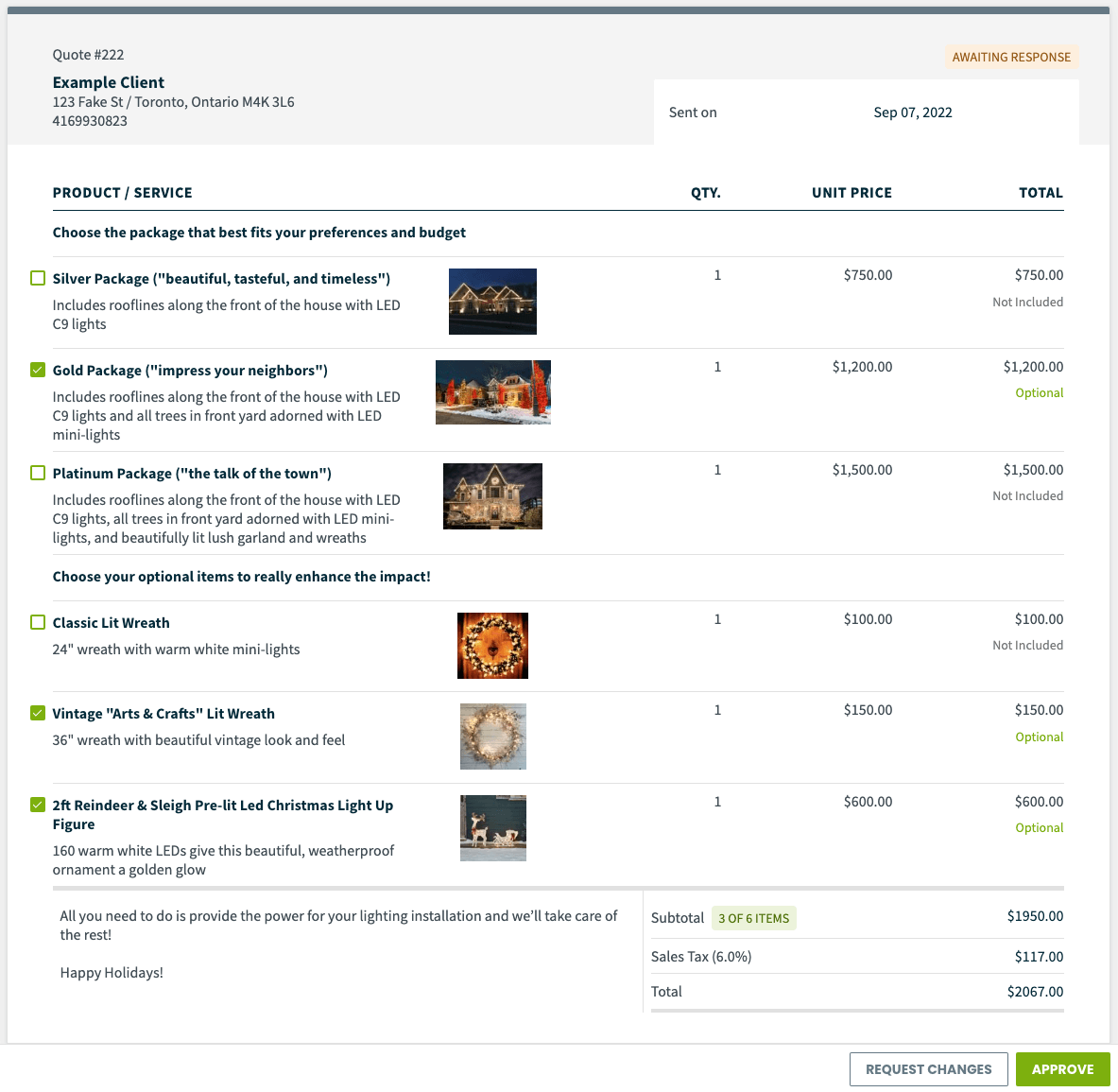
- Create a detailed estimate using job quoting software like Jobber. Include details about the lights you’ll use, installation areas, takedown, and storage. Itemized quotes with optional line items help customers compare bids and understand the value you offer.
- Use templates to save time and quote consistently throughout the holiday season. A free estimate template speeds up the bidding process by helping you create a professional-looking estimate in minutes.
- Offer financing on larger lighting installation jobs. Jobber’s Wisetack integration lets you include financing details directly in your quote. This spreads out customer costs over several months while ensuring you get paid as soon as the job’s done.
- Set clear terms and timelines. Include details about payment terms and conditions, deposit amounts, installation dates, takedown schedule, and warranty or maintenance policies. Clear expectations reduce misunderstandings later.
- Send the bid quickly. Aim to send bids within 24–48 hours of your site visit or quote request. During peak season, customers often contact multiple installers at once, so respond fast to improve your chances of winning the job.
- Follow up with the customer. If you haven’t heard back after a day or two, send a short and polite message asking if they have any questions or need help comparing options. Too busy? Jobber automatically sends quote follow-ups to customers so you don’t have to.
Pro Tip: Unsure how to politely yet effectively follow up with the customer? Use Jobber’s built-in follow-up templates or prompt Jobber AI to write your follow-up emails for you.
Pro tips for winning more bids
If you want to run a successful holiday light installation business, your pricing is only part of the equation. Use these tips to stand out from competitors and close more jobs this season.
Know your audience and pick the right jobs
Before bidding on a job, make sure the project aligns with your business capabilities and goals. Consider your current resources, such as your experience level, equipment, and team size.
Here are some of the different types of properties where you’ll want to consider installing Christmas lights:
| Project Type | Description | Pros | Cons |
| Residential | Homeowners looking for lighting displays without the hassle of doing it themselves | Smaller, manageable projects are great for beginners without much equipment | Tighter deadlines, as many homeowners want lights up around Thanksgiving |
| Luxury Residential | Mansions, estate homes, penthouses, gated communities, and vacation homes | Willing to invest large budgets to create impressive displays | Requires more time for intricate designs and investment in labor and materials |
| Commercial | Larger-scale projects for offices, hotels, and shopping centers | Opportunity for premium pricing with more profit potential | Requires more planning and a larger investment in labor and materials |
| Government | Municipalities wanting lighting in public parks and downtown areas | Lucrative contracts with high visibility that help build your business’s reputation | May need specialized insurance, equipment, or certifications to complete the job |
Choose the right pricing model
Before bidding on a job, it’s important to understand the different models you can use to price your Christmas light installation services. This can help you win more jobs and maximize your profits.
As a Christmas light installer, you can either sell or lease the lights to your customers.
- The selling model is a hands-off approach. Once the lights are installed, the customer is responsible for maintaining and replacing them. This saves you teardown time each year, but you also don’t win recurring annual jobs.
- With the leasing model, you’re responsible for installing, maintaining, dismantling, and storing all lighting and accessories. This model also gives your customers greater flexibility in their holiday lighting designs and helps you land repeat work.
When deciding between leasing and selling, consider what is best for your business and the clients you’re targeting.
Homeowners might prefer the flexibility of buying their own lights and leaning on you for the holiday light installation, while businesses may prefer the hassle-free experience of leasing.
READ MORE: Service pricing strategies for your business
Track material prices each season
Suppliers often change prices before the holidays. Update your pricing sheet regularly to stay competitive and protect your margins.
To get the best deals, and if you have storage for it, buy inventory at the end of the festive season. Most vendors offer preorders in February to get an accurate count of what they’ll be selling next season.
If you can pay lower prices, you can charge customers less—and win more jobs compared to higher-priced competitors.
On the other hand, the closer it gets to Christmas, the more you’ll pay and likely have to deduct from your profits.
Provide amazing customer service
The holiday lighting industry has a short season but high competition. Your customer service needs to be next-level if you want a profitable winter. Try service tips like the ones below:
- Return any customer calls or messages promptly
- Use a field service CRM to keep track of customer information
- Provide an online portal where customers can approve quotes and pay invoices
- Keep customers informed with automated reminders and follow-ups
- Ask for feedback once the job is complete (and automatically request a review)
With clear pricing, accurate estimates, and consistent communication, you can bid confidently and run a profitable and professional installation business.