HVAC Social Media: Post Ideas, Marketing Strategy & Tips for More Leads

Key takeaways:
Mastering social media is a powerful way for HVAC businesses to boost visibility, build trust, and generate more leads.
- Develop a focused social media strategy. Set clear, trackable goals—like increasing bookings or building local awareness—and tailor your posts to support those objectives, using consistent calls to action.
- Know your audience and create relevant content. Adapt your messaging to match your primary clients (residential or commercial), incorporate seasonal topics, and use content pillars such as maintenance tips, before-and-after photos, team highlights, and community involvement.
- Choose the right platforms and maintain consistency. Focus on platforms where your ideal customers spend time (like Facebook, Instagram, X, LinkedIn, YouTube, or TikTok) and keep your branding, tone, and visual style consistent across all channels.
- Plan ahead and prioritize authenticity. Use a simple content calendar, regularly share real jobsite photos and videos, and schedule posts to stay active even during busy weeks. Authentic, helpful posts drive more engagement and trust.
- Monitor performance and iterate. Track the metrics that matter, such as profile visits, DMs, and leads generated—not just likes. Adjust your content based on what produces real results. Consider paid ads to expand reach when organic posts aren’t enough.
Stay up to date with proven marketing strategies and actionable tips for your business—sign up for the Jobber Newsletter.
Social media can be an incredibly effective way to promote your HVAC business—and it’s easy to do it yourself from the front seat of your truck.
With regular posting on the best social media platforms, you can grow your online presence, reach new customers, build brand awareness, and get more visitors to your website.
In this guide, we’ll help you create your HVAC social media strategy, including post ideas, recommendations for social media platforms, and tips for using them effectively.
Kickstart your HVAC social media marketing:
Why HVAC social media marketing matters
Nearly 7 in 10 homeowners research contractors online before hiring. So, your social media presence can influence customer trust before they ever call you.
Using social media is a popular and inexpensive way to:
- Stay competitive locally. Most of your competitors are already on social media. If you want your customers to know about your HVAC business, you need to be on social media, too.
- Build authority before the first call. You know a lot about HVAC, and your customers should be aware. Social media is a great way to share content that presents you as an industry expert.
- Showcase your work. Social media lets you share before-and-after photos of your work, even to people who have never heard of your HVAC business before. This is a simple way to show the services you offer and the quality of your work.
- Provide customer service. Your target audience (that is, your ideal customers) could comment on your posts or send DMs with questions about your services. Respond to show them—and anyone else who sees their comments—that you can meet their needs.
- Drive website traffic and quote requests. Some of your HVAC social media posts should encourage followers to take an action on your website, like requesting a quote or booking a free consultation. This will help you get more site visitors and turn them into potential customers.
- Support local SEO with an active online presence. Posting regularly and keeping your profiles up to date supports your broader local marketing efforts. While social media activity isn’t a direct Google ranking factor for HVAC SEO, an active profile can help more people discover or search for your company and drive traffic to your website.
[A study] found that it takes seven impressions for someone to know your business and to trust you. That’s seven times that they have to see your brand.
And if you’re relying on Google search, 87% of people go to Google to find people, and they’re searching for “HVAC repair near me.”
How to build an HVAC social media marketing strategy
If you want social media to bring in more HVAC service calls and quote requests, you need a simple plan that fits the way your business already operates.
The good news is, you don’t need a marketing department or hours of free time each week. By focusing on the customers you serve and creating a few repeatable content categories, you can build a system that keeps your business visible.
Here’s how to create a practical social media marketing for HVAC strategy that helps turn your day-to-day work into content that generates HVAC leads.
1. Set clear goals
Some HVAC companies post on social media because they know they should. A photo goes up after an install or a seasonal reminder is shared. And then nothing happens. Without a clear goal, social media turns into another task that eats up time.
Before you post anything, decide what social media success looks like for your business. Pick one or two priorities for the next quarter and create content that supports those. Your goals might be to:
- Generate more inbound service calls through direct messages, phone calls, or website visits.
- Fill the schedule during slower shoulder seasons.
- Increase signups for a HVAC maintenance plan.
- Build a local audience you can retarget later with paid social ads.
Then match those goals to metrics you can track, such as:
| Goal | What to measure |
|---|---|
| Book more jobs | Phone calls, contact form submissions, direct messages, booked appointments |
| Increase local awareness | Profile visits, local reach, follower growth, website clicks |
| Build trust | Customer reviews, comments, post shares, saved posts |
Finally, give people a next step. Not every post should be a sales pitch, but most should tell people what to do next. For example, try simple CTAs like “Message us to book your AC tune-up” or “Call today before the next heat wave.”
I’m part of this local Facebook group … there were five posts from one HVAC company, and they were just asking for the sale. You can’t do that.
Learn your audience and see what people are resonating with.

2. Know your audience and service area
The best posts don’t try to speak to everyone. They speak to your ideal customers. Generic tips about changing filters or staying comfortable are easy to scroll past. Posts that reflect your customers’ problems and the neighborhoods you serve are more likely to turn into calls.
If you mainly do residential HVAC work, focus on what they care about most, like:
- Fast repairs when the system stops working
- Seasonal maintenance reminders
- Straightforward pricing and financing options
- Simple explanations that help them make confident decisions
If commercial work is a big part of your business, shift the conversation. Property managers and facility teams care more about keeping buildings running. Talk about:
- Preventative maintenance
- System reliability
- Compliance requirements
- Reducing tenant complaints
That difference in content should show up in your posts. For example:
| Audience | Messaging |
|---|---|
| Residential | Your AC shouldn’t have to run all day just to reach 72 degrees. Here’s what to look at in your AC system. |
| Commercial | Here’s how regular rooftop unit maintenance helps property managers avoid emergency calls during peak summer heat. |
Your content should also change with the seasons. Homeowners don’t think about their HVAC system the same way in April as they do in January, so your posts shouldn’t sound the same all year, either.
Matching your content to the season makes it more relevant when people are actively thinking about their heating or cooling system. Here’s how that seasonal content could look:
- Spring: Shift your focus to AC tune-ups and cooling system inspections.
- Summer: Transition to emergency AC repairs and poor cooling performance.
- Fall: Start talking about furnace inspections and heating maintenance.
- Winter: Prioritize no-heat emergencies and tips for saving energy.
3. Choose your content pillars
One reason HVAC companies stop posting is because they run out of ideas. That’s where content pillars come in.
Content pillars are repeatable categories you cycle through every week. Instead of wondering what to post, you’ll already have a handful of topics to pull from.
A simple strategy is to build your content around 4–6 core pillars, such as:
- Maintenance tips: Share practical advice homeowners can use to keep their HVAC systems running efficiently.
- Before-and-after: Highlight installations, repairs, ductwork replacements, or equipment cleanups with photos that show the difference.
- Team culture: Introduce technicians, share a day in the life, celebrate certifications, or post hiring updates so customers can get to know the people behind your business.
- Promotions: Feature seasonal tune-up specials, financing options, rebates, or maintenance plan offers when they’re most relevant.
- Customer proof: Turn five-star reviews and successful job stories into posts that build credibility.
- Community involvement: Share local events, partnerships with nearby businesses, sponsorships, or volunteer work to show you’re invested in the community.
Once you’ve picked your pillars, rotate them instead of posting whatever comes to mind that day. One week might look like this:
| Post number | Day of the week | Pillar | Topic |
|---|---|---|---|
| 1 | Tuesday | Maintenance tips | A spring AC maintenance tip |
| 2 | Thursday | Before-and-after jobs | Before-and-after photos from a system replacement |
| 3 | Saturday | Customer proof | A recent customer review or a reminder about your maintenance plan |
4. Pick the right platforms
You don’t need to sign up for every social media platform. Just focus on one or two platforms where your target audience spends their time. For example:
- Commercial HVAC businesses might find the best success on LinkedIn.
- If you’re targeting a younger audience, TikTok could be your best bet.
- Community Facebook groups are a great place to reach new residential customers.
Below are some of the most popular social media platforms where you can reach your current and ideal customers. Figure out which one(s) your target audience is using and sign up for an account.
- Facebook isn’t just for posting status updates and messaging friends. You can create an HVAC business Facebook page and connect with your customers on one of their favorite social media networks. Create HVAC Facebook posts to share photos of your work, links to your most recent blog articles, and five-star reviews from happy customers. Customers can also message you to request a quote or other information.
- Instagram is a visual platform that focuses on photo and video (Instagram Reel) posts. Users can tag their content with hashtags, allowing other users to find content that’s relevant to their interests. You can create your own visual posts and use at least one relevant hashtag (like #hvacbusiness or #hvactechnician) to attract followers who are interested in your HVAC content.
We were an early adopter to being an online presence with Instagram.
At first we got made fun of. [But] now people are like, “Wow, this company’s doing great—how do we do more like that?”

- TikTok is a video platform where users can share videos about popular topics, trends, and challenges. It’s designed for a younger audience, but videos are shared across other social media platforms like Facebook, too. Videos are on the shorter side but can be up to an hour in length. You can provide everything from helpful how-to guides and demos to day-in-the-life content that shows your personality and engages your followers.
- LinkedIn is a social media network designed to help professionals connect with each other across various industries, including HVAC. You can also post content that positions you as an industry expert. This platform can help achieve your business goals, whether you want to reach more commercial HVAC customers or simply network with other local business owners.
- YouTube could be a great fit for an HVAC social media account if you have the time and skills to create video content. You can show off your business, work, and team in a quick visual format. This is also a great way to share DIY content showing followers how to complete HVAC maintenance tasks. As a bonus, all YouTube content can be shared on your other social media pages to help you gain followers on those platforms.
- X, formerly known as Twitter, allows you to share short 280-character posts with your followers. You can talk about your HVAC brand and services or share timely content about current promos and industry news. The character limit can be a challenge, but you can always tell followers to click a link to a page or article on your website for more information.
Most of these platforms also allow you to run targeted HVAC ads with any budget. A paid social media campaign lets you reach your ideal customers with your post content, based on criteria like their age and location.
5. Create a simple content calendar
For most HVAC companies, posting two or three times a week is enough to stay visible in the local market. The goal is to make posting part of the workday.
The easiest content is usually capturing your projects in the field. Instead of trying to stage a shoot, document the work you’re doing anyway:
- Take two or three photos during every job—before, during, and after.
- Record a 30-second video explaining what you’re repairing or installing.
- Film a short talking-head clip between service calls to answer common customer questions.
- Take multiple video clips of different things at each job site so you can create more than one post at a time.
It’s also smart to think a few weeks ahead. HVAC marketing follows the seasons, so your content should too. Before demand picks up, have a few posts ready to go. For example:
| Season | Months | Content idea |
|---|---|---|
| Spring | March through May | AC tune-ups, spring maintenance, and reminders to beat the summer rush |
| Fall | September through November | Furnace inspections, heating maintenance, and safety checks |
| All | Every month | Filter change reminders, maintenance tips, or energy-saving advice that are relevant year-round |
Social media visibility is hard to keep up when you’re running jobs all day. Social Posting brings your Facebook page and Google Business Profile into Jobber so you can create and publish content without leaving the platform.
When you create a post, Jobber AI can help generate content from your ideas. Tell it which service you want to promote or a message you want to share, and the AI drafts a post for you.
Educational and seasonal posts
Educational content helps you become a trusted resource before a homeowner ever needs to hire you. It could include:
1. Contests and giveaways (e.g., free furnace maintenance, local business gift card)
2. Holiday posts reminding followers to take advantage of seasonal services (e.g., AC repair, furnace maintenance)
3. How solar heating systems work and what benefits they provide
4. How to clean your HVAC system
5. How to control different types of thermostats
6. How and when to replace a furnace filter
7. Information about charitable causes you support (e.g., kids’ sports, veterans’ groups)
8. Inspirational quotes about work and entrepreneurship
9. The pros and cons of gas vs electric heating
10. Tips for greater energy efficiency in homes and businesses
11. What time of year to turn on your furnace
12. When to replace your HVAC system
Proof-of-work and trust posts
People want proof that you can solve their problem before they invite you into their home or business. To provide that proof, you could post:
13. A list of all the HVAC services you provide to customers
14. Before-and-after photos of your work
15. Educational content and infographics about HVAC systems to explain them to customers
16. How to tell whether an HVAC company is doing a good job
17. Photos from community events that you’re sponsoring or volunteering at
18. Reviews and testimonials from satisfied customers
Team and culture posts
Customers hire the people behind it. These types of team-focused posts can put faces to your brand and make your business feel more approachable:
19. Business news and milestones (e.g., 10th year in business, industry awards)
20. Day-in-the-life content showcasing your employees
21. Employee quotes about your HVAC business and services
22. Introductions to each of your team members
23. Job postings when you’re hiring for new positions
24. Photos of company events (e.g., lunch breaks, holiday parties)
Promotions, contests, and community posts
Promotions, giveaways, and community updates give followers a reason to engage with your business, including:
25. Contests and giveaways (e.g., free furnace maintenance, local business gift card)
26. Information about charitable causes you support (e.g., kids’ sports, veterans’ groups)
27. Posts cheering on local sports teams
28. Seasonal promotions and special limited-time discounts
29. Short summaries of your HVAC blog content with links to the full articles
Fun and engaging posts
A little personality goes a long way. Mixing in lighter content posts like these can help your business feel more relatable:
30. Company background information (e.g., explaining your HVAC company name, outlining the company’s history, describing what sets the business apart from competitors)
31. HVAC industry trends, news, and events (especially any trade shows or conferences you attend)
32. Inspirational quotes about work and entrepreneurship
33. Memes about HVAC systems that your customers can easily understand
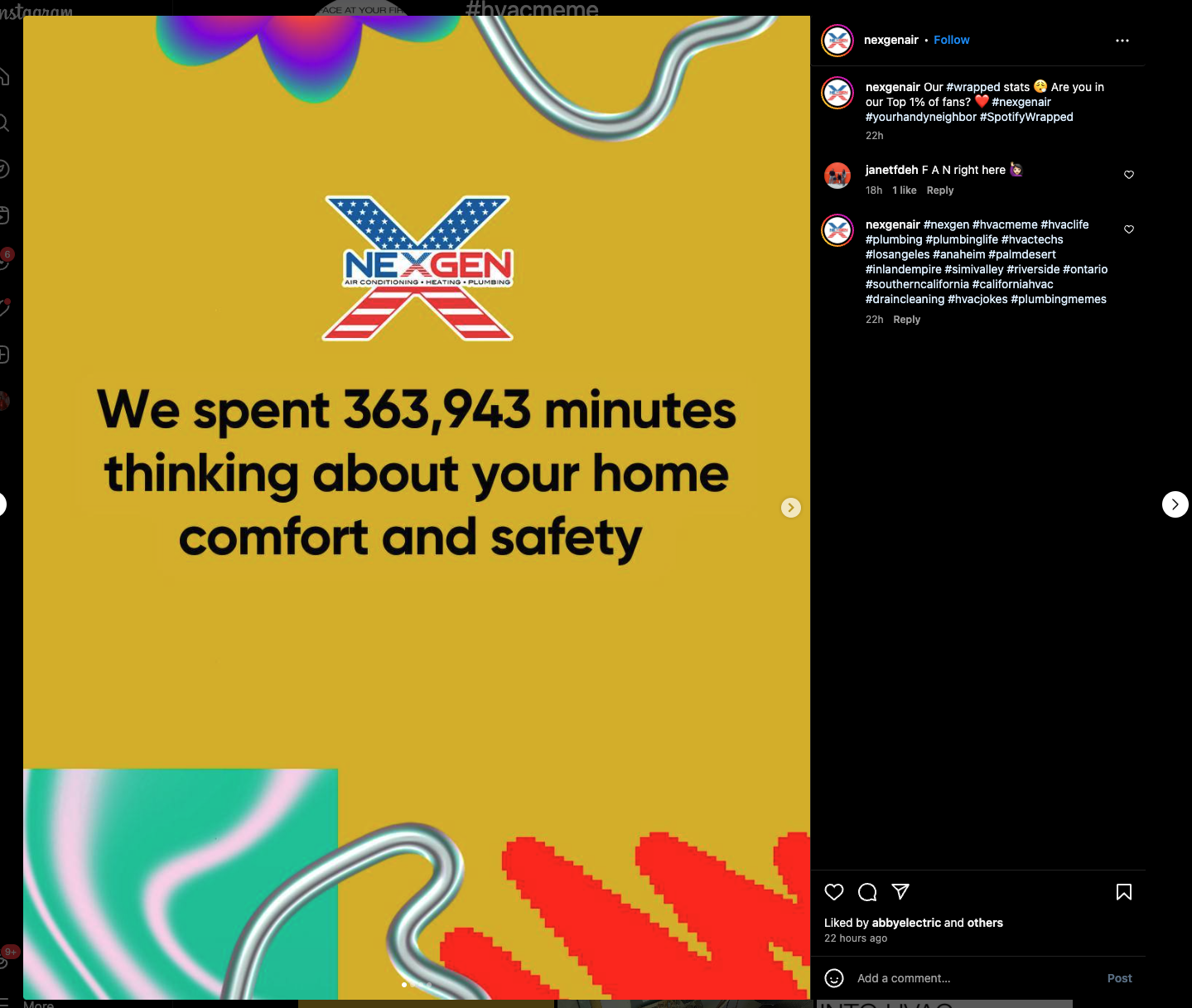
In this example, NexGen Air made their own version of the annual Spotify Wrapped slideshow, which feels familiar to many customers:
HVAC Facebook post ideas
Facebook remains one of the best platforms for reaching local homeowners and building community trust through posts like:
34. Screenshots of 5-star reviews with a short caption explaining the problem, your response time, and the result
35. A photo and one-sentence explanation of what you fixed that day
36. Location-specific promotions with a clear call to message or call. For example, “This week only: AC tune-ups in [city]”
37. An invitation to followers to drop a question in the comments and reply to each one to drive engagement and trust
38. Polls to spark interaction and guide future content topics
39. Non-sales advice and tips in local Facebook groups (only mentioning your business when it’s relevant to the conversation)
40. Photos from community events, sponsorships, or volunteer work (tagging the organizations to expand local reach)
Instagram and short-video post ideas
Instagram rewards visual content, making it a natural fit for HVAC companies with plenty of jobsite photos and videos. You can turn that footage into:
41. Before-and-after reels of installs or repairs using quick cuts to highlight improvements
42. 30-second reels sharing one simple maintenance tip that homeowners can immediately act on
43. Filter change demos that show dirty vs. clean filters and how often they should be replaced
44. Answers to real customer FAQs on camera in under 60 seconds
45. Recurring myth vs. fact posts that correct common HVAC misconceptions
46. Time-sensitive promo reels (e.g., limited tune-up slots) with a direct call to DM or book
47. Maintenance plan explainers that outline what’s included and why it saves money over time
48. Behind-the-scenes “day on the job” videos combining a few clips from one service call
49. Tour of your HVAC van to show you’re organized and equipped for any job
50. Heat pump explainer that demonstrates what it does and how the system works
This Instagram Story by Lennox Air promotes an air purifier with a simple, enticing description, along with a CTA that doubles as a link to their company website:
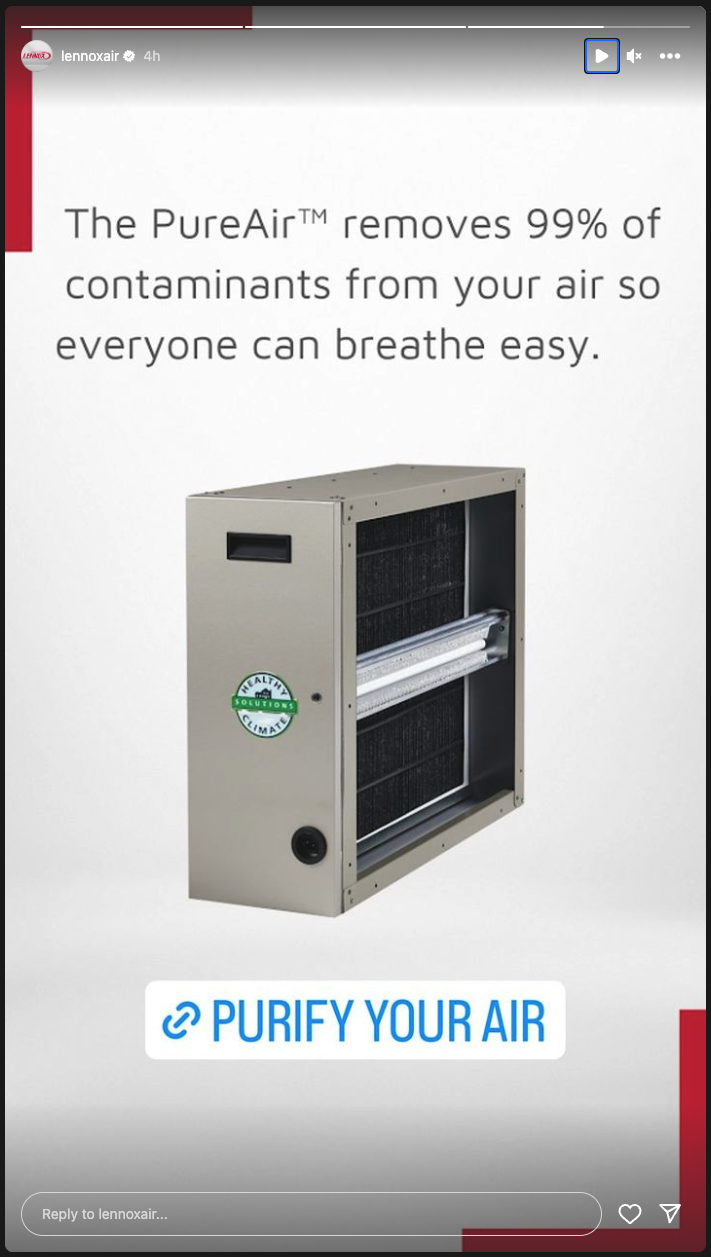
Make sure to include a CTA and a link to your HVAC website whenever possible. This tells your followers what to do next and can encourage them to contact you for HVAC services.
Just 45 minutes, once a week, is all you need to win on social media. Watch or listen to this episode of Masters of Home Service to see how home service businesses can use social media to attract real, paying customers:
Best practices for HVAC social media posting
New to promoting your business on social media? Not to worry—follow these tips and you’ll be posting like a pro in no time.
1. Plan content in advance
You may not have time to post on social media very often. That’s okay—sit down once a month and create a handful of posts for the coming weeks in a design tool like Canva. Then you can schedule them using a social media scheduling tool like Hootsuite.
If you add a few more unplanned posts during the month, great! But at least you’ve already done the heavy lifting and created most of your posts ahead of time.
2. Use consistent branding
Your social media should look and sound like the same company that customers see on your service trucks and invoices. When someone scrolls past one of your posts, they should recognize your HVAC company right away.
Start with the basics. Use the same logo, brand colors, profile photo, and cover image across every platform. It should match your physical marketing, too, like your truck wraps, door hangers, and uniforms. That consistency makes your business easier to recognize.
Your messaging matters just as much as your visuals. If you promise fast service and reliable workmanship, those qualities should come through in every post. The way you write captions, respond to comments, and answer messages shapes how people see your business.
It also helps to standardize the small details. For example:
- Use the same CTA at the end of similar posts (e.g., “Call us today to schedule service” or “Book online in minutes”).
- Stick to a consistent writing style instead of sounding formal one day and overly casual the next.
- Add your logo to before-and-after photos or short videos when it makes sense. That way, your work is still recognizable if it gets shared.
3. Prioritize photo and video quality
You don’t necessarily need an expensive camera or a professional videographer to create content. A lot of successful posts from local contractors are filmed on a smartphone. What matters is that people can clearly see your work.
Take photos in good lighting. If you’re working in a dark mechanical room or basement, turn on additional lights or use your phone’s flashlight. Customers want to see the quality of your work, and a dark, grainy image doesn’t help.
For before-and-after photos, try to take both shots from the same angle so the improvement is easy to compare. And before you take pictures, move any boxes, packaging, or old parts out of the frame—it only takes a few seconds, and it’ll make the finished job look more professional.
The same ideas apply to video. Keep your phone steady, record short clips, and explain what’s happening in a way that customers can understand. If possible, avoid any loud background noise when you’re talking on camera.
4. Respond to comments, reviews, and DMs quickly
A quick, helpful response can turn a question into a booked service call. A slow reply, on the other hand, may send someone to the next HVAC company on their list.
Aim to respond to comments, direct messages, and reviews within 24 hours. If someone has an emergency, they’ll probably call instead of sending a Facebook message. But for quote requests or general inquiries, a timely response shows your business is attentive.
For simple comments, a brief reply is often enough. If someone asks about your service area or financing options, answer the question publicly. That way, other homeowners who come across the post can benefit from the same information.
Not every conversation belongs in the comments, though. If someone has an issue or wants to discuss the details of a specific job, move the conversation to a private message or phone call by saying, “We’re sorry to hear that. We’ll send you a DM so we can make it right.”
5. Avoid sensitive topics
You want your social media content to be as relevant and appealing to your followers as possible. This means avoiding topics that could upset any of your customers, like politics or religion.
6. Use hashtags and location tags strategically
Hashtags can help people discover your posts, but only if they’re relevant. Adding generic hashtags like #hvac, #contractor, or #homeservices usually doesn’t do much for a local business. You’re not trying to reach everyone in the world who’s interested in these topics.
Instead, focus on hashtags that match your service area and the work you’re doing. Consider descriptors like city names, neighborhoods, and your specific HVAC services.
For example, if you’re replacing an air conditioner in Miami, tags related to Miami, air conditioning, or heat pumps are much more useful than broad industry hashtags.
Location tags are just as important. When you post from a jobsite, tag the city or neighborhood. A caption like “Wrapping up an AC replacement in South Beach” shows you’re active in that community and helps your content feel relevant to customers who live nearby.
7. Promote your profiles on every customer touchpoint
Mention your social media handles on all your HVAC marketing materials, including your website, business cards, email marketing, flyers, and door hangers.
This will help your ideal customers find you online on the platforms that are most relevant to them, which will help attract and secure more HVAC leads.
8. When to delegate or hire help
If you don’t have time to post consistently or aren’t getting engagement or leads, it might be time to share the responsibility. Some HVAC companies do their own content creation while getting help with the parts that slow them down.
Your techs are already in the best position to capture content. They’re on-site, seeing the work, fixing the problem, and talking to customers. A couple photos or short videos of the job provide raw material to start with.
You might find you just need help writing captions, posting consistently, and keeping track of what gets the best engagement. If you don’t have time for HVAC social media management, hire a virtual assistant, digital marketing intern, or other support person to help.
Paid social media for HVAC companies
Organic posts are a good start for HVAC social media, but sometimes they need a push to reach the right audience. Paid social media helps expand the visibility of your business beyond your existing followers.
Paid social is about showing up in front of local customers who are already thinking about repairs, replacements, or seasonal maintenance.
When organic isn’t enough
Posting organically is great for building familiarity and keeping your HVAC company visible while people scroll and eventually decide who to call. But organic posts alone aren’t enough when competitors are posting similar content. That’s where paid social media advertising can help.
Start by boosting posts that already work. If a before-and-after install post gets strong engagement, for example, that’s usually worth amplifying. Boosting puts your real field work in front of more people who may not follow you yet but could be dealing with HVAC problems.
You can also layer in simple seasonal campaigns that match how demand moves:
- Spring: AC tune-ups, system prep, and reminders to beat the summer rush
- Summer: Emergency cooling repair and fast-response messaging
- Fall: Furnace inspections, safety checks, and maintenance plans
- Winter: No-heat service calls and upgrades for efficiency
Take the content that actually gets traction on platforms. Run ads with that content to a local audience [and] set up the exact zip codes that you want to see.
Test your content for virality, interaction, engagement on organic. It’s free. Then take the content and run ads on it targeted to your actual audience because you know that it’s going to get in front of their eyeballs.
Budget starting points
You don’t need a big ad budget to get traction with HVAC social ads. As a small shop, you could start with $100–$200 ($500 max per month) and still see value. Rather than trying to flood everyone’s feed, you just want to show up consistently to the right people in the right moments.
Stick to a 10- to 20-mile radius around your service area and narrow your audience to homeowners whenever the platform allows it. That filtering helps you avoid wasting money on people outside your service zone, as well as renters who aren’t making HVAC decisions.
Ad creative that works for HVAC
HVAC ads that perform well usually don’t look like ads—they look like real work from the field. You’ll probably find that real jobsite photos tend to beat polished graphics.
People want proof that you do good work. So, if your ad creative feels like something your tech just snapped between calls, you’re on the right track.
Pair that real-world visual with one clear offer and don’t overthink it. Something like “$79 AC Tune-Up” or “Free Second Opinion on Replacement Quotes” works because it’s direct and easy to understand.
Then add a straightforward CTA like “Call Now” or “Message Us to Book.” A homeowner scrolling Facebook should know in two seconds what you do and what step to take next. If they have to pause to figure things out, you’ll lose them.
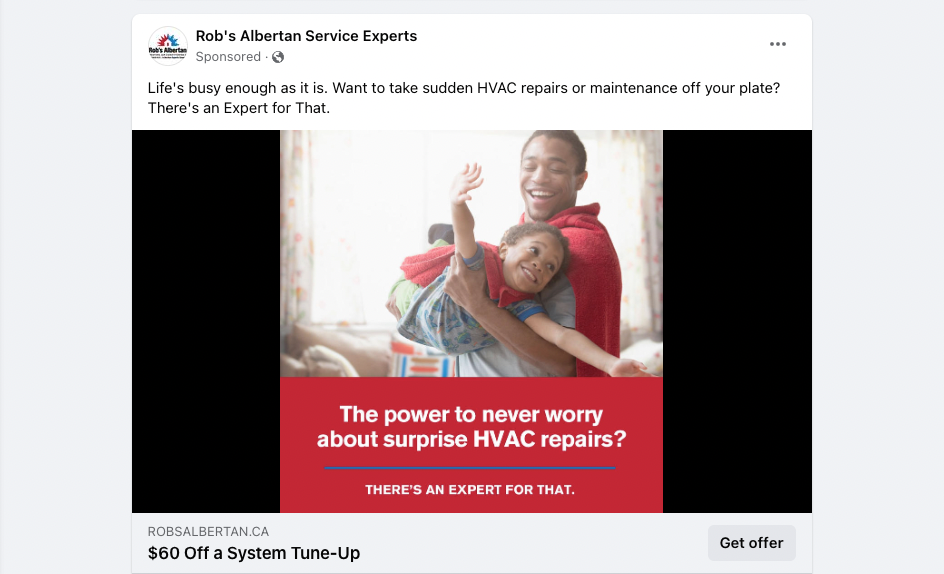
Here’s an example of a Rob’s Albertan Facebook ad that clearly explains the company’s services, the promo they’re offering, and what the reader should do next:
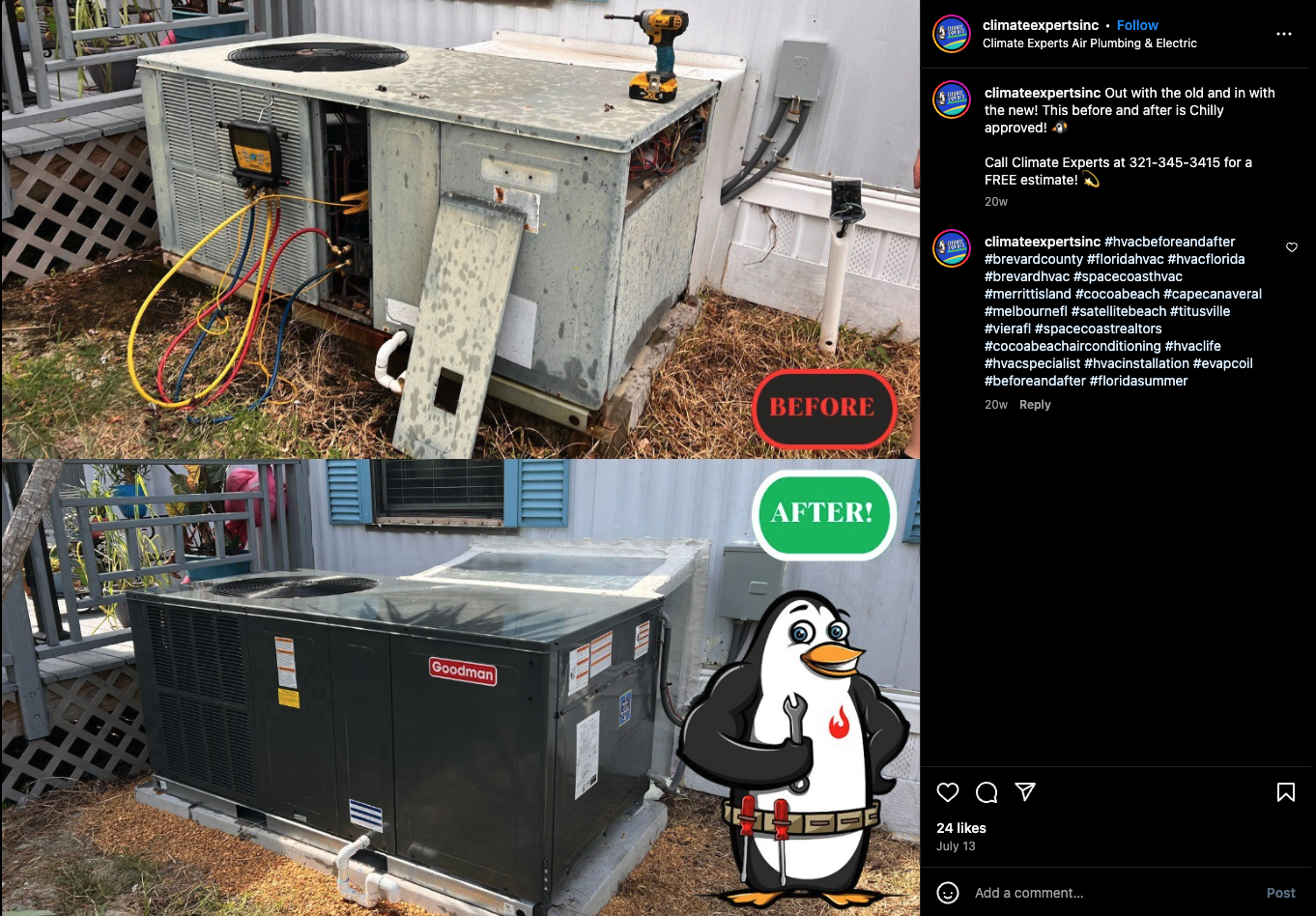
In this Instagram example, Climate Experts Inc. uses a single image to show a before-and-after comparison of a heat pump replacement, including a CTA and phone number:
How to measure HVAC social media performance
Posting without checking results is a bit like servicing a system without taking readings. A few signals can tell you whether your efforts are turning into real leads and steady visibility.
Here’s how to figure out what’s bringing in calls and jobs:
Metrics that matter
Likes and follows won’t keep you in business. A ton of likes on an AC install post feels good, but what really matters is whether that post leads to someone calling. Instead of chasing surface-level engagement, focus on signals that connect back to revenue, like:
- Reach: This tells you how many people are seeing your content. If your reach is low, try different post types or posting times to see what gets your business in front of more homeowners.
- Engagement: Comments, shares, and reactions show which posts are getting attention. Look for patterns and create more of the content that gets people to engage.
- Profile visits: These indicate that someone is interested enough to learn about your business. Watch which posts drive the most profile visits, then use similar topics or formats for future posts.
- DMs, phone calls, and form submissions: Those are your leads. Over time, pay attention to which types of posts drive those actions. Then start leaning into the content that actually brings in service work.
I could post something, and I get a like and a comment. Is this going to actually get business for me? And I’m just doing things to post, but is it actually generating customers and leads?
Simple ROI mindset
You don’t need complicated dashboards to figure out whether social media is paying off or not. Is the time or money you’ve invested turning into calls or booked jobs? If not, something is probably off with your approach.
If you boost a post for $50 and it leads to one or two service calls, that can be a win depending on your average job size.
The same goes for organic posting. If a few hours a week of sharing photos and videos leads to a steady flow of inquiries, that’s a social channel worth keeping.
The mindset is simple—treat social media like you would any other part of the business. If it brings in profitable work, keep at it. If it doesn’t, try tweaking the message or targeting until it does.
Ideally you would want to shoot for 5x return. You spend a thousand dollars, you get $5,000.
Return on marketing spend doesn’t necessarily mean today or tomorrow. It could be a month from now. It’s a long game.

Social media performance tools
Most HVAC companies don’t need anything fancy to track how social media is performing. The built-in tools inside platforms like Facebook and Instagram are usually more than enough.
Meta Business Suite, for example, gives you a clear snapshot of reach, engagement, and message activity in one place. You could even check it between service calls.
If you want a bit more structure, simple scheduling tools can help you stay consistent and keep posts from slipping through the cracks during busy weeks. Whether you use a planner or a tool to schedule ahead, the important takeaway is to learn what’s working.
Tools like Jobber’s Social Posting make it easy to create posts in advance, then publish to your Facebook page and Google Business Profile from a single place.
Social media can bring in new leads, but it takes more than publishing the occasional post. Watch or listen to this episode of Masters of Home Service to see how to turn your followers into paying customers—without having to spend all day online.
Originally published on December 20, 2024. Last updated on July 16, 2026.
Frequently Asked Questions
-
Whether you choose to spend your time on Instagram, Facebook, or another platform, , here are some ideas for posts to show your team is knowledgeable and reliable:
• Photos of your techs at the jobsite
• Before-and-after images of installs
• Advice videos that help homeowners solve simple HVAC problems
• Short videos showing your typical workday
• Relatable memes to show your sense of humor
Whatever social platform you’re using, create posts regularly so potential customers can see you’re active and available. Keep it local and focus on the problems your customers call you about. -
Posting 2–3 times per week on social media is usually enough to prove your business is active. Consistency matters more than volume, and steady visibility will keep you top of mind when HVAC issues pop up for homeowners.
-
Facebook is usually the strongest for residential leads, with Instagram close behind for visual job content. LinkedIn works well for commercial HVAC businesses that target property managers and facility teams.
-
Post real jobsite content and use clear calls to action (like “Call now” or “Message to book”) so people know what the next step is.
Be consistent with the frequency of your posts and focus on homeowners in the areas you serve. For posts with good engagement, consider boosting those and track which ones lead to calls or DMs. Then repeat what works.
You can also run social media ads to get more leads. LinkedIn, Instagram, and Facebook ads let you target ideal customers, control your budget, monitor results, and make quick changes.
HVAC social media post ideas (50 examples)
There are many kinds of HVAC social media posts you can create to attract and engage with customers. The key is to create engaging content that is relevant to your followers and will get them to like, share, and subscribe.
Here are some HVAC post ideas to get you started: