Landscaping Services List: from Lawn Care to Hardscapes [+ Free Download]

Key takeaways:
A comprehensive landscaping services list helps you clearly define your offerings, streamline quoting, and boost your business’s professionalism.
- Clarify your services and pricing. Listing all your services with clear descriptions helps avoid confusion, speed up quoting, and ensures both your team and clients understand what’s included.
- Offer a wide range of services. From lawn care and planting to hardscaping, irrigation, lighting, snow removal, and seasonal decorations, diversifying your services attracts more clients and fills your schedule year-round.
- Select services that match your skills, equipment, and market demand. Focus on your crew’s strengths, consider local needs, and find a balance between recurring jobs (like lawn maintenance) and higher-ticket projects (like patios or irrigation).
- Use your list to boost upsells and efficiency. Identifying natural service add-ons and bundling packages makes quoting easier and can increase your average job revenue.
- Review and refine your lineup regularly. Adjust your offerings as your business grows and make sure each service supports healthy profit margins and year-round stability.
Want more business tips and tools delivered monthly? Sign up for the Jobber Newsletter.
A landscaping services list helps you keep track of the work you offer and record your landscaping pricing in one place.
Plus, you’ll build landscaping quotes faster—during or after the site assessment or consultation—when you don’t have to create line items from scratch.
Follow our guide to learn what lawn and landscape services your small business can provide. Then download our free list template to build an organized record of your services.
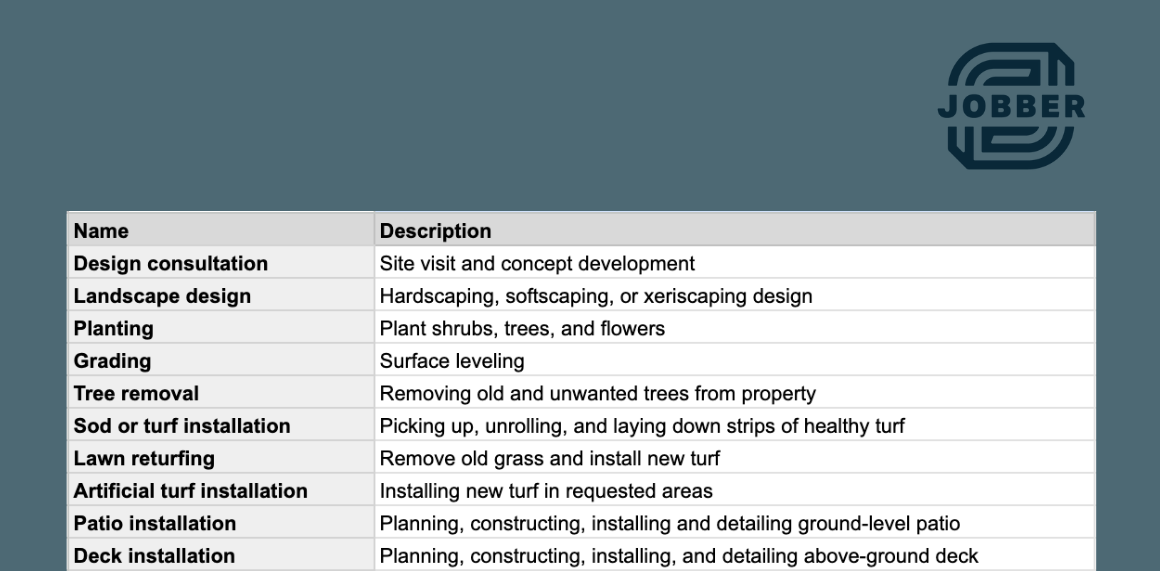
Full list of professional landscaping services:
-
Lawn care
-
Planting
-
Design consultation
-
Landscape design
-
Sod or turf installation
-
Lawn returfing
-
Artificial turf installation
-
Irrigation installation
-
Property grading
-
Tree removal
-
Patio installation
-
Path or driveway installation
-
Retaining wall installation
-
Fence installation
-
Deck installation
-
Outdoor lighting
-
Water/fire feature installation
-
Property drainage
-
Gutter cleaning
-
Snow removal
-
Seasonal decorations
Why you need a services list
A written services list pulls all the details out of your head and onto a page. It gives structure to the work you already do and makes it easier to explain your value to customers. Here’s why that list matters:
- Clarifies what you offer: Many landscaping businesses grow the way jobs come in—one neighbor asks for mowing, and another wants a patio. A clear services list forces you to define your core work and write plain-English descriptions so you’re not quoting jobs that don’t fit your crew or gear.
- Builds professionalism: Customers don’t always know the difference between landscaping and “anything outside.” An organized services list sets expectations around scope, timelines, and pricing. There are fewer awkward conversations later.
- Simplifies quoting and pricing: When each service has a defined scope, estimates stop feeling like guesswork. You can quote faster and your numbers stay consistent. There’s less back-and-forth.
- Helps you spot bundles and upsells: When you see your services side by side, patterns may jump out. For example, lawn maintenance pairs naturally with irrigation checks. Upsells are logical add-ons that some customers already expect.
- Shows gaps and expansion opportunities: Maybe drainage or lighting keeps popping up, but isn’t a formalized service you offer yet. Or maybe you’re offering too much without the right crew or equipment. Either way, the services list becomes a planning tool.
- Keeps your crew on the same page: Clear service descriptions help both the customer and your team. Everyone knows what a spring cleanup will include and how long it should take. There’s less confusion, and handoffs become smoother.
- Strengthens your website and marketing: A services list on your website with all the details helps to boost search visibility when people search for specific services in your area. You can also use that list in your Google Business Profile, add it to flyers, and more.
We’ve stayed pretty close on our service offerings. We mow, we mulch, we pull weeds, we trim bushes, we do leaf cleanup, and we do snow removal. And that keeps us busy year-round.

1. Lawn care
Lawn care involves maintaining a client’s grass and plants so they stay healthy. Not every landscaper provides lawn maintenance, but it can be a great way to bring in recurring revenue, and keep your crew busy all summer long.
Here are the most common lawn care services—use them when building your lawn care services list:
Routine lawn maintenance
- Lawn mowing: Cutting grass to an even height using a push or riding mower. This service is often paired with edging and blowing to clear paths. When pricing your lawn care services, you can give clients the option of one-off or weekly visits.
- Edging: This service creates clean lines between lawns and nearby pathways, garden beds, or other areas. You can offer edging alongside your lawn mowing services for a sharp, detailed look your clients will love.
- Trimming: When trees and hedges get overgrown, the outdoor space looks messy and can be hard to use. You can cut back the overgrown areas to make the space more appealing and help the client enjoy it more.
- Leaf removal: Leaves fall to the ground throughout the year, but especially in the spring and fall. You can offer a recurring seasonal leaf removal service, whether it’s raking or blowing, to keep the lawn clean and green.
- Yard cleanup: Some lawn care professionals offer yard waste removal, like fallen branches or other plant waste. This is a simple add-on service that keeps lawns looking great.
- Weed control: Regular weeding will keep weeds from growing out of control and taking over the entire space. Weeds grow fast, so you can offer hand-weeding or chemical weed control as part of your regular lawn care service.
- Mulching: Mulch is made up of organic materials like grass clippings, leaves, straw, sawdust, and wood chips. You can apply it to the soil’s surface to lock in moisture, reduce weed growth, and promote overall soil health.
Mulch, yes. It’s easy, anyone can put down mulch. So, I think that if you have the extra time or the rain day to go and do mulch, then everyone should do it.
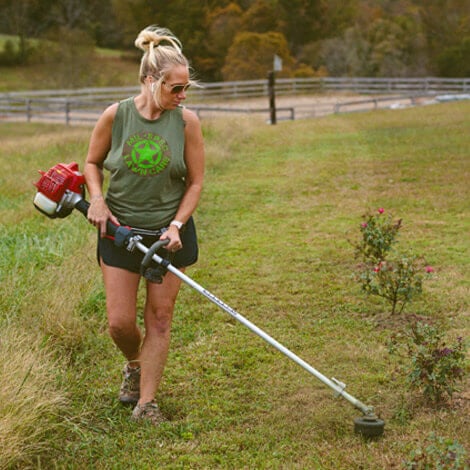
- Pruning: This service involves removing dead or infected branches, twigs, or stems from trees and plants to encourage healthy growth.
- Artificial turf maintenance: Even though it doesn’t grow, artificial turf still needs to be sprayed and maintained regularly to keep it in top condition.
- Hourly labor: Your time is the most important part of any quote. It’s usually bundled into your other services. But if you know a task will take extra time or you need another employee, add more hours for extra labor.
READ MORE: How to get your first 100 lawn care customers
Lawn health and renovation
- Fertilizing: To keep plants healthy and green, add fertilizer to a client’s soil as part of regular lawn and landscaping maintenance. Timing will depend on the season and the type of lawn, but your lawn care schedule should include spring fertilizing.
- Lawn aeration: During aeration, you’re poking small holes in the soil to keep it from compacting. This allows air, water, and other nutrients to seep in and help the roots grow. You’ll want an aerator to help you save time and do the job right.
- Overseeding: Spread new grass seed over an existing lawn without turning the soil to improve overall lawn health. This process adds color, thickens grass, and prevents weed growth. It also helps with insect damage, drought stress, and other signs of deterioration. You can offer this service alongside aeration when a lawn is looking run down.
- Dethatching: Leaves and stems collect at the base of actively growing grass, just above the soil’s surface, forming a layer called thatch. You can dethatch the lawn to help water and nutrients reach the grass’s roots more easily.
- Lawn pest control: Pests can affect a lawn’s health and make it hard to enjoy an outdoor space. Think about offering pest control services to keep insects at bay, like grubs, fire ants, and armyworms.
- Grass planting service: Create a new lawn from scratch, or improve the look and health of your client’s lawn, by grading the soil and planting new grass on it.
- Sod maintenance: If a client has a new lawn, they’ll need ongoing maintenance to ensure the sod stays put. You can provide regular watering to keep the new sod healthy.
Pro Tip: Bundle similar lawn care services together so that you can offer them to clients at a single price—think spring maintenance or fall clean-up packages. Price bundling is a great way to upsell customers and increase the overall value of individual jobs.
2. Planting
You can plant a wide range of shrubs, trees, and flowers according to specific landscape designs. You’ll need to remember the watering, sunlight, and other garden maintenance requirements of the desired plants when creating your softscape design.
Price range: $200–1,500+ for small jobs (flowers, small shrubs). Up to $5,000 for larger designs or many plants.
3. Design consultation
Consultations are a chance for you to visit the client’s site to assess the space and ask questions. You’ll then create a few rough ideas and finalize the design with the client.
Standalone design consultations can be a good fit for clients on a budget who want to do the work themselves.
Price range: $75–300, but some companies waive this if the client proceeds with a project.
4. Landscape design
Landscape design involves planning and designing outdoor living spaces before doing any digging or planting. You can offer design as a standalone service or as the first step of a larger landscaping project.
A few common landscape design services include:
- Hardscaping: This type of design incorporates the “hard” elements of an outdoor space, like brick and rock. For example, a hardscape design could include a plan for a brick patio, stone wall, or fountain. (Price range: $500–2,500 for basic designs.)
- Softscaping: Softscape covers any plants that will be included in an outdoor space, like trees, shrubs, and flowers. A client might want hedges lining their property, trees planted in specific spots, or flowerbeds laid out in a certain way. (Price range: $300–1,500 for simple bed/planting layouts.)
- Xeriscaping: An environmentally friendly landscaping method, xeriscaping involves building outdoor spaces that need little to no irrigation. Xeriscapes often have hardy, low-water plants like cacti, or are designed to collect and distribute rainfall among plants. (Price range: $800–3,000 for basic concepts.)
READ MORE: Landscaping industry stats & 2025 trends you need to know
5. Sod or turf installation
Sodding is a fast way to create an instant lawn where there wasn’t one before. It involves picking up, unrolling, and laying down strips of healthy turf (or sod), then watering heavily to help the grass take root in the soil beneath.
Price range: $1,000–3,500+ for an average yard (1,000–2,000 sq. ft.)
6. Lawn returfing
You can remove old grass that’s too damaged to save, then install new turf. Some clients might need only small areas re-turfed, while others need their lawn completely redone.
Price range: $1,200–6,000+ (or $1.50–4.00 per sq. ft.)
7. Artificial turf installation
Artificial turf is for homeowners who want an always-green lawn that never needs to be cut. It’s also a good option for areas that get little to no water.
Installing this turf is just as big a job as the natural kind. You’ll need to remove existing turf, if there is any, and lay down the new turf on top of the soil.
Price range: $4,000–15,000+ (or $8–20+ per sq. ft.)
8. Irrigation installation
Adding irrigation involves visiting the site, deciding on the best placement, and installing the system. To offer this service, you’ll need to understand how water systems work and how technology can control water flow.
Price range: Anywhere from $1,600–10,000+ for small to large properties.
9. Property grading
If a surface isn’t flat and the client wants to plant new grass, you’ll need to level the surface to prepare for planting. This can be a good add-on service if you also offer sodding or seeding.
Price range: $1,200–4,000, with simple regrading at the low end.
10. Tree removal
Some clients may want to remove trees as part of their softscape design. You can cut a tree down yourself if you’re trained to do it safely.
Price range: $200–500 for small trees. $500–2,000+ for medium to large trees.
11. Patio installation
Constructing a patio on ground level involves building a base, adding a setting bed, and laying the paving. You may also want to add services like grading, planning, and detailing for a start-to-finish experience.
Price range: $2,000–15,000+ (or $10–35 per sq. ft.)
12. Path or driveway installation
You can work with clients to plan, design, and build custom paths and driveways. This often involves paving the area with brick, concrete, bluestone, flagstone, or another hard material.
Price range: $8–25 per sq. ft. for walkways. $4–15 per sq. ft. for driveways.
Watch Tyler Dixon from Dixon & Company share his must-have landscaping tools for running a successful hardscaping business.
13. Retaining wall installation
Retaining walls support soil at an angle that it normally couldn’t maintain on its own, like for a raised garden bed. This type of installation needs planning and design to make sure the wall (and the soil) stays put.
Price range: $2,000-15,000+ (or $20–75 per sq. ft.)
14. Fence installation
Fences are posts connected by boards, wire, rails, or netting. To build a fence, you’ll meet with the client, create technical drawings, dig holes for the fence posts, set the posts in concrete, and secure the framework to the posts. You might also offer finishing work like painting or staining.
Price range: $2,000–8,000+ (or $15–40 per linear foot)
READ MORE: How to start a fencing company in 14 simple steps
15. Deck installation
Above-ground deck construction starts with an on-site consultation where you take measurements. From there, you design and plan the deck, then build the foundation and structure.
Homeowners are usually responsible for getting the right permits, but you can offer this as an added service.
Price range: $4,000–20,000+, depending on size, material, and features
16. Outdoor lighting
Outdoor lighting usually includes pathway lights, uplighting for trees or architectural features, and low-voltage accent lighting around patios and decks. It’s less about brute force and more about placement and wiring.
From a business angle, lighting pairs naturally with patios, walkways, and planting jobs. Once you have the right tools and a solid process, lighting installs can move fast.
Price range: $500–2,500 for simple packages (a few path or accent lights). Up to $7,500 for larger systems with multiple zones.
17. Water/fire feature installation
Some clients want water or fire features like fountains, waterfalls, ponds, or fire pits. This type of landscape construction service takes some specialized knowledge, but it can also provide more opportunities for your business.
Price range: $1,000–5,000 for simple, above-ground features. Up to $20,000 for custom ponds, waterfalls, or built-in fire pits.
18. Property drainage
Drainage work solves problems clients feel every time it rains, like soggy lawns or flooded flower beds. Services can include grading adjustments, French drains, catch basins, dry wells, or directing runoff away from structures. It’s not flashy work, but it earns trust.
Drainage pairs well with grading, hardscaping, and lawn repair. And once you’re known as the landscaper that fixes water issues instead of just patching them, the referrals may follow.
Price range: $1,000–4,000 for basic solutions (downspout extensions, small French drains). Up to $10,000 for larger systems or multiple runs.
19. Gutter cleaning
Gutter cleaning sits firmly in the “simple but necessary” category. Leaves and debris pile up quickly, especially in neighborhoods with lots of trees. The work usually involves clearing out the gutters, checking downspouts, and flagging any visible issues for the homeowner.
This is a low-barrier add-on that fits nicely into fall cleanups. It’s not a big-ticket job, but it strengthens client relationships and opens the door to upselling drainage fixes or seasonal maintenance plans.
Price range: $100–300, scaled by home size and height
I do gutter cleaning. Definitely not the most glamorous job, but it gets me through January. We only do it for around 4-6 weeks a year.
20. Snow removal
Snow removal is all about timing and reliability. Clients want safe, clear access when they start the day. Services may include plowing driveways, clearing walkways, and salting.
This work is highly regional, but in colder climates, it can stabilize winter revenue and help retain your crew members during the slow season.
Price range: $40–150+ for driveway/sidewalk clearing. $300–800+ for seasonal residential contracts.
READ MORE:What Do Landscapers Do in the Winter?
21. Seasonal decorations
Clients who already trust you with their property might ask you about seasonal decorations, like holiday lights, wreaths, and garlands. The service typically covers installation, takedown, and sometimes storage.
It’s a short-window service with strong margins and minimal equipment. You might even have ladders on hand already. Decorating is also a way to add a bit of fun to the schedule while still charging for skilled work.
Price range: $300–1,000+ for simple residential packages. $1,000–5,000+ for larger homes or complex commercial displays.
How to choose the right landscaping services
Choosing which services to offer is about building a lineup that fits your crew, your equipment, and the kind of customers you want to work with. The right mix keeps your crew busy and your margins healthy.
Here’s how to think through your service mix without overcomplicating it:
- Start with your strengths and real customer demand: Look at what your crew already does well and what customers ask you about most—maybe that’s weekly mowing and planting beds. Build your core services around those. Avoid chasing jobs that don’t match your equipment or schedule.
- Mix recurring work with one-off projects: Recurring services like lawn maintenance and seasonal cleanups keep cash flowing. Bigger projects (patios, fences, etc.) can pad revenue, but usually tie up your crew. A smart blend of both helps smooth out slow weeks.
- Match services to your local market: In some regions, drainage fixes and snow removal might pay your bills. In other regions, turf installs or drought-tolerant planting can drive demand. Pay attention to what nearby competitors are doing and what customers keep asking about.
- Consider your equipment and crew skills: Adding services often means new tools and training. Not everyone knows how to safely use an aerator or skid steer. So, start with work that fits what you already own and what your crew can handle confidently. Then expand as capacity allows.
I think stretching yourself too much is a mistake, because you underestimate how much tools and equipment you need to do just one more thing.

- Offer add-ons that make sense: Small extras—like edging with mowing or mulch refreshes during cleanups—add value without being overbearing. When your service descriptions spell these out clearly, an upsell feels natural.
- Focus on profit margin: Mowing may keep business steady, but higher-margin services like irrigation work or lighting can really move the needle. Track labor hours and materials so you know which services pay off.
- Think seasonally: Staggering your offerings helps you stay busy all year round. Spring planting, summer maintenance, fall leaf work, and winter snow removal keep your crew working with less turnover.
- Revisit your list and refine it: Your ideal lineup of services will change as your business grows, so review it once a year. Cut offerings with low returns and add more profitable services. Tighten up your descriptions so customers always know what is (and isn’t) included.
Use our free landscaping services list
There are many different services you can offer, whether you’re exploring new service areas or expanding into new niches.
Regardless of which services you choose, make sure they align with the skills of your crew and that you have the right equipment.
To help you get started, we’ve created a complete list of landscaping services that you can download for free and customize.
Here’s how to use it:
- Download the CSV spreadsheet to your device and open it.
- Update the spreadsheet to include the products and services you offer, as well as their prices.
- Save the spreadsheet as a new file (e.g., “Landscaping Services Price List”).
Use your custom services list each time you price and quote a new job. Or, import it directly into Jobber to quickly add services to quotes, jobs, or invoices.
Originally published June 2021. Last updated on January 15, 2026.