 23 Minutes
Not Just ChatGPT: The Real Ways AI Helps Contractors
With Ryaan Tuttle and Phil Risher


-
Adam (00:10):
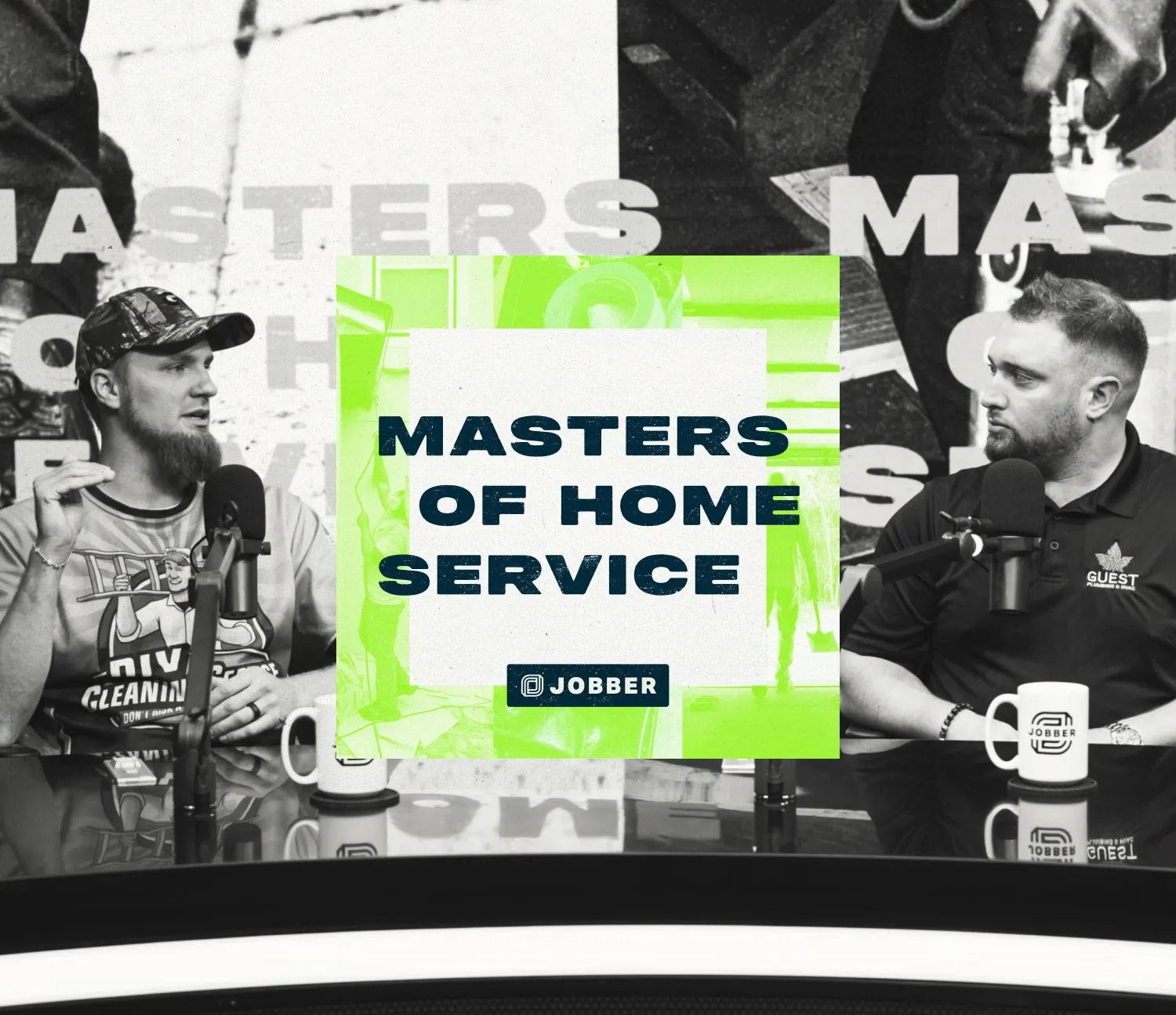
Google’s losing their minds right now. They’re freaking out. Welcome to Masters of Home Service, the best podcast for home service pros like us. I’m your host, Adam Sylvester, and I want you to crush it in business. If you think that AI is just getting ChatGPT to write you a fancy email, then this episode is for you because it is way bigger than that. My experts today are Phil Risher and Ryaan Tuttle, and they live and breathe this AI stuff. Their whole companies are just functioning on AI like you’ve never seen, and so we’re going to give you some really practical advice on how to use it for your marketing, how to use it for your internal staff, the whole thing. So if you’re looking for more AI insights, this is the episode for you. Guys, welcome to the show. Thanks for being here.
Phil (00:57):
Yeah, thanks for having us.
Ryaan (00:57):
Thanks, Adam.
Adam (00:58):
Ryaan, you’re new to the podcast. Welcome on board. I love your company. You’re a big Jobber fan. Tell us who you are and what you do.
Ryaan (01:04):
My name is Ryaan Tuttle. I own a handyman business in Boston, Massachusetts and New Hampshire. Best Handyman Boston and Best Handyman New Hampshire.
Adam (01:13):
And what do you guys do exactly? Just all handyman stuff? Is it subcontractors, employees?
Ryaan (01:18):
Yeah. We offer estimates in 24 hours without going to the job. Something we’ve done from day one in 2018. We just keep a streamlined process for everything and after a couple of years we figured out our business model and we just run a complete subcontractor business model, not only in the field with the technicians, but also in the office with the admins as well.
Adam (01:37):
Awesome. I’m glad you’re here, and we’ll get more into that in a second.
Ryaan (01:40):
Appreciate it.
Adam (01:41):
Phil, what about you?
Phil (01:42):
Yeah, Phil Risher. I’m the owner of Phlash Consulting. We’re a digital marketing consulting company for home service business owners. We help them with automation, tech stack, digital marketing, and using their CSR to help them grow.
Adam (01:52):
Cool. Well, you guys know what I’m talking about. I think there’s a certain listener who just thinks, Oh, AI is just ChatGPT writing me cool haikus and poems that are neat. It’s not that anymore. AI is way bigger than that, isn’t it?
Phil (02:05):
Yeah. I would say a big unlock for a lot of people is that they go to ChatGPT they ask it, Hey, write me this newsletter, write me these social media posts, and you’re just getting regurgitated stuff from ChatGPT. I think a big shift for a lot of people is to use ChatGPT as if it’s the expert in whatever you’re asking it. So one way to do this, and I think this is a big unlock, is instead of just relying on typing something into ChatGPT turn on the voice and talk to it as if it’s the best bookkeeper, as if it’s the best CFO, as if it’s the best marketing person and just tell it the story of everything and then ask it for what you want and use it almost as a copilot to you opposed to the actual results that you want to get out of it. And I guarantee that will change the way that you look at the tool and how you interact with it.
Ryaan (02:51):
Yeah, I like that. I mean, believe it or not, AI has been around since the 1960s. There was another upgrade in the eighties, and now I don’t think we’ll ever see another technology in my lifetime that’s going to beat artificial intelligence and what it has to offer now. When I first started to use it, I really didn’t understand it that well. So I hopped online and took some courses in order to educate myself around that. Learned how to prompt, and that really helped kind of elevate my experience with AI. Now it’s like a daily tool for everything I’m using even to get a little more articulate in emails. I mean, I’m using it down to that granular level.
Adam (03:24):
Give me a few more examples for how you’re using it.
Ryaan (03:26):
Sure. We’re using it for estimating. We’re using it for insights to find out how our numbers, our close rates, and a bunch of other stuff.
Phil (03:36):
I’ll give you one that came up last week. We have a gutter cleaning company out in Kansas City that we work with, and they’re looking to hire a sales manager and a GM, kind of like in one. So what we did was on the call, we went to ChatGPT, and we just spelled it all out. We want a GM that also has sales experience that can drive growth. We’re in Kansas City, so it’s more of a blue collar workforce. What should the budget be for this thing? So then we got a job description based off of their specific situation. Then we took that job description and we said, based off this job description, What are 10 interview questions that we should ask to make sure that this person knows what they’re talking about? Then we took those interview questions with the job description and said, Give me the answers that I should look for to make sure that they know what they’re actually saying and now you’re getting this full HR recruiting co-pilot with your business just by talking to it and getting the information out of it, and for them, they’re like, Oh my gosh, this is amazing. I never thought I could use ChatGPT like this.
Adam (04:30):
Yeah, that’s great. I had a funny experience recently where I went to Google to ask Google about ChatGPT, and I realized I should ask ChatGPT about ChatGPT, but that unlocked a whole lot of other ideas like, oh, maybe every time I have a problem or a question, I should at least ask it. It may not give me a good answer, but it might give me a great answer.
Ryaan (04:55):
Yeah, there’s no more Googling for us. We’re running everything through ChatGPT. I never thought I’d be able to say that, but now any question I have, not only for the business, but personally I’m running through AI just to get a better, deeper answer on things, even such as if we want to look at our competitors in our market and see what they’re doing, that’s another way we’re using AI as well.
Phil (05:18):
Yeah, there was a stat that came out. It said that the average Google search has five words in it. The average ChatGPT search has 357 words in it, and people are using ChatGPT more as a way to get information back and forth and dial in like, okay, who’s the best handyman service, but what is a good ballpark price for this thing? And they’re asking a lot more qualitative questions, like two or three questions at least opposed to just taking the initial answers that they get in which that’s what it’s meant to be. It’s meant to be a lot more conversational interaction to get to the result that you want to use.
Adam (05:50):
Yeah, AI seems like it can empower our processes and our marketing like two different things. More like internal use for AI and then marketing use for AI. Can you explain that more, Phil?
Phil (06:01):
Yeah, so let’s say you have a CRM and you have all these leads that came in. If you were to take all the leads out in a spreadsheet, plug it into ChatGPT and say, analyze this leads. Who are the best leads? Are they in this city? Are they in this zip code? Do they fill out the form at this time? Did they come from this channel? It’s going to do a deep dive on your leads list and tell you the information. You could do this for estimates. You could do this for a bunch of different things inside of your business, and it gives you the data to know what you need to do. I would say from a marketing perspective of content creation, like email newsletters, social. Instead of starting, Hey, ChatGPT, can you write me a newsletter about this thing? What you should do is give it the context and then have it come alongside you to refine it. Kind of like what you’re talking about is refinement inside of what you’re actually doing for emails and stuff.
Ryaan (06:49):
Yeah. One of the things that blew my mind when I first started using it is when I started putting in the prompts, I said, Act like Ryaan Tuttle from Best Handyman Boston, and help me put together this marketing plan and responses to customers in my tone, and two seconds later it started spitting back all this information and I almost fell off the chair. I’m serious.
Phil (07:10):
Something that we started doing with clients is we’ll take their call recordings and then we will put them into ChatGPT and say, Turn this into social media content, into blog posts, because it’s coming alongside you to refine the process, but your subject matter experts in your team is the guiding force. It’s just refining it to the best practices.
Ryaan (07:29):
Yeah, I love that. That’s great. One of the things we’re using it now for is training our sales team. Doing callbacks and checking out responses and narrowing down exactly what we’re trying to deliver.
Phil (07:41):
Have y’all used My GPTs at all?
Ryaan (07:44):
Yeah. Oh yeah.
Phil (07:44):
Okay, so there’s a, in ChatGPT, there’s My GPTs, and they’re GPTs that you can train on certain things.
Adam (07:51):
Yes.
Phil (07:52):
So for example, we have our SOPs on GPT and we have our clients built out for GPT, so we’re training these GPT to know everything based off of this thing, and so then we can take that GPT like what you’re saying and then pair it together and say, Talk like this person or use this from this and that stuff.
Ryaan (08:10):
Yeah, I love that. If you go into ChatGPT, and there’s other large language models as well, I happen to like ChatGPT a lot. If you go into there, you click on Explore in the top right corner, you’re going to see My GPTs. You can click on that button, and then it asks you for a bunch of different questions. What you can do after that is go back into ChatGPT and ask it, Hey, help me create my own custom GPT based off of my business and some other information. It’ll actually give you all those answers and you can plug them in, and that’s how we created our estimating system. We’re doing estimates now within minutes instead of taking a Saturday off in the office, missing soccer games. Now we just run it and right through the model and we’re getting estimates in seconds.
Adam (08:54):
That was a game-changer for you, and let’s talk about it a little bit more because you are literally using AI and some of your own inputs to solve a problem that home service business owners have had for decades. Quoting takes forever, but not anymore. Correct?
Ryaan (09:11):
Yeah. I talked to a few other folks about this. The first question they say is, How do you know it’s right? How do you know the estimate’s going to be, right? Well, you can plug in your own information and you can test that out. You could run 10, 25 of those queries, and then see generally we’re going to be within like a hundred dollars of any estimate, and that’s okay with us.
Adam (09:29):
Guys. I’m going to pause our conversation for a minute to talk about Jobber and why we love Jobber so much. What part has Jobber played, Ryaan in your journey of just becoming AI-dominant?
Ryaan (09:40):
Sure. We use Jobber AI. If you go on the app, you can just click on the top right corner. There’s a little AI assistant. We use it for business insights to know how much we’re doing every month, how much we’re doing every year. We also use it for marketing as well.
Phil (09:54):
I would say for me, we do marketing, and we want to get leads for businesses, and when they don’t answer the phone, it’s like you’re wasting all of your money, so I love Jobber Receptionist because it answers the phone for you and can actually book a request inside of Jobber. It’s literally AI answering service for you.
Adam (10:08):
Yeah, I like the campaign creator where you literally tell it what you want just in text form. It sets it all up for you. The segment that you want to email plus the email content. It’s all so simple. It’s really sleek. I really, really like it and my people can use it too. If you’re not using Jobber, then you need to. It has a lot of cool AI tools in it as well. Go to jobber.com/podcastdeal, get the exclusive discount, and start running Jobber today.
(10:35)
Phil, earlier you said that you import a call data into ChatGPT, just funneling data in there just on a weekly basis or something, just piling it in there.
Phil (10:44):
Yeah. Another use case for this, imagine your bookkeeper sends you your end-of-the-month statements, and you’re like, okay, I don’t know what this means. If you plug it into ChatGPT and say, I want to be the number one gutter cleaning company in the world, what should I fix based off of these numbers? It’s going to take the numbers, and then it’s going to tell you, Well, you really should have this much retainer and you really should have this percentage of profit against compared to your actual revenue. And it’s going to coach you through all of these things. For someone that’s starting out, use it as a copilot or like a wingman and give it the stuff and then allow it to come alongside you.
Ryaan (11:14):
Yeah. That’s one of the things I like about Jobber new feature. Having the AI built in, being able to put in all your company information and it’s going to automatically help you with marketing right away, helps write emails, campaigns, all that sort of stuff.
Phil (11:29):
My prediction, and this is something that we’re doing with our clients, is in 2026, there’s going to be AI avatars that are out there, and these AI avatars are going to be trained on you, the business owner. And every single business owner, when I was in the trades and every single business owner I talked to, they say, I wish I could duplicate myself. Well, guess what? You can. Your CSR can ask it a question if it has a question. Your salesperson can ask it a question if it has a question, and this is why contents and SOPs and processes, you got to have something that you can build your AI avatar because in 2026, there will be AI avatars on websites that will be them in sales processes, and there already are them inside of teams. We have one for our team.
Adam (12:07):
So not just for pricing so to speak, but you just could ask the business owner anything you want, and based on what you’ve put into it, it’ll tell you how the business owner would think basically.
Phil (12:17):
Exactly, so mine, for example, has all my content, all my podcasts, all of our SOPs, and it will actually cite the source if someone asks it a question. For business owners though, if you have SOPs and you make content or something that’s documenting processes, you can create your own AI avatar, kind of like we were talking about with the Jobber avatar, but one that’s just your business’s avatar. It knows everything about your business, and you can use it in your sales process. You can use it internally, you can use it externally.
Adam (12:44):
Yeah, that’s awesome.
Ryaan (12:45):
Yeah. That’s one thing we just added. We’re working on right now actually that you mentioned that. We’ve always used Jotform on our website with a Zapier connection to get all the information into Jobber CRM. It’s been a static form forever. It’s just sitting there and we have some other services. We have a recurring maintenance plan, and we have what we call a home evaluation where we come in, it’s not a home inspection, but it’s like a 40-point checklist that we do, but we never sell. It never sells on our website. We have these other services that just kind of sit there, and so what we’re doing now is we’re taking that static form and turning it into an AI agent based off of our business with all of the information in there so it can walk that customer through the process with upsells, downsells, and introduce ’em to some of those services where they necessarily wouldn’t see on our website.
Adam (13:35):
It’s like a pricing calculator, but a really sophisticated one.
Ryaan (13:38):
Well, what it’s going to do is its gonna, the customer’s going to be able to talk to that thing, say, Hey, how are you? What can we help you with? And they might say, I’d like to get my door fixed. Well, we don’t come out and just fix one door. We have a maintenance plan for that, so instead of just getting an estimate request through this static form that says, Hey, I’d love for you to come fix my doorknob, here’s a picture and a brief description. That AI chatbot will now talk to it and say, Hey, we don’t do those one-off jobs, but did you know we have a maintenance plan for that? We can actually come fix that one doorknob and the rest of them in the house.
Phil (14:12):
Do you know what tool you built that on?
Ryaan (14:13):
Jotform.
Phil (14:15):
Oh, it’s through Jotform still.
Ryaan (14:16):
Yeah. They just had an update with AI agents into it.
Phil (14:18):
Yeah. We use a tool called Delphi, D-E-L-P-H-I.ai. I literally had to put my license in there so that I could use my voice, but you can text it, you can call it, and then you can video it as well.
Ryaan (14:29):
Wow.
Adam (14:29):
What?
Phil (14:30):
Yeah.
Adam (14:30):
So it’s going to be like a video form of Phil.
Phil (14:33):
Yeah, so you go to the website, it’s going to be on home service businesses. It’s going to go to the website. It’s going to say, How can I help you? And then it’s going to have me on there, and it’s going to say, what can I help you with? And then it’s going to talk to you. This is already out there. It’s happening, Adam. It’s happening.
Ryaan (14:49):
I love the excitement. I get so excited too.
Phil (14:52):
There’s some other cool tools that I would be remiss if I didn’t mention them because people listening to this are like, you should talk about these like N8N and Opal is another really big one. Basically what these tools are is that they leverage automation and AI and they allow you to do things that leverages automation with AI. And a lot of times people hear automation, they’re like, okay, I can automate a process, but you can also leverage AI in the automation. So an example of this Opal is a Gemini product, which you could use ChatGPT, Gemini, whatever, but the reason that I like Opal and Gemini is because we use Google Workspace, so if you can connect it all the way through.
Adam (15:28):
Like Google Drive and stuff?
Phil (15:30):
Yeah, so imagine Opal is their beta thing, but basically you could say, Create a social media post for me. It would go to a Google Sheet and it would pull a content calendar theme. Then it would go to Gemini and it would educate itself on all the top-performing posts from Instagram and Facebook for this theme. Then it would go and research your company or go to a Google Doc and you have all your Google Doc information about the business. Then it would spit it out into a Google Drive with all the stuff.
Adam (16:00):
All in one second.
Phil (16:01):
All in one second. Yeah, and this is what I’m saying, it’s like automation and AI pulling it in, that then will run a process for you.
Adam (16:08):
That’s pretty awesome.
Phil (16:08):
Yes.
Adam (16:09):
Okay. Any other marketing hacks that our listeners need to know in terms of using AI for anything else? Marketing, SEO.
Phil (16:17):
The main thing I will say is that in home service businesses, you have two pillars. You have CSRs, your salespeople, you saying a lot of smart things over here. Then you have ChatGPT and your social media marketing stuff over here. You got to make it go together. You got to take all the expert stuff and get it over here into your marketing stuff, and the quickest way to do that is to download everything out of here by using voice recordings, text, and then using ChatGPT to make it so good, but use your real stuff. Don’t just default to regurgitative stuff.
Adam (16:45):
Would it be helpful to just download every quote/estimate out of Jobber as a PDF and put that in there? Would that be helpful?
Phil (16:53):
Eventually, all this stuff is going to be connected so that it can have a constant training on your business.
Adam (16:57):
That’s true.
Phil (16:58):
But for now, if anything that you can give it to educate your business on, the more knowledgeable it’s going to be on your business.
Adam (17:05):
In terms of marketing, does traditional SEO, that kind of stuff matter anymore?
Phil (17:09):
You might hear these terms, GEO, AEO, SEO, search engine optimization. Everyone’s kind of familiar with that, and yes, it is still important, but the other two is GEO, which is generative experience optimization, and this is particularly if you go to Google and you type in, Handyman service near me, you’re not going to see much that’s different. You’re going to see the Google LSAs, Google Search Ads, map pack. But if you say, How much does a handyman cost? You’re going to see an AI overview and a generative experience optimization, which is giving you links to different website and it’s going to give you more context. So generative engine experience is that.
(17:42)
AEO is answer engine optimization. This is on ChatGPT and this is more conversational where you’re asking a question on ChatGPT. Then you might ask another question to follow up with that or a third question. The big thing for this that you can do for your business for both of these, AEO, GEO is instead of, well, first, if you have FAQs on your website, you need to have FAQs on your website, frequently asked questions. Frequently asked questions with answers, but how you can make this better is all the content you create, all the service pages that you have on your thing. I do plumbing, I do HVAC, I do electrical. You need to have FAQs on those pages as well because it’s a lot more descriptive, and it’s on the page that it’s going to be indexing, so it’s very important. One big note on this, I’ve been preaching about taking the real information from your customers. If you take the real stuff, the prompt that you need to say is, Take this call and turn it into a blog post and optimize it for AEO and GEO, and it will just optimize it the right way for you.
Adam (18:41):
That’s awesome.
Ryaan (18:42):
Is that why, you know we’ve been getting, we get inundated with estimate requests every day, and we always ask people how they found us, and one of the new answers is ChatGPT and I assume that’s how they’re finding us, Phil.
Phil (18:55):
Yeah, so on your Google Analytics, you can actually go and see people that are coming to your website and turning into a lead from where they came from. You can see the source of where they came from, but absolutely. There was a stat that right now it’s only like 4 or 5% of people are doing local searches on ChatGPT, but SEMrush, they did a report. SEMrush is a big SEO company. They did a report that by 2028 AI searches on ChatGPT is going to outweigh traditional Google searches, so it’s all shifting that way.
Adam (19:22):
Google’s losing their minds right now. They’re freaking out.
Phil (19:24):
Yeah, they’re rolling out AI, Gemini, all this stuff.
Adam (19:28):
Ryaan, how did you learn about AI and how can our listeners go about learning more about this and any tips on that?
Ryaan (19:35):
Sure. I was nervous about it at first. I was a little overwhelmed. I didn’t know anything really about it. I’ve been using Siri and some other small things, Siri face ID on my phone and things like that, simple stuff. Even Netflix, they’re using AI and so I really wanted to educate myself, so I took some courses at local universities online. Basic introduction to AI, and kind of elevated from there and started taking more and more courses.
Phil (20:02):
I would say this. My company, we hired an AI automation consultant to help us build things and do things and then educate us as we go, so there are people out there that can help you. I think it can be a little bit intimidating at first.
Ryaan (20:15):
Yeah, I like to call those people like player coaches. That’s what we like to hire, and we’ve done the same thing. You can go in and create your own GPT in like OpenAI, or you could actually have your developer go in the backend and write code and do a lot of things that are way above my pay grade.
Adam (20:31):
Talk about a profession that didn’t exist a decade ago or expert in it. And what are they going to help you do?
Phil (20:39):
Well, they can understand N8N and Opal and how to build all these different connections with AI and how to use this thing. They can go through and take data and say, okay, well, here’s the data, here’s the data. Let’s put it together in an AI model. That’s a LLM, large language model, and then we can have it filter out over here. All these things. People are like, What are you even saying? How do I do that? Where do I go? They’ll be able to do it for you.
Adam (21:00):
Guys, this is great. Thanks for all your input. Really fascinating. I’ve got three takeaways that I think our listeners can benefit right now from this episode. Number one is you need to use ChatGPT as your main high-level professional assistant. Lean on it, ask any question you want, and just start to rely on it for all kinds of answers. You never know what it’s going to do. It could do a lot more than you probably think it can right now. Number two is teach your ChatGPT, train it. Just give it tons of data. Download phone calls from your CRM or from your VoIP system. Put in there, transcripts, PDF quotes, all your content, anything you want, blog posts. Put all in your ChatGPT so it starts to learn your business and learn how you do things, and number three is take courses, YouTube university, hire a freelancer, whatever it takes, but you really should become more versed in this stuff. You don’t have to know it all, hire a freelancer, but if you want to learn more and get more equipped with it, YouTube university, ask ChatGPT to educate you on ChatGPT. That will work too. Guys, this was great. Thanks for being here, Phil. How do people find that more about you?
Phil (22:02):
Yeah, if you want to use AI and you’re not using it from a marketing perspective, that’s what my company does, so you can go to phlashconsulting.com, P-H-L-A-S-H consulting dot com, and click discuss your business, and we’ll take it from there.
Ryaan (22:13):
You can find me on LinkedIn, Instagram at @besthandymaninc or I’m always in the Jobber service forum, and you can ask any questions you want in there.
Adam (22:22):
Bingo. Well, thanks for being here, guys. Really insightful as always, and we’ll see you soon.
Ryaan (22:27):
Thank you.
Adam (22:28):
On the next episode, we’re talking about how to give your customers that wow experience. The kind they never forget without charging luxury prices from small, thoughtful touches to simple habits that make clients feel cared for. We’ll show you how to turn everyday jobs into five-star experiences. Follow or subscribe today so you don’t miss out. I’m your host, Adam Sylvester. You can find me at adamsylvester.com and I want to hear from you. Text me, tell me what you like about the podcast, what you want to hear more of. I am all ears. Your family, your team, and your clients deserve your very best, so go give it to ’em.
About the speakers

Adam Sylvester
CHARLOTTESVILLE GUTTER PROS AND CHARLOTTESVILLE LAWN CARE
Website: adamsylvester.com
Adam started Charlottesville Lawn Care in 2013 and Charlottesville Gutter Pros in the fall of 2020, in Charlottesville, VA. He likes to say, “I do gutters and grass! When it rains the grass grows and the gutters leak!” He got into owning his own business because he saw it as a huge opportunity to generate great income while living a life that suited him. He believes that small companies can make a serious impact on their communities and on every individual they touch, and he wanted to build a company that could make a big difference. His sweet spot talent is sales and marketing with a strong passion for building a place his team wants to work. Adam values his employees and loves leading people. While operations and efficiency is not something that comes naturally to him, he is constantly working to improve himself and his business in these areas.

Ryaan Tuttle
Best Handyman Boston
LinkedIn: Ryaan Tuttle
Instagram: @besthandymaninc
Ryaan Tuttle is a Boston-born service business operator and investor with nearly two decades of hands-on experience. He started working in the trades at 17 and launched his first remodeling company at 24. Early on, he saw that many great builders struggled not because of their work, but because their businesses lacked clear systems.
Since then, he’s built and scaled multiple seven-figure home service brands, including Best Handyman Boston, a Best of Boston winner. He’s advised Y Combinator startups and SaaS companies like 1Build and Jobber, authored, The Automated Home Service Business, and consulted for Home Depot and ProRemodeler. Today, through Birch Road Investments, he acquires and grows established service businesses or partners with owners ready for their next chapter, focusing on building durable systems using practical technology, automation, and AI.

Phil Risher
Phlash Consulting
LinkedIn: Phil Risher
YouTube: @phlashconsulting
Website: phlashconsulting.com
Phil Risher founded Phlash Consulting in the Washington, D.C. Metro Area in 2019. He’s a local marketing expert, who specializes in helping businesses scale. His company helps local service businesses boost sales and fill their schedules using the unique “Phlash Customer Journey” framework to create a professional marketing system. This approach has helped clients grow their revenue by over 20% annually. Before founding Phlash Consulting, Phil was a director of business development at a major air duct cleaning company. He was tired of working with generic marketing firms that didn’t understand his industry, so he decided to start his own. Phil’s company combines digital marketing and business development strategies, and works directly with staff and business owners to help them grow. He builds strong partnerships with his clients, and most have stayed with him for over two years.



SIGN UP FOR PODCAST UPDATES
Get email updates on new episodes and podcast news.
You don’t want to miss out!
Interested in being a guest on the show?
Are you a home service professional eager to share your insights and experiences? Apply to be a guest on the Masters of Home Service Podcast, and join a community of experts committed to helping others level up through knowledge.
Other Podcasts We Love