
Key takeaways:
Choosing the right construction estimating software can help boost accuracy, speed up workflows, and maximize profitability across all types of projects.
- Streamline estimating and bidding. Top platforms automate material takeoffs, calculate labor and material costs, and enable quick, professional proposals to help you win more work efficiently.
- Choose the best fit for your business size and project type. From detailed plan-based takeoffs (like ArcSite and STACK) to all-in-one solutions (such as Contractor Foreman and Procore) and workflow-centric options (like Jobber), the ideal software aligns with your specific needs.
- Integrate for efficiency and accuracy. Leading estimating tools connect seamlessly with accounting software, project management, and essential field apps to reduce manual data entry and keep project information organized.
- Prioritize usability and support. Easy-to-use mobile and desktop interfaces, as well as responsive customer support, make onboarding smoother and ensure your team can collaborate in the office and field.
- Test and compare before committing. Take advantage of free trials or demos to ensure the software matches your workflow and budget, considering all costs and potential add-ons.
Want more tips and insights for running a successful construction business? Sign up for the Jobber Newsletter.
Accurate estimating is the foundation of every successful construction project. Price too low and risk cutting into your profits. Price too high and you’ll lose the job to a competitor.
But for construction business owners, striking the right balance between precision, speed, and profitability can be a daily challenge—especially when relying on outdated tools or manual processes.
Luckily, construction estimating software can simplify complex calculations, reduce errors, and improve project forecasting.
Keep reading to discover the six best construction estimating software options to streamline your workflow and save you hours of frustration.
What is construction estimating software?
Construction estimating software is a tool that helps contractors calculate project costs, create accurate construction estimates, and build professional quotes or proposals.
Construction cost estimating software can also connect estimating with workflows like takeoffs, client approvals, scheduling, invoicing, and job costing—bringing all your workflows into one place.
Broader project management software goes further by helping contractors manage schedules, tasks, communication, and construction costs after winning a job.
What construction estimating software can help you do
The exact features vary by platform, but construction estimate software can help you:
- Create material takeoffs. Measure quantities from plans or drawings and build a list of the materials needed for a project.
- Calculate labor and material costs. Apply unit costs, labor rates, quantities, markups, overhead, and other expenses to estimate the total project cost.
- Build bids, proposals, or quotes. Turn estimate details into professional bids or customer-facing proposals, often with customizable pricing and scope information.
- Track client approvals and job profitability. Monitor whether an estimate has been accepted and compare estimated costs with actual job performance.
How we evaluated construction estimating software
To find the best construction estimating software solutions for this list, we checked out review sites such as Capterra to find the best-rated construction estimating platforms. We re-verified this information in 2026 to make sure it reflects their current offerings.
From there, we determined specific evaluation criteria to find the top estimating software.
Evaluation criteria
We evaluated several platforms for their features, ease of use, pricing, and more.
Takeoff and estimating capabilities
We looked for tools that make it easy to build accurate estimates, including material takeoffs, labor and material cost calculations, templates, markups, and reusable cost databases.
We also considered whether estimates can be updated easily as project details or costs change.
Proposal and quote workflow
We evaluated how easily contractors can turn estimates into professional proposals or quotes, customize pricing, and send them to clients.
We also looked for features that support electronic approvals, signatures, and tracking after a quote is sent.
Project and job management
We considered whether estimating features connect with the workflows contractors use after winning a job, such as scheduling, task management, time tracking, job costing, invoicing, and profitability tracking.
Platforms that connect estimating with project management can reduce duplicate data entry between the sales and delivery stages.
Integrations and accounting
We looked at integrations with commonly used accounting and business tools, particularly platforms such as QuickBooks.
Other integrations help you transfer customer, estimate, invoice, and financial data without relying on manual data entry.
Ease of use and mobile access
We assessed how intuitive each platform is for contractors and whether you can quickly create or update estimates without extensive training.
We looked at the quality of mobile estimating apps and whether contractors can access quote details and job information while working in the field.
Software pricing transparency and trial access
We compared available pricing information, including whether plans and additional user costs are clearly explained.
We also looked for free trials, demos, or free plans that let contractors evaluate the software before committing to a subscription.
Construction estimating software comparison
The best construction estimating software depends on the type of projects you manage and how much of your workflow you want to handle in one platform. Use the comparison below to quickly see which features align with your business needs.
| Software | Best for | Takeoffs | Estimating | Quotes | Project management | Integrations | Pricing |
|---|---|---|---|---|---|---|---|
| ArcSite | Mobile drawings and takeoffs | Yes | Yes | Yes | Limited | • Jobber • QuickBooks • Wisetack | Tiered pricing starting at $30 per month |
| Contractor Foreman | All-in-one contractor management | Available in higher tier plan | Yes | Yes | Yes | • QuickBooks • Stripe • CompanyCam | Tiered pricing starting at $49 per month |
| Stack | Cloud takeoffs and preconstruction | Yes | Yes | Yes | Limited | • QuickBooks • Procore • NearMap | Starting at $249 per user per month |
| Procore | Larger commercial construction teams | Yes | Yes | Yes | Yes | • QuickBooks • Xero • Oracle Netsuite | Custom pricing |
| Buildxact | Residentials builders and remodelers | Yes | Yes | Yes | Yes | • QuickBooks • Rendr • HazardCo | Starting at $199 per month |
| Jobber | Quote-to-invoice workflows | No | Yes | Yes | Yes | • Quickbooks • Xero • CompanyCam | Starting at $29 per user per month |
1. ArcSite: Best for mobile drawings and takeoffs
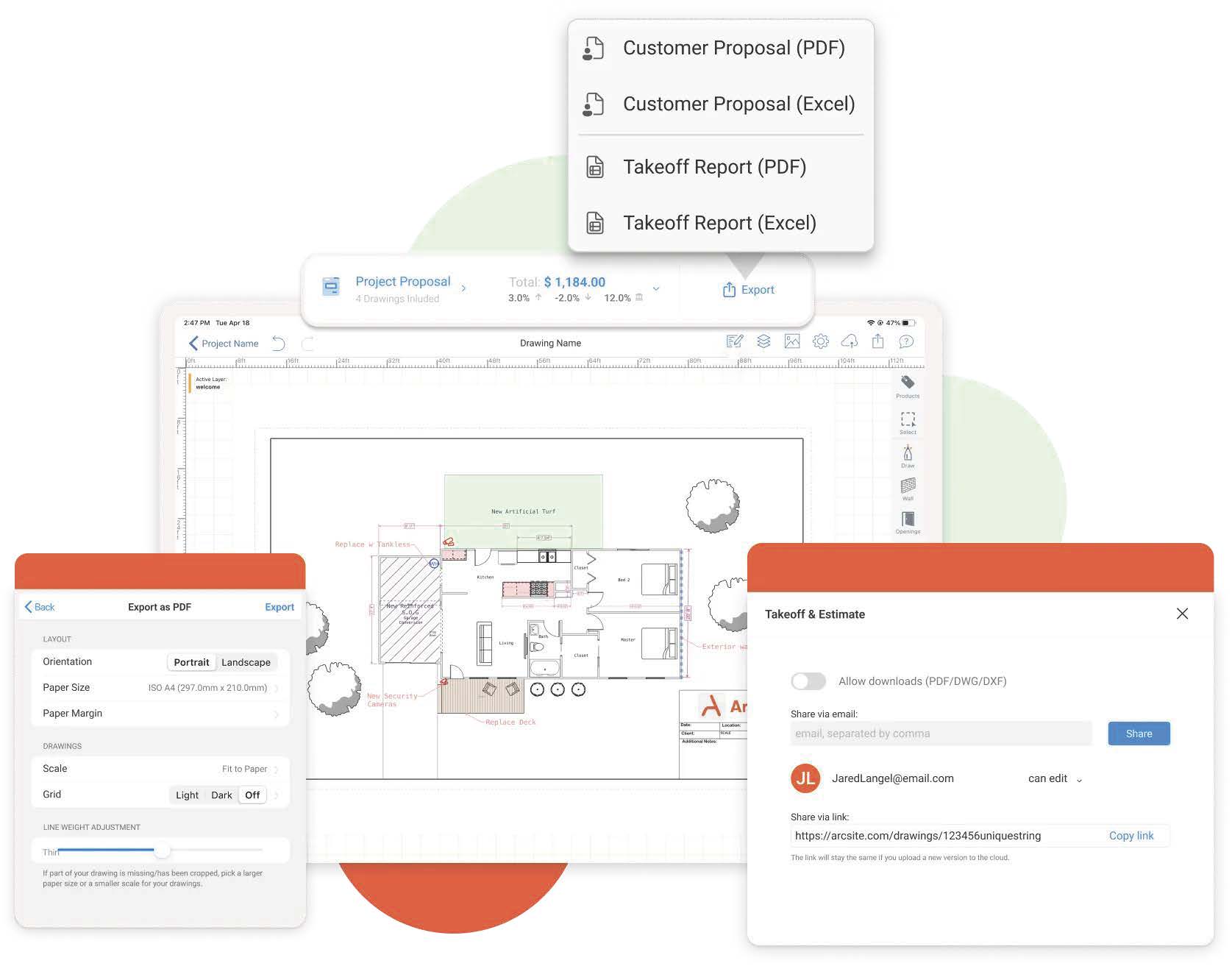
ArcSite is the best construction estimating software for businesses looking for advanced mobile drawing and takeoff capabilities.
Best for
Ideal project types
ArcSite is particularly well suited to specialty contractors that need to measure, design, estimate, and present proposals in the field. It supports workflows for trades such as fencing, flooring, roofing, concrete, HVAC, electrical, and other project-based businesses.
Best-fit team and workflow
ArcSite works well for contractors with field sales teams or estimators who need to capture measurements, create drawings, complete takeoffs, and build proposals during site visits. Its mobile-first workflow can help you reduce manual data entry between the field and office.
Key estimating capabilities
Takeoffs and cost calculations
- Perform takeoffs, generate proposals, and get client sign-offs right from the job site.
- Create precise, professional drawings directly on a tablet or mobile device during site visits.
- Embed and markup photos into your drawings to capture site conditions and highlight specific areas.
- Create your own unique custom shapes to suit your business needs.
- Scan rooms quickly with the AR Room Scanner.
Bids, proposals, and project handoff
ArcSite’s built-in pricing catalogs, custom formulas, and dynamic templates make it easy to generate fast and accurate estimates. You can also quickly turn construction estimates into clean, branded proposals that can be shared or signed on the spot.
Clients can review and approve proposals digitally, while field teams can track proposal status and access project output.
Pros and cons
| Pros | Cons |
| • Instantly converts drawings into material takeoffs and detailed cost estimates • Lets you create proposals with pricing, visuals, and branding—all in one place • Tailored features and templates for different trades | • Limited desktop capabilities • Can be more expensive than basic estimating or takeoff tools |
Key integrations
Arcsite’s key integrations include:
- QuickBooks: Sync ArcSite project and product data with QuickBooks Online to create estimates or invoices and streamline billing workflows.
- Wisetack: Let customers apply for financing directly from an ArcSite estimate, with the financing application sent to them by text message.
For an even more seamless construction estimating process, use the ArcSite and Jobber integration to optimize your workflow. When you connect Jobber and ArcSite, you can streamline project management by:
- Automatically generating ArcSite projects for new Jobber clients
- Adding collaborators to each Jobber request
- Easily exporting Arcsite designs into Jobber quotes
For example, adding a client to Jobber instantly creates projects in ArcSite. That way, you spend less time onboarding clients and can get straight to work.
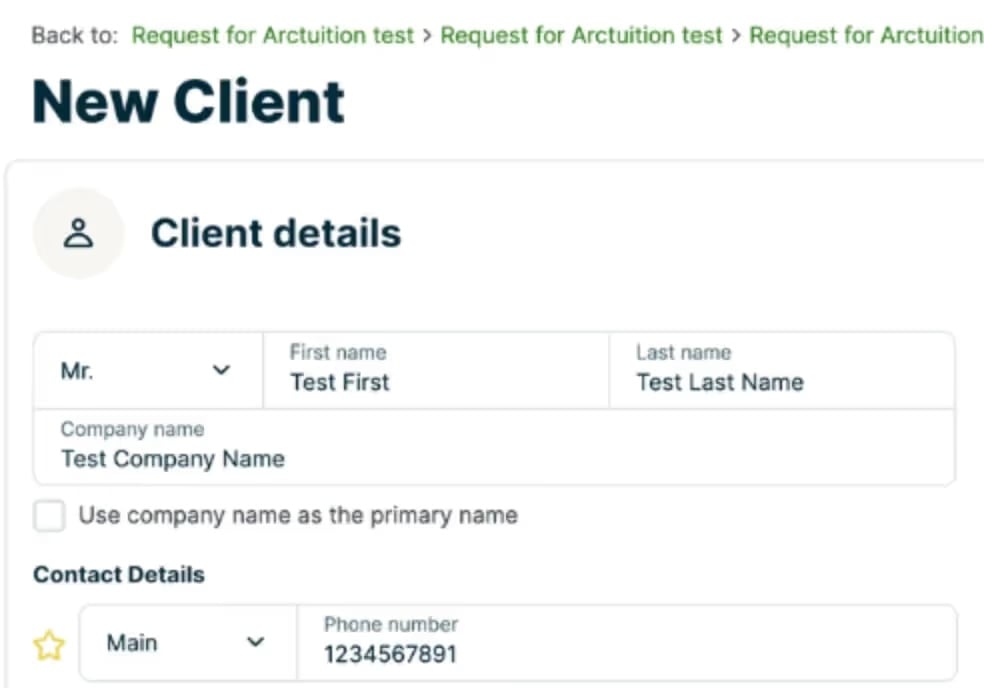
When a client request is created in Jobber, ArcSite automatically adds the designated team members as collaborators to the corresponding project in ArcSite.
Pricing
Arcsite has tiered pricing starting at $30 per month for the Draw Pro plan, $99 per month for the Takeoff plan, and $129 per month for the Estimates plan. All plans include unlimited projects and drawings.
2. Contractor Foreman: Best for all-in-one contractor management
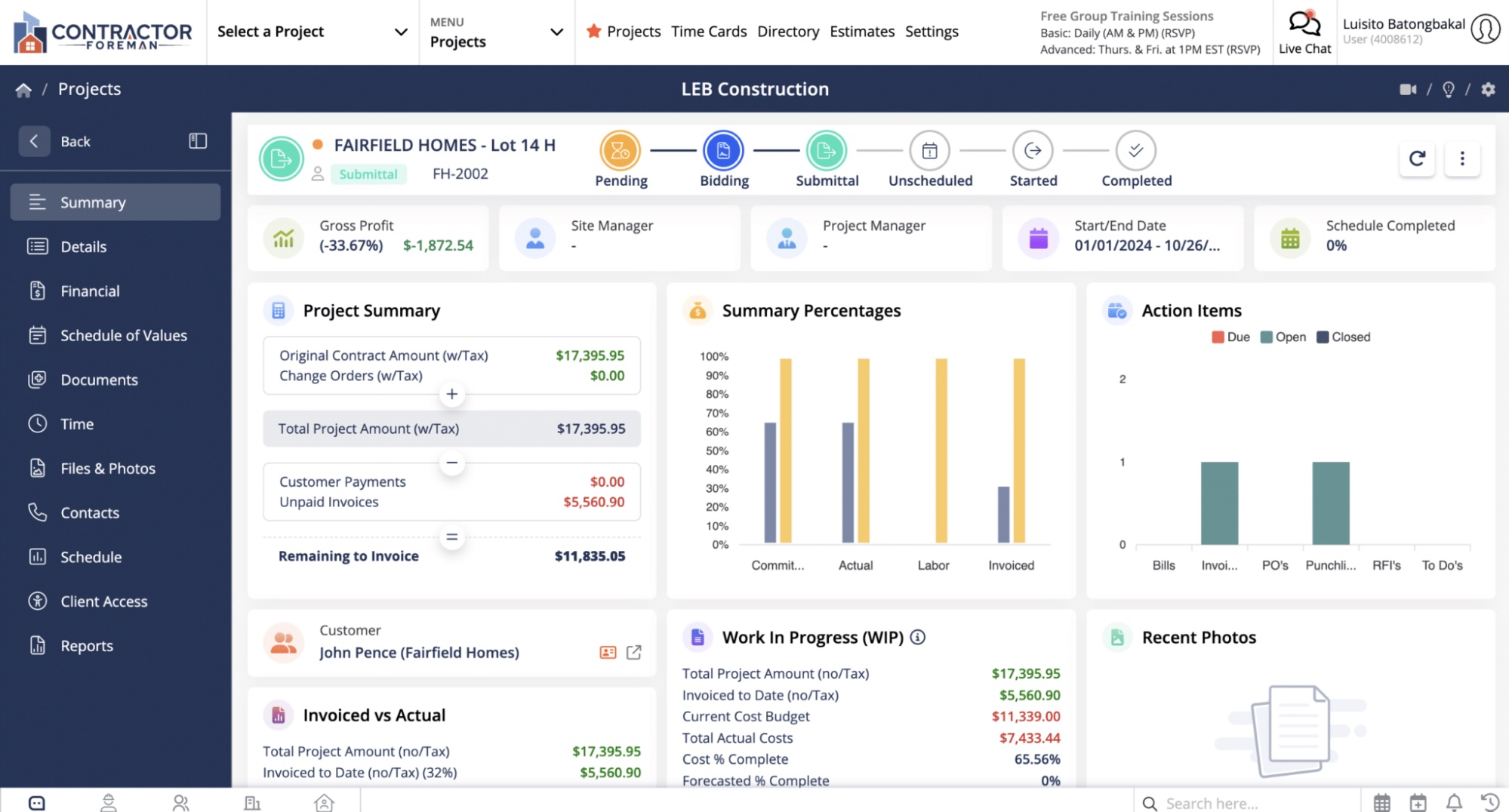
Contractor Foreman is a project management tool best for construction businesses looking for an all-in-one platform with great estimating features.
Best for
Ideal project types
Contractor Foreman is designed for a wide range of construction businesses, including general contractors, remodelers, home builders, and specialty trades. Its broad project management capabilities make it particularly useful if you manage multiple jobs and crews at the same time.
Best-fit team and workflow
Contractor Foreman is a good fit for small to midsize construction teams that want to manage estimating and project operations in one platform.
You can create estimates before a job starts and carry that information into scheduling, job costing, time tracking, invoicing, and other project workflows after the client approves the work.
Key estimating capabilities
Takeoffs and cost calculations
Contractor Foreman includes tools for creating estimates from templates, cost databases, and customizable line items. You can add materials, labor, equipment, and other costs, then apply markups to calculate your desired selling price and profit margins.
Bids, proposals, and project handoff
- Quickly create estimates using pre-built estimating templates, cost databases, and customizable line items.
- Convert your estimates into branded proposals that can be shared with clients for approval.
- Mark up materials and labor to control construction profit margins.
- Convert approved estimates into projects and carry information into other Contractor Foreman workflows, reducing duplicate data entry.
Pros and cons
| Pros | Cons |
| • Perform bulk markups • Choice between a Kanban view and a list view • Convert estimates into proposals or invoices | • Limited takeoff features in lower tier plans • Wide range of features can create a steeper learning curve for teams that only need estimating |
Key integrations
Contractor Foreman’s key integrations include:
- QuickBooks: Sync customers, estimates, invoices, payments, and other financial information between Contractor Foreman and QuickBooks to reduce duplicate accounting work.
- Stripe: Accept online credit card payments through Stripe and connect payment activity with your Contractor Foreman invoices.
- CompanyCam: Connect project photos and documentation from CompanyCam with Contractor Foreman to keep visual job records accessible alongside project information.
Pricing
Contractor Foreman offers tiered pricing starting at $49 per user per month. However, if you want takeoff features, you’ll have to opt for the Plus plan at $166 per month for 8 users.
3. STACK: Best for cloud takeoffs and preconstruction
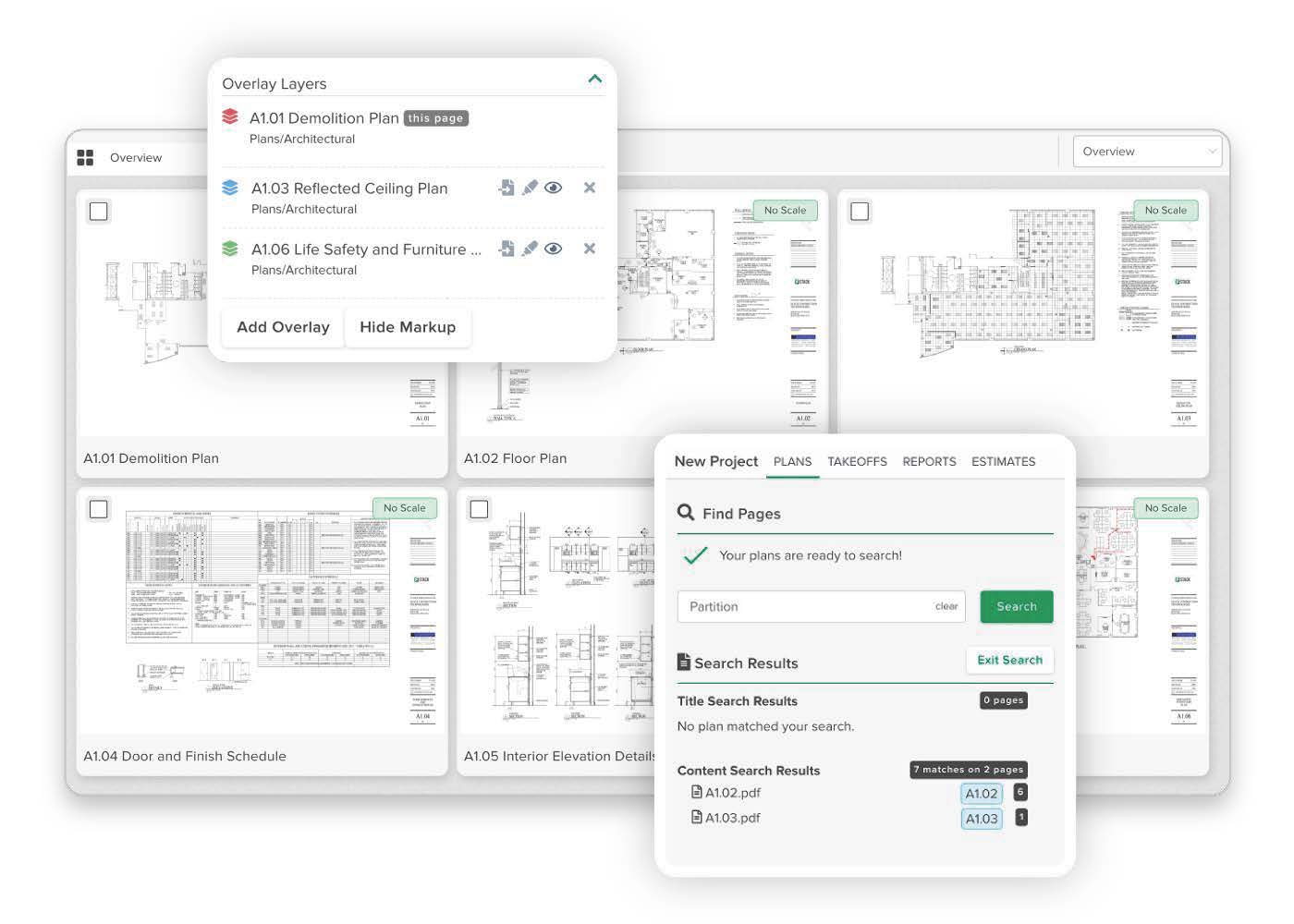
STACK is designed for takeoffs and estimating, making it one of the best construction estimating software solutions available. It’s a great choice for managing multiple projects at once.
Best for
Ideal project types
STACK is built for construction businesses like general contractors, subcontractors, and specialty trades. Its takeoff and estimating tools are particularly useful if you regularly work from digital plans and need to manage large volumes of project documents.
Best-fit team and workflow
STACK is a good fit for construction teams that want multiple estimators and stakeholders to collaborate on takeoffs and estimates without relying on desktop-based software.
It’s a great choice if you want to keep preconstruction documents, measurements, and estimate data organized in one cloud-based workspace.
Key estimating capabilities
Takeoffs and cost calculations
STACK lets you perform digital takeoffs directly from construction plans and create bills of materials for supply orders using pre-built or custom cost libraries.
Automatic sheet recognition can also help you identify and organize drawing sheets, while customizable assemblies and cost databases can speed up repetitive estimating tasks.
Bids, proposals, and project handoff
- Get detailed insight into your estimate data with at-a-glance views of key metrics.
- Have your construction team work on estimates in real time from anywhere.
- Organize plans, specifications, and other project documents in a centralized workspace.
- Compare estimate information across projects to support more consistent bidding and preconstruction workflows.
Pros and cons
| Pros | Cons |
| • Digital takeoff capabilities • Custom cost databases • Automatic sheet recognition to automate drawings | • No built-in project management tools in lower tier • Primarily focused on preconstruction rather than end-to-end job management |
Key integrations
STACK’s key integrations include:
- QuickBooks: Connect STACK with QuickBooks to transfer estimate and project information into your accounting workflow and reduce manual data entry.
- Procore: Integrate STACK with Procore to connect preconstruction information with project management workflows once a job moves into construction.
- Nearmap: Use Nearmap imagery alongside STACK to access high-resolution aerial imagery that can provide additional context when estimating complex projects remotely.
Pricing
STACK offers three pricing plans. The plan that includes estimates and takeoffs starts at $249 per user per month.
4. Procore: Best for larger commercial construction teams
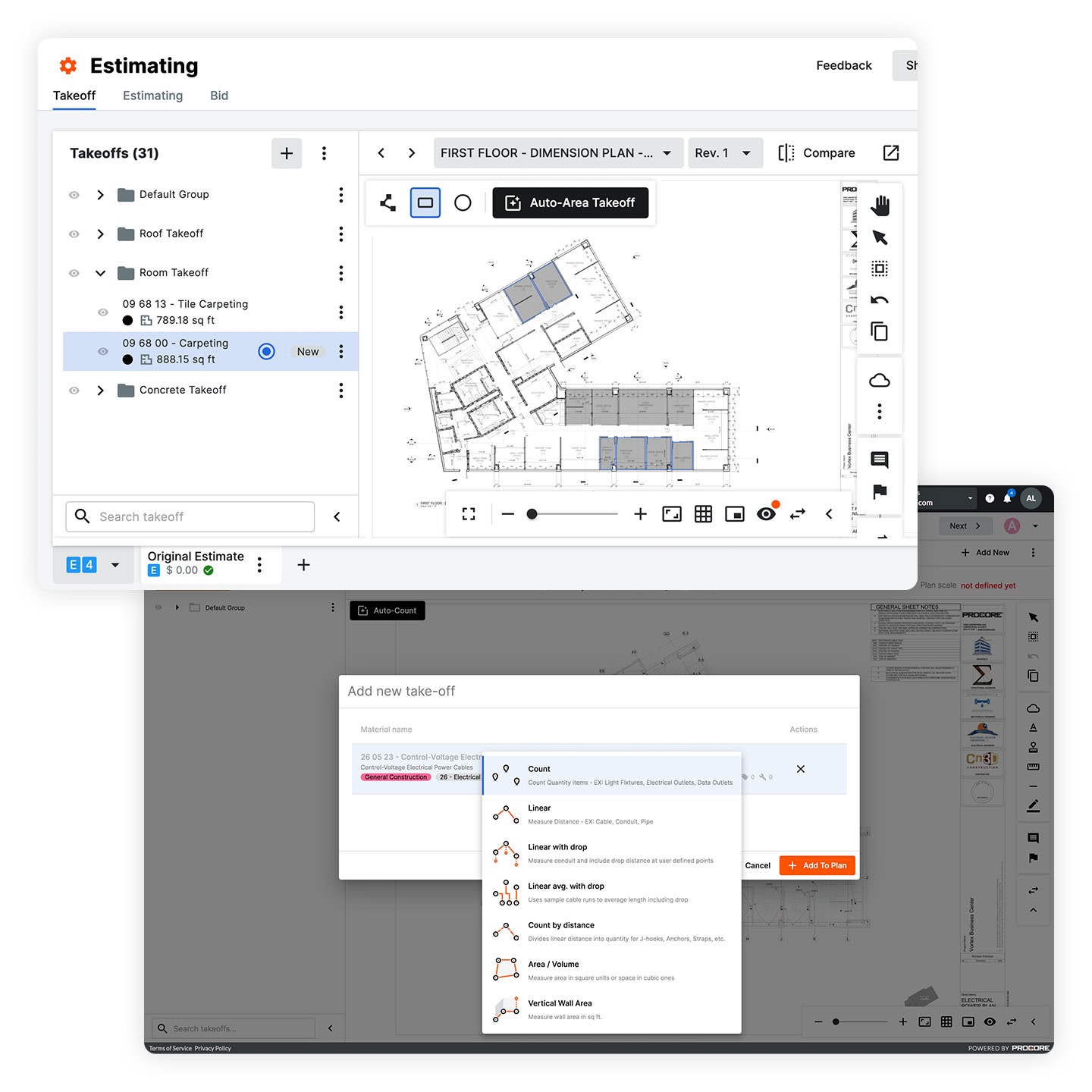
Procore is a construction management platform that connects every phase of your construction project, from the estimation process to closeout. Its advanced features make it best for larger commercial teams.
Best for
Ideal project types
Procore is designed for larger and more complex construction projects, including commercial, industrial, institutional, and infrastructure work.
Its broad features are suited to general contractors and construction firms managing multiple clients, subcontractors, and large project teams.
Best-fit team and workflow
Procore is a strong fit for larger construction teams that need estimating and preconstruction to connect with project management and financial workflows.
You can move information from takeoffs and estimates into budgets, bid packages, schedules, and other project processes without having to recreate project data manually.
Key estimating capabilities
Takeoffs and cost calculations
- Automatically calculate material and labor costs from takeoff data.
- Move takeoffs to completed estimates with a single click.
- Build estimates using customizable cost catalogs and assemblies.
- Organize estimating information across multiple projects and collaborate with team members in the cloud.
Bids, proposals, and project handoff
Procore lets you turn accepted estimates into project budgets, creating a more connected workflow between preconstruction and project delivery. You can also use estimating information to support bid management and other downstream project processes.
Pros and cons
| Pros | Cons |
| • Estimates flow directly into budgets, bid packages, and schedules • Customizable cost databases • Intuitive takeoff tools | • High price for smaller teams • Can be more software than smaller contractors need |
Key integrations
Procore’s key integrations include:
- QuickBooks: Connect Procore with QuickBooks to synchronize financial information and reduce manual entry between construction and accounting workflows.
- Xero: Connect project and financial data with Xero to help teams keep accounting information aligned with their construction operations.
- Oracle NetSuite: Integrate Procore with NetSuite to connect construction project data with broader enterprise financial and business management workflows.
Pricing
Procore offers custom pricing based on the size of your business.
5. Buildxact: Best for residential builders and remodelers
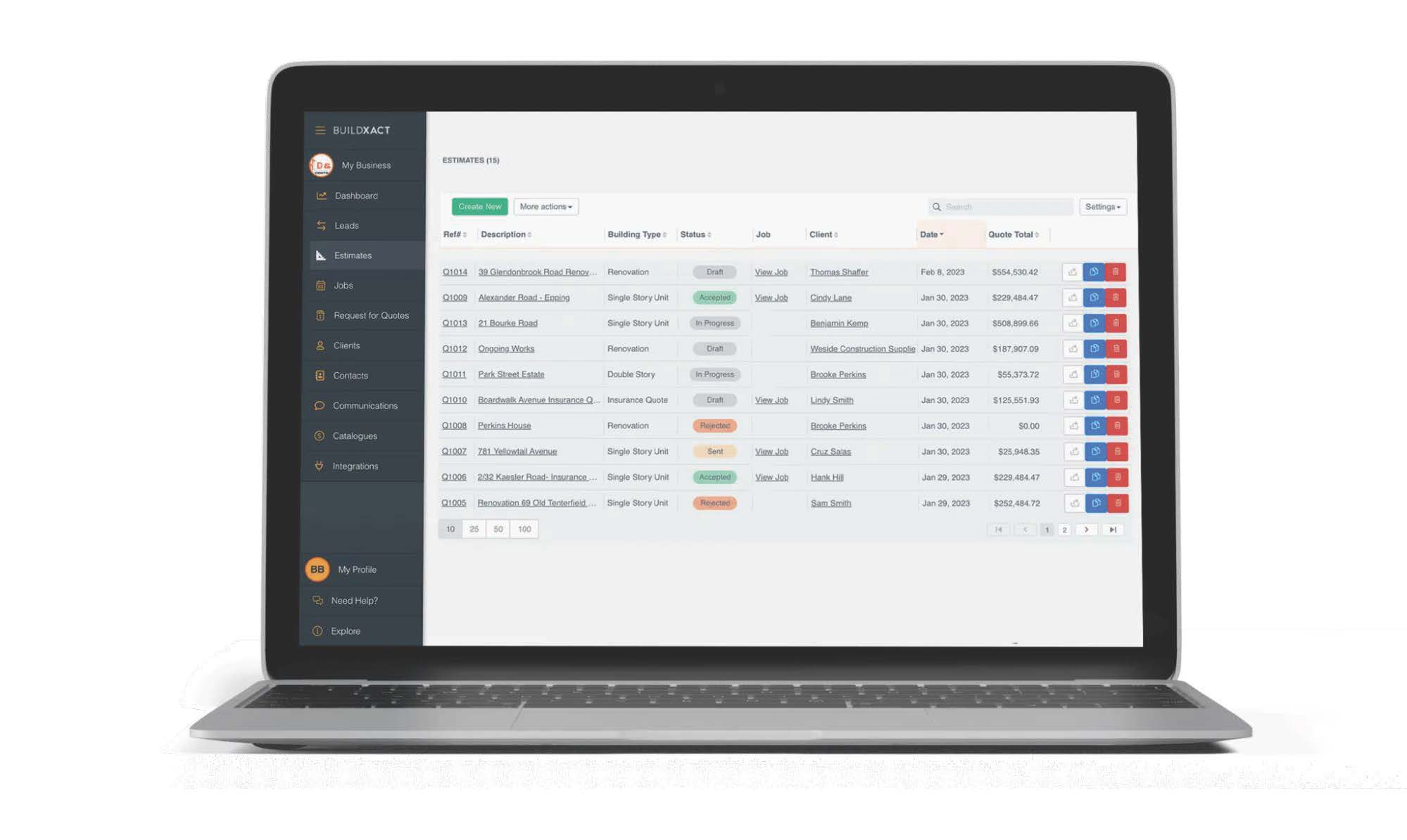
Buildxact is construction management software made for residential construction firms, specifically construction and remodelling companies. Use Buildxact’s construction estimation software to create clear estimates for accurate bids and better project planning.
Best for
Ideal project types
Buildxact is designed primarily for residential construction projects, including new home builds, renovations, additions, and remodeling work.
Its estimating and takeoff tools are well suited to contractors who regularly work from digital plans and need to calculate materials and labor costs before starting a project.
Best-fit team and workflow
Buildxact is a good fit for small to midsize residential construction businesses that want estimating and project management tools in one platform.
You can create takeoffs and estimates during preconstruction, then carry project information into scheduling, purchase orders, and other workflows after winning the job.
Key estimating capabilities
Takeoffs and cost calculations
Buildxact lets you add material, subcontractor labor, equipment, and markup to create detailed project estimates and target desired profit margins. Its on-screen takeoff tools let you measure digital plans and add quantities to an estimate without manual calculations.
Bids, proposals, and project handoff
- Use customizable templates to create estimates for common residential construction projects.
- Turn estimates into professional quotes that can be shared with clients online.
- Give clients access to estimates through a client portal for easier review and approval.
- Carry estimate information into other project workflows to reduce duplicate data entry after winning a job.
Pros and cons
| Pros | Cons |
| • Ideal for residential construction professionals • Easy drag-and-drop estimating tools • Quick estimate sharing through a client portal | • Lacks tools for advanced cost estimating • Estimate Generator has an additional cost |
Key integrations
Buildxact’s key integrations include:
- QuickBooks: Connect Buildxact with QuickBooks to synchronize financial information and reduce duplicate data entry between estimating, invoicing, and accounting.
- Rendr: Integrate Buildxact with Rendr to create 3D renderings from project plans and help clients visualize proposed residential projects.
- HazardCo: Connect Buildxact with HazardCo to support health and safety workflows and keep project safety information connected with construction operations.
Pricing
Buildxact offers tiered pricing starting at $199 per month for unlimited users. You can add the Estimate Generator to your plan for an additional $99 per month.
6. Jobber: Best for quote-to-invoice workflows
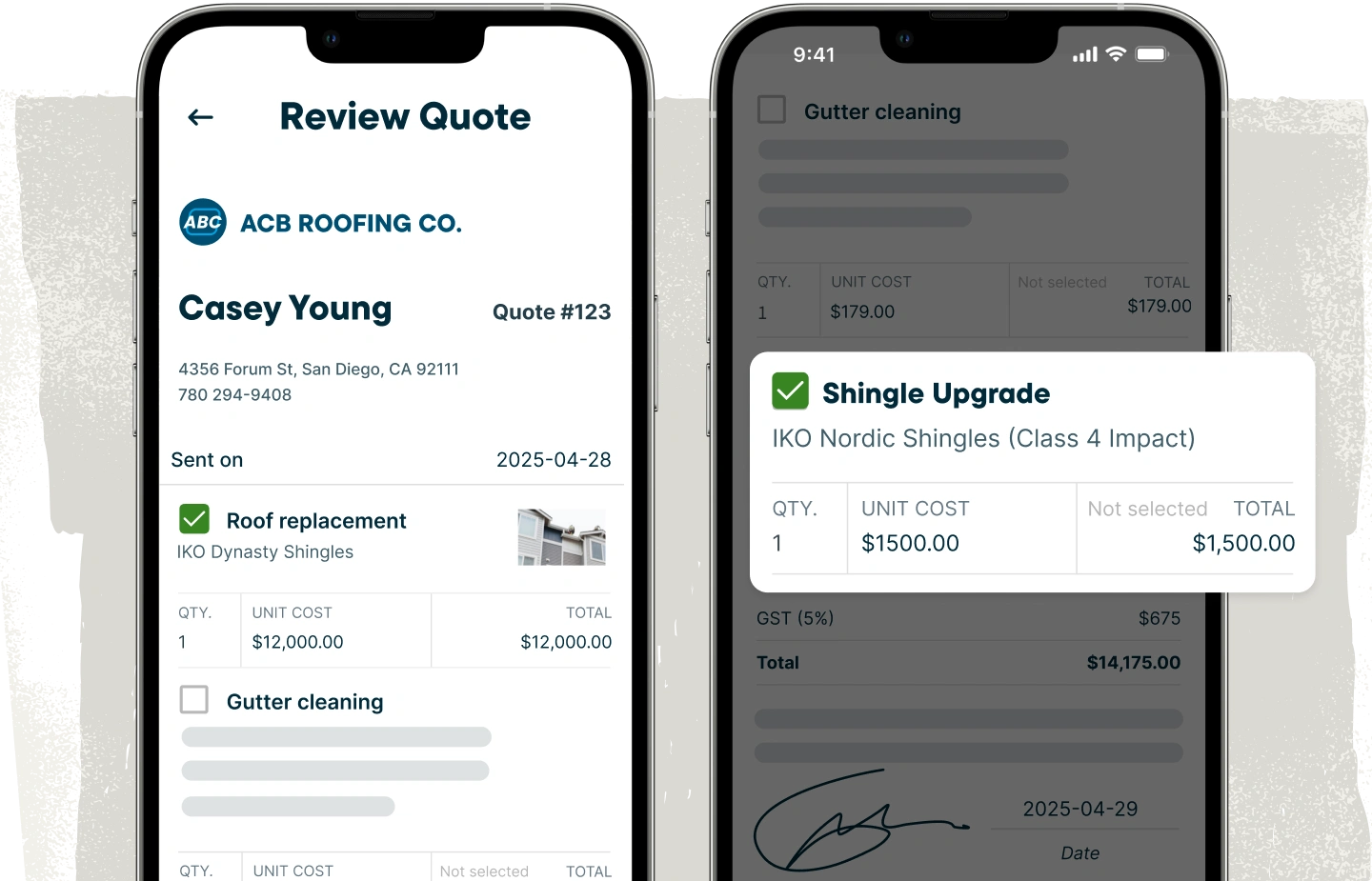
If you’re looking for an easier way to send estimates and invoices to your clients, Jobber’s general contractor business software is the best solution for your construction company.
Use Jobber to create simple yet detailed estimates by using custom estimate templates and adding optional line items. Once you send the estimate, your client can quickly approve through Jobber’s client hub, and you can get to work.
Jobber’s construction estimate software also helps you:
- Schedule and dispatch work once a client approves a quote.
- Track job progress, time, expenses, and costs.
- Send invoices and collect online payments.
- Follow up automatically on outstanding quotes.
- Monitor job profitability against your estimated costs.
Best for
Ideal project types
Jobber is well suited to small and midsize general contractors, remodelers, and specialty contractors that need to manage customer-facing workflows alongside day-to-day job operations.
It’s an especially great option for residential and smaller commercial projects where quoting, scheduling, communication, invoicing, and payments need to stay connected.
Best-fit team and workflow
Jobber is a good fit if you want one platform to manage the customer and operational workflow from the initial request through quote approval, scheduling, job tracking, invoicing, and payment.
It isn’t dedicated construction takeoff software. If you need detailed plan-based takeoffs, you can pair Jobber with ArcSite to combine ArcSite’s takeoff and drawing capabilities with Jobber’s quoting and job management workflow.
Key estimating capabilities
Takeoffs and cost calculations
Jobber isn’t a dedicated construction takeoff tool, but it provides tools to calculate project costs and apply markups to price a job. You can add labor, materials, and other costs to estimates, while the ArcSite integration can handle detailed drawings and takeoffs.
Jobber also supports consumer financing, allowing eligible customers to pay over time while contractors can receive payment upfront.
Bids, proposals, and project handoff
- Close more contracting jobs with automated quote follow-up texts and emails.
- Create professional quotes using custom templates, optional line items, and pricing options.
- Let clients review and approve quotes through client hub.
- Turn approved estimates into scheduled jobs and carry estimate information into the job workflow.
- Turn estimates into invoices when the job is complete in just a few clicks.
We would send out a quote to a customer. Three days later, they would respond to the quote and it’s because Jobber sent them a reminder. We saw our new business skyrocket.
Pros and cons
| Pros | Cons |
| • Connects to accounting software such as QuickBooks and Xero • Client hub for easy communication with customers • Convert estimates into invoices | • No dedicated takeoff capabilities • Its capabilities work best for small to medium-sized construction companies |
Key integrations
Jobber’s key integrations include:
- QuickBooks: Sync Jobber with QuickBooks to keep customer, invoice, payment, and financial information aligned between your field service and accounting workflows.
- Xero: Connect Jobber with Xero to transfer financial information and reduce duplicate data entry when managing invoices and payments.
- CompanyCam: Connect Jobber with CompanyCam to organize project photos and documentation alongside client and job information.
- ArcSite: Connect Jobber with ArcSite to combine detailed mobile drawings and construction takeoffs with Jobber’s quoting, scheduling, job tracking, invoicing, and payment workflow.
Pricing
Jobber offers tiered pricing starting at $29 per user per month.
How Jobber fits the construction workflow
Jobber connects the customer-facing and operational stages of a construction project in one workflow:
- Initial request
- Quote
- Client approval
- Scheduling
- Job tracking
- Invoice
- Payment
- Job costing
If you need detailed plan-based takeoffs, integrating ArcSite adds the takeoff and drawing capabilities that Jobber doesn’t provide natively, while Jobber manages the rest of the customer and job workflow.
How to choose construction estimating software
Finding the best construction estimating software for your construction company will help improve your business’s cash flow, profitability, and bottom line.
READ MORE: How to make money as a contractor
The right choice doesn’t depend on how many features a platform offers. Instead, it’s more about how well the construction software fits the way your business estimates and manages work.
For example, consider how many general contractors you have working for you. With fewer contractors, you might want an estimating solution that drives efficiency. With more contractors, you might want to prioritize staying organized.
Here are some other key factors to consider in your search.
Match the software to your project type
Consider the types of projects you estimate and how complex they are. A residential remodeler may need simple material and labor estimates, while a commercial general contractor may need detailed digital takeoffs, subcontractor bids, and advanced cost tracking.
Look for software that supports the level of detail your projects require without adding unnecessary complexity. If you need plan-based takeoffs, make sure the platform supports them natively or integrates with dedicated takeoff software.
Map your estimating workflow
Before choosing a platform, map out what happens from the initial project request through the final estimate. Consider whether you need to:
- Measure plans
- Calculate material and labor costs
- Apply markups
- Create a proposal
- Get client approval
- Hand off the project to scheduling and job management
Then look for software that supports as much of this workflow as possible in one place. Connecting these steps can reduce duplicate data entry and make it easier to carry estimate information into the job once the client approves the work.
Check ease of use for field and office teams
A powerful tool only works if your team can adopt it. Look for an intuitive interface that your estimators, project managers, and office staff can learn without extensive training. Consider how much setup is required before your team can start creating estimates.
Mobile access is particularly important if your project managers work from job sites. Check whether the mobile app lets your team create or update estimates, access project information, capture measurements or photos, and communicate with clients while they’re in the field.
You should also consider the quality of onboarding and customer support. A platform with useful training resources, implementation help, and responsive support can make it easier to get your team up and running.
Review integrations
Check whether your chosen estimating software connects with the construction apps you already use for accounting, project management, communication, and field operations. For example:
- Accounting: Look for integrations with tools such as QuickBooks. That way, estimates, invoices, payments, and customer information can flow between systems without unnecessary manual entry.
- Project management: If your team uses separate project management software, check whether you can transfer estimates into budgets, projects, schedules, or other workflows.
- Field tools: Consider integrations with tools for photos, takeoffs, drawings, time tracking, or communication if your team relies on them in the field.
Compare pricing and total cost
Don’t compare software based on the advertised subscription price alone. Check whether you’re paying per user, per project, or through a tiered plan, and determine which features and users are included at each level.
You should also consider potential add-ons, implementation or onboarding fees, additional users, payment processing costs, and annual contract requirements. A less expensive plan may cost more in the long run if you need several add-ons to support your workflow.
Use a free trial or demo
Whenever possible, test the software before committing. Use a free trial or demo to build a real estimate from one of your typical projects, create a proposal, and walk through what happens after the client approves it.
Have the people who will actually use the software—including estimators, project managers, and office staff—test it. This can help you identify workflow gaps, usability issues, or missing integrations that aren’t obvious from a feature list.
Get the right construction estimating software for your business
Choosing the best construction estimating software is an essential step toward running a more efficient, accurate, and competitive construction company.
The right tool for your business is the one that fits your workflow and helps you win more work with confidence. Before committing, take advantage of free trials and demos to test which solution truly works best for your team.
Originally published in June 2025. Last updated on October 5, 2026.
Frequently Asked Questions
-
Some construction estimating tools offer free plans or limited free versions with basic estimates, templates, or project tracking. However, paid software typically makes more sense when you need advanced takeoffs, integrations, automation, or support for a growing team.
-
Some construction estimating software include built-in digital takeoff tools, while others focus on estimating and connect with dedicated takeoff software through integrations. Check whether your projects require plan-based takeoffs before choosing a platform.
-
Many construction estimating platforms integrate with QuickBooks and other accounting software to sync estimates, invoices, payments, and customer information. Check each platform’s specific integration capabilities to make sure they support your accounting workflow.
-
The best fit by workflow depends on whether you primarily need takeoffs, estimating, quoting, or an end-to-end quote-to-invoice workflow. For the best fit by team and budget, prioritize software that is easy to adopt, offers the features you need, and is priced to scale with your business.