
Key takeaways:
Explore 16 creative ideas for building a customer referral program that helps service businesses win more high-quality leads and boost repeat bookings.
- Offer tailored rewards to fit your business and customers. Options include service discounts, cash or gift cards, service credits, double-sided incentives, tiered rewards, priority scheduling, and charitable donations.
- Incorporate unique and timely program structures. Consider referral contests, seasonal promotions, limited-time bonuses, neighbor-specific offers, milestone rewards, or split rewards to keep the program engaging and encourage more participation.
- Set clear, simple terms and track referrals effectively. Define program details, reward triggers, geographic or scheduling limits, and use tracking tools to ensure fair and prompt reward distribution for successful referrals.
- Promote your program across multiple channels. Use email, social media, invoices, and follow-ups to let customers know about the program. Include easy-to-share links or codes, and provide templates to make referrals hassle-free.
- Review, adjust, and automate your program for lasting results. Regularly monitor the cost and success of your referral strategy, and consider automation tools like Jobber to streamline requests, tracking, and reward management.
Stay ahead with proven tips for growing your service business. Sign up for the Jobber Newsletter.
Referrals are one of the most effective ways to get high-quality leads that result in booked jobs and repeat customers. They encourage happy clients from past jobs to vouch for your services to their friends, family members, and neighbors.
A referral program boosts word-of-mouth by rewarding clients who send work your way. The right program depends on what you do and who your market is. Some programs reward referring clients with discounts and credits, while others offer gift cards or free products.
Run through this list of customer referral program ideas to find the best fit for your industry, services, customers, and budget to build a successful program in no time.
Start a referral program for your service business:
What is a customer referral program?
A customer referral program gives past clients a reason to send new work your way by offering them rewards like discounts, credits, gift cards, or free products.
Instead of hoping a happy customer passes along your information to a friend, it gives them a reason to actively promote your business.
Referred clients are also easier to win over. 88% of people surveyed said they trust recommendations from people they know more than other forms of advertising.
Referral programs work by turning customer satisfaction into a dedicated marketing strategy. And with 59% of surveyed home service business owners saying referrals and repeat customers are their top sources of new work, it’s almost always worth pursuing.
How does a referral program work?
A referral program works by tracking who sends new customers your way and rewarding them when it results in a booked job. The customer referral process usually includes these steps:
- Onboarding: You invite a happy customer to join your referral program after a job ends by email, in person, or on the final invoice.
- Referral: The customer shares your business information with a connection, ideally with a unique code or link so you can track where the lead comes from.
- Booking: The referred customer books a job and makes a full payment when it’s complete.
- Reward: You reward the original customer for referring work to you. Some businesses also reward the new customer as an added incentive.
When you wait until the referred client makes a payment, you can ensure you don’t reward referring customers for leads that never turn into paid work.
16 customer referral program ideas for service businesses
Referral reward ideas range from discounts and free services to charitable donations. Many home service businesses mix and match rewards based on the time of year, the referral’s value, and what they offer.
1. Recurring service discounts or upgrades
Recurring service discounts or upgrades reward a referring customer through savings on something they already book. This can be by offering a discount on their next service, a complimentary upgrade, or a free month of service.
Many businesses wait until the referred customer books a recurring service before rewarding the referring client. You’ll need to decide when they earn the reward and how many visits they get, like a single service or multiple bookings within a set period. For example:
- JS Pest Control gives customers their next pest control visit free when they refer friends who sign up for an annual service plan.
- DLL Cleaning Services offers a $25 credit on future bookings for every successful referral.
Why it works: The reward is tied to a service a customer already pays for, making it less work for customers to participate.
Mistakes to avoid: Using vague terms about when the reward will be applied, who qualifies, and how many services it applies to.
2. Cash and gift-card rewards for one-time jobs
When customers book a one-time service like a roof replacement or water heater repair, a discount on a future service won’t mean much. Cash and gift cards give them something they can use right away. For example:
- PV Heating, Cooling, and Plumbing offers Visa gift cards to referring customers once a referred job is complete, with card values ranging from $50 to $250.
- CertaPro Painters sends a $50 gift card to customers who provide them with a successful referral for a project of $2,000 or more.
Why it works: The reward isn’t dependent on the customer booking another service with you, which is better for one-off projects.
Mistakes to avoid: Offering a flat rate regardless of job size and taking too long to deliver a reward.
3. Service credits
Service credits apply a dollar value to a referring customer’s next bill. The credits are earned once a referred customer’s job is complete and automatically come off the referrer’s invoice.
For example, Turner Pest Control gives referring customers a $50 credit once their referral signs up for a recurring service and completes their first treatment.
Some service providers prefer to set a percentage instead, like 10% of the value of the referred project. With referral tools like Jobber Referrals, you can choose between a fixed dollar amount and a percentage, which isn’t applied until the new customer’s bill has been paid.
Why it works: It encourages customers to book more work with you by offering them a credit that only applies to your services.
Mistakes to avoid: Forgetting to outline whether or when credits expire and what they can or can’t be applied to.
4. Double-sided incentives
Double-sided incentives offer both the referring and referred customers a reward. They make it easier for a new customer to choose you over a competitor, while helping existing customers make an introduction without feeling like they’re selling something. For example:
- Rose Pest Solutions gives referring customers and their friends a $50 credit toward an ongoing maintenance program.
- NW Maids offers referring customers a $50 commission, while the referred person gets $50 off their first cleaning service.
Why it works: Both current and potential customers have a stake in following through, helping to turn the referral into actual booked jobs.
Mistakes to avoid: Forgetting to track successful referrals, so you don’t know who qualifies for a credit.
5. Referral contests
Referral contests turn referring into a friendly competition. A current customer can earn an entry or move up on a leaderboard each time they make a successful referral. At the end of a set period, you can select a winner either based on points or by a random draw.
Since more referrals mean more entries, the prizes are often bigger, like a free season of service or cash. For example:
- A lawn care company could run a contest for the month of May where the customer with the most referrals wins a free season of mowing.
- A house cleaning company could enter every referring customer into a monthly draw for a free deep clean, with one entry per referral.
- An HVAC company could run a fall leaderboard where the top referrer by December 1st wins a $500 prepaid Visa gift card.
Many contests still reward each referral with something small, like a discount or credit, so referring customers don’t feel like their referrals didn’t count.
Why it works: Using a deadline gives your customer base a reason to refer you today instead of waiting until someone they know mentions needing your services.
Mistakes to avoid: Unclear contest rules, like when it starts, ends, who qualifies, and what counts as a referral.
6. Holiday and seasonal referral programs
Holiday and seasonal referral programs tie offers to a specific time of year, like spring cleaning or the start of winter. They’re only available for a limited time and line up with the services customers already want at that time of year.
Unlike a contest, a seasonal program doesn’t have a winner. Every customer who makes a referral during that time gets the same reward. For example:
- A landscaping company could offer customers a free spring cleanup when a neighbor books a lawn care package between March and May.
- A snow removal company could give customers a $25 credit towards next season’s contract for everyone they refer before the first snowfall.
- A cleaning company could run a holiday offer in December where customers get a free add-on for a successful referral, like an oven cleaning.
- A pest control company could reward referring customers with a $50 gift card for every referral that signs up for a mosquito treatment plan during the summer months.
Why it works: Customers are already looking to book certain services during that season. This keeps your offer top of mind and makes it easier to send new bookings your way.
Mistakes to avoid: Not setting a clear start and end date, or promoting services that don’t fit the season, like holiday light installation in April.
7. Limited-time referral bonuses
Limited-time referral bonuses boost your regular rewards for a short window, like doubling a $25 service credit for two weeks. For example:
- A window cleaning company could double its referral reward from $25 to $50 for any referral booked within the next 14 days.
- A plumbing company could add a free drain cleaning on top of their regular reward for referrals who book by the end of the month.
- A lawn care company could offer an additional $20 gift card to customers whose referrals sign up for a recurring plan during a one-week promotion.
You can run limited-time bonuses whenever you need more customers fast, like during the slow season or when you have gaps in your schedule.
Why it works: The short window and increased reward gives customers a reason to act now.
Mistakes to avoid: Forgetting to set a time limit or running bonuses so often that customers wait for your next promotion to make their referral.
8. Charitable donations
Charitable donation referral rewards give back to a good cause instead of rewarding the referrer directly. When a referral books or completes a job, you donate a set amount to a local charity or let the referring customer choose from a list of approved options. For example:
- Two Small Men With Big Hearts Moving Co. donates $10 to local food banks every time a referral books a move with them.
- A pet waste cleanup company could donate $25 to a local animal shelter for every referral that books for at least three consecutive months.
Why it works: Customers feel good about supporting a cause, and the donation shows your business cares about the local community.
Mistakes to avoid: Not telling customers how much was donated or choosing a cause your customers don’t connect with.
9. Referral-count milestones and tiered rewards
Milestone and tiered referral rewards increase the value of the reward as a customer makes more referrals, like a bigger bonus on the fifth compared to the first. You can reset the tiers each year or let customers keep building towards the next level. For example:
- A cleaning company could offer a $20 credit for the first referral, $30 for the second, and a free deep cleaning for the third.
- A lawn care company could offer a free mowing for every fifth referral.
Why it works: It gives customers a reason to keep sending referrals your way, since a new level or reward is in sight.
Mistakes to avoid: Making the tiers too hard or complicated to reach so customers don’t bother to refer you.
10. Referral partnerships with businesses
B2B referral programs are when two businesses work together to share customers. They work best between businesses that serve the same homeowners but offer different services. Try one of these referral ideas for business owners:
- A house cleaner partners with a real estate agent. The real estate agent recommends the cleaner for move-in and move-out cleans, and the cleaner gives them a $25 gift card for every referral.
- A pressure washing company and painting business team up to share customers who may need both services for a single project.
Why it works: You reach customers in need of your services who already trust the other company that’s referring you.
Mistakes to avoid: Partnering with businesses you wouldn’t recommend yourself or whose services don’t make sense when paired with yours.
11. Neighbor referral offers
Neighbor referral offers reward referring customers within a defined service area, like a specific street or neighborhood. They work best for local work, like lawn care, window cleaning, and pool service.
The idea is for each referred visit to add a stop without increasing drive time. Check out these referral service examples:
- Jet Window Cleaning offers a 10% discount to neighbors on the same street who book on the same day as another customer they’re already servicing.
- Neighbors Lawn Services takes $5 off each ongoing service when a neighbor on either side signs up for lawn maintenance.
Scheduling conditions keep the reward in check. You might require neighbors to book on the same day or within a set period. That way, you don’t waste time driving back and forth to a neighborhood you aren’t already working in.
The incentive needs to pay off, so compare the discount to the fuel and travel time you’d save.
Why it works: It results in more booked jobs without adding to your travel time and increases work in a specific area.
Mistakes to avoid: Not defining a time period or service area, which can cut into your per-job profit.
12. First-referral bonuses
First-referral bonuses are designed for customers who have never referred you before. In exchange for their referral, you give them a one-time referral boost, like doubling the regular referral reward or offering a bonus service.
Try one of these first-time referral program ideas for service business owners:
- A pool service company could offer a first-time referral reward of $50, and their standard $25 for every referral after that.
- A lawn care company could offer a free fertilizer application on top of a service credit to first-time referrers.
Why it works: A bigger first reward helps get customers involved in your referral program, showing them how easy it is to participate.
Mistakes to avoid: Offering too much or too little as a first-time reward, or not clarifying that the reward only applies to the first referral.
13. Rewards for referred customers who stay
For recurring services, you don’t have to reward a referral after the first booking. Instead, you can hold it back until the new customer completes several paid visits.
This ensures any referrals specific to recurring work actually result in more than one job, like in these referral program examples:
- Eldredge Cleaning sends referred customers $50 off their first cleaning. Once they complete three visits, the referring customer receives a $125 reward.
- Chalet Landscape gives referring customers a $500 credit on a future service for new referrals. However, this only applies if the referred customer signs up for weekly or biweekly services for the remainder of the landscaping season.
Why it works: You only pay out a reward for customers who book recurring work with your business.
Mistakes to avoid: Setting the requirements so high that customers don’t bother to refer you to anyone.
14. Early booking or priority scheduling perks
Early booking and priority scheduling perks reward referrers with access instead of money, like first pick of seasonal openings or preferred appointment slots. They work best when demand is high, and your schedule fills up fast. Consider business referral program ideas like these:
- A holiday lighting company could let referring customers book installations first, before they open their calendar to the public.
- A cleaning company could let referring customers pick their preferred time slots before anyone else.
Why it works: It offers customers something they may value more than a small discount or credit without eating into your profit.
Mistakes to avoid: Promising priority booking you can’t deliver on during busy seasons, or offering dates and slots no one wants.
15. Let customers choose their referral reward
Customers have different needs, so letting them choose their referral reward means they’re more likely to get what they want. It takes the guesswork out of choosing what you think your customers would prefer.
For example:
- Hammond Services lets referring customers choose between cash, a gift card, or a charitable donation.
- An HVAC company could offer a gift card, but let customers choose where it’s from, like their favorite restaurant or gas station.
Why it works: Choice lets customers pick the reward that means the most to them, making it appealing to more people.
Mistakes to avoid: Offering too many choices or making one option noticeably more valuable than the others.
16. Split rewards across referral milestones
Split rewards are paid out in stages. You give a small reward when a referral qualifies, like when they book an estimate, then a larger one when the job’s finished and paid for. It keeps referrers motivated to send leads your way while saving a bigger payout for completed projects.
For example, CertaPro of Toms River offers a $25 gift card when a referral leads to a proposal of $2,500 or more, and a $100 gift card once it leads to a completed job.
Why it works: The initial reward thanks the customer for sending a lead to you in the first place, and you only offer a bigger reward if the referral results in a completed job.
Mistakes to avoid: Forgetting to define what qualifies for a reward at each stage or making the first milestone too simple, costing you more than it makes.
How do you choose a customer referral program?
To choose a customer referral program that works for your business, you need to match the reward to your customers, set a budget, and choose clear terms.
The right fit depends on the kind of work you do and who you do it for. Follow these steps to choose the program that’s best for your company:
1. Understand your customers
The best referral program offers a reward your customers actually want. Start with how they buy from you by considering these questions:
- How often do they book? Customers with recurring services tend to prefer credits or referral discounts they can use right away. One-time customers may get more out of cash or a gift card that isn’t dependent on booking again.
- What is a typical customer worth? Higher-value jobs make it easier to offer larger rewards. A smaller, recurring job, on the other hand, might only justify a modest reward.
- Who already refers you? Your best referrers are often your long-standing customers. Think about what would feel like genuine appreciation to them, and what would help improve their customer experience.
If you’re not sure where to start, just ask. Send a quick email or survey to your best customers, asking what they would prefer as a referral reward. This is a simple way to narrow down referral incentive ideas.
2. Do the math
Before you pick a reward, make sure it isn’t going to cut too deeply into profit. It needs to be both affordable for your business and appealing to the customer.
A simple breakdown can help determine how much you have to work with. For example:
- Job value: $300
- New customer referral discount: -$25
- Service costs (labor, materials, fuel): -$150
- Referrer reward: -$25
- Total left before overhead and taxes: $100
Swap in your own numbers to see how much room you have to work with after deducting costs from a typical job’s value. Then decide what a reasonable reward could be.
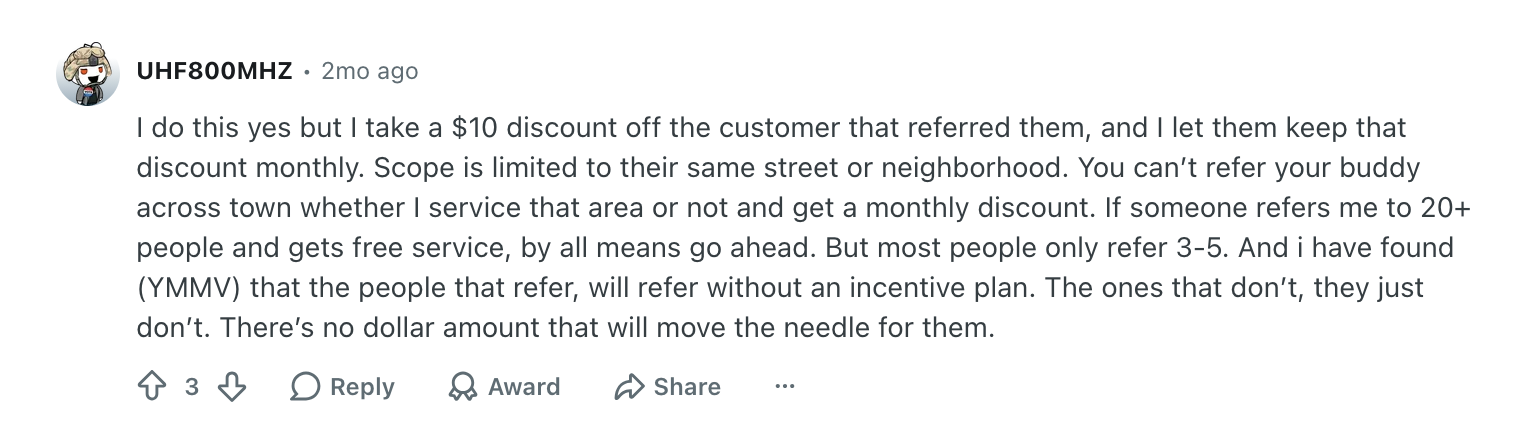
In a community discussion, one pool service business owner said they offer a $10 monthly discount to customers who refer someone on the same street or in the same neighborhood. Since most of their referring customers only send 3–5 referrals, costs stay manageable.
3. Know your desired program length
Customer referral programs can be ongoing, seasonal, or limited time only. Which you choose depends on the work you offer and what you can afford.
- Ongoing referral programs work best when you have steady, ongoing work or recurring clients. A cleaning company could use this type of program to encourage long-time customers to regularly send work their way.
- Seasonal referral campaigns make sense for service businesses with busy and slow seasons, like lawn care and holiday lighting. You can use them before the busy season to fill up your calendar or during slow months to drum up extra work.
- Limited-time referral offers are an effective way to test out a potential program to see how customers respond and how it affects your budget. They also work well if you have an unexpected slowdown in business and want to win new customers fast.
You don’t have to commit upfront. You can test out a few different options before settling on one that works for your budget, customers, and services.
How to get customer referrals
The simplest way to get referrals is to ask for them. Happy customers may not think to refer your business to friends unless you give them a little nudge. Here’s how to make the request easy for everyone:
- Ask when they’re happiest, like at the end of a job, after they leave a review, or when they make a payment.
- Make sharing easy by providing a referral link, code, or business card that tells them the basics of your program in one line. For example, with a “Give $25, get $25” offer, the referring customer offers a friend a $25 discount and gets a $25 credit in return.
- Keep the in-person request short. All you need to say is, “I’m glad you’re happy with how the job turned out! If you know anyone who needs [service], I’d love to help them, too. We’ll send you [reward] once they book.”
- Give them a message to pass along, like “Hi [name]! I’ve been using [business name] for [service], and they’ve been great. Mention my name or use this link to get [new customer offer] on your first job: [link]”
You can also add a line about your referral program to invoices, customer service follow-ups, thank-you notes, review requests, and payment receipts.
How to build a customer referral program
To build a referral program, you need a simple workflow to keep it running. Follow this process to get started:
- Ask for referrals. Send a request to happy customers after a job wraps up.
- Track who sent them. Note who sent each customer so you know who to reward.
- Deliver the reward. Wait until the referred customer’s job is done and paid in full before rewarding the referring customer.
- Check your numbers. Review leads, jobs, referral revenue, and reward costs to determine whether your program is worth it.
Jobber Referrals supports each of these steps. That way, you don’t have to track referrals in a spreadsheet or remember who to send rewards to.
Automated referral requests
Asking for referrals is time-consuming for service business owners with more than a handful of clients. Automating referral requests with software like Jobber Referrals handles the admin for you, whether you want to send one-off emails or fully automated campaigns.
You can automate referral requests to send after a completed job or separate customers into segments, like customers whose last job was completed more than 12 months ago.
Each template is also ready to customize. Just change the subject line, body content, and image to make it sound like you. Every client also gets a unique referral link so you know exactly where each referral comes from.
Referral tracking
Once a referral request goes out, you need to be able to track it. That ensures you always know who to give a reward to. Jobber Referrals handles this through:
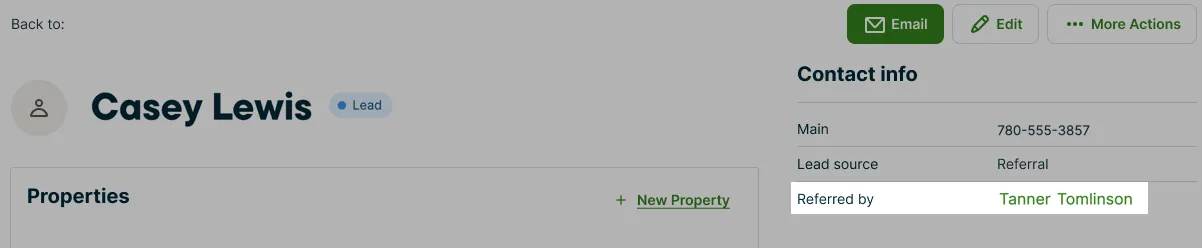
- Unique referral links: Each referral request comes with a unique link for your customer to share, so you always know who referred someone to you.
- Automatic attribution: When someone uses a referral link to request a service, it automatically shows the referrer as the lead source.
- Manual referral entry: If a referral comes in by phone or during a conversation, you can add it manually, so no one gets missed.
Referral incentives
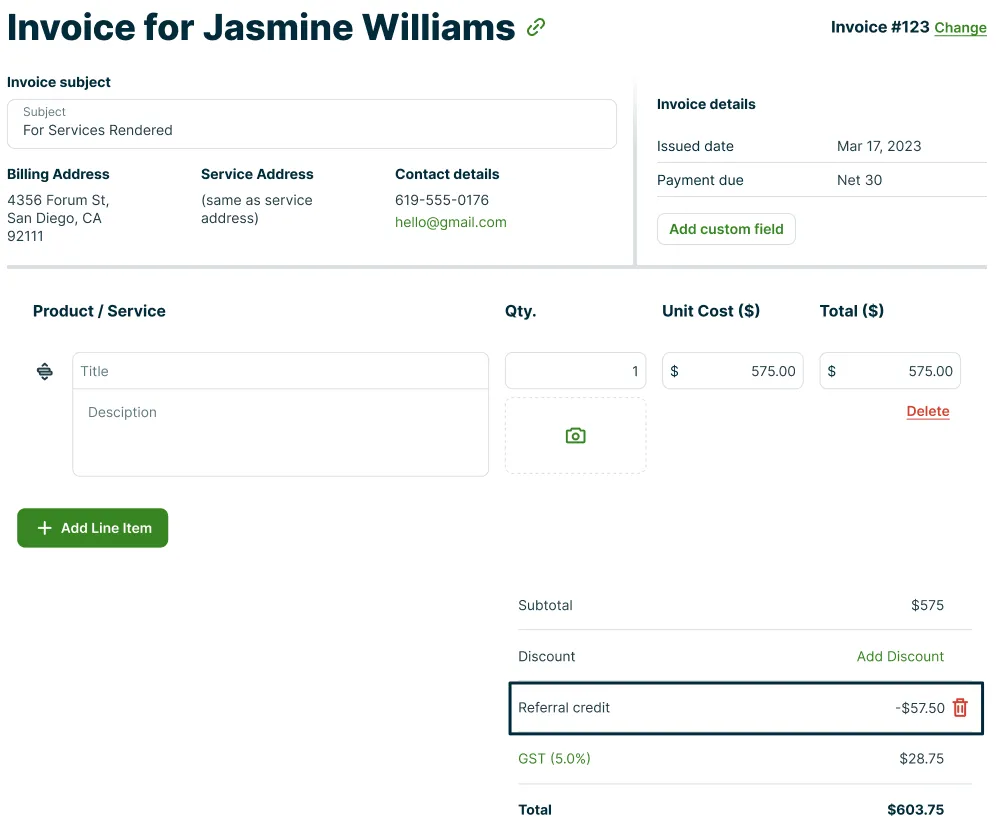
The next step is rewarding the referrer. In Jobber Referrals, the reward is a credit toward their next invoice. It works like this:
- Pick your referral credit. You can choose between a fixed dollar amount, like $25, or a percentage, like 10%.
- The referred customer has to make a payment before the referrer receives their credit. Before that, it’s marked as pending.
- Only one credit is applied to an invoice at a time, even if a referring customer has multiple credits on their account. The earliest credit is applied first, and any others carry over to later invoices.
- Credits automatically apply to manually created invoices, not invoices generated by automatic payments or the mobile app.
Referral reporting
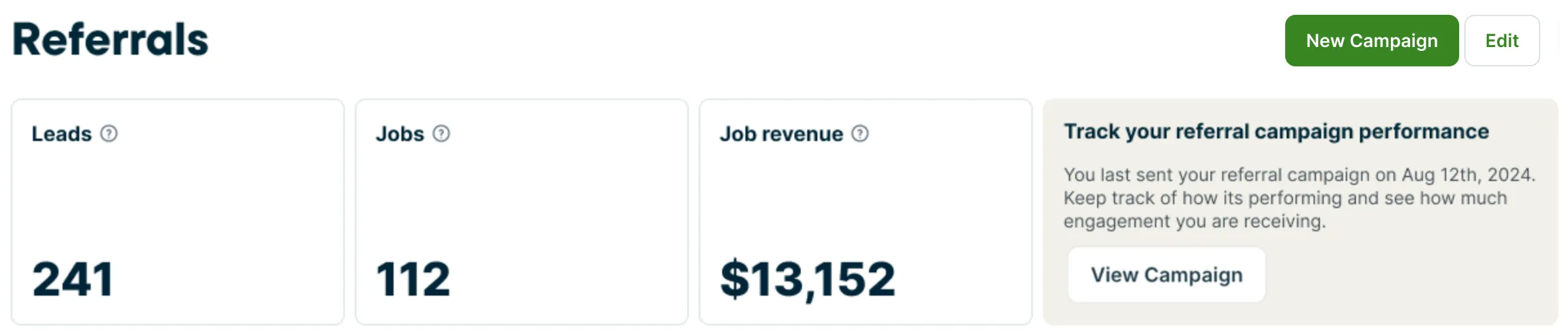
The last step is to check whether your referral program is paying off. The Jobber Referrals dashboard shows you:
- The total number of leads, jobs, and job revenue that came through referrals
- How many people each referring customer has sent to you, the jobs and revenue that came from each, and their credit balance
- Each referral’s credit status, such as “pending” until the referred customer pays, “earned” once they do, and “applied” once the credit is used on an invoice
Jobber reports that 70% of campaigns made through Jobber result in new work being booked.
How to promote a customer referral program
Once you have a referral program in place, it’s time to let customers know it exists. Emails or social media posts are easy places to start doing referral marketing. Each one should introduce the program, explain the reward, and share how to join.
Here’s an email template you can use:
Subject: Refer a friend and save $25
Hi [customer name],
We’re launching a referral program to thank customers who send friends and neighbors our way. When you refer someone who books [service], you’ll get $25 off your next job, and they’ll get $25 off their first.
To get started, share this link: [link]
Thanks for trusting us with your [home/property/yard/etc.]
[Your name]
And on social media, you can say:
Know someone who needs [service]? Refer a friend to [business name], and you’ll both get $25 off. Send them to [link] or use code [code] to book.
Starting a successful referral program
Your happiest customers are often more than willing to promote your services to friends and family members. A dedicated referral program makes it easy for them to share your information, and for you to show them how much you appreciate their support.
Keep your customers in mind, stick to a budget, and stay on top of your numbers. That’s how successful referral programs help appeal to clients, boost customer retention, and grow a business.
Originally published in October 2024. Last updated on November 19, 2026.
Frequently Asked Questions
-
Your referral reward should balance profit and value to the customer. Run your numbers before choosing an amount to see how much profit you have to work with before a reward is applied.
If profit is already low on a job, stick to a small reward, or reserve rewards for jobs over a certain value. If profit is high, consider offering a higher-value reward. -
Since most high-ticket jobs aren’t for recurring work, a gift card, discount, or cash works best. For example, Paschal Air, Plumbing & Electric rewards referrals with gift card credit as follows:
• $30 reward for jobs up to $4,999
• $250 reward for jobs of $5,000–$14,999
• $500 reward for jobs of $15,000+ -
You don’t have to reward both the referrer and the new customer, but offering a reward to a new customer gives them a reason to choose you over a competitor. It also helps the referring customer feel less like they’re making a sale to a friend, and more like they’re doing their friend a favor.
-
Yes, gift cards are a common referral reward. They can be Visa gift cards or gift cards to specific places, like a local restaurant or store.
-
Yes, some referral platforms send digital gift cards automatically when a referral qualifies. Jobber Referrals automatically applies a service credit to a customer’s account when the referral is complete. This credit is deducted from the customer’s next invoice.