How to Estimate Electrical Work: A Complete Guide to Pricing, Bidding & Quoting Electrical Jobs

Key takeaways:
Estimating electrical work accurately is essential for winning jobs, maintaining profitability, and growing your business.
- Bid on the right jobs and review specifications thoroughly. Focus on projects suited to your team’s skills, equipment, and resources, and always clarify details and timelines before proceeding.
- Analyze drawings and perform a detailed material takeoff. Carefully study blueprints or site conditions and list every required material, noting current prices and including a disclaimer about price validity due to volatility.
- Calculate labor and overhead costs precisely. Estimate labor hours needed, use regional average rates, and factor in all business overhead to avoid underpricing your services.
- Determine profit margin and set your markup. Calculate your desired profit margin (typically 12–18%), apply it as a markup to your job cost, and choose the best pricing model—hourly, flat rate, or per-unit—to fit the job and client needs.
- Create detailed, professional estimates and avoid common mistakes. Break down costs clearly, include exclusions and terms, and double-check for overlooked expenses like permits or travel to protect your profits and build client trust.
Stay ahead with actionable tips for electrical businesses—sign up for the Jobber Newsletter.
Knowing how to price electrical jobs accurately can help you win more work, earn more profit, and grow your business. This is important for every stage of your company, whether you’re just starting an electrical business or you’ve been operating for years.
There are a lot of elements to consider when you’re pricing your services, like materials, labor, and overhead. Getting these numbers right is critical to make sure your pricing strategy is profitable.
To help you improve your quoting process, we’ll walk you through how to quote electrical jobs the right way.
Here’s how to quote an electrical job:
-
Bid on the right electrical jobs
-
Review electrical job specifications
-
Analyze drawings and blueprints
-
Perform a material takeoff
-
Calculate your labor costs
-
Add in your overhead costs
-
Decide your profit margin and add a markup
-
How to price electrical work
-
How to bid electrical jobs
-
Estimating residential vs. commercial electrical work
-
Create your electrical estimate
-
Common estimating mistakes to avoid
1. Bid on the right electrical jobs
The most important parts of running a successful electrical business are bidding on the jobs you know you can deliver and that fit your objectives.
It’s crucial to be aware of your skills and understand what types of jobs are right for you—including jobs you’ve done before—and which ones might be too much to handle.
Factors to consider when bidding on electrical jobs are:
- Skills and equipment: In addition to having the skills to complete the job, you also want to make sure you have the right tools. If renting a tool and other equipment logistics are going to cost you time and money, it might not be worth it.
- Job site: Electrical work on paper is not always what it seems at the job site. For example, a job at a well-organized luxury house may require hours of labor laying floor protection and cleaning every day. This adds to your total costs and could eat into your profit margin.
- Client management: If a client is decisive and trusting, you will have an easier time focusing on the work. If a client wants a walkthrough of every wire installed, you’ll spend more time talking and less time working. The longer the job takes, the smaller your margin.
- Calendar: Every electrical business wants a full work schedule, but one job can have a rippling effect on your whole calendar. Do you want one larger job that will take all your time for a month? Or five smaller projects that will keep you busy and maintain steady cash flow?
Some types of electrical work will fit your business better than others. Having prior experience with these types of jobs will help you provide a more accurate estimate, and complete the electrical work successfully.
2. Review electrical job specifications
If you’re bidding on commercial or construction electrical jobs, you’ll often receive a request for proposal (RFP) that details the specifications of the job.
Review this document carefully to make sure you have an accurate electrical estimate that reflects the specific requirements in the RFP. If anything is unclear, ask questions to get clarification before continuing on to the next step.
When responding to a proposal, iron out any details that may increase your costs. This may come as hidden expenses like power supply or fire-stopping, or price exclusions for things like trenching and permit fees.
Lastly, clarify the project timeline and make sure you can meet the deadline or adjust accordingly. For example, an RFP may indicate a four-week timeline but you need 12 weeks to secure your gear. That should be flagged with the client as part of your response.
3. Analyze drawings and blueprints
Carefully analyze any pictures, architectural and construction drawings, or blueprints provided to understand the electrical requirements for the job.
Look for anything that may increase the project’s difficulty or affect the materials or equipment you’ll need to get the job done. You’ll want to pay close attention to a building’s plumbing, HVAC, and elevations.
If the electrical service is for a house and the homeowner can’t provide the blueprints or drawings, request a walk-through to get a full picture of the project’s requirements.
4. Perform a material takeoff
An electrical or material takeoff is a comprehensive list of the inventory you’ll need for the job.
To perform an electrical takeoff, work off the existing blueprints to create a list of all the materials and quantities needed for the specific project.
Depending on the project, your material takeoff sheet will include:
- Light fixtures
- Conduit
- Electrical wiring
- Switches
- Switchboards
- Circuit breakers
- Emergency or backup systems
- Electrical outlets and switches
- Energy efficiency upgrades
Then use this list to calculate prices for each material and your total materials and electrical costs. Keep this document handy, as you’ll include the required materials and pricing in your estimate.
Example: 1,000 sq. ft. office tenant improvement (TI)
| Item description | Quantity | Cost per item | Total cost |
|---|---|---|---|
| 2×4 LED flat plate troffers (dimmable) | 12 | $85.00 | $1,020.00 |
| 1/2″ EMT conduit (10ft lengths) | 50 | $12.00 | $600.00 |
| 12 AWG THHN wire (500ft spools – black/white/green) | 6 | $95.00 | $570.00 |
| 4″ square boxes and mud rings | 25 | $6.50 | $162.50 |
| Commercial grade duplex receptacles (20A) | 20 | $4.50 | $90.00 |
| 20A single pole breakers (square D/Eaton compatible) | 6 | $15.00 | $90.00 |
| MC cable 12/2 (250ft coil for whips) | 2 | $165.00 | $330.00 |
| Occupancy sensors and wall switches | 4 | $45.00 | $180.00 |
| Misc. hardware (couplings, connectors, wire nuts, supports) | 1 Lot | $250.00 | $250.00 |
| SUBTOTAL MATERIALS | $3,292.50 |
The above material costs are based on market-average estimates. These prices can fluctuate from week to week, so put a disclaimer in your electrical quote that says “material pricing is valid for 14 days due to market volatility.”
5. Calculate your labor costs
Now that you fully understand the requirements of the job, you can figure out how many electricians you’ll need and how long the job will take to complete. Use this formula to calculate your labor cost:
Total labor cost = Hourly labor rate x number of labor hours
Electricians who work on residential or commercial electrical jobs typically charge per hour. If you’re bidding on a new construction project, you may choose to charge a flat fee upfront.
However you decide to charge, make sure you include a little extra time in case your electrical contractor runs into complications on the job.
Average hourly rate for an electrician
On average, electricians earn an hourly rate of $29.51 in the U.S. But your hourly wage and annual salary will depend on where you work, how much experience you have, and the electrical license you hold.
For example, journeyman electricians earn (on average) $68,058 annually, and master electricians earn an average of $79,936 annually.
READ MORE: How much do electricians make?
Example: Residential panel upgrade labor estimate
| Phase | Estimated man-hours | Tasks |
|---|---|---|
| 1. Prep and demo | 4 hours | Coordinate with utility, pull meter, and strip old equipment |
| 2. Rough and mount | 6 hours | Install new mast, panel tub, and grounding system |
| 3. Trim and test | 4 hours | Land circuits, install breakers, and final labeling |
| TOTAL | 14 hours | Projected labor cost: $413.14 |
6. Add in your overhead costs
Your overhead costs are the operational expenses you pay to keep your business running smoothly, like:
- Business equipment (like tablets, computers, or cell phones)
- Work vehicles, fuel, and maintenance
- Office rent
- Electrical advertising and marketing
- Electrical business management software
- Taxes and electrical contractors’ insurance
- Electrical tools (like voltage testers, wire cutters, and screwdrivers)
- Safety equipment and PPE
- General liability and workers’ compensation insurance
- Electrician licenses and certifications
- Warehouses and/or storage units
- Permits
To figure out your hourly overhead rate, use this formula:
Total monthly overhead costs ÷ Number of billable hours per month
For example, if your overhead costs for the month are $4,000 and your business produces 500 billable hours every month, your overhead costs would be $8.00 per hour.
To calculate your overhead costs for an electrical job, use the following formula:
Hourly overhead costs x Number of hours the job will take to complete
READ MORE: A guide to pricing strategies for service businesses
7. Decide your profit margin and add a markup
Your profit margin is how much money you make once you’ve covered all the costs for a job, like materials and labor. Your markup is the amount you take home after applying your profit margin.
If your ideal profit margin is 15%, use this formula to determine your markup:
(Hourly rate + material cost + overhead costs) x 0.15 = your markup
Then add your markup to the cost estimate to get the total price for the electrical work.
You can also use Jobber’s electrical estimating calculator to calculate the total cost for your electrical job, or a profit margin calculator to ensure every job is profitable.
Industry benchmarks for a healthy profit margin are 12–18%. Setting a starting point of 15% is a solid baseline to begin your calculations.
Example: Residential bathroom remodel estimate
Consider a bathroom remodel that includes the installation of an outlet, vanity light, shower light, and exhaust fan.
| Category | Costs | Subtotal |
|---|---|---|
| Materials | ROMEX wire, boxes, devices, plates, fan, and fixtures | $450.00 |
| Labor | 8 hours of work (rough-in + trim) × $29.51/hr | $236.08 |
| Overhead | Business expenses (estimated 20% of labor + materials) | $137.22 |
| Total base cost | The actual cost to your business to do the job | $823.30 |
Now that you have your total cost, you can add your markup.
$823.30 (total cost) x 1.15 (markup) = $946.80
For this bathroom remodel, you should charge $946.80 to cover your costs and reach your target profit margin of 15%.
How to price electrical work
With a good understanding of your total costs, you can select one of three methods of pricing electrical work—hourly, flat rate, or per-unit pricing.
- Hourly pricing is based on labor and the amount of time a job takes. It keeps you accountable for how you use your time, but can be unpredictable for the client.
- Flat rate pricing applies a single rate for an entire job. It’s more predictable for the client, but you run the risk of underestimating the work.
- Per-unit pricing takes a fixed rate and multiplies it for each item installed. It makes quoting more efficient, but can also be underestimated if issues arise on the job.
Each model has its benefits. It’s up to you to decide how to charge for electrical work for your business and customers.
Example: Residential installation for ceiling fans
In this example, we’re installing three standard ceiling fans using the average electrician hourly rate of $29.51.
| Pricing strategy | Calculation | Total price |
|---|---|---|
| Hourly rate | (1.5 hours per fan × 3 fans) × $29.51 | $132.80 |
| Flat rate | (4.5 total hours × $29.51) + $100 travel and setup fee | $232.80 |
| Per-unit pricing | $125.00 fixed rate per fan × 3 fans | $375.00 |
The per-unit pricing is the most profitable in this scenario because it incorporates all your costs and profit margin. The client is charged for the outcome and not the process.
How to bid electrical jobs
Bidding on electrical jobs is a process that should be a primary focus for your business. It requires significant planning, preparation, and attention to detail. The process includes:
Request for proposal (RFP)
The bidding process typically starts with the RFP. The client has a job that needs to be done, and they send out all the requirements for you to review. An RFP includes:
- Project overview and timeline
- Scope of work
- Technical specifications
- Job site information
- Submission requirements
- How a bid will be selected
- Insurance requirements
- Exclusions and other assumptions
Competitive vs. negotiated bid
For your pitch, you’ll either be looking at a competitive bid or negotiated bid.
- A competitive bid is an open call for electrical businesses to compete for a client’s project. The winning bid is usually a product of efficient labor and affordable materials to keep the cost low.
- A negotiated bid is the result of a client specifically reaching out to your business with a project for consideration. For this bid, you’re working with the client to build a mutually beneficial agreement that fits the unique capabilities of your business and the project budget.
The main difference between the two types of bids is whether you’re competing with other businesses to win the work.
Bid-to-win strategies
Winning a bid isn’t just about being the lowest price. You need to find the balance between cost, quality, and service to provide the most value. Here are a few winning strategies to consider in your project bid:
- Pricing options: Provide a range of good, better, best pricing options that showcase your understanding of the project requirements and client needs. This might mean using more affordable materials in certain situations, as long as everything meets electrical code standards.
- Define exclusions: Let the client know what services you won’t provide—like trenching or drywall—so they can be confident there won’t be any hidden costs later in the project.
- Competitive pricing: The lowest bid often doesn’t win because clients feel something is missing. A detailed and cost-effective bid that’s slightly higher than the lowest option showcases your professionalism and feels more reliable as a service.
When to bid vs. when to decline a project
Bidding on a project comes down to your biggest strengths as a business and the ability to meet the client’s needs at a high level.
You should bid on a project when:
- Your business specializes in the work required.
- You have enough capacity in your team to take on the job.
- The job is in an area that won’t result in a lot of travel expenses.
- The client is a good fit for your company and you’d like to develop a relationship.
- The budget and payment terms fit your business needs.
You should decline a project when:
- The RFP is unclear and incomplete.
- The competition is high and you have a low chance of winning the bid.
- There are safety concerns with the type of work or location.
- Taking on the job would have a negative impact on other clients and your schedule.
- The financial terms aren’t strong enough (cost, budget, profit margin, etc.).
Sample Bid: Kitchen lighting upgrade
Client: [Name] | Date: April 29, 2026
Service options
We’ve outlined three options to update the lighting features in the kitchen. The three tiers are based on your initial needs with the option to install additional lighting and smart home features.
- Good (standard): Install 6 standard LED recessed lights with wall mounts ($1,250)
- Better (modern): Install 6 standard LED recessed lights with wall mounts; plus under-cabinet LED tape lighting and dimmers ($1,850)
- Best (smart home): Install 6 standard LED recessed lights with wall mounts; under-cabinet LED tape lighting and dimmers; plus motion-sensing pantry lighting and voice-control setup ($2,400)
Project Exclusions
The services we will not provide include:
- Drywall & Paint: Patching, sanding, and painting
- Permit Fees: City permit fees will be billed as a separate line item.
- Furniture Moving: Please ensure the kitchen area is clear prior to the work starting.
Why choose us?
- We use compliant materials and certified labor hours.
- We ensure a clean working space, including the use of floor runners and HEPA-filtered dust extraction
- Our price includes high-quality fixtures that come with a replacement warranty, saving you maintenance costs.
Estimating residential electrical work vs. commercial electrical work
Depending on whether you offer residential or commercial electrical services, how you estimate jobs may slightly differ. Here’s how to price jobs for residential and commercial electrical work:
Residential electrical work
When estimating for residential electrical work, start with a walkthrough of the house to evaluate the state of the property and the scope of the work that needs to be done.
Your walkthrough checklist should highlight things like:
- The condition of the main panel: Does it have room to add new circuits or does the entire unit have to be replaced?
- Access points: Can you easily get to the area that needs electrical work or will you have to cut through drywall to gain access?
- Existing wires: Is the home equipped with old or modern wiring? Is the current electrical wiring and system up to safety and code standards?
- Safety alarms: Do all the smoke alarms work properly?
- Outlet locations: Where does the homeowner want new lights and/or outlets installed?
Once you understand the condition of the home and its electrical system, you can properly evaluate and estimate the work. The most common residential jobs fall under these categories:
- Panel upgrades: Replacing an old electrical panel for a new one to handle more power.
- Kitchen remodels and moving appliances: Installing lights and outlets, and reconfiguring appliance setups as part of kitchen makeovers.
- EV chargers: Installing a fast-charging station in the garage for an electric car.
- Smart home setup: Setting up smart light switches that can be controlled by a device like a home hub or smart phone.
Estimating residential jobs follows the same format as any electrical work. Once you have the scope of the project, you can effectively price out the materials and labor before adding your markup.
And while every home is unique, there are typical estimate ranges for common residential electrical work. Here are a few examples:
- Fixing lights or outlets: $150–$500
- Installing an EV car charger: $800–$2,500
- Upgrading the main panel: $2,000–$4,500
- Rewiring a whole house: $15,000–$25,000
Residential electrical work is a more personal project. You’re working in people’s homes and in their private space, so you need to communicate well and make them feel safe.
Jobber helps you communicate with your clients throughout the course of a project. You can send important messages like visit reminders, quote followups, and on-my-way texts. The client can also respond with two-way texts to keep the conversation nice and simple.
Commercial electrical work
Commercial electrical work is often much larger in scope than residential. It also follows a more formal professional process for bidding and winning jobs. The rules are more strict and the stakes are higher.
The request for proposal (RFP) is the starting point for most commercial work. The client outlines the requirements of the job and sends out a package to you and all your competitors to bid on the project. To give yourself the best chance to produce a winning bid, you’ll want to:
- Carefully review the electrical plans to understand every wire and conduit run in the blueprints.
- Perform a material takeoff and estimate the cost based on market prices.
- Calculate labor costs considering the project timeline and any extra expenses.
- Include all overhead costs and decide on a profit margin.
- Add value by providing material and pricing options to the client.
One major estimating consideration for commercial electrical work is prevailing wages. This is the minimum rate paid to workers within a geographic area. It’s common on large-scale and government-funded electrical projects.
Not only are you required to meet the minimum pay rate for prevailing wages, but you’re also accountable for filing paperwork to prove everyone was paid fairly according to the law.
Now you may have all your plans and estimates prepared, but your electrical business won’t be the only trade on a commercial job. Your estimate needs to reflect thoughtful scheduling and project phases to make sure all trades have enough time to complete their work.
Lastly, your estimate should include time to meet regularly with the general contractor on the job. It’s important to communicate frequently with status updates, safety checks, and coordination throughout the lifetime of the project.
Building a strong relationship with the GC is a good way to be considered for future commercial electrical work.
Create your electrical estimate
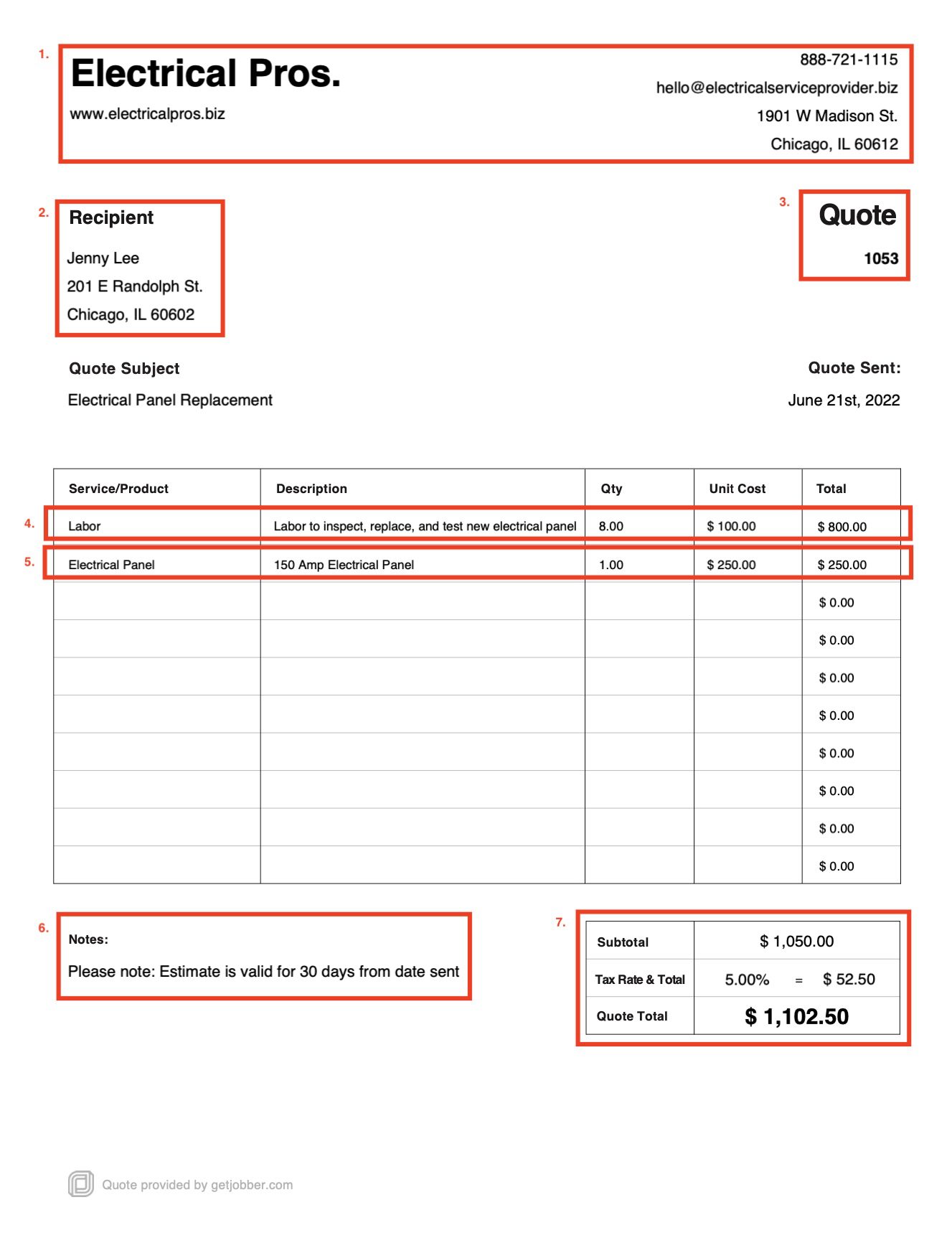
Your electrical estimate should include:
- Your electrical business’s name, logo, and contact information
- Your client’s name and contact information
- An estimate number
- A breakdown of the electrical services or electrical installation you’ll be providing (e.g., replace an electrical panel or install an electrical outlet), and the cost estimate to complete the job
- The electrical materials you’ll need (e.g., wiring, electrical panels) and each material’s cost
- How long the estimate is valid for
- The total cost for the electrical project including taxes
Here’s an example of an electrical estimate you can send to your client:
Some electrical estimating methods, like paper and pen or Google Sheets, can be time-consuming to manually complete.
With an estimate template, creating an electrical estimate should only take a few minutes. This way, you can quickly send professional-looking estimates that impress new clients and win more jobs.
You can use Jobber’s electrical contractor software to handle your estimating and quoting from start to finish in just a few minutes. It takes the manual effort out of estimating so you can get back to the job site.
- Estimating and quoting: Quickly build professional bids using a branded template and saved line items for your services, materials, and prices. Once you’re done, you can send the quote directly to a client with one click.
- Automated quote follow-ups: Jobber automatically sends a friendly reminder to clients who haven’t responded to your estimate. This means you don’t have to spend time chasing leads or worrying about lost work.
- Converting estimates to jobs: Once a client approves your quote, Jobber turns the quote into a scheduled job. The details move to your calendar and a final invoice is prepared, keeping your business organized and cash flowing.
READ MORE: Best electrician invoicing app options
Before using Jobber, there would be times it would take so long to do the back and forth with the clients. I probably lost out on some jobs because of it.
I realized Jobber made a lot of sense when I started to get more jobs out of it.
Common estimating mistakes to avoid
Estimating is not one-size-fits-all for every electrical job and mistakes happen. Keep an eye out for these common mistakes to avoid cutting into your profit:
- Underestimating labor hours: A job taking longer than expected will wear down your profit quickly. This is common in older buildings. For example, you may estimate 30 minutes to cut holes in drywall to install new outlets, and find brick layers behind that result in hours of drilling.
- Ignoring permit costs: Pulling the right permits makes sure you have all necessary costs in your estimate. Without the right permits, you could be subject to penalties and fines.
- Not accounting for travel time or setup/teardown: Include travel and setup in your estimate to make sure you’re accounting for all labor hours and additional expenses. This will help you capture unavoidable expenses and use your time more effectively.
- Failing to include contingency for unexpected issues: Add a contingency into your estimates to protect yourself from unexpected occurrences on a job, like electrical systems that no longer meet safety standards. Building a 10–15% contingency into your estimate helps you maintain your target profit margin.
- Using outdated material prices: Make sure your estimate is up to date to avoid undercharging for critical components. Electrical material costs for things like copper, conduit, and transformers can change from week to week.
Win more jobs with professional electrical estimating software
Knowing how to charge electrical jobs and create professional-looking estimates can help you win more work and grow your business.
Once you send your estimate, use electrical quoting software like Jobber to create and track quotes, schedule jobs, and convert quotes into invoices.
Originally published in June 2021. Last updated on April 29, 2026.
Frequently Asked Questions
-
A material takeoff in electrical estimating is an inventory list of all the supplies you need for a job. Before you begin a project, review the plans and blueprints and perform a site walkthrough to understand all the equipment and materials you need to complete the work. This list is then used to provide a price estimate for the materials to add to your total cost.
-
To calculate the labor cost on an electrical job, you need to understand the amount of people you need working on the project, the hourly rates for those employees, and the total time it will take to complete the job. Multiply the number of team members by their hourly rates, and then multiply that by the number of hours it will take to finish the work. Use this formula:
(Total employees x hourly rates) x total hours to complete job = Total labor cost -
Your overhead costs for electric work should include every expense you incur to provide your services and complete a job. Examples of overhead costs include:
• Business equipment (like tablets, computers, or cell phones)
• Work vehicles, fuel, and maintenance
• Office rent
• Electrical advertising and marketing
• Electrical business management software
• Taxes and electrical contractors’ insurance
• Electrical tools (like voltage testers, wire cutters, and screwdrivers)
• Safety equipment and PPE
• General liability and workers’ compensation insurance
• Electrician licenses and certifications
• Warehouses and/or storage units
• Permits -
Your profit margin is up to you. It’s a target you set to make sure you’re making enough to cover your total costs and bring in more money to grow your business. A healthy profit margin for an electrical business is 12–18%. To calculate the markup on your prices, add up your total costs and multiply by your target profit margin:
(Hourly rate + material cost + overhead costs) x profit margin = your markup -
An electrical estimate should include a summary of the work you’re doing, like installing pot lights and replacing an electrical panel. It should also include the work you’re not doing, like trenching and drywall.
Your estimate should also include clear line items and details about your overhead costs, labor costs, and material costs. In addition to these costs, you should include a markup to secure your target profit margin.
Lastly, your electrical estimate should highlight important payment terms so the client understands when and how they will pay for your services.