


Key takeaways:
Building a strong brand for your service business is key to standing out, attracting ideal clients, and earning lasting trust in your community.
- Start with a clear brand strategy. Define your brand story, the services you offer, your ideal audience, and how you differ from competitors. Set your mission, vision, and values to guide every decision you make.
- Choose the right business name and slogan. Pick a name that’s memorable, easy to pronounce, unique in your industry, and reflective of your services and values. Consider a catchy slogan to reinforce your brand promise.
- Create a distinct visual identity. Design a professional logo, choose a limited set of brand colors, and select easy-to-read fonts to ensure your branding is clear, appealing, and consistent across all materials.
- Apply your branding everywhere. Use your visual identity and messaging on marketing materials like business cards, uniforms, vehicles, and your website to strengthen recognition and trust.
- Promote your brand consistently, online and offline. Launch your brand with a clear introduction, build a strong online presence with an optimized website, social media, and Google Business Profile, and raise awareness in your community through networking and partnerships.
Stay up to date on business-building strategies—sign up for the Jobber Newsletter for tips right to your inbox. Sign up here.
Originally published in May 2016. Last updated on August 27, 2025.
As a small business owner, you want your company to stand out from competitors and impress potential clients. Effective branding is one of the best ways to do that.
But what is a brand? And how do you even go about branding your business? We’ll give you the answers and show you exactly how to build a service brand that helps your business succeed.
We even include insights from experienced home service business owners and Jobber’s own Creative Director, Jason Ford. Jason has worked with world-famous brands like Coca-Cola, Adidas, Red Bull, and Toyota.
How to brand a service business in 7 easy steps:
What is a brand and why does it matter?
Your brand is your business’s overall identity and reputation. It’s the feeling or impression people get when they see, interact with, or think about your business.
For service businesses, branding goes beyond your name and logo. It’s about clearly communicating who you are, what you offer, and what customers can expect.
By intentionally developing your brand, you gain greater control over what people think about your business.
1. Build a brand strategy
To brand your service business, start by figuring out what the company is, what it represents to customers, and how it’ll meet their needs. Your branding strategy should include:
Your brand story
Even if you’re just starting a service business, you still have a story to share. Storytelling is one of the most powerful ways to show people what your business stands for. A good story not only explains what you do but also builds an emotional connection.
What makes you memorable isn’t just the mowing, planting, and seasonal cleanups your landscaping business offers, it’s the story behind them. Maybe you fell in love with landscaping because you grew up working alongside your grandparents in their garden. And now you want to bring that same pride and care to homeowners in the community.
Your brand story should answer three questions:
- Why we started: What inspired you to open your business in the first place?
- A problem we solve: What customer problems do you plan to fix? For example, you design landscapes that don’t just look good in spring, but thrive all year long.
- How our values shape the customer experience: How do your values show up in everyday work? For example, you keep your crew accountable for cleanup so clients never feel like they have to pick up after you.
Here’s a simple way to structure your story:
- The spark: The personal motivation or gap you saw in the market
- The journey: The work you put into growing your business and serving clients
- The outcome: The impact on your customers’ lives and homes
Services
Defining your service list helps you better understand what you offer and communicate that to your clients.
Make a list of all the services you provide, as well as the services you don’t currently offer but plan to provide in the future.
Target audience
Determine who your ideal customer is and what they need from a service provider.
For example, maybe you like working with busy professionals who don’t have time for many household tasks, and they want a company that provides a wide range of services.
Jason recommends asking questions like, “What is my ideal customer? Are they a luxury customer? Do they live in a certain area? Is budget an important factor?”
Knowing the answers to these questions will help you figure out who your ideal potential customer is, what they’re looking for, and how to reach them.
Market and competitive analysis
This step in your branding process involves determining your business’s position in the market before deciding how to position it. Where do you fit in terms of pricing and services?
As part of this brand positioning, you’ll need to identify competitors and see how you compare. Make a list of the top businesses in your area and note their strengths and weaknesses.You’ll also want to perform a SWOT analysis. This involves listing your business’s strengths, weaknesses, opportunities, and threats so you can highlight what you do well and fix anything that needs improvement.
Look at the companies that you’re going to be competing with.
What does the landscape look like? What colors are they using? What fonts? Are they using a character? Is there an illustration in their logo? You want to look different from all those people.
Unique selling proposition (USP)
A USP is the one thing that makes your business different from (and better than) any other competitor. For example, maybe competitors have lots of reviews complaining about poor communication.
This is something you know you can do well, so clear customer communication management can be your USP. Just back up that claim by sending appointment reminders, on-my-way texts, and follow-up emails to clients.
Mission, vision, and values
A clear mission, vision, and values describe why your business exists, where you want it to go, and what qualities are important to you. They will also help guide you as you make business decisions, from hiring employees to planning your marketing efforts.
For example:
- If you promise sustainability, that means using eco-friendly products
- If you claim to be honest, that means being upfront about pricing instead of sneaking in hidden costs
- If you say your team is responsive, that means answering messages within 24 hours—not a week
When you align your values with a consistent customer experience, people will trust your brand.
READ MORE: How this business’s mission sets them apart from competitors
2. Choose a business name and slogan
A brand name is one of the most recognizable pieces of any business, so it’s important to get it right. When you’re naming a business, choose a name that:
- Is short, memorable, and easy to pronounce
- Doesn’t use your name if you plan to sell or franchise
- Is unique in your industry so you can trademark it
- Reflects your services and values
For example, if you know a big part of your brand is clear communication, you could reference that by calling your business something like “Clear Contracting.”
A lot of service pros forget to mention their service area.
If someone’s just looking for three seconds, they need to know what area you service. [A] name like Seattle Plumbers… I know these are plumbers that work in Seattle.
Pro Tip: Find out if your business name is taken by searching for it online. Your area may also have a state or national trademark database you can search.
You can also create a slogan that tells clients what to expect from your business. Using our example of clear communication, you could create a slogan like “Your On-Call Expert.”
Use this slogan alongside your business name on your website, business cards, vehicle, and other marketing materials. It’ll help your slogan—and business name—be recognized and remembered.
3. Decide what your branding looks like
When you’re branding a service business, think carefully about what your brand will actually look like. It should appeal to potential customers while making it clear what you offer.
Here’s what your visual identity includes:
Logo
A brand logo should include your business name at the very least. Many businesses add an icon (a simple picture) as well.
Here’s an example of a logo that goes with our “Clear Contracting” example. Note that the icon is shaped like tools, which helps communicate that this logo is for a contracting business.
You can design your logo yourself using a logo maker like Looka, or you can hire a freelance designer or branding agency to create an identity for you.
Colors
Choose brand colors that stand out from competitors and appeal to your clients. In our example, the gold icon suggests quality and pairs nicely with the clean-looking business name in white.
It’s a good idea to use as few colors as possible in your company branding, especially for print materials like flyers and business cards. Fewer colors will help reduce printing costs, and it makes it easier for customers to recognize you.
Your brand color palette could look something like this:
Fonts
Choose a font that’s clear and easy to read. Different types of fonts can say different things about your business, depending on how simple or fancy they are. So, pick one that feels right for your clients.
Make sure that your font is very legible.
You can’t read a scripty font or a hardcore graffiti font. You have three seconds to say, what is the name of this business? What do they do? If you can’t read that font in three seconds… that’s a mistake.
Pro Tip: When you’re finished with brand building, write down the rules for using your logo, colors, and fonts in a set of brand guidelines. This helps keep your brand identity consistent and improves brand recognition.
4. Design marketing materials to promote your business
Once you have your logo and colors nailed down, you can apply them to every marketing material you use. This can include:
- Vehicle wraps and decals
- Employee uniforms
- Swag (hats, shirts, etc.)
- Business cards and email signatures
- Print ads and digital advertisements
- Email marketing
- Door hangers and postcards
- Digital branding, like your service website and social media
You might feel a little intimidated making these items yourself. But if you’re using Looka to make your logo, it’ll make marketing materials for you. Check out these items for Clear Contracting.
You should also apply your brand to non-marketing items you’ll use every day, like estimates and invoices. (Use our free estimate template and invoice template to get started.)
5. Launch your brand and introduce it to clients
Your brand is ready to roll out. If you’re an existing business that’s rebranding, explain the change to clients and why you did it.
Or, if you’re starting a new business, you can carry out your marketing strategy for your new brand right away. Be ready to answer questions and help clients understand your business.
From there, the most important thing is to use your new brand consistently. Over time, you’ll build up a brand reputation that your customers will recognize and trust.
Consistency is big.
You see your logo and your fonts and your colors every day. You get sick of them. Your customers do not get sick of them. They are not seeing them as much as you’re seeing them. They need to have that consistency and that trust.
6. Market your brand online
A brand with a strong online presence is easy to find through search engines, social media, online directories, and other platforms where people seek your services.
Here’s how to market your brand online:
Set up your social media profiles
Social media is a key part of brand-building. But with so many platforms to choose from, where do you start? The short answer: Facebook.
With over 2 billion daily active users worldwide and over 194 million users in the US alone, Facebook has the largest audience of any platform. Even better, two-thirds of those Facebook users visit local business pages at least once per week, making it the best place for home service businesses to reach clients who need their services.
Create your Facebook business page
Creating a Facebook business page is an obvious first step. It is a professional and free way to boost brand awareness and improve visibility.
Guest Plumbing & Heating is a great example. This plumbing business has a Facebook business page with its company logo as a profile image, and it showcases its team in a cover photo of its vans.
Optimize your Facebook page
Once your page is set up, make sure it’s fully optimized to reflect your brand and attract jobs. Here’s how to do that:
- Use consistent visuals. Upload a profile picture (like your logo) and cover image that match your brand colors and style. Keep graphics and fonts consistent across posts so your page feels professional and recognizable.
- Match your tone and brand messaging. Write captions and updates in a voice that reflects your brand personality.
- Highlight what makes you unique. Use your bio to share your business story, core values, and service information.
- Collect leads. Add an online booking form linked to your company’s website or an online booking tool like Jobber.
- Build trust with reviews. Encourage happy customers to leave reviews. Showcase some on your page.
- Invest in visibility. Boost a post or page with Facebook advertising to reach more potential clients.
- Share engaging content. Post photos and videos—not just text—to encourage likes, shares, and comments.
- Update your page regularly with valuable content that helps readers (e.g., posts and news about your industry).
Mitchell’s Lawn Care in Colfax, North Carolina, has a “Book Now” button on its Facebook page to help bring in leads more easily. The page also shows its high review score, which offers some social proof that it runs a trustworthy business.
Grab your Google Business Profile
When potential clients search for services on Google, your Google Business Profile (GBP) is often one of the first brand impressions they see. It’s a chance to showcase the personality and credibility of your business.
To get the most out of your profile:
- Make sure it reflects the same visuals, tone, and messaging you use across your website and social media
- Upload a logo and photos that align with your brand style
- Write your business description in your brand voice
- Keep your services clearly listed
Your GBP is also a credibility builder. Reviews from happy customers and photos of your work will reassure potential clients that your company is trustworthy. Before you spend money on paid ads, optimize your profile to strengthen your online presence and make a strong first impression.
When people search for your company’s name on Google, your GBP listing will show your contact information, location, business hours, and photos. It also lets customers leave online reviews with star ratings.
To claim your profile, follow the instructions on the GBP page.
Build a simple website
A website is one of the first places customers will visit to learn more about you. It’s also one of the strongest tools you have to create a strong brand identity, share your brand story, and showcase what you do.
Your website should:
- Incorporate your logo, visuals, messaging, tone, and fonts so everything consistently reflects your brand identity
- Attract visitors by using search engine optimization (SEO) to show up in Google results
- Allow customers to book you for work or request a quote
- Showcase your professionalism and establish trust with customer reviews
READ MORE: How to create a professional website without a website builder
Get your business online and in front of customers fast with a simple, professional website—customized to include your branding—that you can set up in minutes.
Simply provide Jobber with details on your business and services, and we’ll create a website that highlights what sets you apart from the competition.
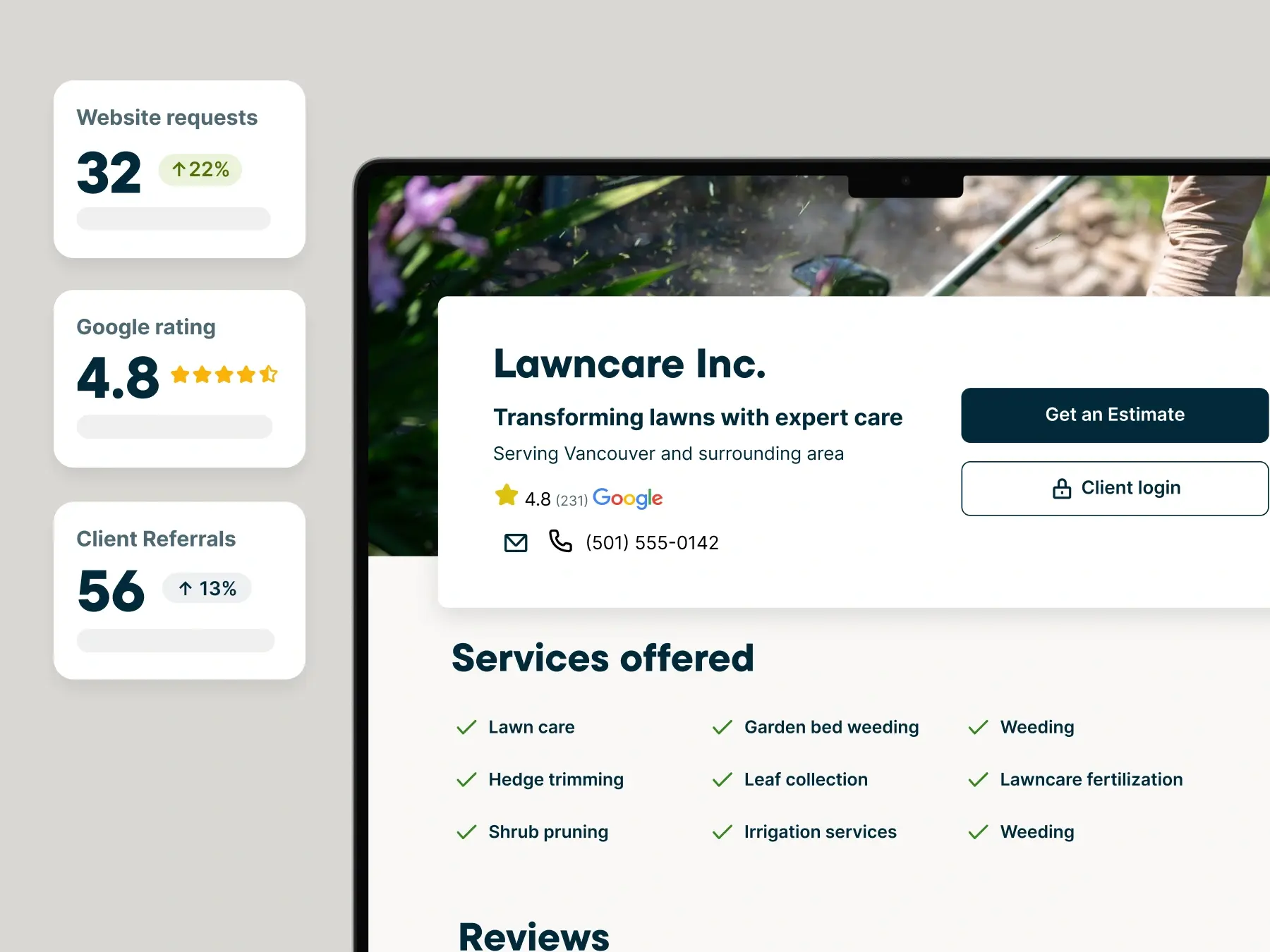
To help you convert website visitors into leads, your website automatically comes with a quote request form. And when you connect your Google Business Profile to your website, visitors will see exactly why you’re the business that they should be working with.
You can even measure your website’s success by tracking how many visitors your site is getting and how many requests are coming from it.
7. Build brand recognition in your community
When people remember your brand, they’re more likely to call when they need service. Building local relationships can help you stay top-of-mind.
To find jobs and build your brand, go where people are already connecting. Local business groups and Chamber of Commerce events are great places to meet property managers, small business owners, and homeowners—your target audience is at least one (and maybe all) of those.
For example, a pressure washer may build recognition by:
- Partnering with complementary businesses who serve the same customers, such as realtors and property managers. Hardware stores or garden centers might let you leave business cards or flyers near the registers.
- Attending community events, from farmers’ markets to neighborhood fairs. This is a chance to chat with residents and put a face to your brand. Sponsor a tee-ball team with your business logo or set up a demonstration of your services at a city-sponsored community day.
- Volunteering. Get noticed by offering free pressure washing to community centers or local nonprofits. Team up with charitable groups to help low-income families restore the appearance of their property. When your business name keeps popping up around town, brand recall improves.
Interested in learning more from Jason Ford?
Watch “3 Branding Mistakes Most Businesses Make” from the Masters of Home Service podcast:
Now that you know how to brand your business, you’re ready to begin! Start building your brand, wow your clients, and make your business a trusted name in the home service industry.
Want to go even deeper to win new customers? Listen to the Masters of Home Service Podcast on Getting New Customers on a Budget.
Frequently Asked Questions
-
A good brand is memorable, accurately represents your business, and makes you stand out from the competition. It also shows your clients you know them and what they’re looking for.
Strong branding for service businesses shows clients you understand their needs and what they’re really looking for. Employees can identify your purpose and get on board with it. Clients will want to work with you, and employees will want to work for you.
READ MORE: What makes a business successful? -
When you’re branding a small business, you’ll pay $100–1,000 to build the brand yourself.
This is the most budget-friendly option—you only pay for the design software you’re using, plus any printing and production costs.
If you work with a freelance designer, it can cost up to $1,000 for a logo, colors, and fonts. This price depends on the designer’s experience and what they include in a brand design package.
If you partner with a branding agency, you could pay $5,000–$10,000. This amount can include the design of print and digital marketing materials, as well as photography and illustrations.