
About 55% of homeowners search for home services online before choosing a provider. If your business isn’t showing up in search results on Google or Bing, you’re missing out on leads.
But online visibility takes more than just a social media page or website. To show up when potential customers search for services in your area, you’ll need to concentrate your efforts on home services SEO (search engine optimization).
You don’t have to be a marketing expert to get started, either. Keep reading to learn the SEO strategies yourself—like making a website, claiming online business profiles, and asking for reviews.
Search engine optimization for home service businesses:
What is home services SEO?
Home services SEO is the process of optimizing your website and online presence so your business appears at the top of the search results when potential customers look online for your services.
For example, if someone searches “emergency plumbing repair in Dallas,” or “Glendale house cleaning,” effective home services SEO helps your business show up in those results.
Then, when your website, profile, or listing shows up, they’ll be more likely to click on it and, if you’re a fit for their needs, book an appointment.
There are many ways to grow your business’s online presence through SEO, including:
- Building and optimizing a website
- Claiming your Google Business Profile
- Asking for reviews
Why is SEO important for home service businesses?
If you aren’t leveraging home service SEO, you’re missing out on leads. But that’s not the only reason SEO is an important tool to have in your marketing plan. It also helps you:
1. Stay competitive
Chances are, your competitors are using SEO to attract leads and grow their online visibility. If you don’t keep up, you’ll fall behind.
For example, a Local Services Ads report shows what percentage of customers search for services online in different industries:
- House cleaning: 59%
- Appliance repair: 64%
- Electrical: 58%
- Pest control: 75%
- HVAC: 62%
- Moving: 82%
That means a huge percentage of your customer base likely searches for home services online before booking an appointment. And if your competitors are the only ones showing up, it won’t be much of a competition at all.
SEO doesn’t just offer you a competitive edge—it helps you stay ahead of the pack.
2. Increase visibility
Physical ads like vehicle wraps and door hangers cast a wide net. But they don’t have staying power.
After all, a potential customer has to be in the right place at the right time to see your truck. And if they don’t need your services, that flyer you left on their front step is likely to end up in the trash within a day or two.
SEO helps your business show up when your customers are looking for what you offer. And appearing when there’s a need for your services is much more effective than a spray-and-pray approach.
If you invest in SEO, you could have potential customers coming into your website or whether it’s day or whether it’s night or whether it’s the weekend, even in slow periods when you’re looking for more business.
The more places leads can find your business, the better. Especially when they’re ready to choose a service provider.
3. Generate local business
When done correctly, home services SEO targets potential clients in your service area. That means more relevant eyes on your business and a way to solidify yourself as an expert in the community.
Paired with your services, it also positions you as a recognizable service provider in your city or town, encouraging word-of-mouth marketing like referrals.
4. Save money
Like any marketing strategy, SEO may take some upfront investment, especially if you hire an SEO agency or professional SEO services instead of doing it yourself.
But over time, SEO pays for itself.
Unlike paid ads that stop delivering results as soon as you stop paying, SEO continues to bring in leads over time.
For example, writing helpful articles about your services or creating landing pages tailored to specific service areas can bring in ongoing website visitors. Or you can claim and build a Google Business Profile and generate positive reviews from real customers to build trust.
These tactics come with little to no cost per lead and often generate enough profit to cover whatever you spent to set them up.
SEO strategies you can implement yourself
While you can hire a digital marketing firm or a search engine optimization expert to handle home services SEO for you, it’s not your only option.
Having a properly built website with proper keywords, with proper locations, and all that stuff can help you. If you want to try to do it yourself, you can. It’s worth every dime if it’s done right.
Review these easy local, on-page, and technical SEO strategies you can tackle on your own with a little elbow grease.
Local SEO
Local SEO is when you use location-based words and phrases to associate your services with a specific city or town. That way, you’re more likely to attract your ideal customer by appearing when they search for things like lawn mowing Scottsdale or Tacoma pressure washing.
To boost visibility in local search results, start by:
1. Claiming your Google Business Profile
If you haven’t already, claim your Google Business Profile. It’s free and can help you to:
- Appear at the top of the search results
- Show up in Google Maps
- Showcase before and after images
- Collect Google reviews
- Display your business hours and booking info
- Let customers book directly from your profile
Whether you have an existing profile or not, it’s important to fill it out completely by:
- Adding your business name and logo
- Including up-to-date contact information such as a website, phone number, location, and email address
- Listing your hours
- Specifying your service area
- Defining the services you offer
- Uploading photos of the work you do
- Filling out the Q&A section
- Posting updates and promotions
- Responding to reviews
READ MORE: How to respond to a negative review
2. Asking for Google reviews
Reviews build trust, prove you run a legitimate business, and show leads you have real customers.
Asking happy customers to leave positive Google reviews will enhance your Google Business Profile and help it to stand out.
You can collect reviews by reaching out to happy clients after jobs and simply asking them, or by including a link in your payment receipts and invoices.
Or, you can automate the process with review software like Jobber. As soon as a customer pays their invoice, it reaches out to ask them for a Google review on your behalf. That means you get more reviews for less work, and a robust, trustworthy profile that attracts more leads.
3. Joining local directories
Local directories like Yelp, Yellow Pages, and Angi are free online directories that customers use to search for services where they live.
Filling them out using the same information as your Google Business Profile signals to search engines that:
- Your business details are consistent across the web
- You serve a specific geographic area
- Your business is trustworthy and legitimate
All of these elements add to your online reputation, both to customers and search engines like Google. The more your business is listed with the same information, the more likely it is to appear in search results when customers search for your services.
4. Using Google Local Service Ads (LSAs)
Google LSAs are tied to your Google Business Profile. They’re a type of ad you can use to highlight your business in local search engine results, above regular listings and other ads.
They give you a boost over competitors and make your search listing more noticeable to potential customers by:
- Showing your business name, services, hours, and contact info
- Including your Google review rating
- Adding a “Google Guaranteed” badge for vetted profiles
This makes your services and location easy to see, and immediately gives leads the reassurance they need to book a job.
While they do cost money, they’re an effective way to promote your local SEO efforts. You can also set a budget to ensure you don’t overspend.
Pro Tip: Google LSAs are not available for every industry or location. Review Google’s LSA guide to find out if your business is eligible.
On-page SEO
On-page SEO is the written content you use to talk about your business. For example, service pages on your website or articles on your blog.
On-page SEO can seem intimidating, but it’s not as complicated as you might think. Prioritize the basics by:
1. Making a website
If you don’t have one already, it’s time to make a website.
“If you can do anything, just make sure you can try to get a website up that can post pictures of the jobs you completed, basic contact information, hours of service, and the services that you provide.” —David Brooks, Contractor Rhino
To get started, that means:
- Choosing a domain (website address) that matches your business name
- Using a tool or hiring a web designer to map out your pages
- Writing content for your services
- Gathering high-quality images of your work
- Collecting customer testimonials
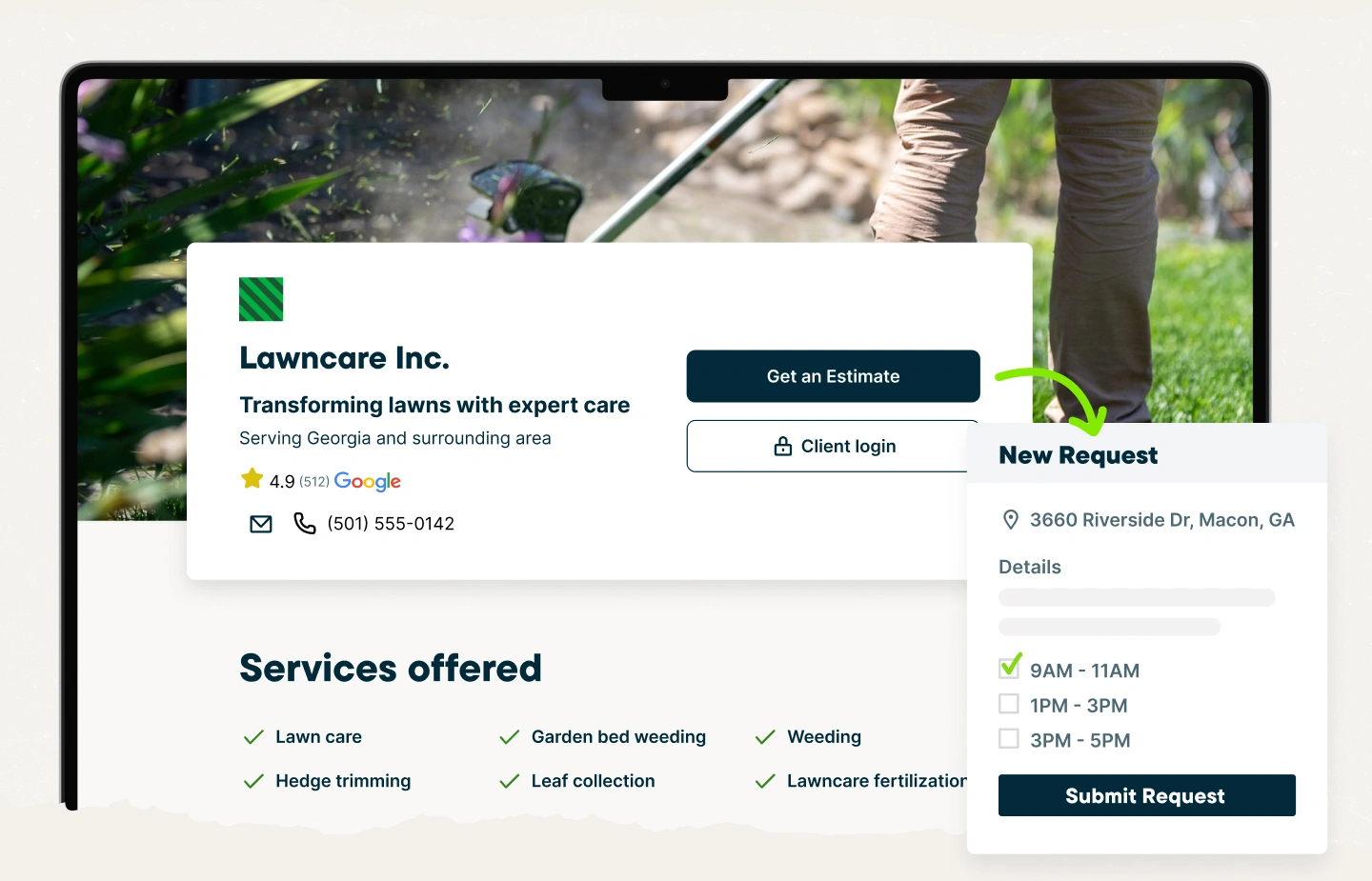
You can make one yourself in minutes with website software like Jobber that features your business and service info, a quote request form, and customer reviews.
2. Learning keyword basics
Keywords are the words or phrases potential customers would use to find you. They’re most likely to be related to your industry, specific services, problems you solve, and location.
Using them within your content, like on your web pages, helps search engines understand what you do and where you operate. That information allows them to choose when, how, and where to show your home service business to customers based on what they searched for.
For example, keywords for a lawn care home service company could include:
- Lawn mowing
- Weed trimming
- Fertilizer
- Weekly mowing
- Grass cutting
- Yard work
- Raking
But they may also be:
- Lawn care services
- Lawn maintenance
- Yard care company
- Summer lawn care
It’s also important to include the name of your city or town alongside service-specific keywords.
For example, on your home page, you might want your main keyword to be Cleveland lawn care services, then use separate service pages for each of the different services you offer, like weekly lawn mowing, custom fertilizer, and weeding.
3. Optimizing page content
Your website’s content impacts how well your home services SEO performs.
To get the best results, ensure each page has:
- Specific titles (headings). For example, a page that lists your mowing services, prices, and booking information should be called something like “Lawn Mowing Services in [City]” instead of something generic like “Services”.
When looking at your website, it’s really good if you could implement a ‘service areas’ page or ‘areas we serve’ page.
That way, you can break down the different areas inside of your big area into smaller segments that you can target on your website.
- Contact information. This can go at the bottom of your website (the footer) for each page, so customers can easily reach out for a quote or to make a booking.
- Keywords. If possible, focus on a single keyword for each page and use it naturally within the content. It should fit the topic of the page without feeling forced or repetitive. For example, a page about weeding services in Pasadena probably doesn’t need to include keywords for mowing or fertilizing because that can confuse search engines.
- Content. Blog posts, service descriptions, articles, and FAQs all count as content. The more content you have, the more keywords you can cover. And the more keywords you cover, the better your chances of serving a larger number of potential customers.
Blogs are still relevant because they help customers be able to find your business when they’re looking for their specific solution to their problem.
Why is my roof leaking? Why doesn’t my heater work? Why is my AC blowing out hot air? So those different things can allow blogs on those different topics.
4. Using links
Links from one page on your website to another help search engines see how your pages are connected and which content is important. (Also known as link building.)
For example, your home page should link to specific service pages. And your service pages might link to how-to articles, booking pages, or customer testimonials.
This not only helps search engines to understand your site better, but it also makes it easier for visitors to find relevant information and take action.
Technical SEO
Technical SEO plays a big role in home services SEO.
It’s made up of the SEO strategies on the backend of your website that help search engines find, organize, and show your business to potential customers.
It can be broken into three categories: basics, site health, and metadata.
The basics include:
- Making sure your web pages load quickly, so visitors don’t get frustrated and leave
- Using a mobile-friendly design that works well on phones and tablets
- Having secure hosting to protect your site and boost trust with search engines
Most website builders and tools will automatically handle these elements for you. However, it’s important to test out your web design before you launch it to make sure it looks right on different devices and works as it should.
Make sure that the website is displaying well on desktop, but also it fits in a smartphone tablet where users can scroll down, look at the content.
1. Site health
Monitoring and maintaining your website’s health includes checking for and fixing any broken links so users aren’t sent to pages that no longer exist.
For example, if you remove an old blog post that’s no longer relevant, or you stop offering a service and delete the page. Once it’s gone, you’ll need to update or delete any links pointing to it. This prevents users and search engines from encountering confusing and frustrating error pages.
2. Meta data
Metadata is the information Google pulls from your web pages to display in Google search results. The most important parts of your metadata include your title links (also called title tags) and meta descriptions.
A title tag is the link that appears in search results, while a meta description is the text that appears below it to describe the web page.
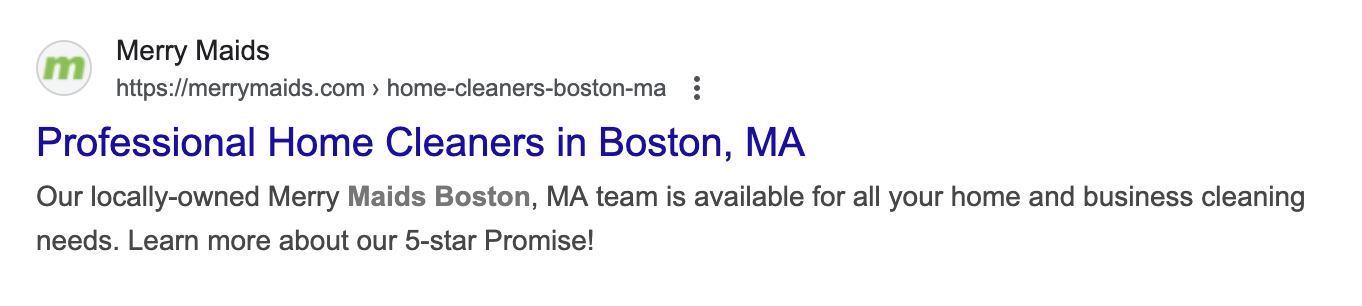
In this example, “Professional Home Cleaners in Boston, MA” is the title tag, and “Our locally-owned Merry Maids Boston, MA team is available for all your home and business cleaning needs. Learn more about our 5-star Promise!” is the meta description.
Each of your web pages should have a unique and descriptive title tag and meta description that includes relevant keywords. For example, your services and location, and any specialities.
Home services SEO marketing best practices
Home services SEO isn’t a one-and-done task. It takes consistent maintenance and adjustments to perform well. After you get the basics set up, it’s important to:
1. Update content regularly
Your website content, Google Business Profile, and online directory listings should be updated frequently with:
- Changes to contact information, hours, or services
- Testimonials and reviews
- Photos
- Promotions
- Important news and updates
It’s also beneficial to use reports to track performance and make changes as necessary.
3. Create new content
Blog posts, reviews, new services, and company updates all make for fresh content that keeps your website and profiles relevant. This is also known as content marketing. Search engines like to see that your website is active and up to date, which can impact where and how it shows in search results.
4. Use social media
Social media marketing, like sharing content on your Facebook business page or running Facebook ads, also help with home services SEO. Especially when the information is consistent across your website, Google Business Profile, and online directory listings.
You can also use these platforms to bolster your other strategies by:
- Sharing blog posts and articles from your website
- Posting images of jobs
- Featuring reviews and testimonials
- Announcing promotions
- Engaging with customers by asking and answering questions
5. Follow the rules
Home services SEO does come with a few rules.
For example, it’s not a good idea to:
- Stuff your content with keywords when they don’t fit naturally
- Use misleading or fake titles and page descriptions just to entice people to click
- Buy reviews, likes, comments, shares, or website traffic
- Post incorrect or outdated information about your business
It’s all about user experience. The user experience has to be good when the user gets there, and Google is thinking of that too.
So if the user experience is not good, you’re not going to rank higher than your competitors.
If you prioritize their needs and focus on providing a helpful and trustworthy online experience, search engines will reward your efforts over time.
6. Track progress
Lastly, track progress. Home services SEO is a long game.
When you set up SEO, it may take three months to have a website rank, but once it’s ranking, you’re good.
After setting up your home services SEO strategies, keep an eye on:
- When you implement new strategies
- How many people visit your website
- Which tactics are (and are not) working
It’s also important to consider where your leads are coming from. Your website, Google Business Profile, or somewhere else?
I look at our numbers on a monthly basis, 50 to 60% of the traffic that comes to our website is all from organic, all organic SEO.
You can track progress manually with reporting tools like Google Analytics, Google Business Profile reports, and social media admin insights.
Or, you can use Jobber’s marketing tools to implement new strategies, track their success, and make data-driven decisions that grow your home service business.