
Key takeaways:
If you’re asking whether running a pool cleaning business is profitable, understanding your costs, pricing, and service mix is key to success.
- Profitability depends on more than a full schedule. Keeping your expenses (like chemicals, fuel, labor, and equipment) under control and managing efficient routes are just as important as attracting new customers.
- Track gross margin and net profit. Use clear formulas to measure how much money remains after your direct and overhead expenses, and separate owner compensation from business profits to gain better financial clarity.
- Diversify your revenue streams. While recurring maintenance provides steady income, offering repairs and specialty add-on services can boost profit margins—just be sure to account for their costs and required skills.
- Understand and manage all expenses. Identify your fixed and variable costs in detail so you can price services profitably and ensure healthy margins, especially as you grow.
- Succeed through efficiency and planning. Maximize route density, revisit your pricing regularly, optimize your service mix, and forecast cash flow around seasonality and customer retention challenges.
Want tips to keep your pool business profitable? Sign up for the Jobber Newsletter.
A pool cleaning business can be quite profitable, especially when you have a steady base of recurring customers, efficient service routes, and pricing that covers your costs.
But a full schedule doesn’t automatically equal more profit. Between chemicals, fuel, labor, equipment, and operating expenses, it’s important to understand how much of your revenue you’re actually keeping.
This guide explains how to calculate your potential earnings, identify your biggest expenses, and make smarter decisions to grow a profitable pool service business.
Pool cleaning business profitability guide:
-
What profitability means for a pool service owner
-
Where pool cleaning businesses make money
-
How to calculate pool cleaning business profitability
-
What determines pool cleaning business profitability?
-
How startup costs affect the path to profit
-
How to improve pool service profit margins
-
Pool cleaning business profitability checklist
What profitability means for a pool service owner
Profitability is the money your business keeps after you pay expenses and operating costs. Profit is different from revenue, which is the total amount customers pay you for any pool cleaning services.
To understand whether your business is making money, you’ll need to look at both gross margin and net profit together. Let’s take a closer look at how you can understand and calculate these figures accurately.
Gross margin versus net profit
Gross margin and net profit give you two different ways to measure your pool service business’s profitability.
Gross margin shows what percentage of your revenue remains after paying the direct costs of providing pool services. Those costs might include chemicals, technician wages, and fuel used to travel between jobs. Use this formula to calculate it:
Gross margin = (Revenue − Direct service costs) ÷ Revenue × 100
Net profit is the money your business keeps after accounting for both direct service costs and other business expenses. This might include insurance, software, marketing, and administrative costs. For net profit, you can use this simplified calculation:
Net profit = Gross profit − Overhead expenses
For example, say your pool service business earns $10,000 in monthly revenue:
- Direct service costs: $5,500
- Gross profit: $4,500
- Gross margin: 45%
- Overhead expenses: $2,000
- Net profit: $2,500
In this example, your business keeps 25% of its revenue as net profit before taxes, assuming you’ve accounted for all other expenses first. Tracking both figures helps you see whether you’re pricing jobs profitably and keeping business expenses under control.
Owner pay versus business profit
If you’re a solo pool service owner, it’s tempting to treat whatever money remains after expenses as profit. But your time has value, too.
Even if you’re not paying yourself a regular salary, you should factor in the time you spend cleaning pools, traveling between jobs, making repairs, and managing your business.
Consider what it would cost to hire someone to do that work. This helps you see whether your pricing adequately covers labor costs or relies on unpaid work to stay profitable.
When you separate owner compensation from business profit, it gives you a clearer picture of your earnings and whether you can afford to hire employees as you grow.
Where pool cleaning businesses make money
Most pool cleaning companies generate revenue through recurring maintenance, repairs, and additional services. Before you start planning services, you’ll want to know the different costs and profit potential of each revenue stream.
Recurring pool service
Recurring pool service provides a predictable source of income through scheduled residential pool service or commercial maintenance.
Your recurring customers might pay monthly or per visit for services like pool cleaning, water testing, chemical balancing, and routine equipment checks.
Your maintenance revenue depends on factors like:
- Average invoice: How much each customer pays per month or visit
- Service frequency: How often you maintain each pool
- Customer retention: How long customers continue using your recurring services
- Route density: How efficiently you can serve customers within the same area
- Direct service costs: What you spend on labor, chemicals, and transportation
Recurring service visits can provide steady, predictable revenue. Keeping your pricing profitable and routes efficient helps prevent travel time and service costs from eating into your earnings.
Pool repair services and add-ons
Routine pool maintenance isn’t the only way to bring in revenue. You can also offer one-off services like filter cleaning, acid washing, equipment repairs, and seasonal pool openings or closings to earn more from your existing customers.
In a community chat on r/pools, one pool business owner shared that repairs and specialty services offered better earning opportunities than routine maintenance alone.

While that’s just one owner’s experience, it’s worth considering as you look for ways to grow your revenue. Specialty services can bring in higher-paying jobs, but you’ll also need to account for the extra skills, equipment, and labor.
Compare revenue potential by pool service type
Each type of pool service offers different opportunities to earn revenue, but each comes with its own costs and scheduling considerations. Take a look at how they compare:
| Service line | Billing model | Typical frequency | Direct costs | Margin drivers | Operational risks | Role in recurring revenue |
|---|---|---|---|---|---|---|
| Routine maintenance | Monthly or per visit | Weekly (during season) | Labor, chemicals, fuel | Route density, retention | Travel time, underpricing | Primary recurring income |
| Equipment repairs | Per job | As needed | Labor, parts, tools | Accurate estimates, skilled work | Callbacks, parts delays | Supplemental |
| Filter cleaning | Per service | Periodic | Labor, supplies | Efficient scheduling | Unexpected labor time | Repeat add-on |
| Acid washing | Project based | Occasional | Labor, chemicals, equipment | Specialized pricing | Safety, surface damage | Occasional |
| Seasonal services | Per service or package | Seasonal | Labor, chemicals | Advance bookings | Weather, demand changes | Seasonal supplemental |
Pro Tip: Rather than focusing only on revenue, compare how much profit each service brings in, compared to the time and resources it requires.
How to calculate pool cleaning business profitability
You don’t need complicated financial software to estimate profitability for your business. Start with your monthly revenue, subtract expenses, and calculate how much business you need in order to maintain a healthy gross profit, net profit, and break-even point.
Estimate monthly pool cleaning business income
Use this formula to estimate your pool cleaning business income:
Monthly revenue = (Active clients × Average monthly ticket) + Repair and add-on revenue
For example, suppose you have:
- 40 recurring customers paying $200 per month
- $2,000 in monthly repair and add-on revenue
Your total monthly revenue would be: (40 × $200) + $2,000 = $10,000
If you’re wondering how much pool cleaners make, remember that business revenue isn’t the same as owner earnings. Your take-home income depends on your actual expenses, labor requirements, and profit.
List pool cleaning business expenses
Pool cleaning business expenses generally fall into two categories: variable costs and fixed costs. Understanding both helps you price your services accurately, manage business-related spending, and protect your profit margins.
Variable costs
Variable costs change based on how many pools you service and the type of tasks each job requires. As you add customers or take on more complicated jobs, these expenses might increase.
Some of the most common variable costs for pool service businesses are:
- Chemicals and cleaning supplies: Chlorine, shock, algaecides, test reagents, and other products used during service visits
- Direct labor: Technician wages and related payroll costs for time spent completing jobs
- Fuel and travel: Gas and vehicle expenses associated with driving between customers
- Replacement parts and materials: Filters, fittings, seals, and other parts needed for repairs
- Equipment wear and consumables: Replacement brushes, vacuum parts, and other supplies that wear out with use
- Payment processing fees: Transaction fees charged when customers pay by credit or debit card
Keep in mind that a customer who lives 30 minutes outside your regular service route may cost more to serve than one located near several existing customers. Even if both customers pay the same monthly rate, the extra driving time and fuel can reduce your profit.
Fixed costs
Unlike variable costs, fixed costs generally stay the same from month to month, even during slower seasons. Common fixed costs for pool service businesses include:
- Business insurance: General liability, commercial auto, and other coverage needed to protect your business
- Licensing and registration: Business licenses, permits, and annual registration fees
- Software subscriptions: Tools for scheduling jobs, managing customers, sending invoices, and collecting payments
- Vehicle payments: Monthly loan or lease payments for your service truck
- Storage or office expenses: Rent for storing chemicals, equipment, and supplies or maintaining an office
- Marketing and administrative costs: Ongoing website hosting, advertising budgets, bookkeeping, and other business expenses
If your pool service business has $2,000 in monthly fixed expenses, you’ll need to bring in enough revenue to cover those costs before you can turn a profit. Adding more recurring customers can help spread those expenses across more jobs without increasing your overhead.
Calculate gross margin, net profit, and break-even point
Once you know your revenue and expenses, you can calculate how much your pool service business earns, how much it keeps, and how many customers you need to cover your costs.
Calculate gross profit and pool service profit margin
Gross profit is the revenue left after subtracting the direct costs of providing your services, including chemicals, fuel, and service labor.
To calculate your gross profit and gross margin, use these formulas as a guide:
Gross profit = Revenue − Direct service costs
Gross margin = (Gross profit ÷ Revenue) × 100
For example, here’s what the monthly finances might look like for a hypothetical pool service business:
| Monthly financial metric | Amount |
|---|---|
| Revenue | $10,000 |
| Direct service costs, including owner service labor | $5,500 |
| Gross profit | $4,500 |
| Gross margin | 45% |
| Overhead | $2,000 |
| Net profit before taxes | $2,500 |
| Net profit margin before taxes | 25% |
In this example, the business keeps 45 cents of every revenue dollar after covering direct service costs. These figures are hypothetical and assume all direct service labor, including the owner’s hands-on work, is accounted for.
You can also calculate gross margin separately for recurring maintenance, repairs, and specialty services. Doing so can help you see which types of work earn the most profit relative to their direct costs.
Calculate net profit
Net profit shows how much money remains after covering the costs of providing services and running your business. Use these formulas to calculate net profit:
Net profit = Gross profit − Overhead and other expenses
Net profit margin = (Net profit ÷ Revenue) × 100
Using the example above, let’s say your pool service business earns $4,500 in gross profit after covering direct service costs. You also spend $2,000 per month on overhead, including insurance, software, and marketing.
Subtracting those expenses leaves you with $2,500 in monthly profit before taxes, or a 25% profit margin.
Tracking net profit each month helps you see whether increasing revenue is making your pool service business more profitable or if rising expenses are cutting into your gains.
Calculate the break-even point
A break-even point is the amount of revenue or number of customers you need to cover your costs without making a profit or taking a loss. For pool service businesses with recurring customers, you can estimate this using the formula below:
Break-even clients = Monthly fixed costs ÷ Monthly contribution margin per client
Contribution margin is the amount each customer pays you after subtracting the variable costs of serving them. This includes chemicals, fuel, and direct service labor.
For example, assume:
- Your monthly fixed costs are $2,000.
- Each recurring customer pays $150 per month.
- Variable service costs average $60 per customer per month, including the cost of service labor.
- Each customer contributes $90 toward covering fixed expenses and generating profit.
Your calculation would be: $2,000 ÷ $90 = 22.2 customers
In this example, you would need 23 recurring customers to break even. This assumes you have similar pricing and service costs across customers, no other revenue, and enough capacity to serve them without increasing fixed expenses.
Calculate profit by service line
Not every pool service contributes the same amount to your bottom line. Tracking maintenance, repairs, and add-on services separately helps you see where your business earns the most money.
For each service type, compare:
- Revenue: How much customers pay for the service in total (your “sticker price”)
- Direct costs: Chemicals, materials, parts, and labor needed to complete the work
- Time spent: Hours spent on the job and traveling to the customer
- Gross margin: How much revenue remains after covering direct service costs
For example, a $300 pool equipment repair might bring in more revenue than a $150 monthly maintenance account. But if the repair requires expensive parts, several hours of labor, or a return visit, its profit margin could be lower.
In a discussion on r/PoolPros, one pool service professional described the challenges of earning strong margins from maintenance routes compared with repair work. While that’s only one person’s experience, it shows why you should track the profitability of each service you offer.
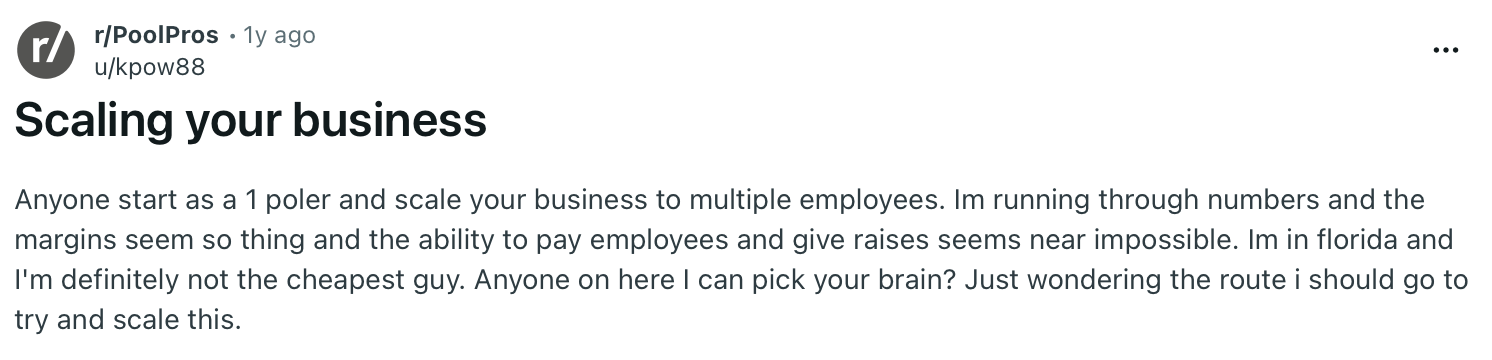
Reviewing these numbers regularly helps you identify which services are worth promoting, where you may need to raise prices, and how to build a more profitable mix of recurring maintenance and higher-value jobs.
What determines pool cleaning business profitability?
A profitable pool cleaning business depends on how you price your services, plan your routes, manage expenses, and balance low and high-paying jobs. All of these factors affect how much revenue you keep after a job.
Route density and service area
The closer your customers are to one another, the less time and fuel you’ll spend traveling between jobs. For example, servicing 10 pools within one neighborhood may be more efficient than servicing the same number of pools across several towns.
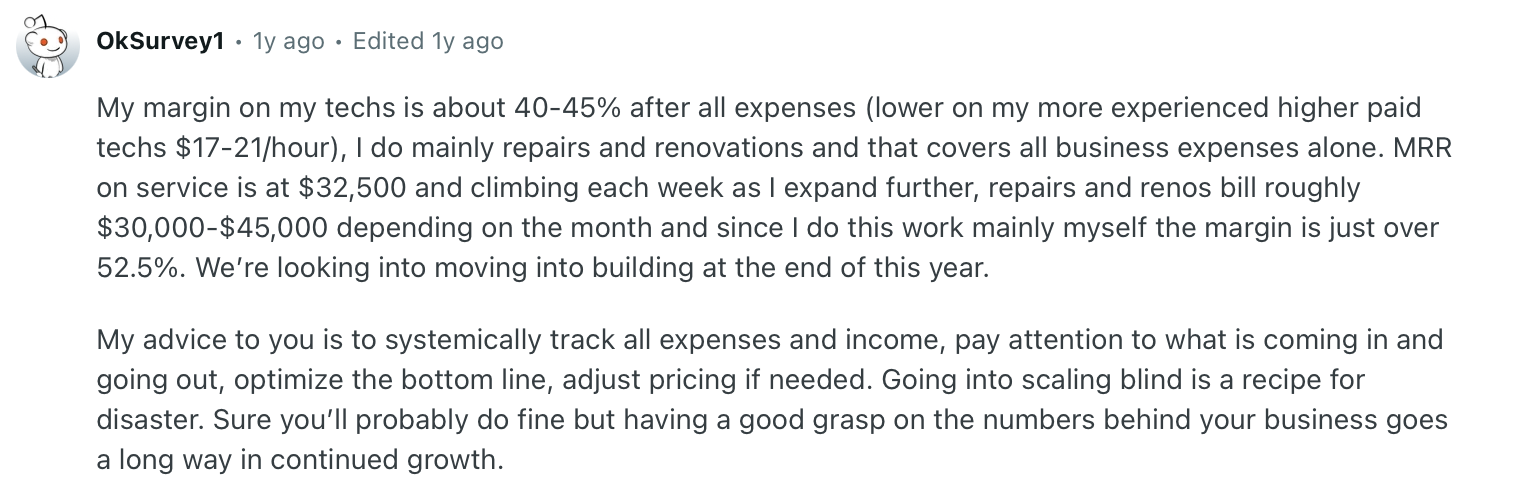
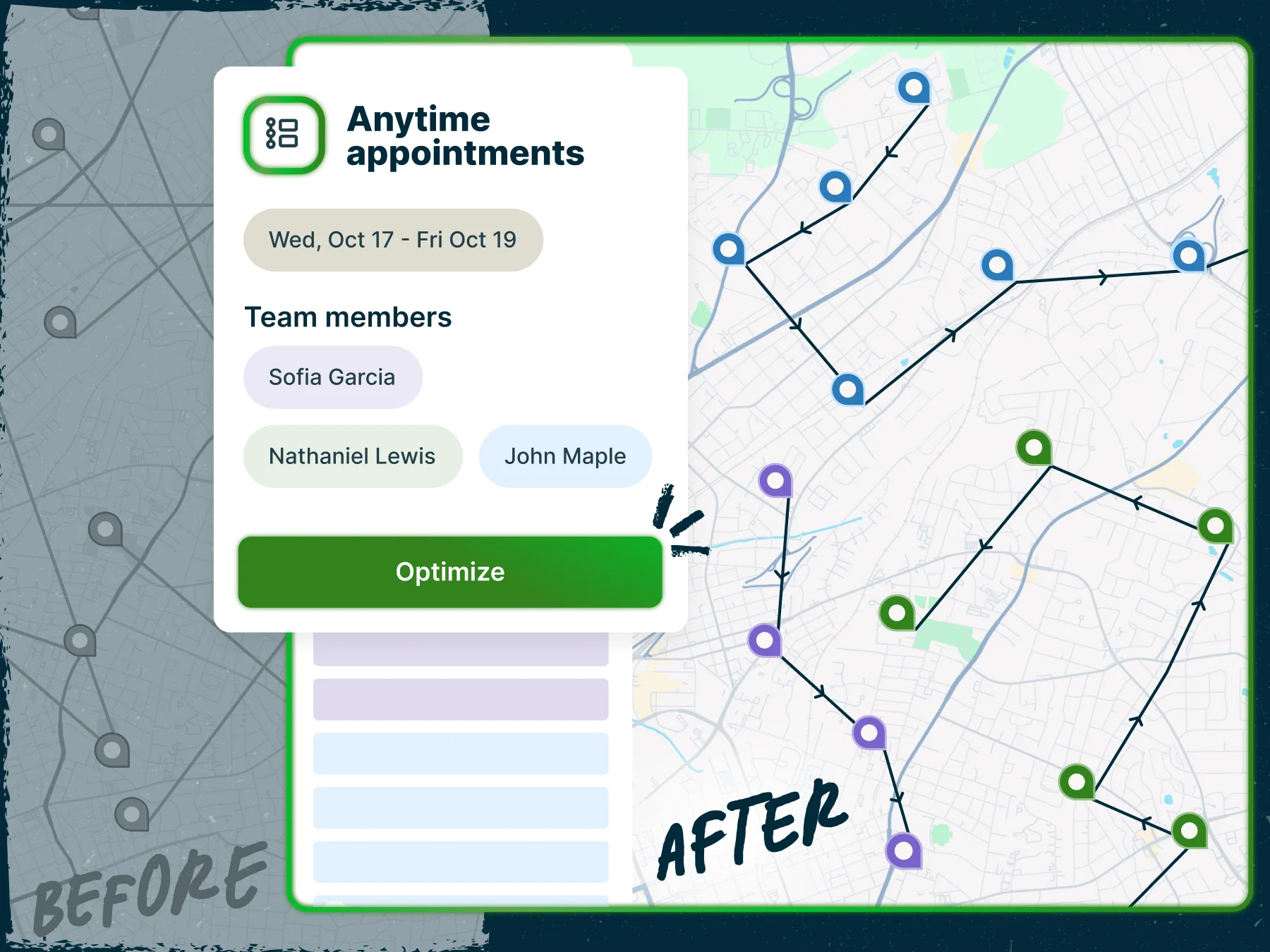
Another pool service operator in a r/PoolPros emphasized keeping overhead low and building a dense route. To improve route efficiency, group nearby appointments, review your team’s drive times, and consider how new customers fit into your existing service area.
Pool cleaning pricing and customer retention
Your pool cleaning prices should cover labor, chemicals, travel, overhead, and leave room for profit. Review rates as costs change, and make sure customers understand what’s included in their service agreements.
Retaining customers helps maintain predictable, recurring revenue, but not every account is equally profitable. For example, customers who need frequent extra visits or live far outside your regular routes may cost more to serve than they’re actually paying you.
Track costs by customer to see when you need to raise rates, adjust service terms, or reconsider an unprofitable account.
Seasonality and market mix
Your location can affect how much work you have throughout the year. Pool businesses in warmer climates may offer year-round maintenance. Those in colder regions often see demand increase during spring and summer.
Instead of assuming your revenue will stay consistent year-round, build a month-by-month forecast based on your local market. Include expected maintenance income, seasonal openings and closings, repair demand, and slower periods.
This helps you plan for changes in cash flow and make sure you have enough money set aside to cover expenses during quieter months.
Residential pools versus commercial pools
Residential and commercial pools can both provide recurring revenue, but each comes with different service needs and operating costs.
- Residential pools often allow for efficient neighborhood routes, flexible scheduling, and opportunities for repairs, upsells, or seasonal services. Working directly with homeowners can also mean quicker sales decisions.
- Commercial pools in hotels, apartment buildings, and community facilities may require more frequent service, detailed records, stricter schedules, and additional insurance or compliance measures. Sales cycles and payment terms may also be longer.
Neither market is automatically more profitable. Compare labor, travel, equipment, administrative costs, and payment timing to determine which customers are the best fit for your business.
How startup costs affect the path to profit
The cost of getting your pool cleaning business off the ground can affect how quickly you turn a profit.
Whether you’re just learning how to start a pool cleaning business or planning to expand your services, understanding upfront costs helps you set more realistic goals and avoid unnecessary spending.
Model pool cleaning business startup costs
Before taking on your first customers, you’ll need to invest in the equipment, supplies, and business essentials required to operate safely and professionally.
Your pool cleaning business startup costs will also depend on the services you offer, whether you already own a work vehicle, and how much equipment you need to purchase upfront.
A few of the most common startup expenses include:
- Cleaning equipment and tools: Pool poles, brushes, skimmers, vacuums, water testing kits, and other tools needed for routine maintenance
- Vehicle and transportation supplies: A reliable truck or van, along with secure storage and equipment for safely transporting chemicals and tools
- Insurance and licensing: Business registration, required licenses or certifications, and insurance coverage to protect your business
- Initial chemical inventory: Chlorine, shock, pH adjusters, and other chemicals you’ll need to service your first customers
- Business software: Tools for scheduling appointments, planning routes, creating estimates, sending invoices, and managing customer information
- Website development and marketing: A basic business website, local advertising, and other marketing materials to help attract your first customers
When you’re building your startup budget, separate one-time purchases from ongoing monthly expenses. This helps you estimate how much money you’ll need to launch and how much revenue you’ll need to keep the business running as you build your customer base.
Estimate the payback period
A payback period is an estimate of how long it will take to recover your initial investment. This simple equation can help:
Payback period = Startup investment ÷ Monthly net cash flow
For example, here’s how long it’ll take to recover a hypothetical $12,000 business investment, based on your monthly net cash flow:
| Scenario | Monthly net cash flow | Payback period |
|---|---|---|
| Best case | $2,000 | 6 months |
| Expected case | $1,000 | 12 months |
| Slower growth | $500 | 24 months |
These examples assume steady positive monthly cash flow. For a seasonal business, use cumulative monthly cash flow to estimate when the investment will actually be recovered.
You’re staying busy, you’re employing people, but how are you actually making money?
In the course of one year, you might move from $65 an hour per technician [to] $125 per hour. Charge more money, do less jobs.

How to improve pool service profit margins
Once you know where your money is going, you can start making changes that improve profitability. Small adjustments to pricing, scheduling, labor, and customer acquisition can add up, especially when you’re servicing the same pools every week.
Improving profitability often comes down to the everyday decisions you make as an owner. The pool service business tips below can help you build more efficient processes as your customer base grows.
Price for margin, not just revenue
Pool service rates should reflect what it actually costs to complete each job, not just what competitors charge.
Review your pricing regularly, especially when your overhead costs increase. Compare what you charge against your average cost per visit, including travel time and a share of your business overhead.
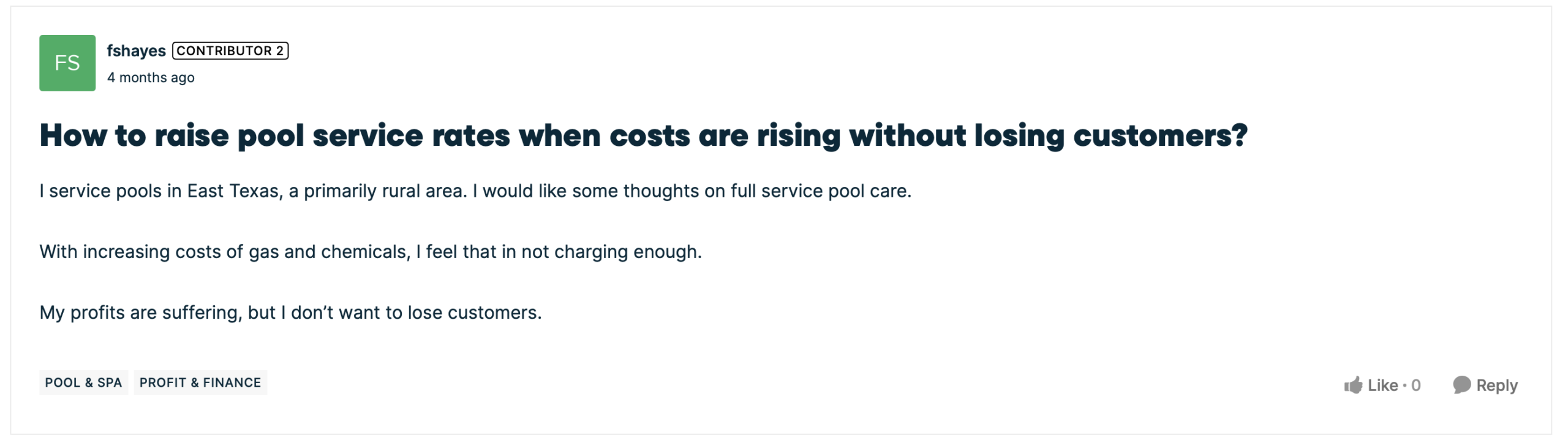
One pool service owner shared this challenge in a Jobber Community discussion, asking how to raise prices to keep up with rising gas and chemical costs without losing customers.
If your costs are climbing, consider these steps before adjusting your prices:
- Review your most expensive accounts. Look for customers who require extra chemicals, longer visits, or significant travel time.
- Calculate the increase you need. Determine how much your rates must change to cover rising costs while maintaining your target margin.
- Give customers advance notice. Explain when the new rate takes effect and remind them what’s included in their service.
You don’t necessarily need to raise every customer’s rate by the same amount. Start with your actual job costs and adjust pricing where your margins are falling short.
Build a stronger revenue mix
Recurring pool maintenance provides a foundation of predictable revenue, but repairs and add-on services often earn more from customers you already serve.
For example, a technician visiting a pool for weekly maintenance might notice a filter that needs cleaning or equipment that requires repair. Offering a separate quote for that work creates another revenue opportunity without having to go find a new customer.
Before expanding your services:
- Confirm demand. Ask customers which additional services they need and review the requests you’re already receiving.
- Check your skills. Make sure you have the skills, training, equipment, licensing, and insurance coverage required.
- Estimate profitability. Calculate the labor, materials, travel, and other costs involved before setting a price.
The best add-on services are ones you can offer alongside regular maintenance without taking time away from your most profitable routes.
Use Jobber to track costs and run a tighter route
As your pool service business grows, Jobber helps you manage daily operations and keep track of the costs that affect profitability. With Jobber, you can:
- Schedule recurring jobs. Organize regular pool maintenance visits and keep customer appointments on track.
- Plan efficient routes. Group nearby jobs to reduce unnecessary driving and travel time.
- Create quotes and invoices. Send professional quotes, invoice customers, and track payments.
- Track job costs. Record labor, materials, and other job expenses to better understand profitability.
With everything in one place, you can stay organized, reduce administrative work, and make better decisions about your business’s profitability.
Compare service-line profitability with job costing
A busy schedule doesn’t always mean your jobs are profitable. You need to know how much each service costs to complete.
With Jobber’s job costing features, you can track labor, materials, and job-related expenses to compare estimated costs with actual results.
For example, you might discover that a repair requiring two technician visits earns less than expected once you’ve accounted for parts, labor, and travel.
This means that you can use job costing to:
- Compare profitability across recurring maintenance, repairs, and add-ons.
- Identify jobs that regularly take longer or require more materials than estimated.
- Adjust future quotes and service rates based on actual costs.
Over time, you’ll have a clearer picture of which jobs are worth taking on, where you’re losing money, and when it’s time to adjust your rates.
Schedule recurring work and reduce route waste
Driving between pools takes time you can’t spend completing paid work. Keeping customers close together can help you fit more service visits into the day without increasing labor hours.
Jobber’s pool service software helps you schedule recurring maintenance visits, organize daily routes, and track job progress.
As you add customers, try grouping appointments by neighborhood or service area. You can also review your routes to identify unnecessary driving, close gaps between appointments, or find out if customers could benefit from a different service day.
More efficient routes can help reduce fuel costs, make technician schedules more manageable, and create room for additional recurring customers.
Plan labor before hiring
Hiring another pool technician makes it possible to serve more customers, but only if the additional revenue supports the cost.
Before you hire, estimate how many pools a technician can realistically service each day. Then, account for driving time, breaks, equipment preparation, and the complexity of each job.
Next, compare that expected revenue with the full cost of employment, including:
- Hourly wages and employer payroll taxes
- Workers’ compensation and applicable benefits
- Training, onboarding, and supervision
- Paid travel time and other non-billable hours
For example, if a technician can complete eight visits per day at an average of $60 per visit, that’s $480 in daily revenue. But you’ll still need to subtract chemicals, fuel, labor, and other expenses to determine how much those visits contribute toward overhead and profit.
You should also account for the time it takes a new hire to reach full productivity. A clear pool technician job description helps you define responsibilities, required skills, and expectations before bringing someone onto your team.
Track customer acquisition costs
Finding new pool service customers takes time and money, especially when you’re starting out. Customer acquisition cost (CAC) measures how much you spend to gain each new paying customer. You can reference this formula to calculate your CAC:
CAC = Total sales and marketing costs ÷ New customers acquired
Include advertising, website expenses, promotional materials, and the value of your marketing time. For example, if you spend $400 on marketing and gain four customers, your CAC is $100 per customer.
In a Jobber Community discussion, one new pool service owner described building a website and promoting their business without attracting customers right away. That’s because marketing effort doesn’t mean there will be immediate demand for services.
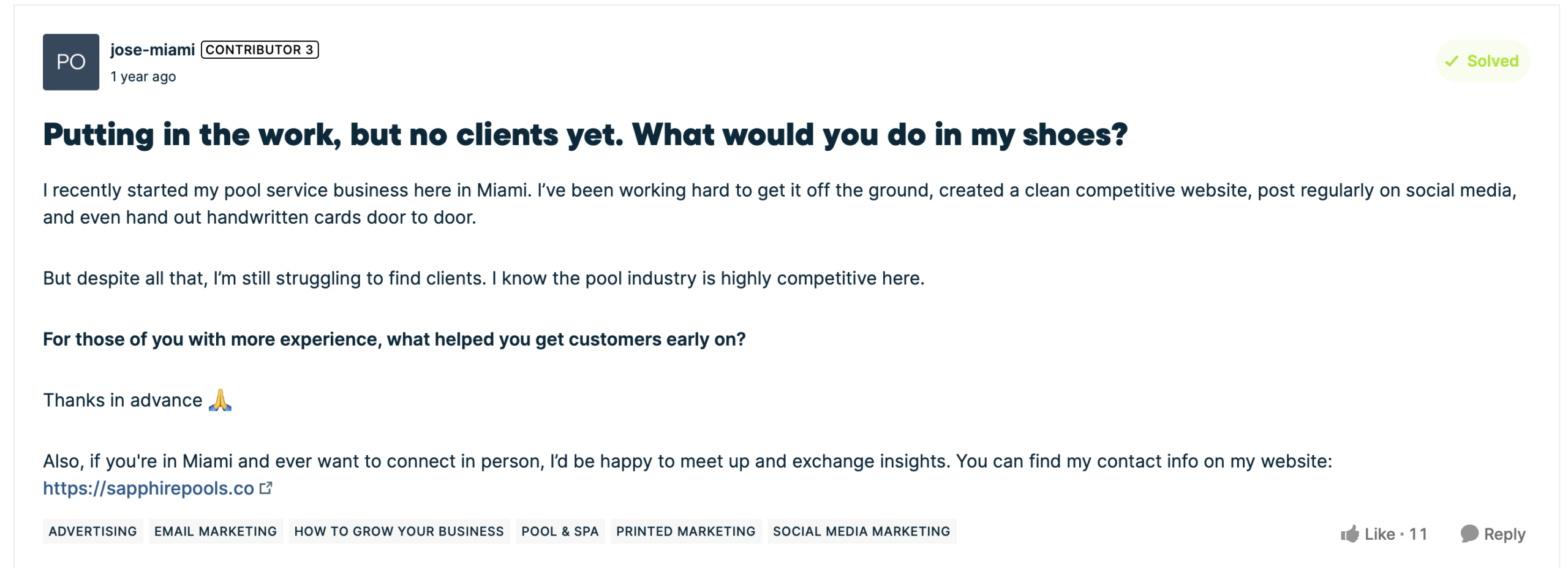
This shows why it’s important to track which marketing efforts bring in paying customers—not just leads. Compare your acquisition costs with the profit each customer generates over time, especially for recurring maintenance accounts.
READ MORE: Pool service marketing tips and strategies
Pool cleaning business profitability checklist
Before starting or expanding your pool cleaning business, use this checklist to evaluate whether your local market, pricing, and operating costs support a profitable business.
Check off what you’ve confirmed, and use the questions below to identify any gaps in your financial plan.
Signs the business model may be viable
- Strong local demand: There are enough pool owners in your service area willing to pay for regular maintenance, repairs, or specialty services.
- Profitable pricing: Your rates cover labor, chemicals, travel, overhead, and your target profit margin.
- Compact service area: You can build efficient routes with customers located close enough together to limit driving time and fuel costs.
- Repeatable customer acquisition: You have a realistic way to attract new customers through referrals, local marketing, or other consistent lead sources.
- Recurring customers: You can build and retain a reliable base of maintenance customers who provide predictable monthly revenue.
- Profitable add-on opportunities: Repairs, filter cleaning, and specialty services can generate additional profit after accounting for labor, materials, and other costs.
- Sustainable cash flow: Your projected annual revenue can cover operating expenses and support the business during slower periods.
Warning signs to solve before investing
- Unclear business requirements: You haven’t confirmed the licensing, certification, or insurance requirements for your service area.
- Long drive times: Customers are spread too far apart and you can’t complete enough profitable jobs each day.
- Competitor-based pricing: Your rates are based on what other pool service companies charge, not your actual costs.
- Weak cash reserves: You don’t have enough working capital to cover startup expenses, unexpected costs, or seasonal slowdowns.
- Untracked owner labor: Your profit estimates don’t account for the time you spend servicing pools, traveling, and managing the business.
- Unverified income claims: Your revenue projections depend on advertised earnings or anecdotal success stories rather than realistic local estimates.
Questions to answer before moving forward
Use your own numbers to answer these questions before making a major investment:
- Break-even clients: How many recurring customers do you need to cover your monthly fixed and variable costs?
- Route density: How many pools can you realistically service per day, and how much driving time will each route require?
- Average ticket: How much revenue do you expect to earn per customer each month?
- Service mix: What percentage of your revenue will come from recurring maintenance versus repairs and add-on services?
- Customer acquisition cost: How much will you spend on marketing and sales to gain each new customer?
- Seasonality: How will customer demand, service frequency, and revenue change throughout the year?
- Working capital: How much cash will you have available to cover expenses before customer payments arrive or during slower months?
Realistic answers to these questions can help you decide whether to launch, expand, or adjust your business model. If you’re still unsure, take time to research your local market and refine your numbers before investing further.
Build a profitable pool service business
Keeping your schedule full is one thing. Making sure every pool you service contributes to your bottom line is another. Sustainable pricing, efficient routes, controlled expenses, and the right mix of services all help protect your bottom line.
For more guidance on pricing, managing customers, and growing your business, explore Jobber’s pool cleaning business resources.
FAQs about pool cleaning business profitability
-
Yes, a pool cleaning business can be profitable when your rates cover labor, chemicals, travel, overhead, and other expenses. Your earnings also depend on route efficiency, customer retention, service mix, and seasonal demand. Use the gross margin, net profit, and break-even calculations above to estimate profitability using your own numbers.
-
Profit depends on your local market, customer count, list of services, labor costs, and overhead. To see how much your specific business could earn, subtract your personal direct service costs, overhead, and any other expenses from the rates you’re charging. If there isn’t enough profit, it means you can safely increase prices.
-
Your biggest expenses will depend on your team size, service area, and the types of pool jobs you complete. The most common expenses include:
• Technician labor
• Chemicals
• Fuel
• Pool cleaning equipment
• Vehicle payments
• Maintenance
• Insurance
• Licensing
• Software
• Marketing
• Payment processing fees
• Administrative costs -
Neither service is automatically more profitable. Repairs may bring in more revenue per job, but they can also require expensive parts, specialized skills, and additional labor. To determine which type of service brings in more profit for your business, compare revenue, direct costs, labor time, and overhead for each service using the service line comparison above.
-
Divide your monthly fixed costs by the average monthly contribution margin per customer (revenue minus variable service costs). Here’s the formula:
Break-even customers = Monthly fixed costs ÷ Contribution margin per customer
For example, with $2,000 in fixed costs and $90 in monthly contribution margin per customer, you’d need 23 recurring customers to break even. This assumes that you have no other revenue or costs beyond those included in the calculation. If you do, the number of customers you need may change.
How can a -
Here are a few ways to increase profit margins long-term:
• Review your pricing regularly
• Build efficient service routes
• Focus on retaining current customers
• Offer profitable repairs and add-on services
• Track job costs
• Monitor customer acquisition expenses