
Key takeaways:
Looking for alternatives to ServiceTitan? Here are key comparisons to help you choose the best field service management software for your business.
- Diverse options for all business sizes. ServiceTitan is geared towards established, larger businesses, but there are many alternatives—like Jobber, Housecall Pro, and Kickserv—that cater to small and mid-sized teams and even solopreneurs.
- Consider features and ease of use. Alternatives vary in usability and feature sets. Platforms like Jobber stand out for user-friendly tools for quoting, invoicing, payment processing, and customer communication, while others may offer specialized options for fleet management or inventory tracking.
- Pricing transparency and value. While ServiceTitan’s pricing isn’t advertised and can be costly, several alternatives offer transparent and flexible pricing models, with options including free trials and affordable entry-level plans so you can find the best match for your budget and needs.
- Integration and customer support matter. The ease with which software integrates into your existing workflow, and the quality of customer support, are critical. Some alternatives, like Jobber, provide strong integration capabilities and responsive support to make transitions seamless.
- Choose based on your growth goals. Think about your current team size, industry, and future ambitions. Some platforms are built to scale as you hire more employees, while others are better suited for businesses with straightforward needs.
Jobber is the top ServiceTitan competitor, with quoting, scheduling, invoicing, and payments—all in one place. Start your free trial.
Field service management software like ServiceTitan automates workflows such as writing estimates, scheduling jobs, sending invoices, and processing payments. This automation lets you focus on work that makes you money, like getting jobs done.
However, ServiceTitan isn’t your only option. And because it’s geared towards larger businesses, it isn’t ideal if you’re just starting out or have a smaller team.
Check out these ServiceTitan competitors to find one that matches your business, budget, and goals.
Best alternatives to ServiceTitan:
What is ServiceTitan?
ServiceTitan is field service management software made for small to large businesses. While it fits a variety of industries, it’s most popular for contractors in:
- HVAC
- Plumbing
- Electrical
- Roofing
- Commercial cleaning
- Septic
- Pest control
- Landscaping
- Security
- Irrigation
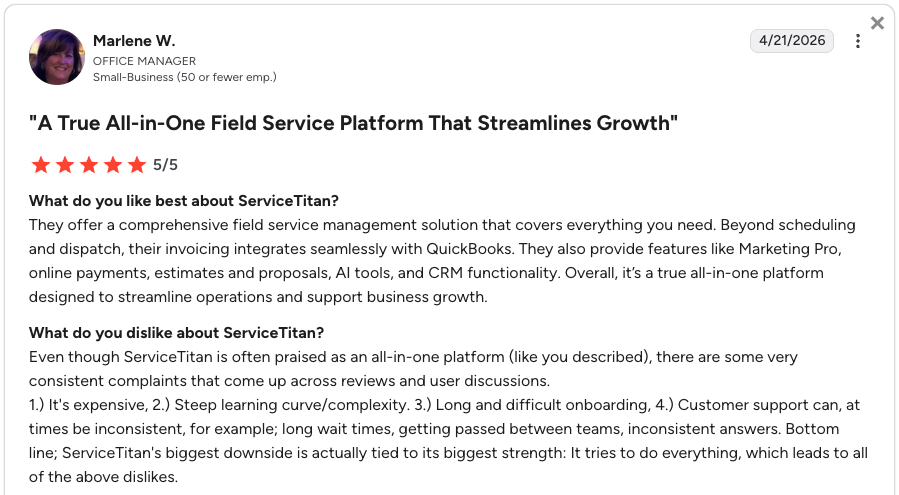
Another user notes that you can tailor ServiceTitan to your workflow, but that may require a significant time investment due to the learning curve.
How much does ServiceTitan cost?
ServiceTitan pricing isn’t publicly available, but users report a minimum monthly fee between $125 and $398.
Who does ServiceTitan work best for?
ServiceTitan works best for established mid- to large-sized home service businesses that have office staff, multiple field technicians, and a reliable flow of jobs. Unlike many of its competitors, it isn’t a great option for sole proprietors or small businesses.
READ MORE: Jobber vs ServiceTitan
ServiceTitan competitors comparison chart
| Disclaimer: App prices are subject to change after publishing. |
| App | Best for | Key features | Pricing | Rating (/5) |
|---|---|---|---|---|
| Jobber | Businesses looking for an all-in-one field service software | • Easy quoting and invoicing • Several payment options • Automated review collection | Starting at $29 per user per month | 4.6 |
| Housecall Pro | Home service businesses | • Job scheduling • Payment processing • Consumer financing | Starting at $59 per month for one user | 4.3 |
| FieldEdge | Businesses that use flat-rate pricing | • Proposals and quotes • Built-in pricing management tools • Payment processing | Must contact for pricing | 4.0 |
| Service Fusion | Small to mid-sized field service businesses | • Invoice creation • Centralized calendar • Team dispatch and scheduling software | Starting at $208 per month | 4.1 |
| Workiz | Small home service teams | • Equipment tracking • Customer call recordings • Online payment processing | Must contact for pricing | 4.5 |
| FieldPulse | Trade businesses that need stronger project management | • Inventory management • Centralized scheduling system • Structured service catalogs | Must contact for pricing | 4.7 |
| Kickserv | Field service businesses on a budget | • Payment collection • Custom reports • Expense tracking | Starting at $60 per month for 5 users | 4.5 |
| RazorSync | Field service businesses wanting simple software | • Easy scheduling and dispatching • Time tracking • Streamlined invoicing | Starting at $85 per month for up to two users | 4.3 |
| Simpro | Commercial contractors | • Asset management • Multi-phase job planning • Fleet tracking | Must contact for pricing | 4.2 |
| Service Autopilot | Home service businesses looking to scale | • Centralized calendar • Route optimization • Recurring billing | Starting at $49 per month | 3.7 |
1. Jobber
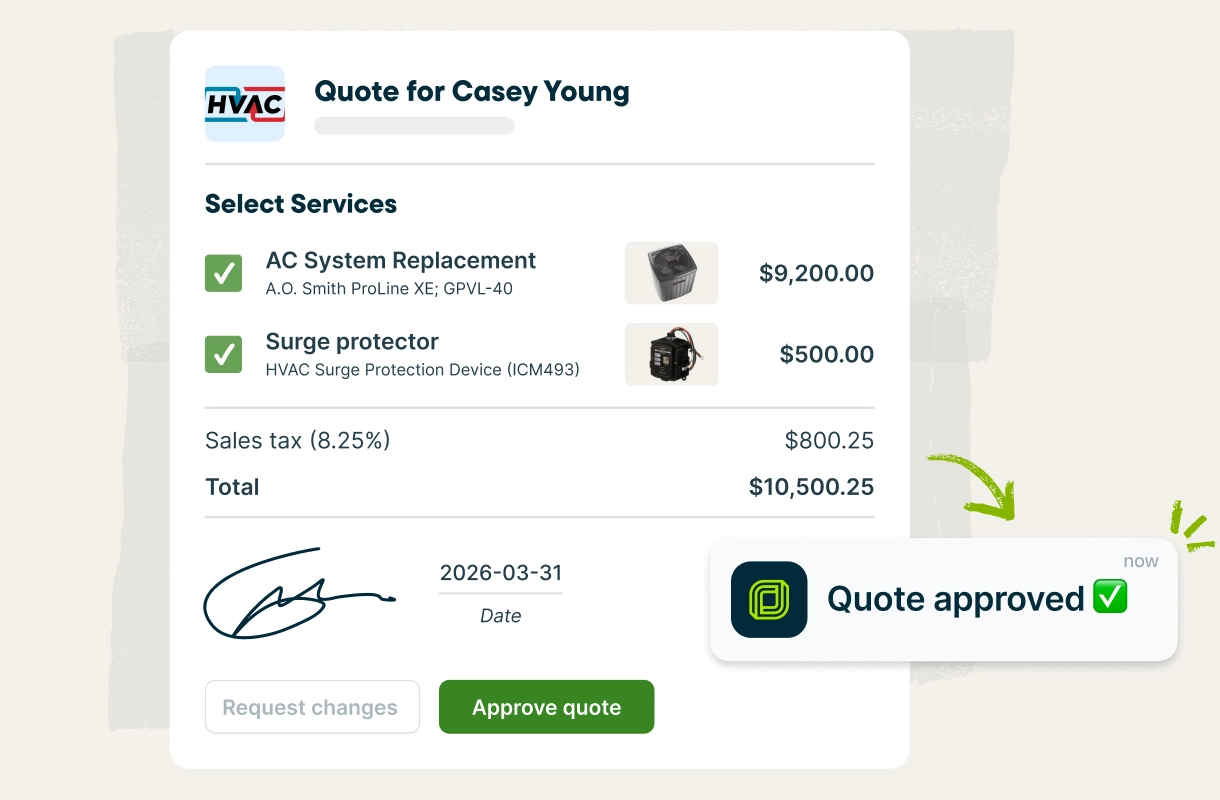
Jobber is field service management software for home service businesses of any size—whether you’re just starting out, looking to scale an already successful business, or running a franchise.
Jobber works well for virtually any home service industry, including:
- Residential and commercial cleaning
- Plumbing
- Pressure washing
- Dog walking
- Roofing
- HVAC
- Appliance repair
- Handyman services
- Lawn care
- Landscaping
- Pool cleaning
- Pest control
- Snow removal
- Painting
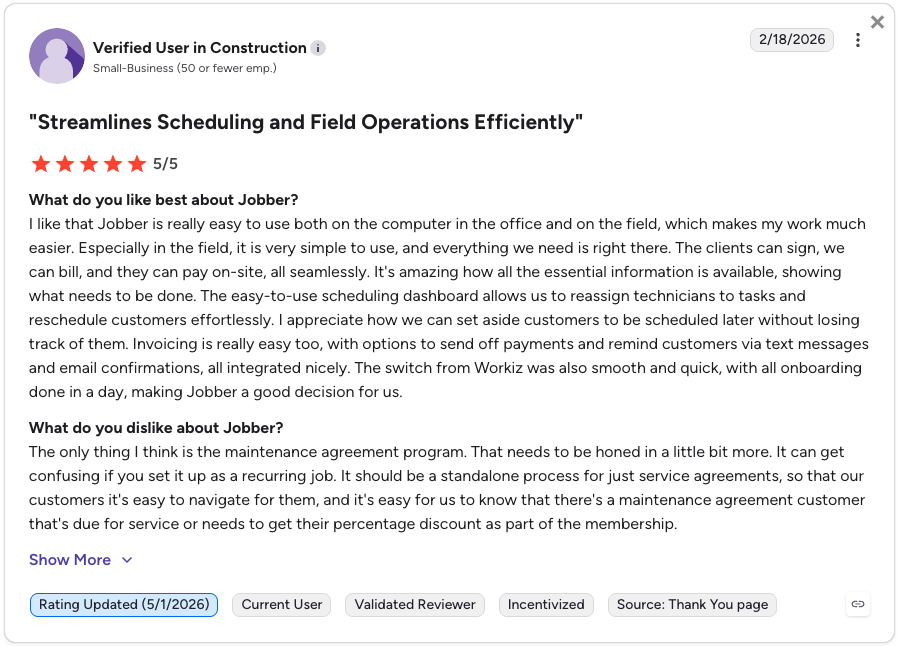
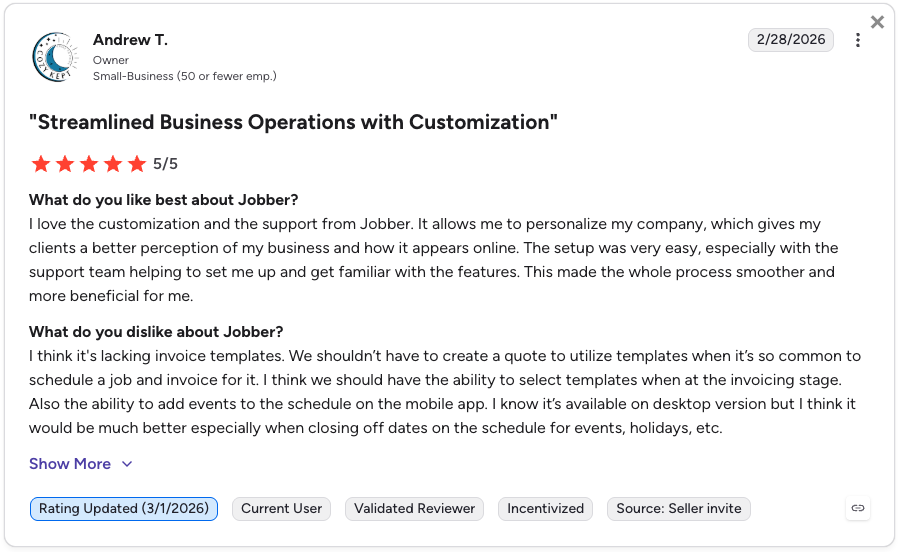
Another user highlighted Jobber’s customer support when it came to setting up and getting familiar with Jobber features.
Key features
Jobber helps you:
- Create and send customer-friendly quotes and invoices that are easy to view and approve online.
- Process credit card payments to get paid faster and in full.
- Track expenses to monitor job costs and make accounting a breeze.
- Schedule and dispatch teams with a drag-and-drop calendar.
- Provide customized performance reports that show you what’s working and where you have room for improvement.
- Maintain steady cash flow for large, multi-phase projects with progress invoicing.
- Automate review collection to boost your reputation, build trust, and develop an online presence.
- Communicate with customers through emails and texts, like automated payment reminders and on-my-way messages.
- Market your business using email campaigns, referral programs, and a company website.
Pros
- Easy-to-use interface with minimal onboarding
- Affordable pricing compared to enterprise-focused platforms like ServiceTitan
- Strong customer communication and automation tools
Cons
- Limited inventory management
How much does it cost?
Jobber’s pricing starts at $29 per user per month, with additional tiers and add-on options depending on which plan you need and how many employees you have.
No matter which plan you choose, Jobber offers a 14-day free trial—no credit card required. That way, you can test out different features before committing.
How does it compare to ServiceTitan?
Jobber is made for businesses of all sizes, making it a great long-term ServiceTitan alternative. Where ServiceTitan only serves established companies with existing teams, Jobber also accommodates smaller one-person businesses, as well as mid-size and large teams.
It integrates well with a variety of small business tools, from accounting and lead generation software to customer financing and call tracking platforms.
Jobber also comes with a lower price tag than ServiceTitan, allowing you to keep more money in your pocket while still accessing the tools you need to grow.
And unlike ServiceTitan, which requires extensive onboarding, Jobber is easy to learn and use. It’s a good option if you want to hit the ground running.
My buddy pushed me over to Jobber. I checked it out, and I was sold very quickly just based on this simplicity. That’s why we chose Jobber. We’re five years in now and we’re not looking back.

2. Housecall Pro
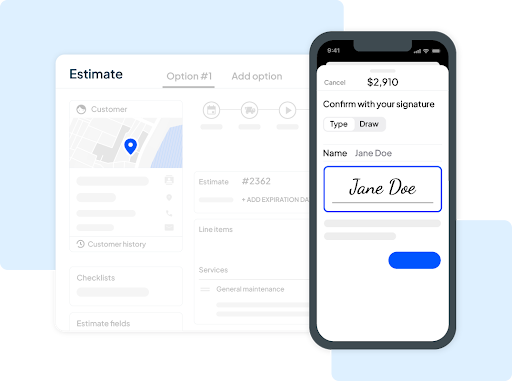
Housecall Pro is a home service business software built for businesses of all sizes, from solopreneurs to teams with up to 100 employees.
This ServiceTitan competitor works for a broad range of industries, including HVAC, plumbing, electrical, cleaning, general contracting, and pest control.
READ MORE: Jobber vs Housecall Pro
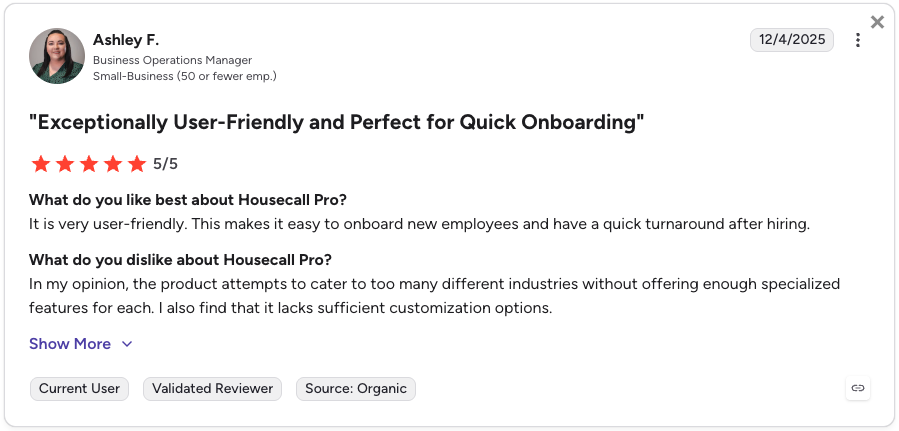
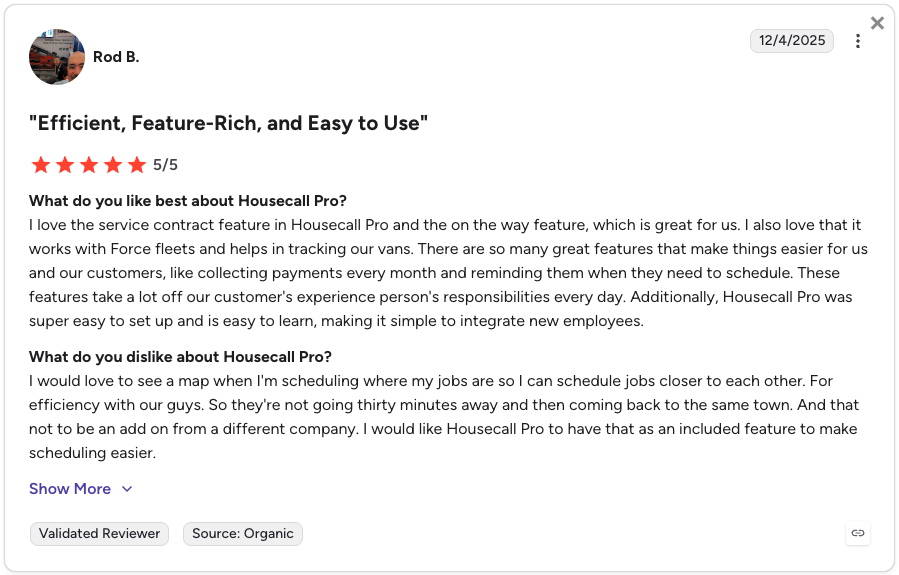
Another user notes that they enjoy the platform’s integration with Force Fleets, but wished the software had better mapping features.
Key features
Housecall Pro helps you:
- Book jobs online and schedule teams through a centralized calendar that helps prevent double bookings and keeps technicians organized in the field.
- Dispatch and track fleets with GPS vehicle tracking integrations that help managers monitor technician locations and improve response times.
- Send professional quotes and invoices digitally, allowing customers to approve estimates and pay online from any device.
- Process payments in the field or online through integrated payment processing tools that help businesses get paid faster.
- Run payroll by tracking employee hours, job times, and commissions in one place to simplify back-office operations.
- Track expenses and job-related costs to better understand profitability and maintain accurate financial records.
- Offer consumer financing options that help customers approve larger repair or installation projects.
Pros
- Easy-to-use interface with a straightforward onboarding process
- Strong mobile app functionality
- Wide range of integrations, including fleet management, financing, and accounting tools
Cons
- Route optimization and advanced mapping capabilities require additional integrations and added monthly costs
- Some advanced reporting and operational management tools may not scale as well for larger, more complex service businesses
How much does it cost?
Housecall Pro’s pricing starts at $59 per month for a single user, $149 per month for up to five, and $299 per month for up to eight users. Specific add-ons, like vehicle tracking, come with additional fees.
How does it compare to ServiceTitan?
Housecall Pro is a more affordable and simpler alternative to ServiceTitan, especially for smaller teams. However, it doesn’t have built-in route optimization, meaning you’ll have to pay an additional monthly fee for an integration if you need that feature.
While it doesn’t offer the same level of marketing support as competitors such as Jobber, HouseCall Pro is a good option if you’re just getting started. It offers a straightforward setup and onboarding process, making it easy for you and your team to make it part of your routine.
3. FieldEdge
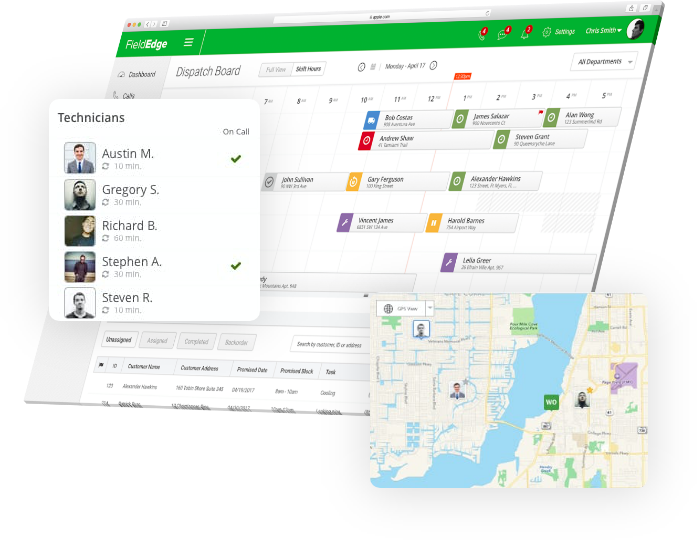
FieldEdge is a field service management tool for small to large enterprises in industries like HVAC, plumbing, locksmithing, and appliance repair.
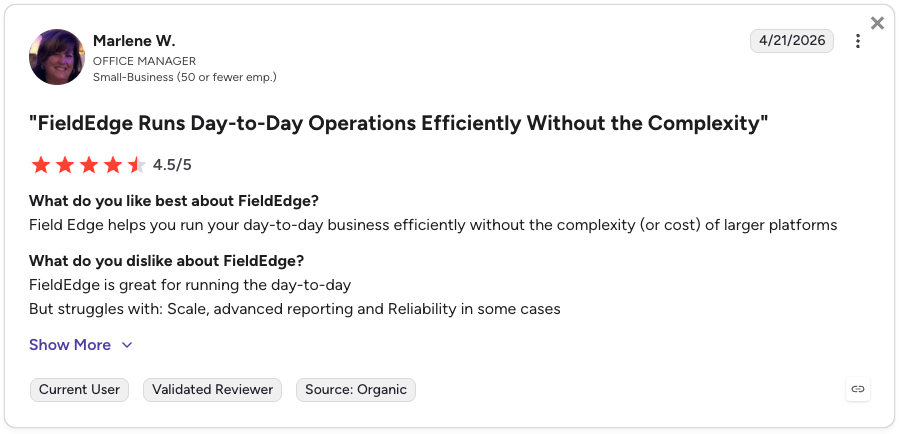
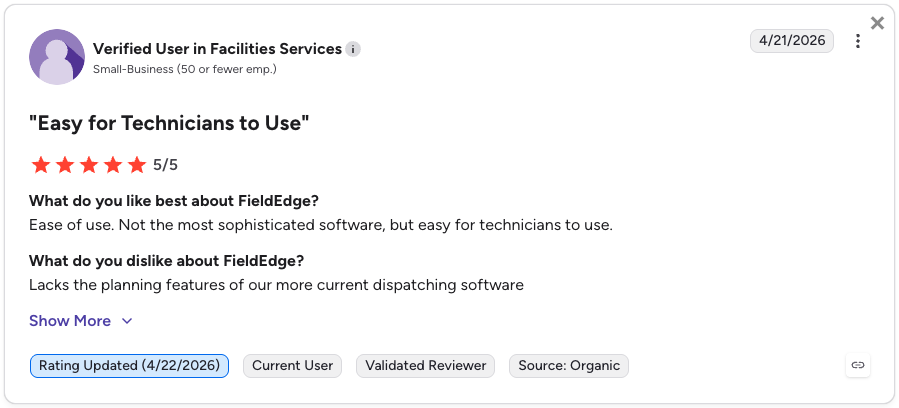
Another user writes that they appreciate FieldEdge’s ease of use, but it lacks a few features related to dispatching.
Key features
FieldEdge helps you:
- Draft proposals and quotes with flat-rate pricing tools that help build accurate estimates and present service options to customers in the field.
- Process payments through integrated invoicing and payment collection tools that allow businesses to accept payments faster and reduce outstanding balances.
- Schedule and dispatch teams using a centralized calendar that helps office staff assign jobs, monitor technician availability, and manage appointments more efficiently.
- Create and send email campaigns to stay connected with customers, promote seasonal services, and encourage repeat business.
- Set service prices with built-in pricing management tools that help standardize rates.
Pros
- User-friendly interface
- Pricebook, flat-rate pricing, and service agreement tools that make it one of the best HVAC service software
- Integrates with accounting platforms like QuickBooks
Cons
- Limited customization and reporting capabilities
- Dispatching and scheduling features may feel restrictive for businesses with larger fleets or more complex operations
How much does it cost?
FieldEdge’s pricing isn’t publicly available, but it’s made up of a monthly fee and an initial setup charge that varies based on your business needs.
How does it compare to ServiceTitan?
FieldEdge serves fewer industries than ServiceTitan. Unlike other competitors such as Housecall Pro or Jobber, it doesn’t offer as many features and customizations.
It works best for smaller teams in specific industries who need help with setting prices, handling basic accounting tasks, or managing service agreements.
On the other hand, it can be limiting if you’re looking for marketing support, popular integration capabilities, or software that supports a wide range of services.
4. Service Fusion
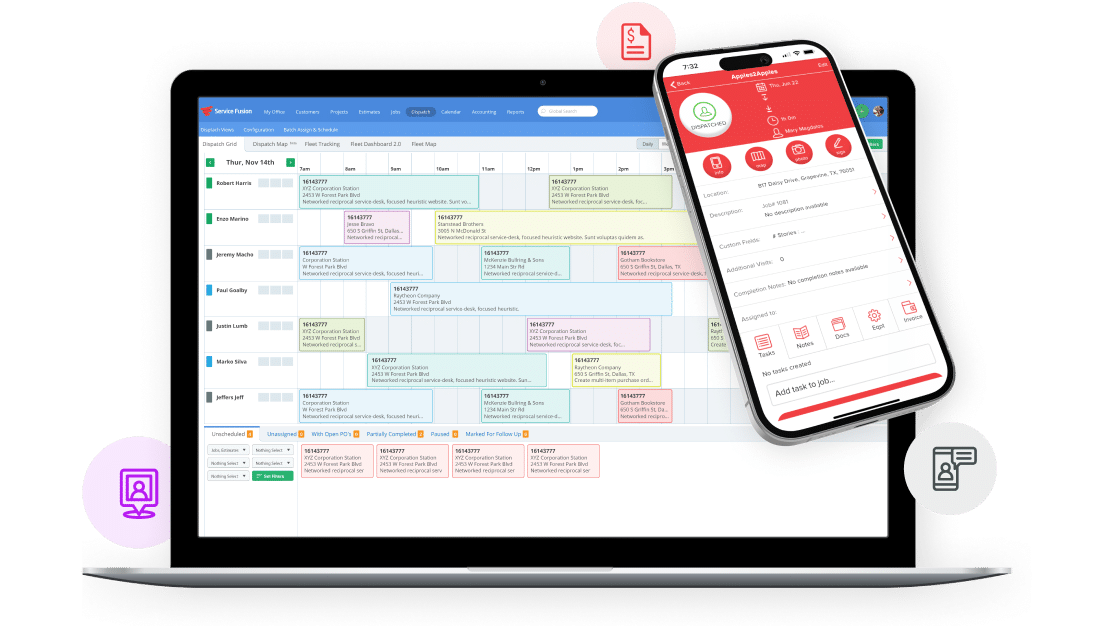
Service Fusion is a field service management platform built for small- to medium-sized home service businesses. It works for a variety of service industries, including HVAC, plumbing, electrical, tree care, carpentry, remodeling, cleaning, and more.
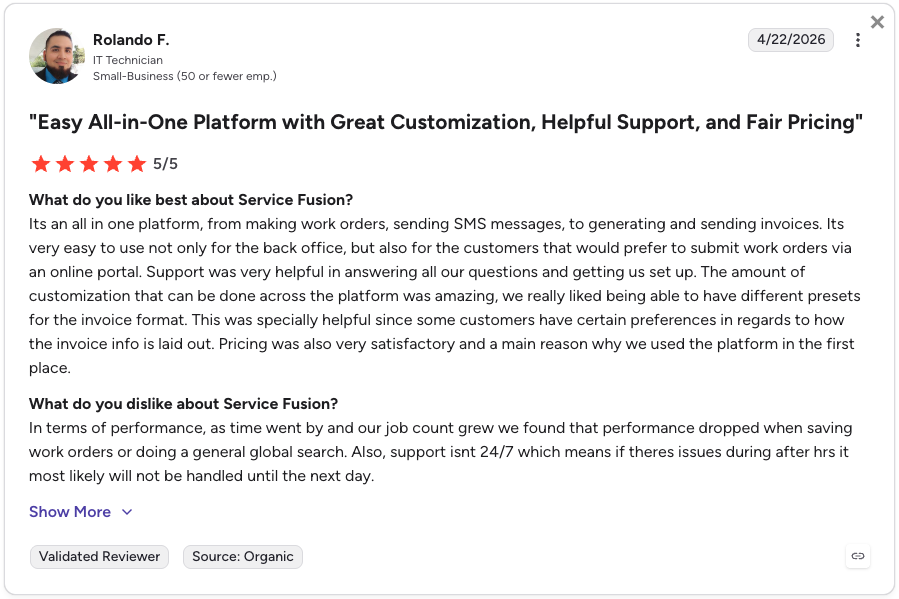
Another user notes that Service Fusion makes dispatch and tracking easy for their team, but some of the features aren’t mobile friendly.
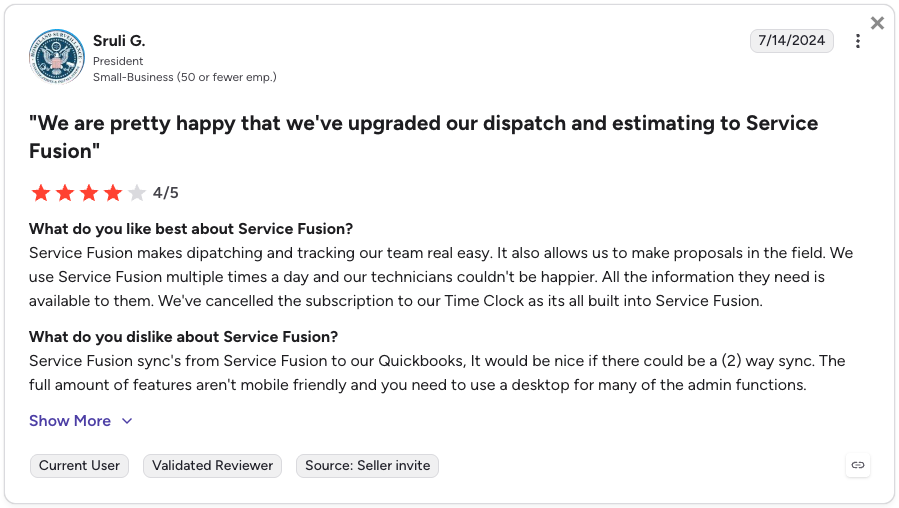
Key features
Service Fusion helps you:
- Track fleets with GPS monitoring tools that help dispatchers view technician locations in real time.
- Manage customer phone calls through built-in VoIP functionality that allows teams to make, receive, record, and track calls directly within the platform.
- Send invoices digitally so customers can quickly review charges and pay online without additional paperwork.
- Process payments through integrated payment tools that support faster collections and reduce manual billing.
Pros
- Unlimited user pricing structure makes it cost-effective for growing teams
- Built-in VoIP phone system to help manage customer calls and improve communication tracking
- Easy-to-use scheduling and dispatching tools
Cons
- Some mobile app features are less intuitive or fully functional compared to the desktop experience
- Customer support isn’t available 24/7, which can create delays when issues arise outside normal business hours
How much does it cost?
Service Fusion pricing starts at $208 per month for a basic plan with an unlimited number of users.
How does it compare to ServiceTitan?
Unlike ServiceTitan, Service Fusion offers customer phone call management through VoIP, allowing service providers to answer and make phone calls directly through the platform.
This feature integrates with the platform’s scheduling system, making it easier to link calls to specific jobs, track conversations, and record customer communications.
Service Fusion is a good option for smaller teams that receive a lot of customer calls and need a way to manage them. However, it doesn’t offer as many features or integrations as other tools, like Jobber.
5. Workiz
Workiz is field service management software for small to medium-sized service businesses in industries such as:
- Junk removal
- HVAC
- Appliance repair
- Carpet cleaning
- Moving
- Computer repair
- Pool services
Reviews
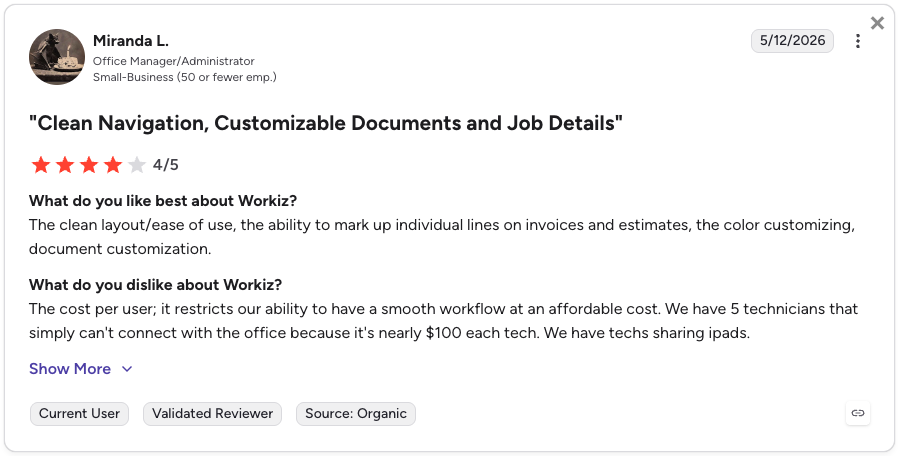
Workiz has a rating of 4.5 out of 5 on G2. One user notes that Workiz is a good option for a simple software, but it has limited functionality and customization on the mobile app.
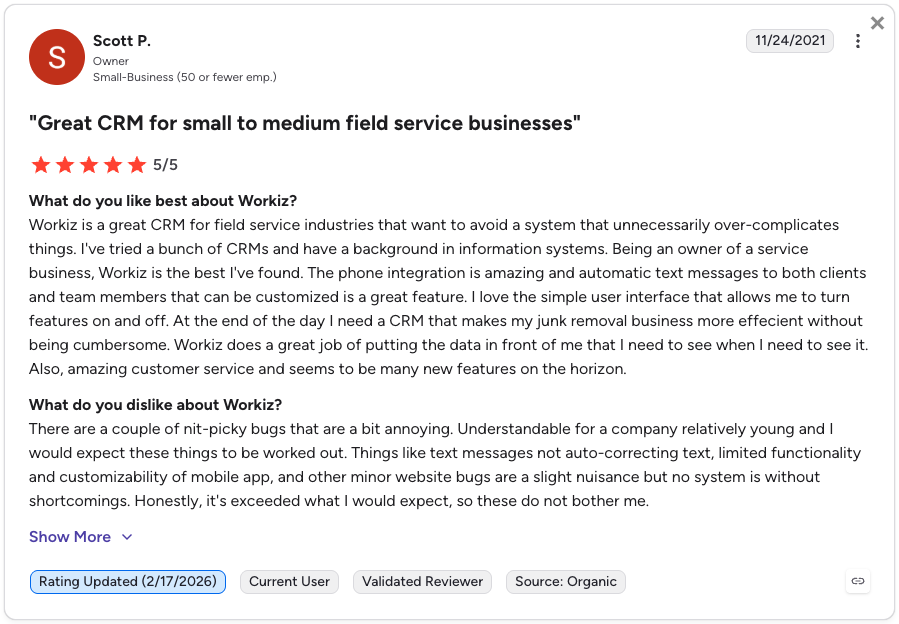
Another user notes that the platform’s layout is clean and easy to use, but the cost per user is restrictive.
Key features
Workiz helps you:
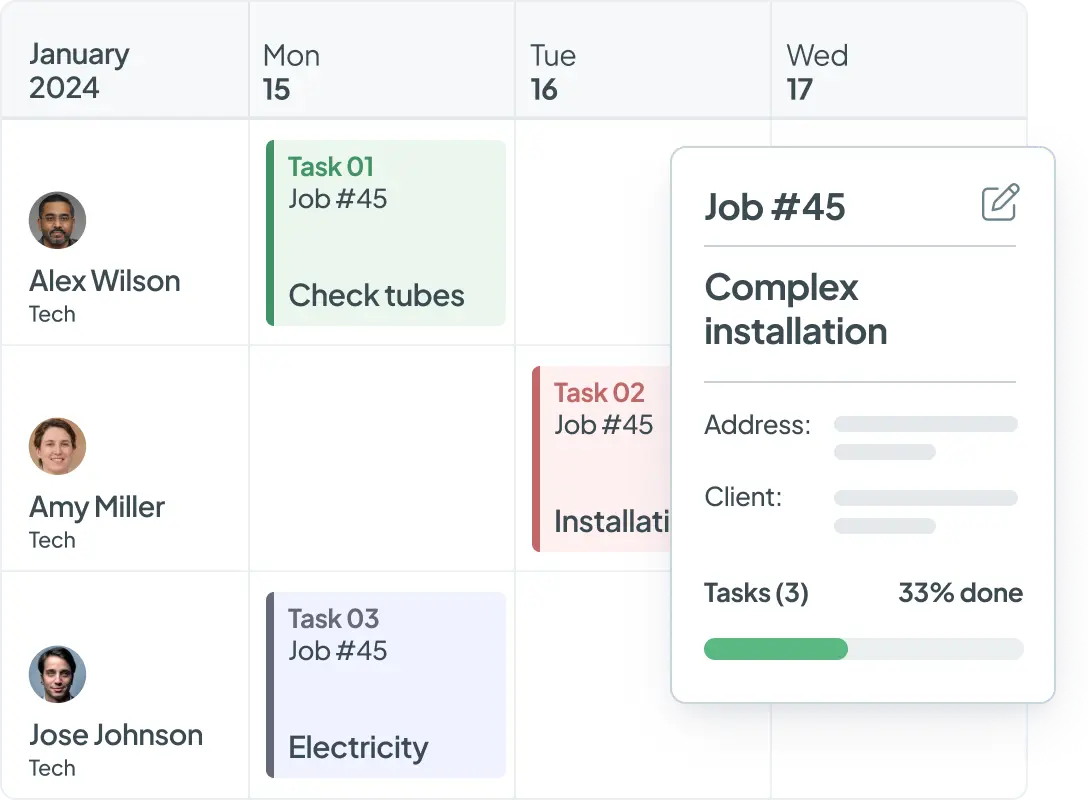
- Schedule and dispatch crews through a centralized calendar that helps you assign jobs, manage technician availability, and reduce scheduling conflicts.
- Track equipment availability so teams can monitor tools and assets needed for upcoming jobs and avoid double booking equipment.
- Manage expenses by organizing job-related costs and tracking spending to better understand profitability.
- Record customer phone calls with built-in call management tools to document conversations and improve customer service.
- Process payments online or in the field to speed up collections and simplify billing workflows.
- Draft estimates and proposals that customers can review and approve digitally.
Pros
- Clean and user-friendly interface
- Built-in call tracking and communication tools help businesses manage customer interactions without relying on separate software
Cons
- Mobile app functionality and customization options are more limited than the desktop version
- Per-user pricing can become expensive as your business grows
How much does it cost?
Workiz doesn’t publish their pricing online. You’ll need to contact them to request pricing.
How does it compare to ServiceTitan?
Workiz has fewer features than ServiceTitan, but the free basic plan makes it a good option for those on a tight budget or who only need limited tools. It’s also an easy platform to scale, so it can grow with you as you hire your first employee and expand your team.
However, it has fewer marketing capabilities and analytics capabilities than ServiceTitan. This means it has less wiggle room for teams with more robust needs.
6. FieldPulse
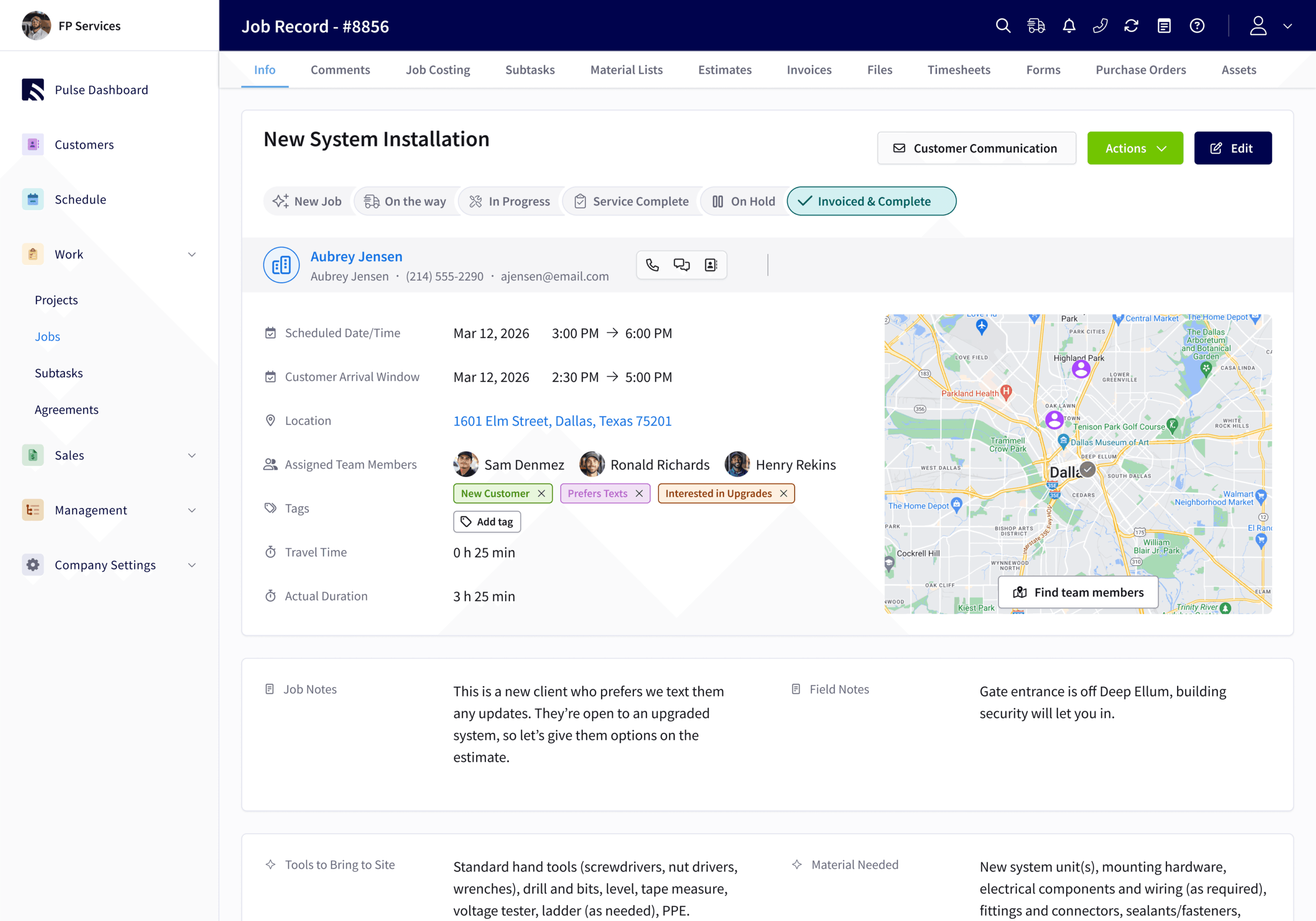
FieldPulse is field service management software for small to medium home service businesses. It’s designed for industries like property management, fire and security, electrical, plumbing, commercial equipment, and glass repair.
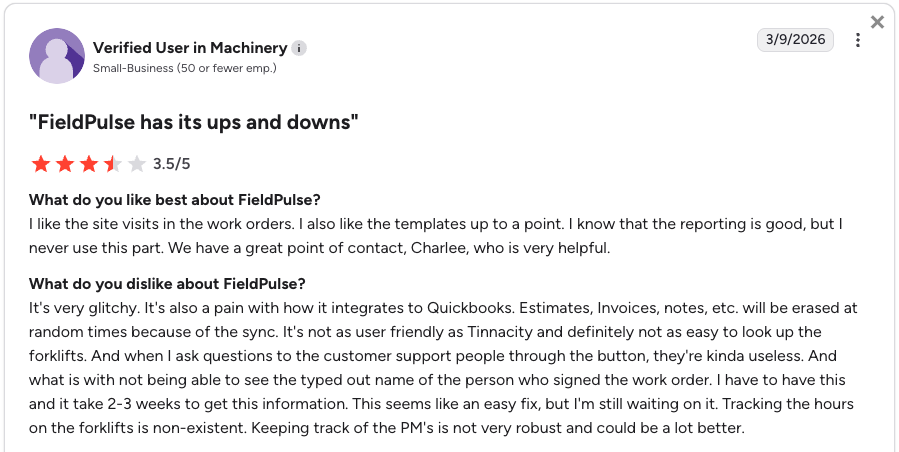
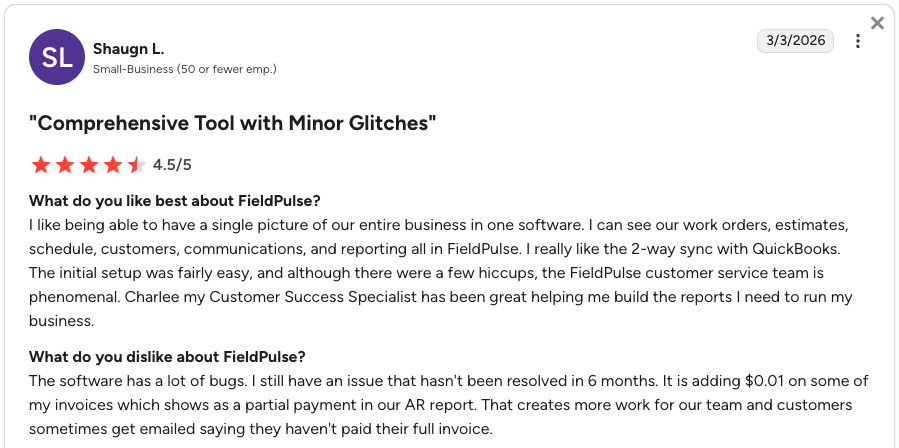
Another user notes that they like how FieldPulse gives them a single view of their entire business. That said, they echo other uses and mention that the software has some bugs.
Key features
Field Pulse helps you:
- Create and send estimates and invoices digitally, allowing customers to review, approve, and pay online for faster job turnaround.
- Oversee project management through centralized job tracking tools that help you manage tasks, timelines, work orders, and technician assignments.
- Set custom prices to standardize service rates and maintain consistent profitability.
- Manage inventory by tracking parts, materials, and equipment so technicians have the supplies they need for upcoming jobs.
- Book jobs through scheduling tools that help coordinate appointments, assign technicians, and organize daily operations.
Pros
- Strong work order and project management features for a centralized view of operations and job progress
- Supports a wide range of industries with residential and commercial flexibility
- Inventory management capabilities to track parts, materials, and equipment
Cons
- Users frequently report bugs and glitches, particularly with integrations and system reliability
- Reporting, automation, and enterprise-level functionality are not as advanced as ServiceTitan for larger organizations with more complex workflows
How much does it cost?
FieldPulse doesn’t list its pricing, so you have to book a demo to find out what it will cost based on your needs.
How does it compare to ServiceTitan?
FieldPulse is made to scale with your business and offers a wide range of features. But the software isn’t as comprehensive as ServiceTitan’s and may not offer the same levels of functionality for larger enterprises with complex needs.
It’s also less user-friendly than other platforms, such as Jobber or Housecall Pro. This affects customer experience and makes it harder for your team to adopt the technology.
7. Kickserv
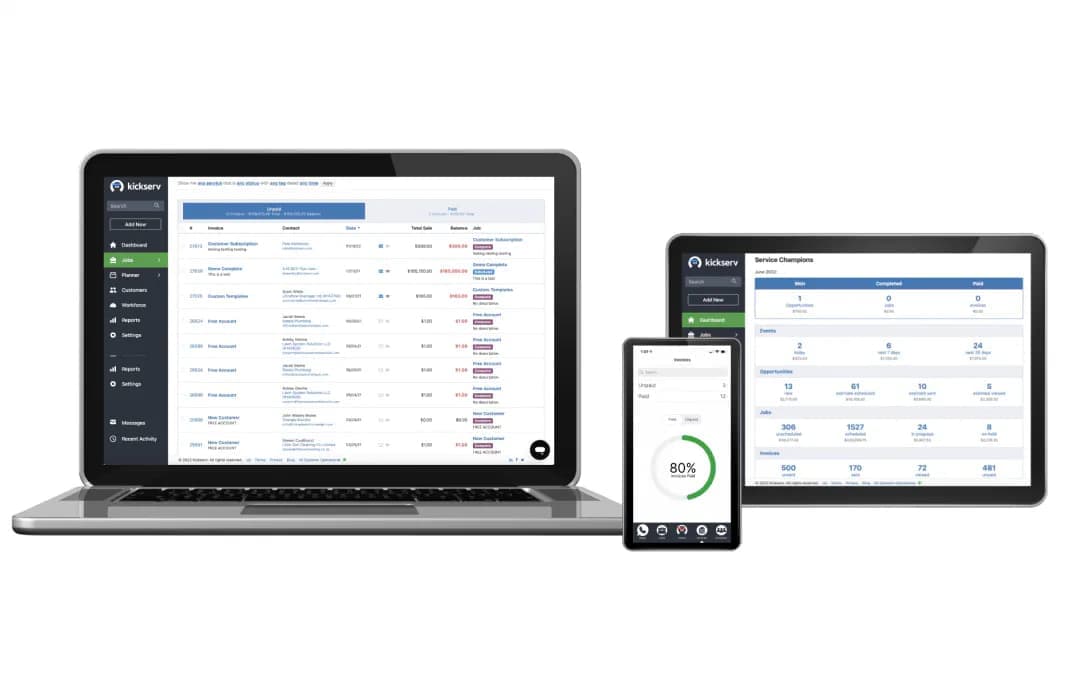
Kickserv is a small business service management tool that works best for solopreneurs and small teams, although it can be used for growing companies and larger businesses as well. It’s designed for industries like construction, landscaping, cleaning, restoration, and mechanical.
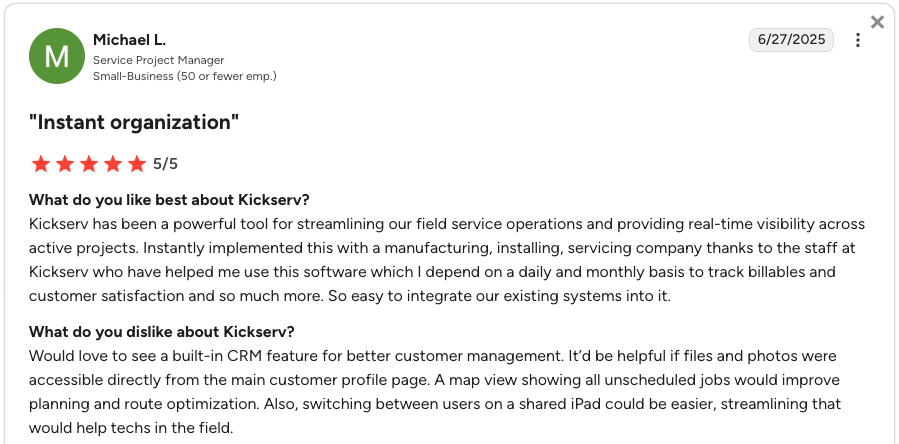
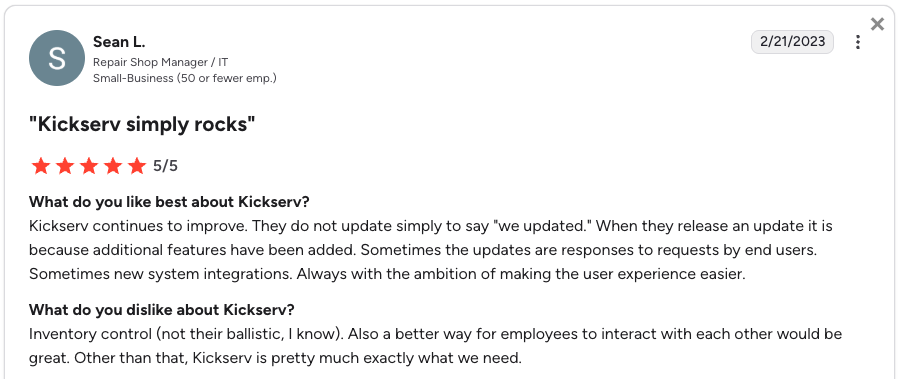
Another user wishes that the software had inventory control and a better way for employees to communicate with each other.
Key features
Kickserv helps you:
- Schedule jobs through a centralized calendar to assign technicians, organize appointments, and avoid scheduling conflicts.
- Create and send invoices online so customers can quickly review charges and pay online.
- Generate custom reports that provide insights into revenue, technician productivity, completed jobs, and overall business performance.
- Track time and expenses to better monitor labor costs, job profitability, and employee hours.
- Monitor your fleet with GPS tracking tools that help dispatchers see technician locations and improve coordination in the field.
- Process payments through integrated tools that support faster collections and reduce manual billing work.
Pros
- Affordable pricing structure
- Easy-to-use scheduling and invoicing tools
- Custom reporting and time tracking features
Cons
- Lacks advanced CRM, marketing automation, and referral management tools compared to other platforms
- Limited inventory management and internal communication tools
How much does it cost?
Kickserv’s pricing starts at $60 per month for up to five team members. Pricing goes up to $199 per month for up to 20 users. Different plans come with different features. The cost will depend on your needs, like whether you need features like expense tracking or live GPS maps.
How does it compare to ServiceTitan?
Kickserv offers various features useful to small- to medium-sized service businesses, but it lacks the same enterprise-level options, making it less scalable.
For example, Kickserv currently doesn’t offer automated marketing campaigns or referral programs found in ServiceTitan or other field service software alternatives like Jobber. It also offers limited integration capabilities, making it harder to get your software to work together.
8. RazorSync
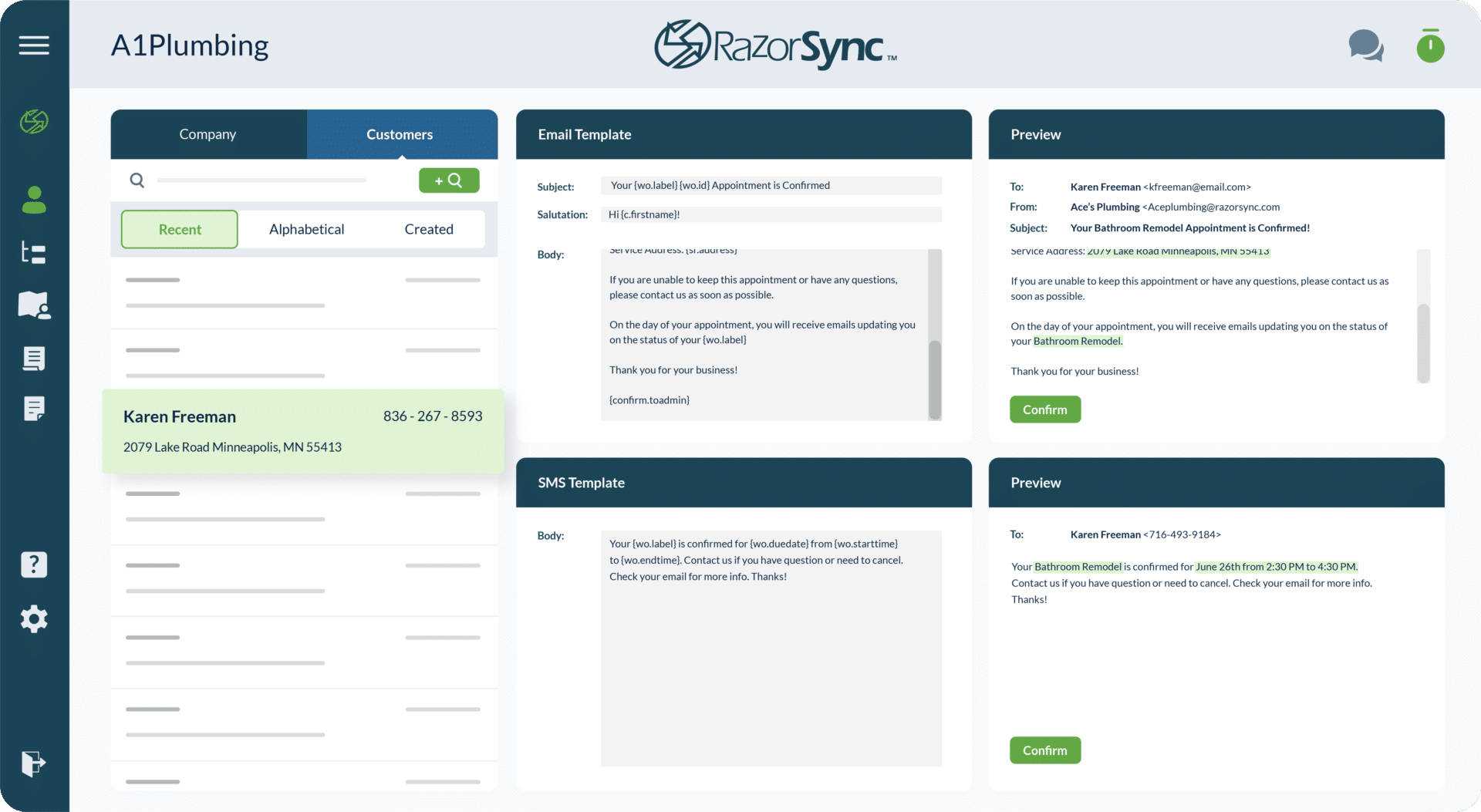
RazorSync is another platform made for small to medium-sized teams. It works in many different service industries, such as:
- Alarm and security
- Appliance repair
- Plumbing
- IT and computer repair
- HVAC
- Lawn care
Reviews
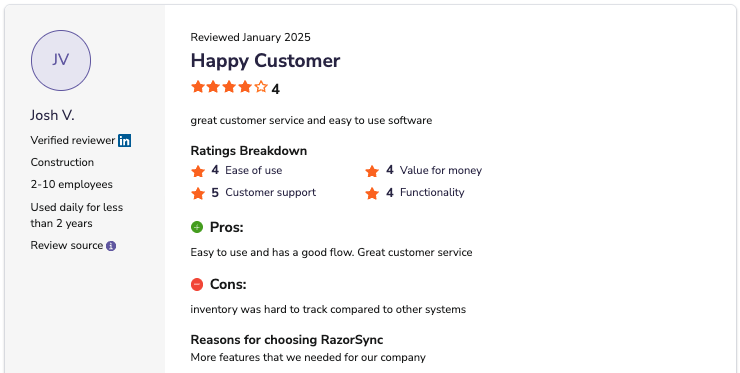
Razorsync has an overall rating of 4.3 out 5 on Software Advice. One user notes that RazorSync has great customer service, but the platform’s inventory tracking is not as good as that of other ServiceTitan alternatives.
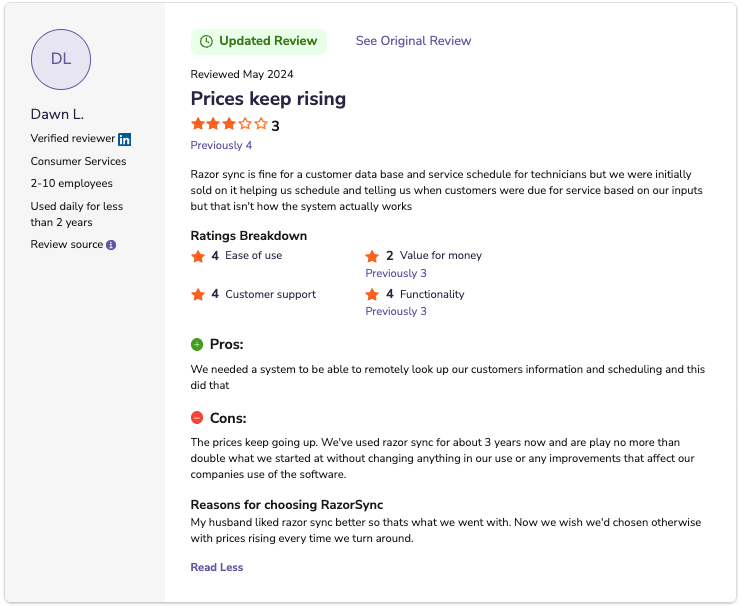
Another user says they enjoy RazorSync’s scheduling feature, but the software’s price is getting high for their business.
Key features
RazorSync helps you:
- Automate billing by generating invoices from completed jobs, reducing manual paperwork and helping ensure faster, more consistent payments.
- Manage customers through a built-in CRM for field service companies that stores contact details, job history, and service notes in one place for easy reference.
- Schedule jobs using a drag-and-drop calendar that helps dispatchers assign technicians and manage daily workloads efficiently.
- Dispatch crews with real-time updates that help coordinate field operations and respond quickly to changes or urgent requests.
- Track time so you can monitor technician hours, improve payroll accuracy, and better understand job costs.
- Process payments through integrated payment tools that allow customers to pay invoices online or in the field.
Pros
- Strong customer support that helps users get set up and resolve issues quickly
- Intuitive scheduling and dispatching tools
- All-in-one functionality for invoicing, scheduling, and customer management
Cons
- Inventory tracking is limited compared to other platforms
- Pricing can become expensive as your business grows or as add-ons are required
How much does it cost?
RazorSync’s pricing starts at $85 per month for up to two users. It goes up to $360 per month for up to 15. Depending on the plan you choose, you may also need to pay additional fees for add-ons like route optimization or templates for service requests.
How does it compare to ServiceTitan?
Like other ServiceTitan competitors, RazorSync is best for small to mid-sized teams. It doesn’t offer marketing support like email campaigns or deep-level reporting that enterprises might need. And it has fewer integration options than alternatives like Jobber.
9. Simpro
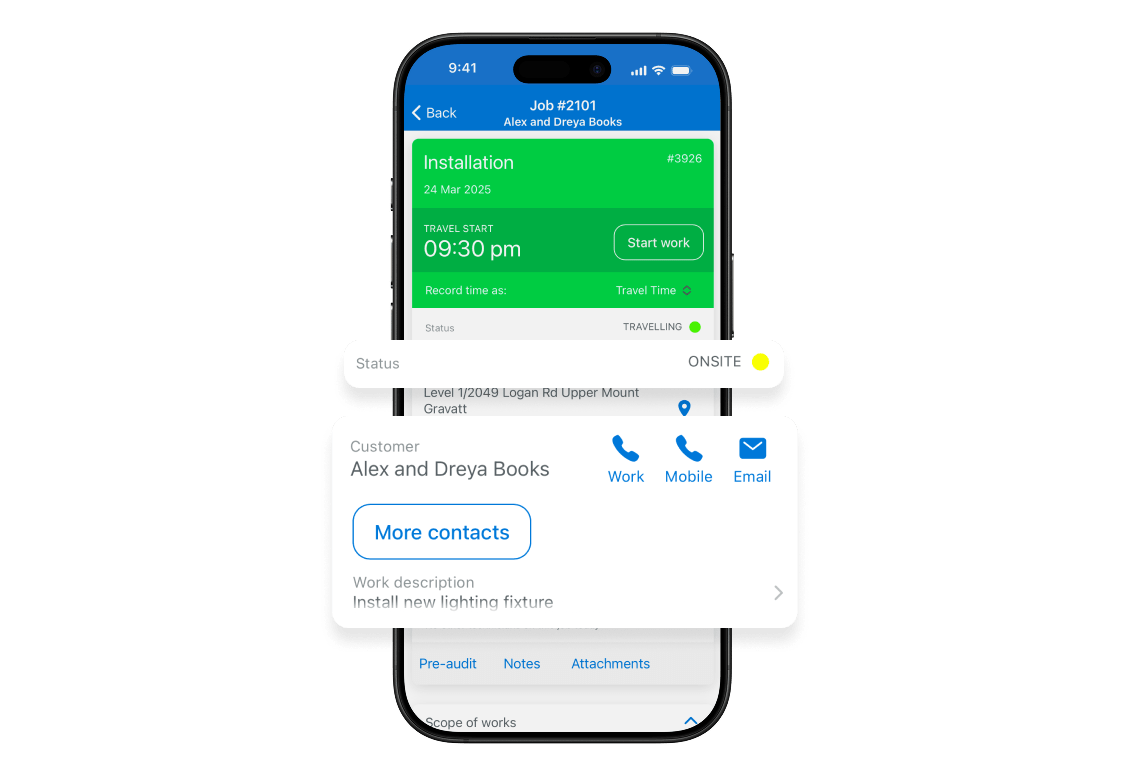
Simpro is field service management software made to serve large service businesses or those with commercial clients. It can be used for many different service industries, such as:
- Electrical
- Fire protection
- Security
- Plumbing
- Solar
- Gas
- Construction
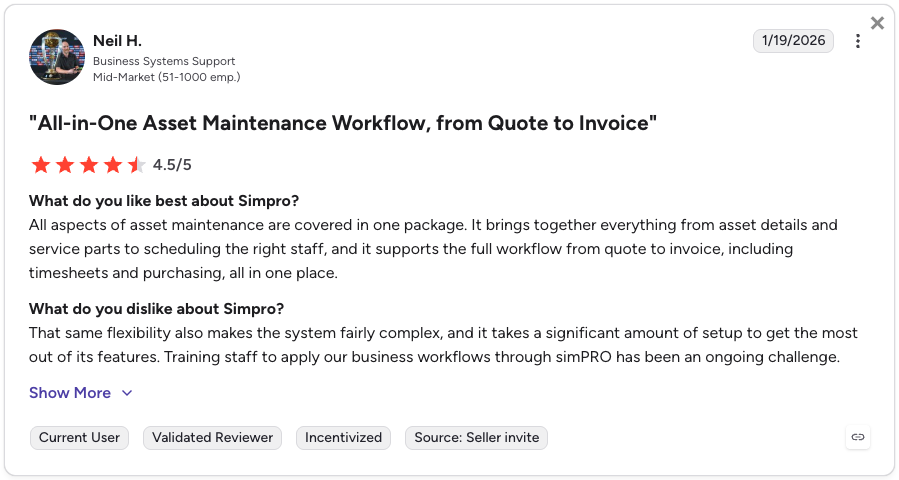
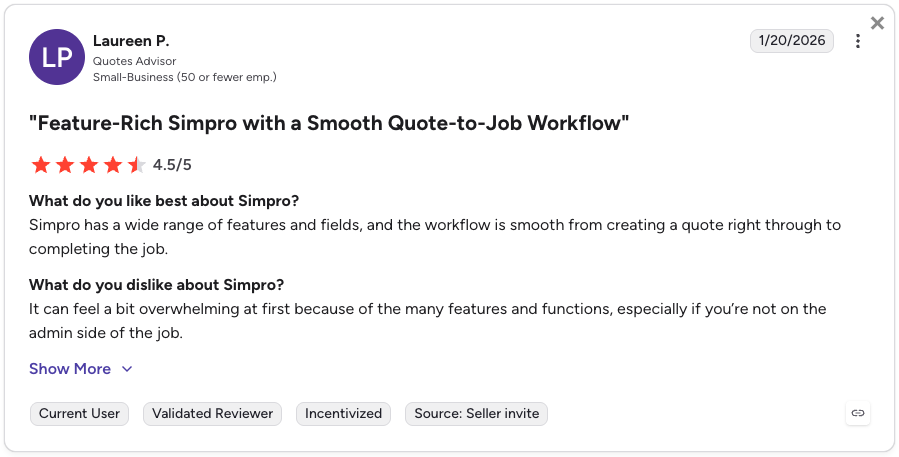
Another user likes Simpro’s wide range of features, but again, says that the platform can be overwhelming.
Key features
Simpro helps you:
- Manage multiple companies within a single system, making it easier to oversee operations and reporting in one place.
- Plan maintenance with preventative scheduling tools that help you stay ahead of recurring service needs and reduce equipment downtime.
- Oversee inventory with detailed tracking of parts, materials, and equipment across warehouses, vehicles, and job sites to improve job readiness and cost control.
- Schedule and dispatch teams using tools designed for complex, multi-technician jobs and long-term project coordination.
- Track fleets through GPS-enabled tools that help managers monitor field staff, optimize utilization, and improve operational visibility.
Pros
- Strong enterprise-grade functionality for job costing, asset tracking, and inventory management
- Detailed workflow capabilities that support end-to-end project management
- Scales effectively for commercial and multi-branch businesses
Cons
- Steep learning curve, often needing in-depth training and onboarding before teams can use the platform efficiently
- Can feel overly complex and overwhelming for smaller service businesses or those with simpler operational needs
How much does it cost?
Simpro’s pricing is based on your business needs, and you have to request a demo to get a quote.
How does it compare to ServiceTitan?
Simpro is meant for service businesses that need detailed job costing, inventory tracking, and asset management. It works well for commercial clients and large-scale construction projects, but it isn’t ideal for smaller businesses with simpler needs.
It also doesn’t offer marketing support, it has fewer options for residential contracts, and it’s missing customer-facing features such as a self-serve portal.
10. Service Autopilot
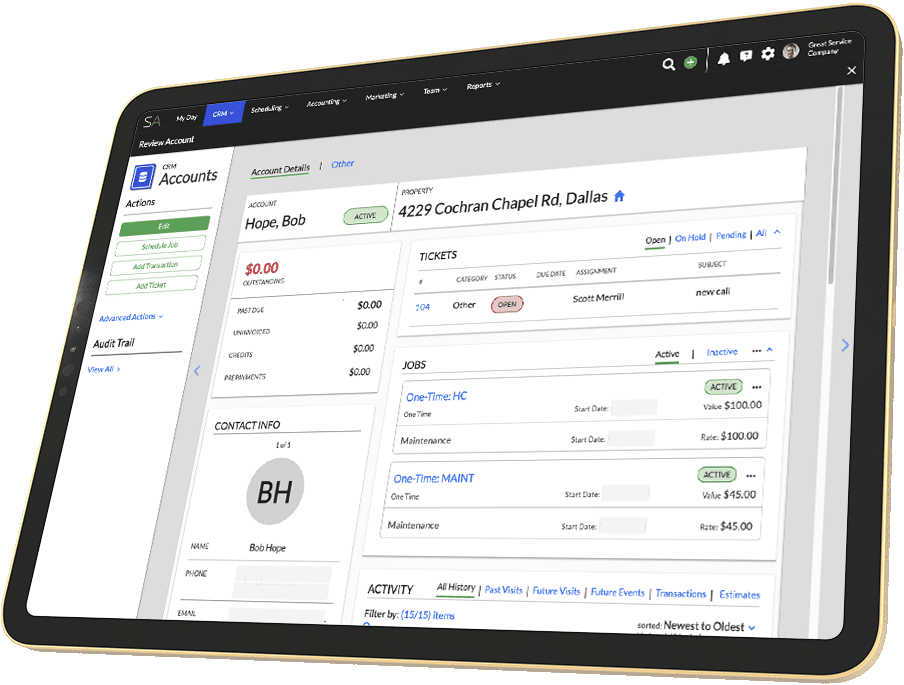
Service Autopilot is field service software geared towards specific industries, such as lawn care, cleaning, snow removal, pest control, and pool cleaning. This platform is made for businesses of all sizes.
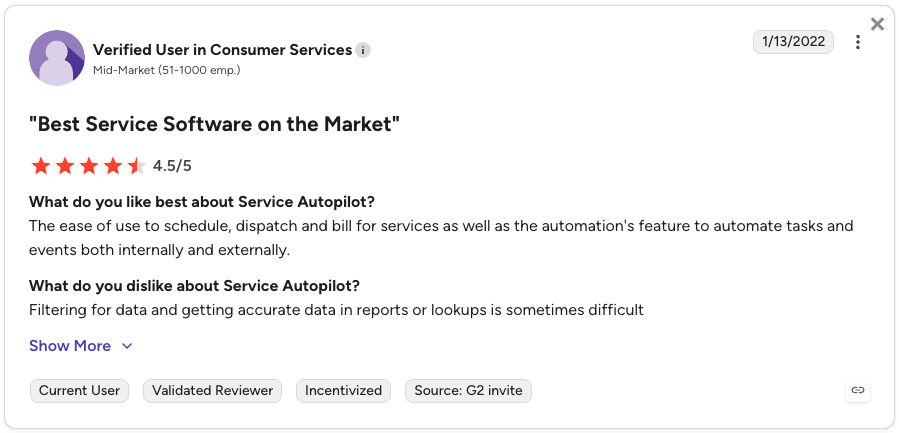
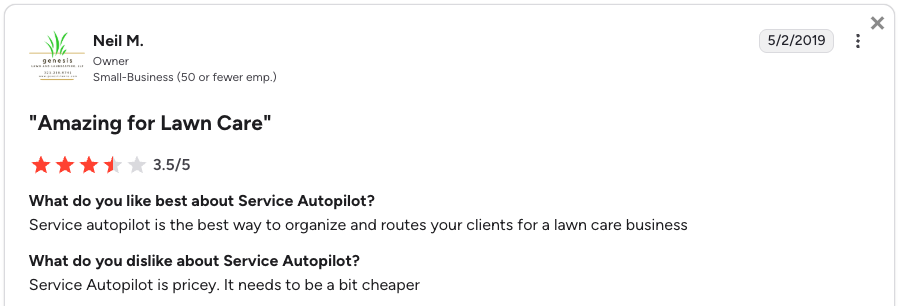
Another user uses Service Autopilot’s routing for their lawn care business but finds the software pricey.
Key features
Service Autopilot helps you:
- Send invoices through automated billing tools that convert completed jobs into professional invoices and help speed up payment collection.
- Receive payments online or in the field with integrated payment processing that reduces manual follow-ups and improves cash flow.
- Create estimates that allow customers to review service options, approve quotes, and move jobs forward more quickly.
- Track time and productivity to monitor employee performance, job duration, and overall operational efficiency.
- Manage recurring payments and jobs with subscription-style scheduling tools designed for lawn care, cleaning, pest control, and other recurring service work.
Pros
- Strong recurring job management tools that make it especially useful for subscription-based service businesses
- Built-in routing and scheduling features
- Affordable entry-level pricing compared to other ServiceTitan competitors
Cons
- Reporting and data navigation can be difficult
- Lacks advanced features like job costing, asset tracking, and robust marketing tools
How much does it cost?
Service Autopilot’s pricing starts at $49 per month for basic features. Their most robust plan costs $499 per month. No matter which plan you choose, you’ll pay an additional sign-up fee based on your business’s needs.
How does it compare to ServiceTitan?
Service Autopilot caters to fewer industries and offers more basic features than ServiceTitan. For example, it doesn’t offer job costing or asset tracking.
It can work well for home service providers in the industries it serves who are looking for basic field management software. However, it isn’t the best fit for those with commercial clients, bigger teams, or who want marketing support.
How to pick the right field service management software
To pick the best ServiceTitan competitors for your business, consider the following factors.
1. The size of your team
Are you a sole proprietor, or do you have a few service contractors or employees to manage? Different field service management platforms are geared to different sized teams.
Some, like Jobber, work well whether you have a team of one or 30. Others, like ServiceTitan, are made for larger enterprises.
You also need to think about your long-term growth goals. For example, whether you want to scale your business in the future, and what that would look like. Some tools will be able to grow with you, while others won’t be able to support your needs as you expand.
Think about the support you need today, like invoicing or payment processing, and what you might like to have down the road, like fleet management or marketing tools.
2. Customer support
Customer experience matters when choosing field service management software—not just for your clients, but also for you and your team. If you run into a problem during setup, will you get fast, helpful customer support that answers your question?
Take a look at reviews from other users to get an idea of a platform’s customer service. This should also tell you whether you’ll be able to speak to a real person or just a bot. Getting the support you need without having to wait on hold or chase down answers can make all the difference.
My favorite thing about Jobber is the support. You can ask a question right in the chat.
You don’t have to deal with finding contact info and then calling or emailing. If you have an issue, it’s right there. That’s why I chose Jobber.
3. Integration capability
Ideally, you want a field service management platform that integrates well with other tools and software you use, like QuickBooks, Angi, or DocuSign.
The more integrations your software has, the easier your life will be. That way, you don’t have to go back and forth between apps, and you can handle everything within a single platform.
Pro Tip: Check out Jobber’s integrations in the App Marketplace to see if we integrate with the software you already use.
4. Pricing
You need a platform that fits your budget. Think about what you need help with, like automated invoicing, employee scheduling, or online booking. Then, review which tools offer those features for the lowest price.
Watch out for platforms that hide basic features behind higher plan tiers, like templates or reporting tools. These add-ons can quickly increase your monthly cost and force you to opt for upgrades you won’t use.
Choose a platform with transparent pricing that covers your needs without breaking the bank.
For example, Jobber’s Core plan takes care of all the basics with online booking, job scheduling, quoting, invoicing, online payment processing, and reporting for $25 per month.
Then, you can purchase add-ons for things like marketing tools or app integrations to customize your subscription and only pay for what you need.
5. Ease of use and onboarding
Ease of use can make or break adoption of field service management software. If a platform is confusing or hard to navigate, your team is less likely to use it consistently—no matter how many features it offers.
Look for software with a simple interface that makes everyday tasks simple and intuitive, like scheduling, invoicing, and dispatching. This reduces training time and helps teams get productive faster.
Onboarding also varies widely between platforms. Some tools require heavy setup and training, while others offer guided onboarding and can be up and running in a short time.
For example, Jobber is known for being easy to learn and adopt quickly, especially thanks to its award-winning customer service.
Final verdict: Which ServiceTitan alternative is best?
The best choice among ServiceTitan competitors depends on your business size, budget, and feature needs.
Smaller teams often prefer simpler, more affordable tools like Jobber for their ease of use and fast onboarding. Larger, more complex operations may find it’s easier to scale with tools like Simpro.
The right platform is the one that balances functionality with usability. It should be easy to operate while helping your team stay organized, efficient, and profitable.
Originally published in April 2025. Last updated on June 5, 2026.