11 Housecall Pro Competitors & Alternatives for Service Businesses in 2026

Key takeaways:
If you’re searching for Housecall Pro competitors to better suit your service business’s needs in 2026, this guide offers a comprehensive comparison to help you find the ideal solution for your size, budget, and workflow complexity.
- Diverse alternatives for every business size and specialty. Top Housecall Pro competitors like Jobber, ServiceTitan, Service Fusion, FieldPulse, and others cater to everything from solo operators and small teams to large, enterprise-level contractors.
- Feature and pricing flexibility. Each alternative offers a unique mix of features—including scheduling, invoicing, payments, automation, and route optimization—with options ranging from affordable entry-level plans with free tiers to robust, customizable enterprise solutions.
- Ease of use and scalability. Many alternatives, such as Jobber, stand out for intuitive interfaces, built-in support, and features that scale seamlessly as your business grows, unlike platforms with steep learning curves or higher costs as you expand.
- Specialization and integrations. Solutions like Lawn Pro offer specialized tools for specific industries, while others like Service Fusion provide flat-rate pricing and unlimited users. Integration options and customer support quality vary, making it important to match software to your workflow and client management style.
- Choosing the right fit. Evaluate your current needs, growth goals, and preferred support experience. Whether you prioritize budget-friendliness, advanced features, simple setup, or a balance of all three, there’s a Housecall Pro alternative designed to help you organize and scale efficiently.
Stay informed and get more tips on running a 5-star business—sign up for the Jobber Newsletter.
Housecall Pro is one of many field service management platforms designed to help home service businesses streamline scheduling, dispatching, invoicing, and day-to-day operations. But the right software depends on your business size, workflow complexity, and growth goals.
This guide compares the top Housecall Pro competitors so you can evaluate features, pricing, and strengths side by side. Whether you want to reduce administrative work, improve team coordination, or scale your operations more efficiently, these alternatives can help you find the best fit for your business.
11 Housecall Pro alternatives with more features:
The best Housecall Pro competitors at a glance
| App | Best for | Key features | Pricing | Rating |
|---|---|---|---|---|
| Jobber | Businesses looking for an all-in-one Housecall Pro alternative | • Detailed quotes • Easy invoicing and multiple payment options • Automated marketing features | Starting at $29 per user per month | 4.6/5 |
| ServiceTitan | Large businesses | • Complex multi-phase project management • Asset management • Customizable workflows | Must contact for pricing | 4.5/5 |
| Service Fusion | Small to mid-sized field service businesses | • Invoice creation • Centralized calendar • Team dispatching | $208 per month for unlimited users | 4.1/5 |
| FieldPulse | Trade businesses that need stronger project management | • Inventory management • Centralized scheduling system • Structured service catalogs | Must contact for pricing | 4.7/5 |
| ServiceM8 | Sole proprietors | • Job checklists • Client communication • Easy invoice creation | Free for one user, then starting at $29 per month for unlimited users | 3.8/5 |
| Kickserv | Field service businesses on a budget | • Payment collection • Custom reports • Expense tracking | Free plan, then $75 per month for 5 users | 4.5/5 |
| Workiz | Small home service teams | • Equipment tracking • Customer call recordings • Online payment processing | Starting at $225 per month for 3 users | 4.5/5 |
| Simpro | Commercial contractors | • Asset management • Multi-phase job planning • Fleet tracking | Must contact for pricing | 4.2/5 |
| RazorSync | Field service businesses wanting simple software | • Easy scheduling and dispatching • Time tracking • Streamlined invoicing | Starting at $85 per month for up to 2 users | 4.3/5 |
| Service Autopilot | Home service businesses looking to scale | • Centralized calendar • Route optimization • Recurring billing | Starting at $49 per month | 3.7/5 |
| Lawn Pro | Lawn care businesses | • Expense monitoring • Employee timesheets • Payment processing | Free plan, then $39 per month for 3 users | 3.8/5 |
What is Housecall Pro and why look for alternatives?
Housecall Pro is a field service management platform that helps you run, manage, and organize your service business.
It’s a good option if you’re a sole proprietor or have a small-to-medium-sized team, and you need basic field management support.
It supports industries such as:
- HVAC
- Snow removal
- Plumbing
- Electrical
- Appliance repair
- Pest control
- House cleaning
- Handyman services
- General contracting
- Pressure washing
- Landscaping and lawn care
Reviews
Housecall Pro has an overall rating of 4.3 out of 5 on G2.
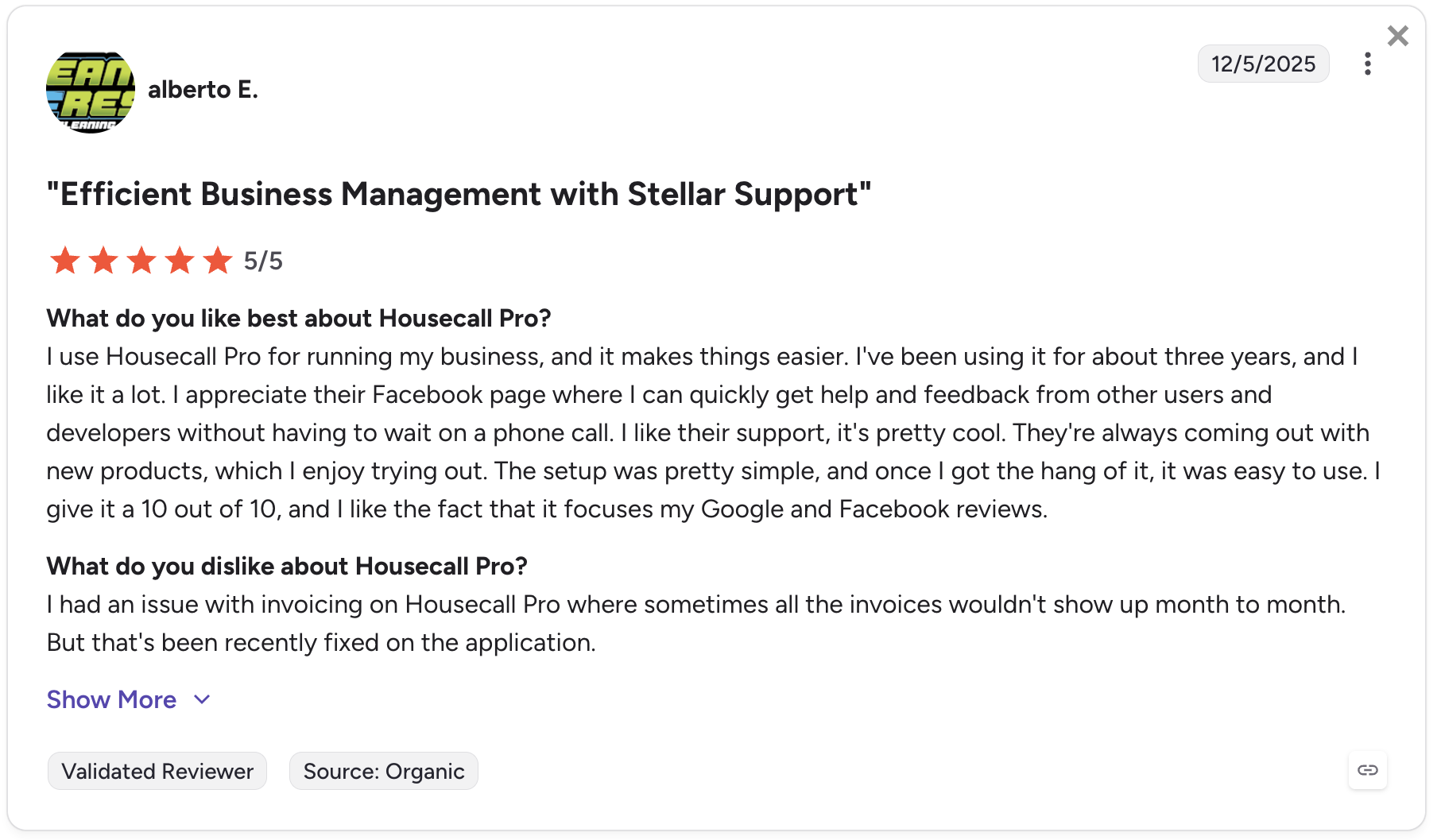
One user enjoys how simple Housecall Pro is to set up and notes how helpful the customer support team is.
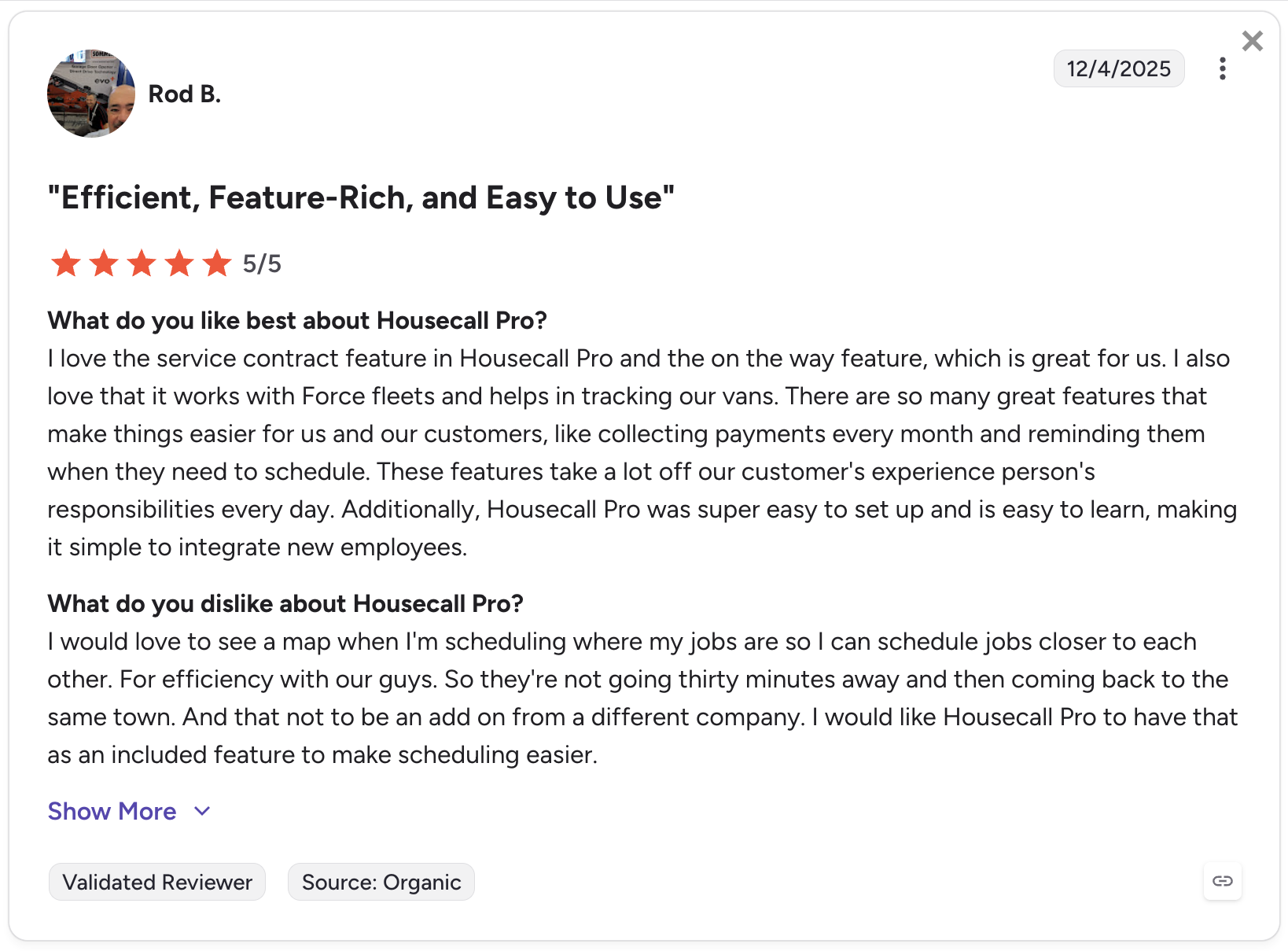
Another user notes that the mobile app is convenient for technicians in the field, but scheduling and route planning feels limited.
Key features
Housecall Pro works best for small- to medium-sized home service businesses that need help to:
- Schedule jobs and dispatch crews so technicians know where to go and managers can avoid scheduling conflicts.
- Create estimates and invoices quickly, speeding up approvals and getting paid faster.
- Process payments in the field or online, making it easier for customers to pay immediately after service.
- Manage customer communications with automated reminders and follow-ups that reduce missed appointments.
- Record expenses and track job costs to better understand profitability.
- Offer consumer financing options that help customers approve larger repair or installation projects.
- Track profitability and growth with reporting dashboards that provide insight into revenue and performance trends.
Pros
- Easy to use
- Built-in invoicing, payments, and customer communication tools
- Mobile app to allow field technicians to manage jobs and collect payments on-site
Cons
- No built-in route optimization
- Pricing can become expensive for larger teams that need advanced features and automations
Housecall Pro pricing
Housecall Pro offers a 14-day free trial, and after that, pricing starts at $59 per month for a single user and $299 per month for up to eight.
COMPARE:Jobber vs. Housecall Pro
1. Jobber
Jobber is a robust field service management platform that serves sole proprietors and small business owners with teams of up to 30 people.
As one of the best Housecall Pro competitors, Jobber helps service providers in industries such as roofing, lawn care, HVAC, plumbing, general contracting, cleaning, electrical, pressure washing, painting, and more.
Reviews
Jobber has an overall score of 4.6 out of 5 on G2.
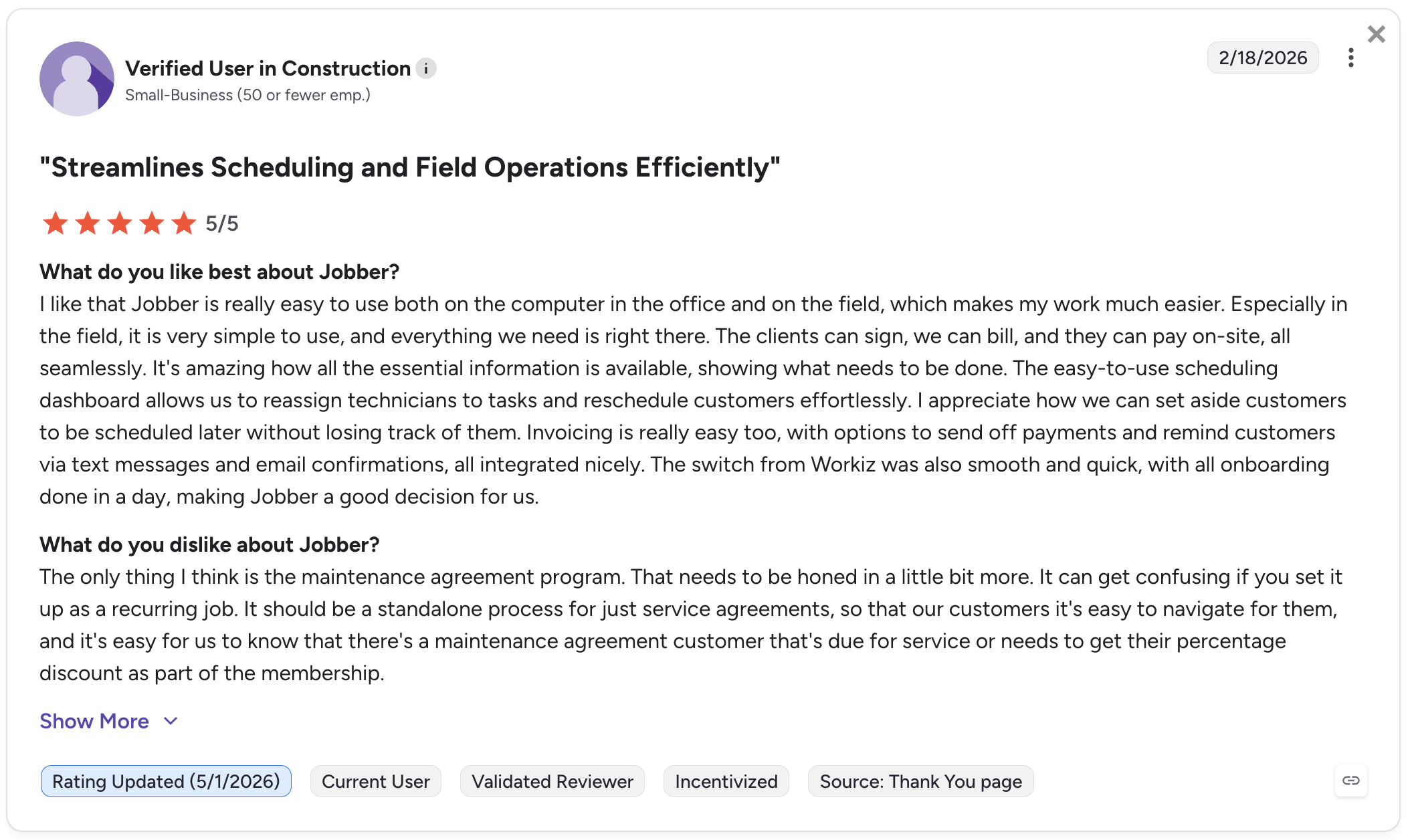
One user notes that Jobber is easy to use—especially scheduling, invoicing, and payment collection.
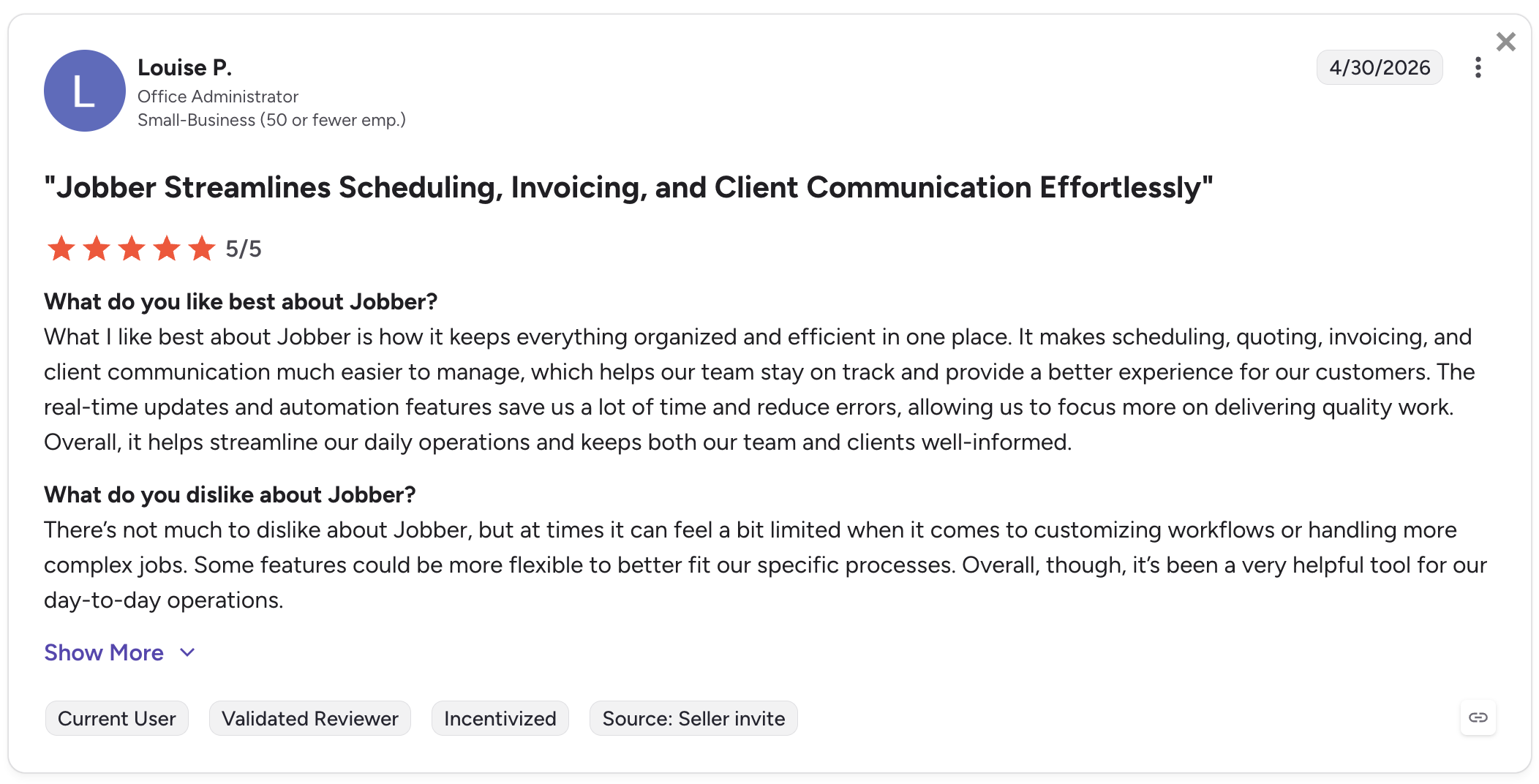
Another user enjoys how Jobber helps them keep everything in one place and helps provide a better experience for their customers.
Key features
Jobber helps you:
- Make detailed, itemized quotes that clients can view and approve in their self-service portal.
- Easily schedule jobs, dispatch crews, and automatically generate the fastest and most fuel-efficient routes.
- Get paid up to 4x faster with accurate invoices that customers can review and pay online, or pay in person with one tap.
- Keep cash flowing on big, multi-phase projects with progress invoicing.
- Manage customer information and job details in one place and make it easy to access in the field from Jobber’s mobile app.
- Let new leads book appointments or request work right from your website.
- Automatically collect reviews and referrals from satisfied customers.
- Boost customer communication by sending emails, text messages, appointment reminders, and on-my-way messages to clients.
- Develop, send, track, and analyze marketing emails to get repeat customers, promote new services, and book more jobs.
You can also use it to make a website, track expenses, cost jobs, and set strategic business goals to make smart growth decisions with AI tools like Jobber AI.
Pros
- Route optimization is included in standard plans.
- Easy to use and scales well for both solo operators and growing service teams.
- Built-in marketing, automation, and customer communication tools.
Cons
- Limited inventory management
- Advanced marketing features increase monthly subscription costs
How much does Jobber cost?
Jobber’s base pricing starts at $29 per month for a single user and includes online booking and job scheduling, customized quotes and invoices, online payment processing, and reporting.
Monthly fees increase as you add team members and advanced features, such as Jobber’s Marketing Suite.
Similar to Housecall Pro, Jobber offers a 14-day no-commitment free trial you can use to test it out.
How does it compare to Housecall Pro?
Jobber and Housecall Pro both offer scheduling, invoicing, customer management, and mobile apps for field service businesses. However, Jobber stands out by including route optimization in its standard plans, while Housecall Pro requires an additional paid add-on for similar functionality.
Jobber also offers stronger marketing tools, including automated review requests, referral campaigns, and email marketing features that help you generate repeat customers and grow revenue.
If your business is focused on ease of use, operational efficiency, and long-term scalability, Jobber is often the better choice.
Who should use Jobber?
You should use Jobber over Housecall Pro if you’re a home service provider:
- Who wants to invest in software that’s easy to use and that grows with your business
- Who needs more features included in a monthly plan, like route optimization
- Looking for more affordable monthly or annual software subscription fees
- Who wants help with planning and implementing promotions and marketing campaigns
- Operating as a sole proprietor or with a team of up to 30 people
- Interested in field service management software that seamlessly integrates with a variety of popular tools and platforms
Jobber also offers robust product coaching, a comprehensive onboarding process, and an award-winning customer service team to ensure you always have the answers you need.
Because of the time Jobber has saved me on tasks that used to consume my day, I’ve been able to focus on the bigger picture… and provide my family six-figure incomes back-to-back years.
2. ServiceTitan
ServiceTitan is similar to both Housecall Pro and Jobber, but it serves mid-to-large enterprises. It’s made for industries like roofing, irrigation, electrical, septic, commercial cleaning, and snow removal.
Reviews
ServiceTitan has an overall rating of 4.5 out of 5 on G2.
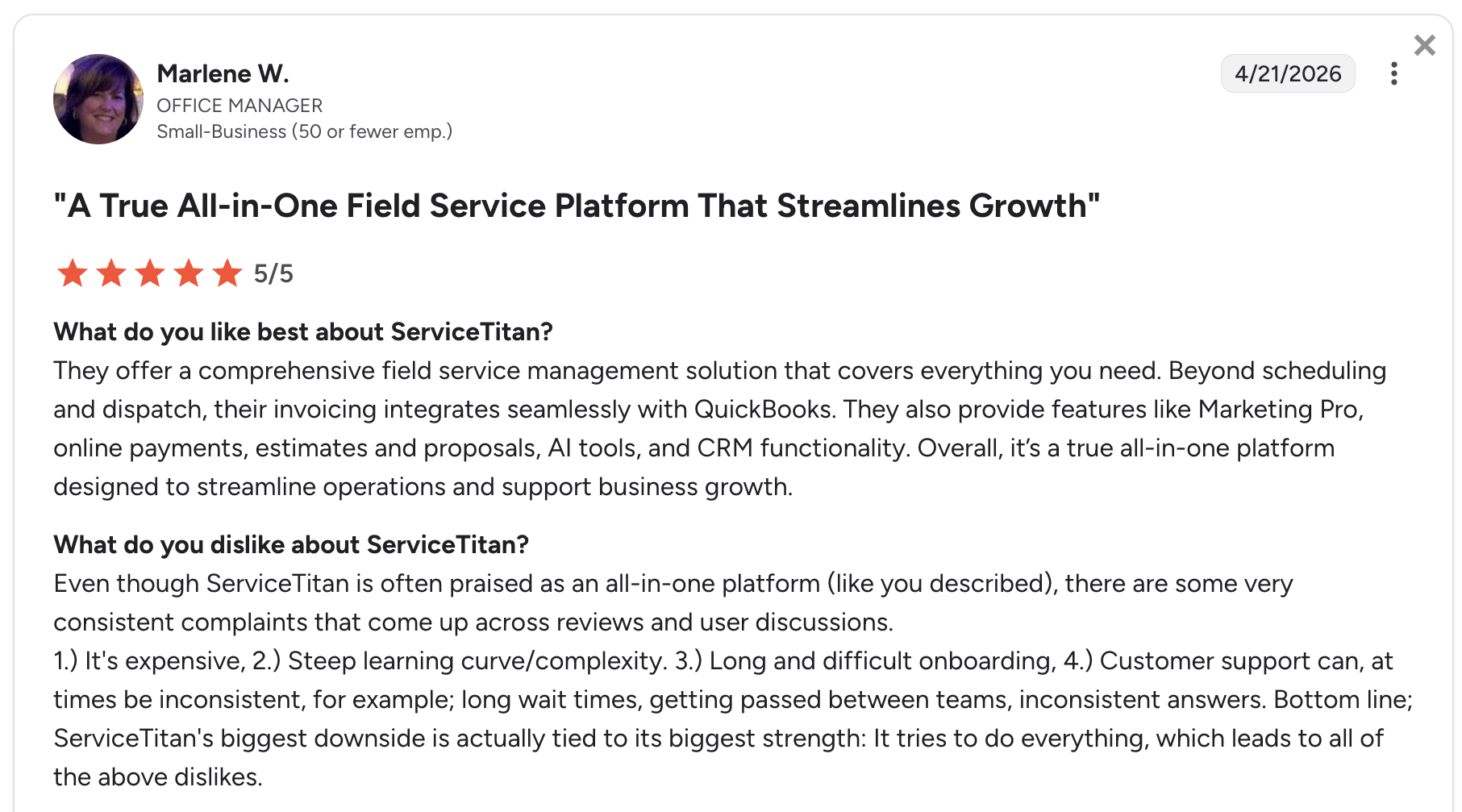
One user says that ServiceTitan is a true all-in-one platform that supports their business growth, but also notes that it’s expensive and has a steep learning curve.
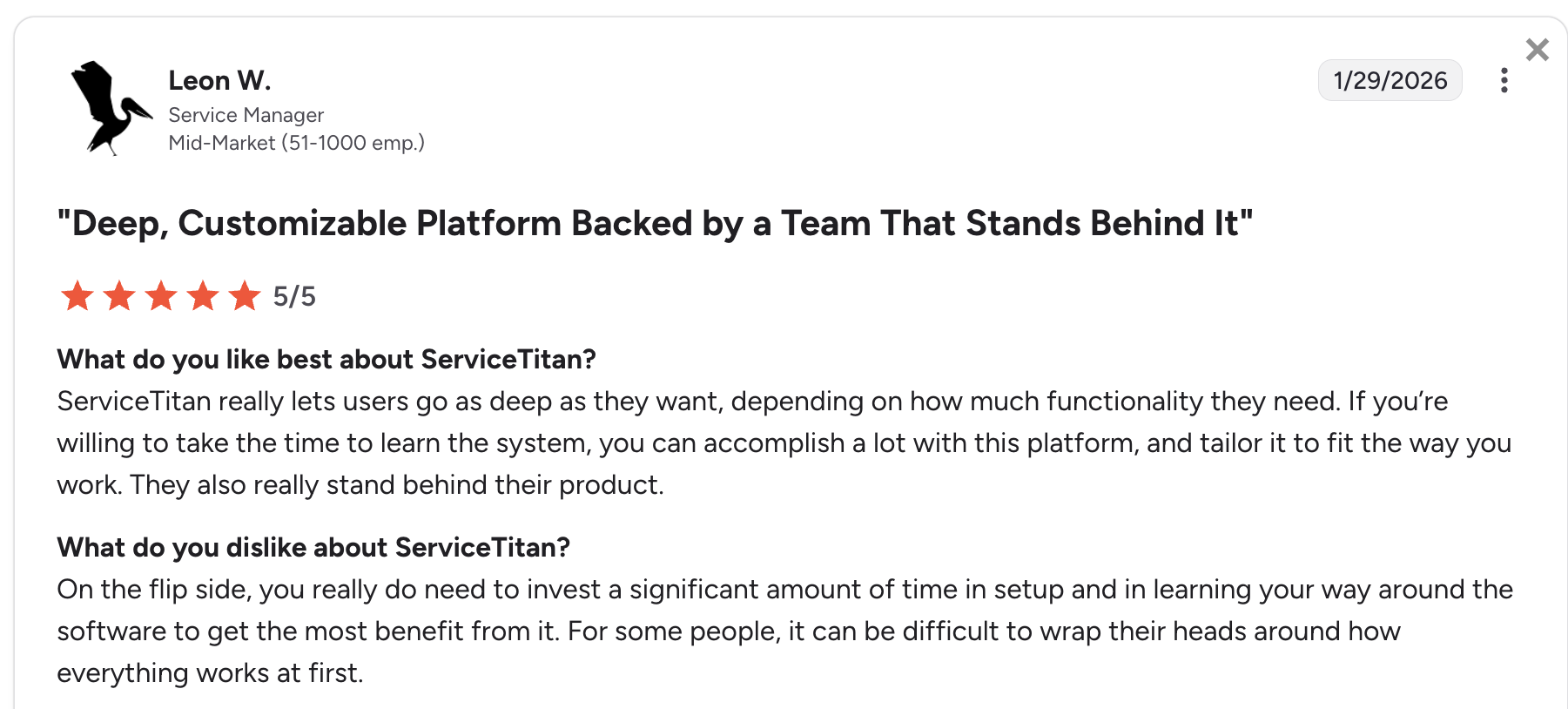
Another user notes that you can tailor ServiceTitan to your workflow, but that may require a significant time investment.
Key features
You can use ServiceTitan to:
- Manage customer relationships to track leads, service history, and customer communication in one system.
- Dispatch and track work crews in real time so managers can optimize technician schedules and reduce downtime.
- Automate marketing tasks, such as follow-ups and promotions, to generate repeat business without manual effort.
- Track and analyze business performance through advanced reporting dashboards that provide deep operational insights.
- Manage long-term and multi-step projects to ensure complex jobs are completed in the correct order and on schedule.
- Oversee asset management to track equipment, service history, and maintenance schedules.
- Create customizable workflows that standardize processes across teams and improve operational consistency.
- Integrate with tools like QuickBooks Online to streamline accounting and financial reporting
Pros
- Designed for scaling large service businesses with complex operations.
- Advanced reporting and analytics provide deep visibility into your business.
- Strong automation tools help reduce manual administrative work.
Cons
- High cost compared to smaller competitors, making it less accessible for small businesses.
- Steep learning curve.
How much does ServiceTitan cost?
ServiceTitan’s pricing isn’t publicly available. You’ll need to request a demo to get cost estimates based on your needs.
How does it compare to Housecall Pro
ServiceTitan is more advanced and enterprise-focused than Housecall Pro. While Housecall Pro is designed for small to mid-sized businesses that need simple scheduling, invoicing, and customer management, ServiceTitan is built for larger companies that require deep operational control, automation, and reporting.
It’s important to note that ServiceTitan offers more powerful analytics and workflow customization, but at a much higher cost and with greater implementation complexity.
READ MORE: ServiceTitan competitors to consider
Who should use ServiceTitan?
You should use ServiceTitan if you have:
- A mid-to-large-sized service business looking to scale
- A flexible budget and can cover a higher monthly subscription fee
- A team of at least 3-5 employees or subcontractors to oversee
- Advanced requirements, like asset management and comprehensive reporting
COMPARE: Housecall Pro vs. ServiceTitan
3. Service Fusion
Service Fusion is a good Housecall Pro competitor if you’re looking for software that scales with your business without a drastic price increase.
It’s meant for small-to-medium-sized service businesses but can also be used at an enterprise level for bigger teams in industries such as HVAC, plumbing, and electrical.
Reviews
Service Fusion has an overall rating of 4.1 out of 5 on G2.
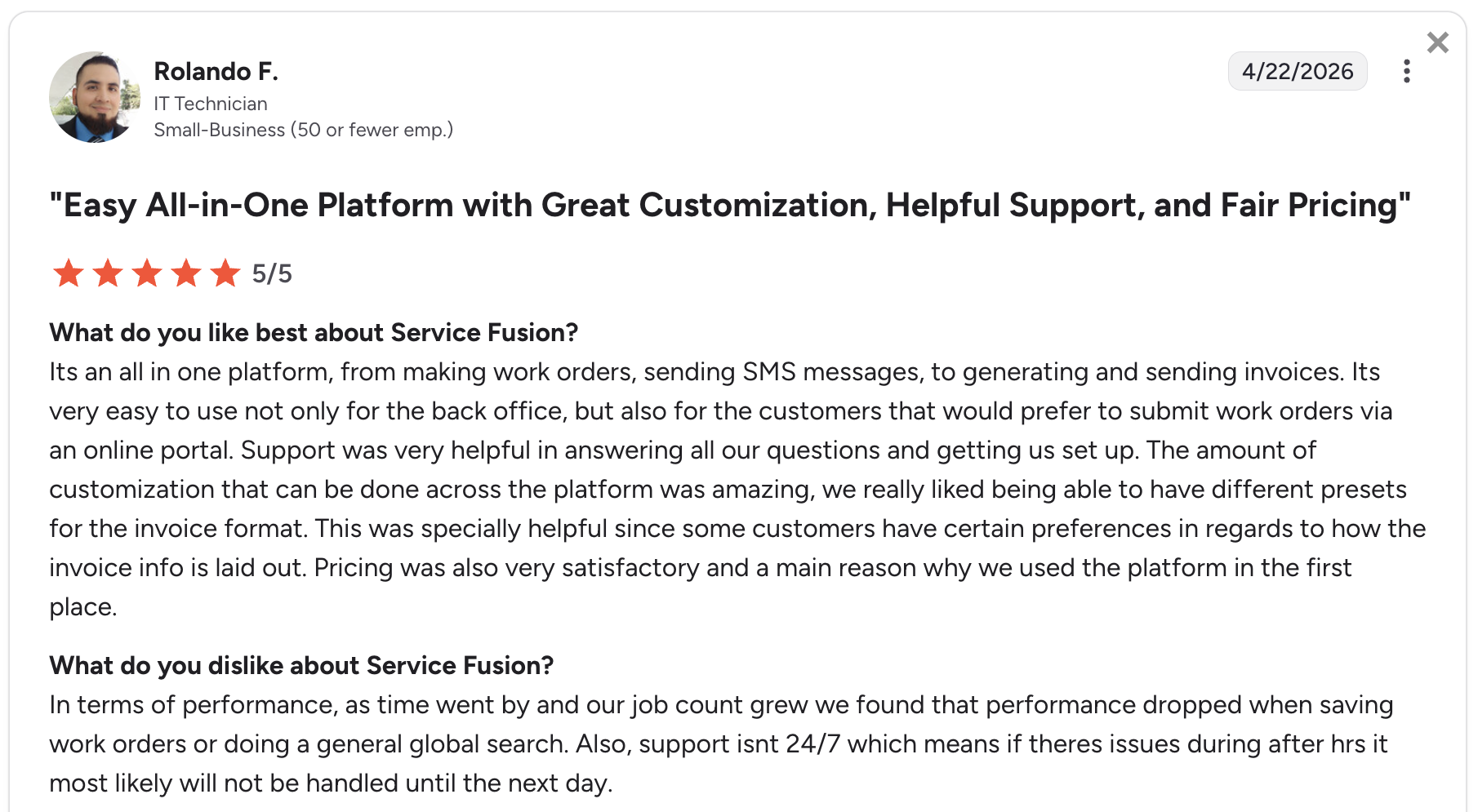
One user notes Service Fusion is a cost-effective option for service businesses that want unlimited users without paying per-seat fees, especially for growing teams.
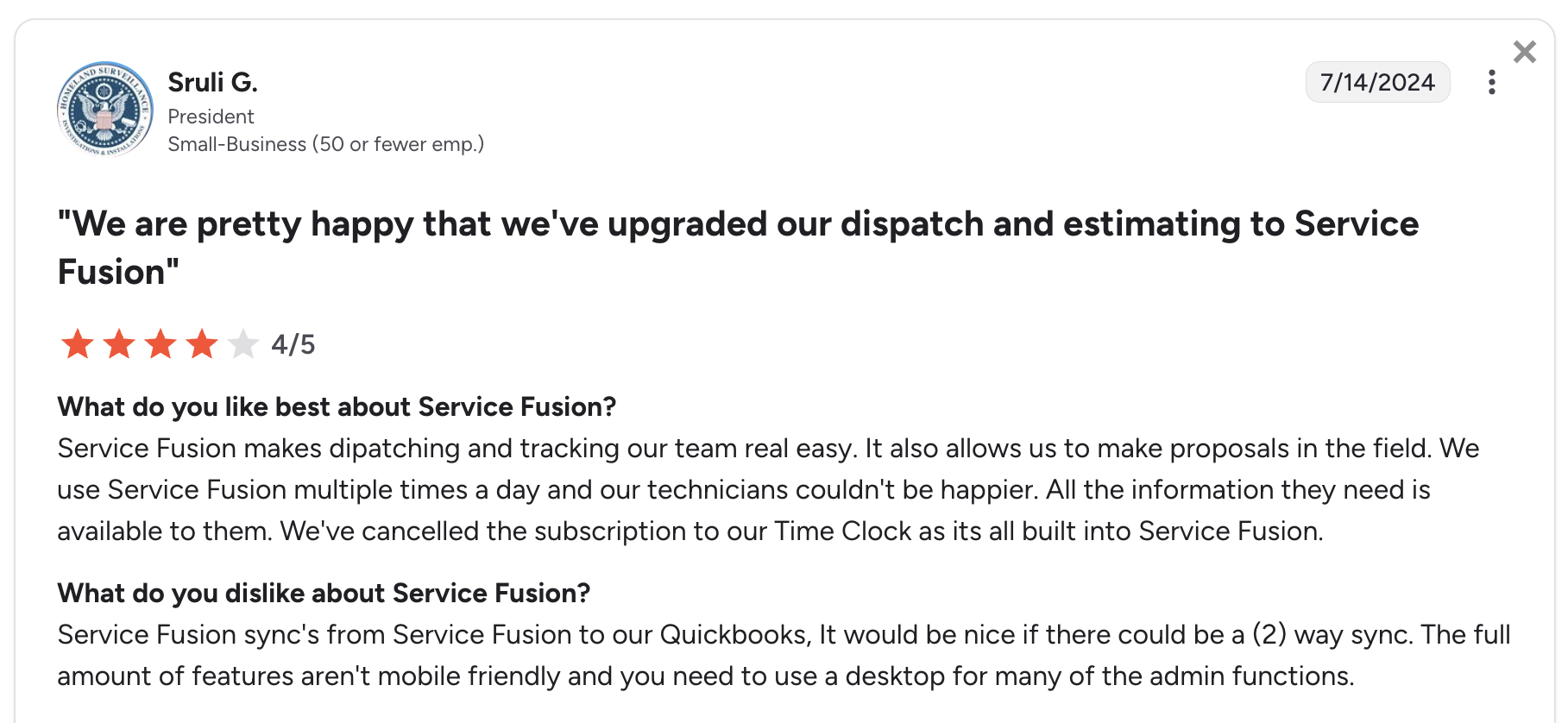
Another user says that the platform covers core scheduling and dispatch needs well, but the interface and reporting tools can feel less modern compared to competitors like Jobber or ServiceTitan.
Key features
Service Fusion helps you:
- Create and send invoices to clients quickly, helping reduce administrative delays and get paid faster.
- Schedule employees in a centralized calendar so mobile crews can stay organized and avoid double-booking jobs.
- Dispatch teams efficiently so managers can assign work based on availability, location, and skill set.
- Manage customer communication primarily through phone calls, making it useful for businesses that rely on direct client contact.
- Process payments in the field or office to streamline billing and improve cash flow.
COMPARE: Jobber vs. Service Fusion
Pros
- Flat-rate pricing with unlimited users makes it cost-effective for growing teams.
- Strong functionality for scheduling, dispatching, and invoicing covers essential field service needs.
- Scales well from small businesses to larger operations without requiring per-user cost increases.
Cons
- User interface and reporting tools are less modern compared to some competitors.
- Fewer integrations than other leading field service platforms, limiting workflow flexibility.
How much does Service Fusion cost?
Service Fusion’s pricing starts at $208 per month for an unlimited number of users.
How does it compare to Housecall Pro
Service Fusion differs from Housecall Pro primarily in its pricing model and communication approach. While Housecall Pro charges per user and offers a more modern, feature-rich interface, Service Fusion uses a flat-rate pricing structure that can be more cost-effective for larger teams.
Who should use Service Fusion?
Service Fusion is a good option for service business owners who:
- Want to save on monthly per-user fees and pay a flat rate instead
- Are planning to scale in the future
- Use phone calls to book jobs and communicate with customers
- Need fewer integrations than what other platforms offer
4. FieldPulse
FieldPulse is the best Housecall Pro competitor for businesses looking for highly customizable software. It works best for small-to-medium-sized businesses in the following industries:
- Property management
- Fire and security
- Electrical
- Plumbing
- Glass repair
- Commercial equipment
Reviews
FieldPulse has an overall rating of 4.7 out of 5 on G2.
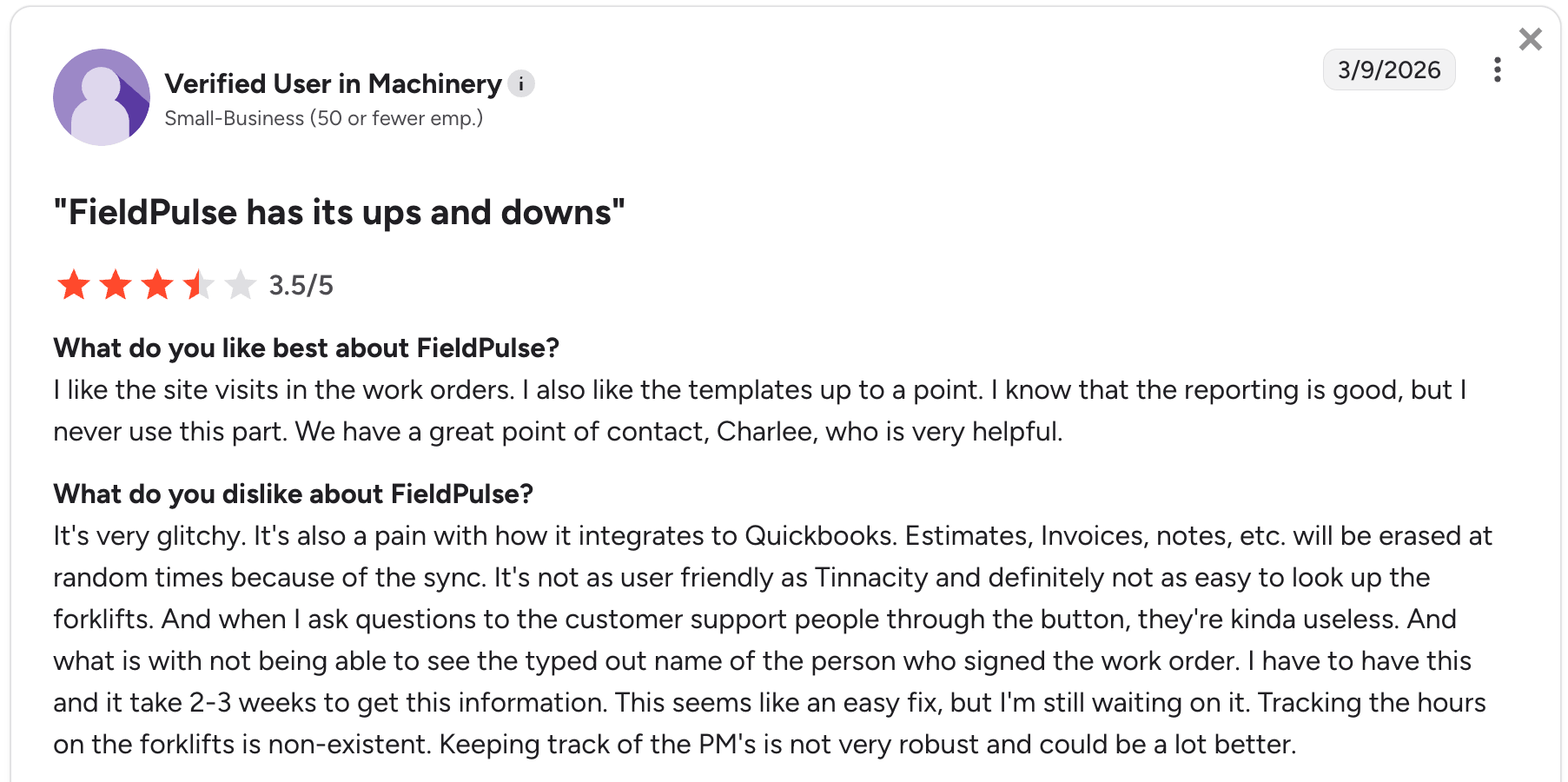
One user notes that they like FieldPulse’s customer service, but says that the software can be glitchy, including its integrations.
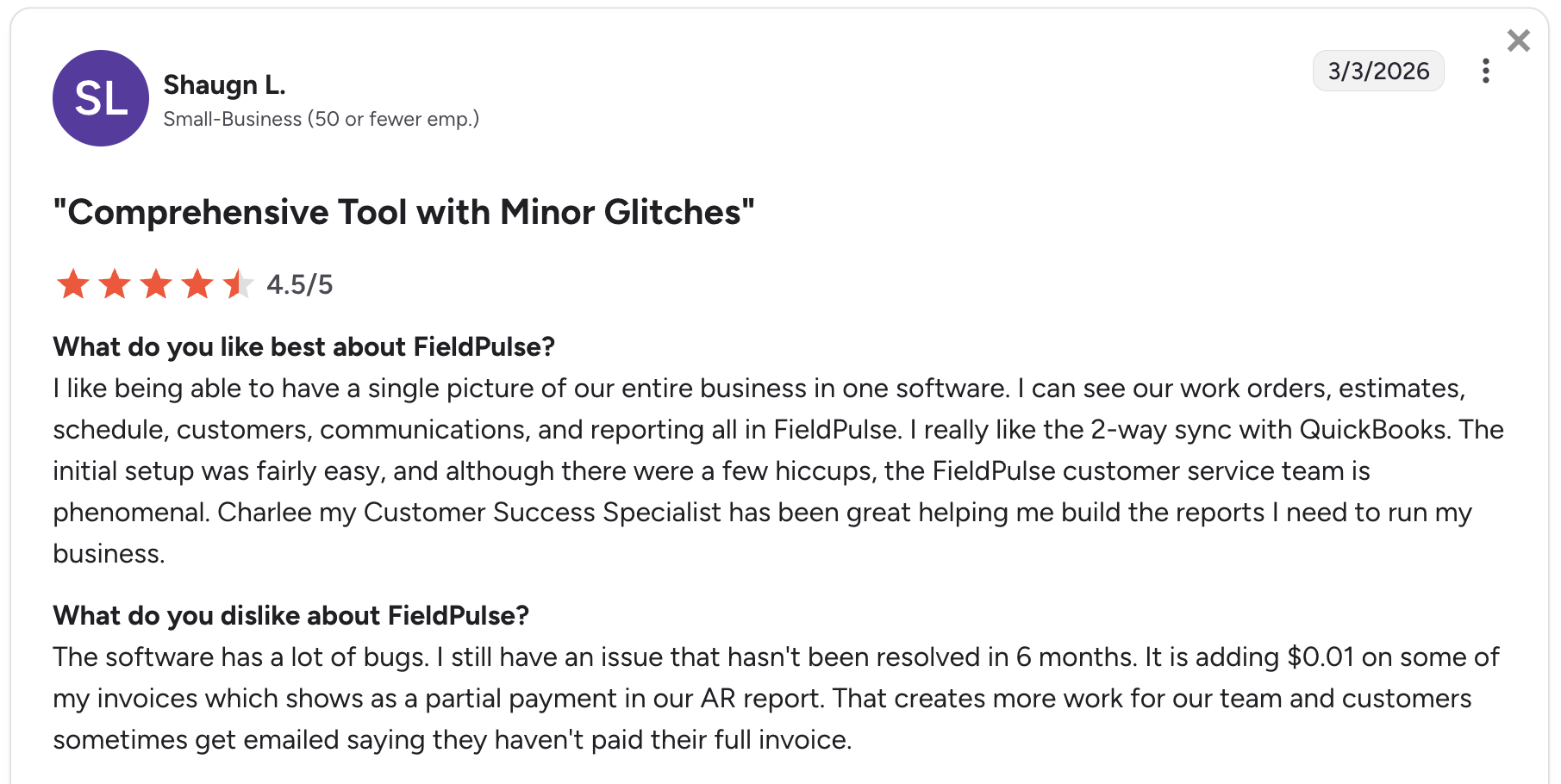
Another user says that they enjoy seeing every aspect of their business from one tool, but also acknowledges that the platform may have some bugs to work out.
Key features
FieldPulse helps you:
- Send estimates and invoices that help speed up customer approvals.
- Manage inventory so teams can track parts, supplies, and equipment usage across multiple jobs.
- Book jobs and schedule crews in a centralized system that reduces scheduling conflicts and improves efficiency.
- Dispatch technicians to jobs so managers can assign work based on availability and skill set.
- Price services accurately by creating structured service catalogs and customizable pricing rules.
- Manage projects from start to finish, making it easier to handle both simple and multi-step service work.
Pros
- Highly customizable, allowing you to tailor workflows to your specific service operations.
- Works across Android, iOS, and web.
- Covers scheduling, invoicing, inventory, and project management.
Cons
- Pricing is not transparent and requires a sales demo to access cost information.
- Can require more setup time and onboarding compared to simpler, plug-and-play competitors.
How much does FieldPulse cost?
FieldPulse doesn’t list pricing options. To find out costs, you’ll need to book a demo with their sales team.
How does it compare to Housecall Pro?
FieldPulse is more customizable and flexible than Housecall Pro, making it appealing for teams that want to tailor workflows and processes.
However, Housecall Pro is generally easier to set up and use out of the box, especially for small businesses that want a more guided experience.
Who should use FieldPulse?
You may want to use FieldPulse if you:
- Need a platform that works for Android, iOS, and on the web
- Can adopt new technology with less support and onboarding
- Have a bigger budget to play with
COMPARE:Jobber vs. FieldPulse
5. ServiceM8
ServiceM8 is a field service management platform designed to help small service businesses and solo operators streamline job management, scheduling, and customer communication.
It works for both individual service providers and small-to-mid-sized teams in industries such as electrical, pool maintenance, house cleaning, appliance repair, locksmithing, and lawn care.
Reviews
ServiceM8 has an overall rating of 3.8 out of 5 on G2.
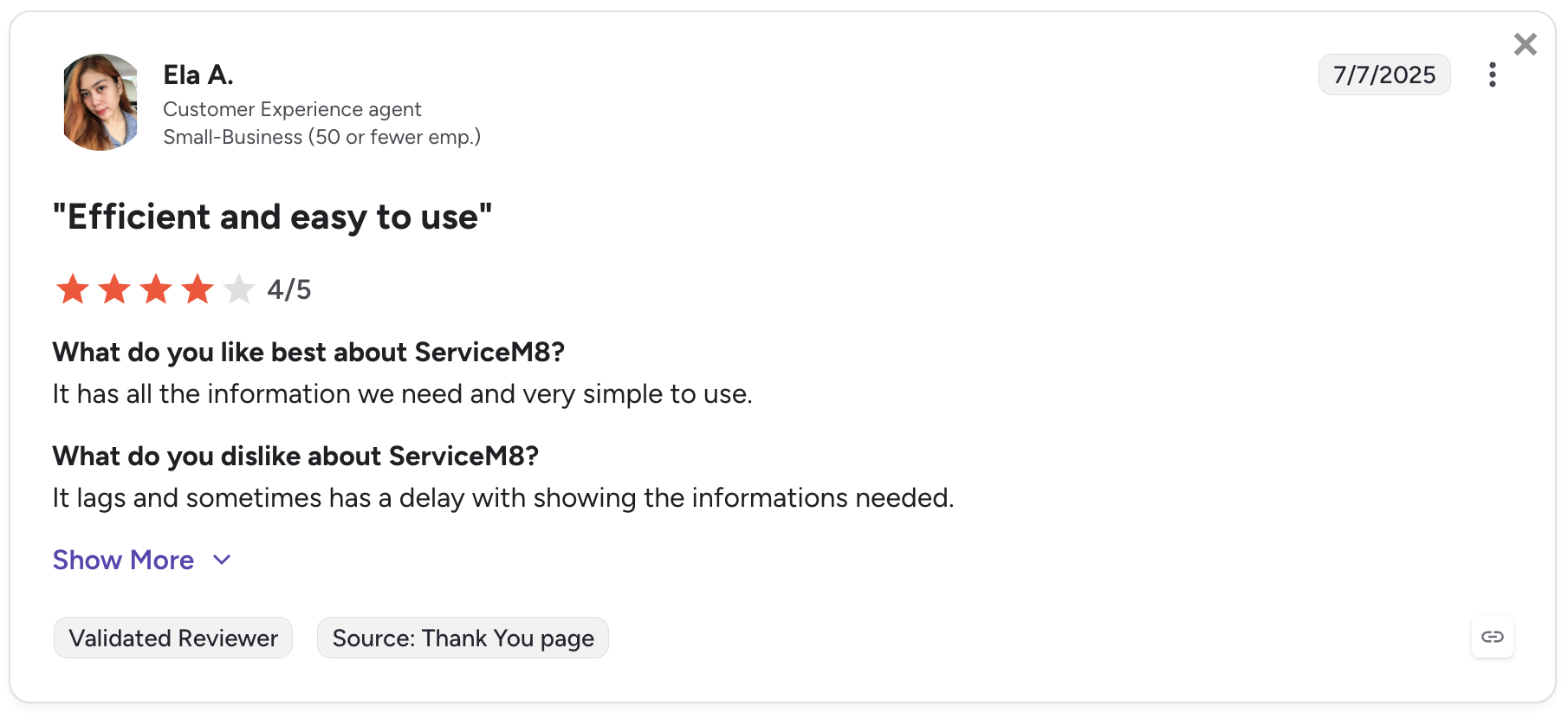
One user notes that ServiceM8 is simple to use, but that the platform lags occasionally.
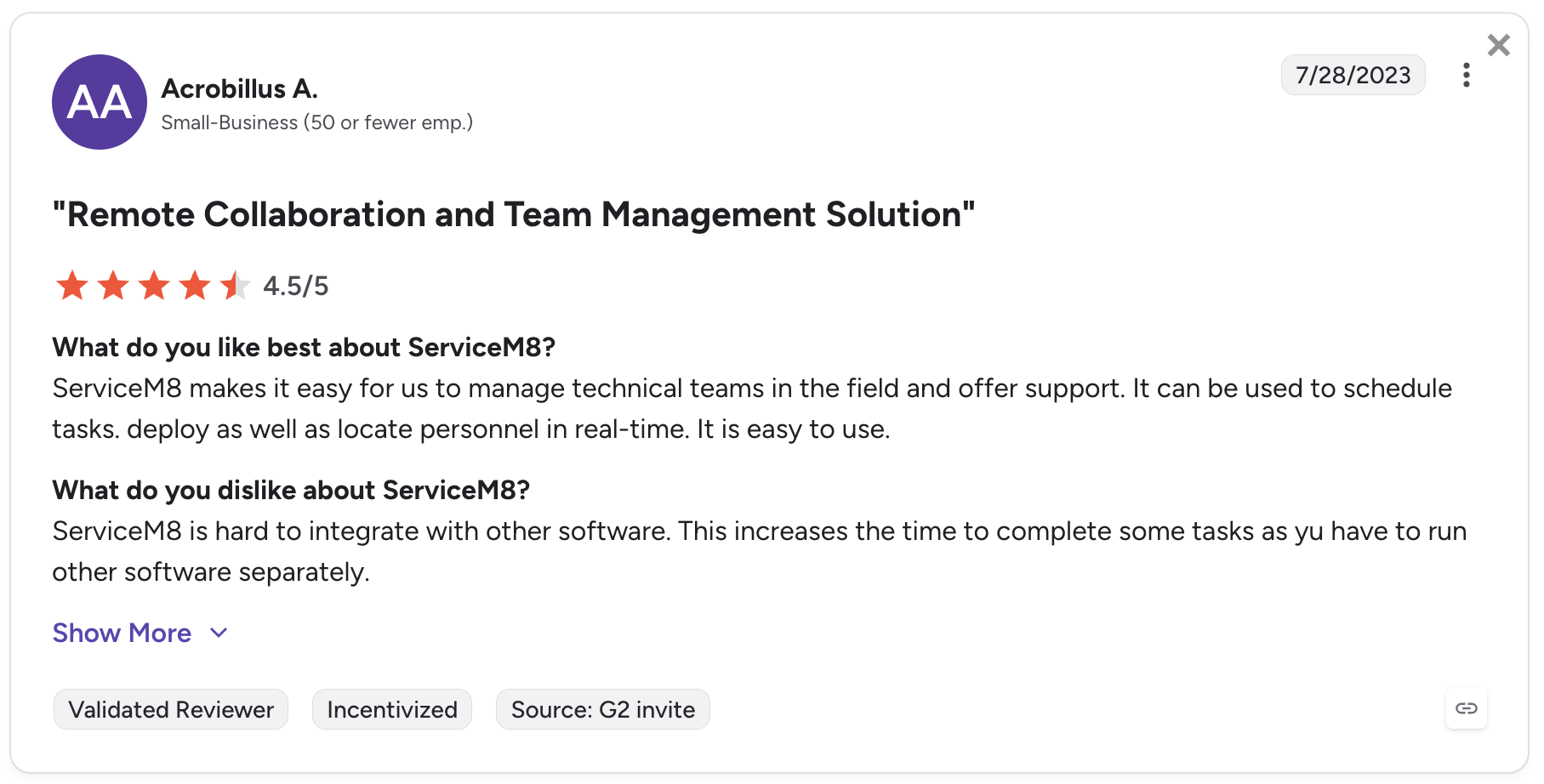
Another user notes that they enjoy using ServiceM8 to locate staff in real time, but that it can be difficult to integrate it with other software solutions.
Key features
ServiceM8 helps you:
- Manage jobs from start to finish, helping you keep all job details organized in one system.
- Create invoices quickly after completing work, which helps improve cash flow and reduce administrative delays.
- Schedule bookings in a centralized calendar to keep technicians and customers aligned on appointment times.
- Create checklists for each job, ensuring consistent service delivery and reducing missed steps in the field.
- Communicate with clients through messages and updates, improving customer experience and reducing missed appointments.
Pros
- Easy to use, making it ideal for solo operators and small teams with minimal training needs.
- Mobile-first design to allow technicians to manage jobs, invoices, and communication directly from their phone.
- Affordable entry-level pricing with a free plan available for basic use cases.
Cons
- Limited scalability for larger teams or businesses with complex workflows.
- Fewer advanced features in areas like reporting, marketing, and automation compared to competitors.
How much does ServiceM8 cost?
ServiceM8 offers a free subscription that includes basic features for a single user.
Paid subscriptions start at $29 per month and go up to $349 per month, depending on how many jobs you complete and the number of users you need.
The higher the pricing, the more features you get, such as job costing and asset management.
How does it compare to Housecall Pro?
ServiceM8 is generally simpler and more lightweight than Housecall Pro, making it a better fit for solo operators or very small teams. Housecall Pro, on the other hand, offers more advanced features, like marketing tools, financing options, and stronger automation for growing service businesses.
While ServiceM8 focuses on ease of use and mobile job management, which may be all you need if you are solo.
Who should use ServiceM8?
ServiceM8 is a good option for:
- Sole proprietors who aren’t looking to build a team
- Those with limited budgets who don’t need advanced features
- Teams that don’t need marketing support
COMPARE: Jobber vs. ServiceM8
6. Kickserv
Kickserv is a simple field service management platform for businesses on a budget. It is designed for solopreneurs and very small teams that need simple tools for scheduling, invoicing, and basic job tracking without the complexity or cost of larger systems.
Kickserv’s field service management is geared toward industries like carpentry, landscaping, mechanical, and restoration.
Reviews
Kickserv has an overall rating of 4.5 out of 5 on G2.
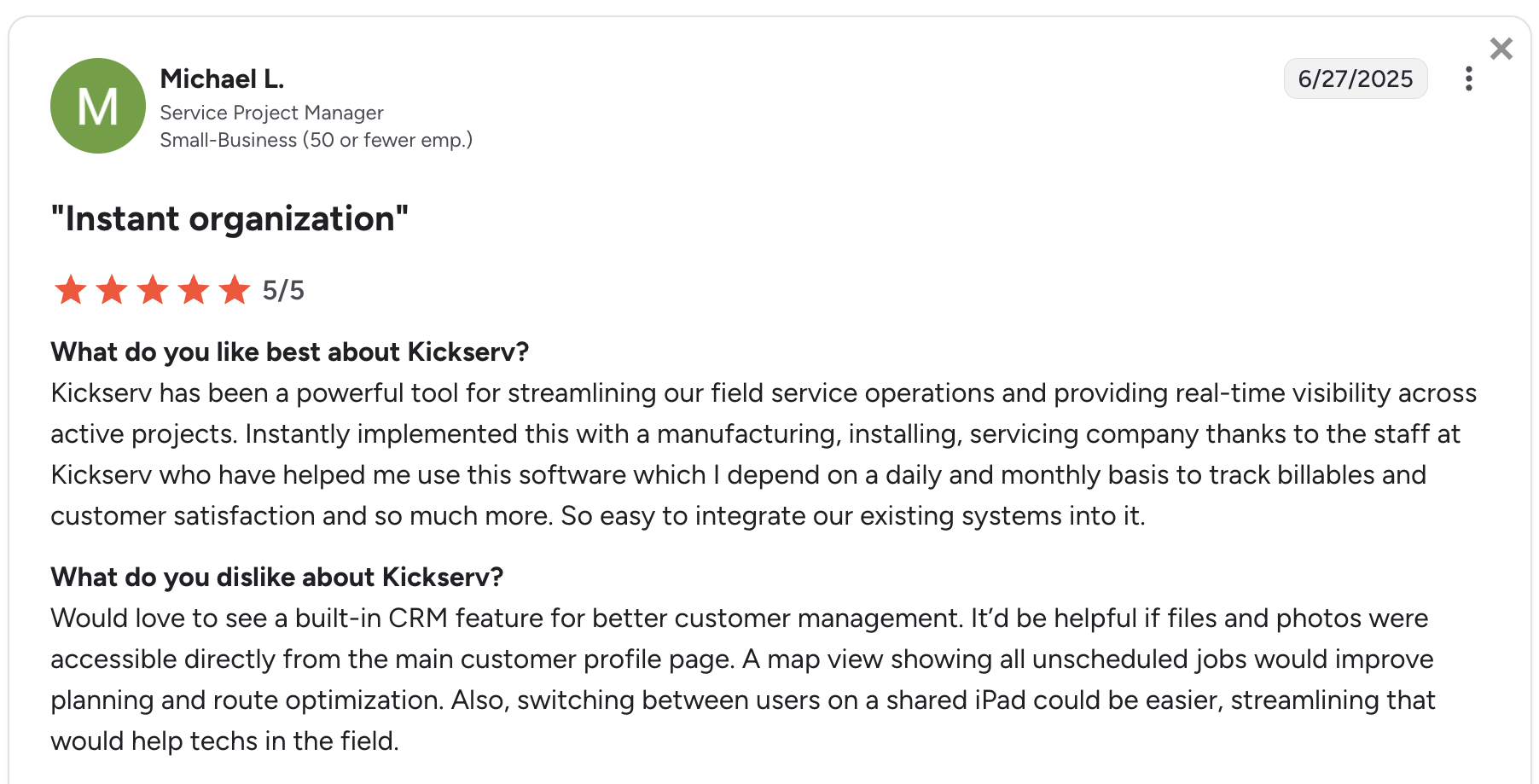
One user notes that Kickserv provides real-time visibility into active projects, but lacks a few customer management features.
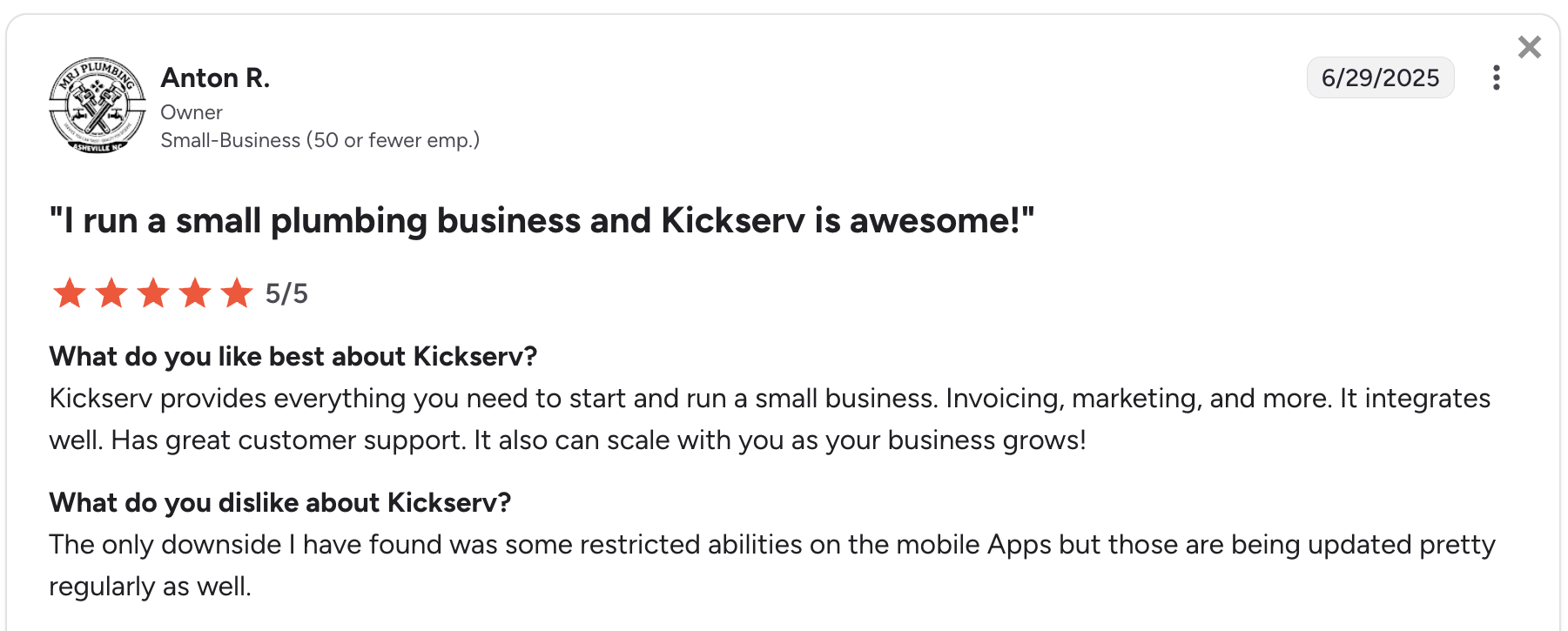
Another user notes that they enjoy Kickserv’s customer support but that some features are restricted in the mobile app.
Key features
Kickserv helps you:
- Schedule jobs efficiently so small teams can stay organized and avoid double-booking work.
- Receive payments from customers, helping businesses improve cash flow and reduce administrative delays.
- Create and send invoices quickly, making it easier to bill clients immediately after completing work.
- Build custom reports that give visibility into basic business performance and job activity.
- Track time and expenses to better understand job profitability and labor costs.
- Oversee fleet operations at a basic level, helping small teams manage vehicles and job assignments.
Pros
- Free plan available for up to two users, making it highly accessible for very small businesses.
- Very affordable paid plans, making it one of the lowest-cost options in the field service software space.
- Simple interface that is easy to learn and use without extensive training.
Cons
- Limited functionality for larger teams or businesses with complex workflows.
- Lacks advanced features like deep automation, marketing tools, and robust reporting compared to competitors.
How much does Kickserv cost?
Kickserv is free for up to two users, and monthly pricing starts at $75 per month for teams of five and up.
How does it compare to Housecall Pro?
Kickserv is much simpler and more budget-friendly than Housecall Pro, making it ideal for small businesses that only need basic scheduling, invoicing, and job tracking.
However,Housecall Pro offers more advanced features like customer communication automation, financing options, and marketing tools, but at a higher cost and with more complexity.
Who should use Kickserv?
Consider using Kickserv for your home service business if:
- You are a sole proprietor or a team of two who can take advantage of the free version
- You have minimal operational needs
- You don’t need complex inventory management or tracking
COMPARE:Jobber vs. Kickserv
7. Workiz
Workiz is the best Houscall Pro competitor for small teams that want to manage scheduling, dispatching, payments, and customer communication in one system without an overly complex setup.
It serves a variety of industries, including computer repair, HVAC businesses, carpet cleaning, junk removal, appliance repair, and moving.
Reviews
Workiz has an overall rating of 4.5 out 5 on G2.
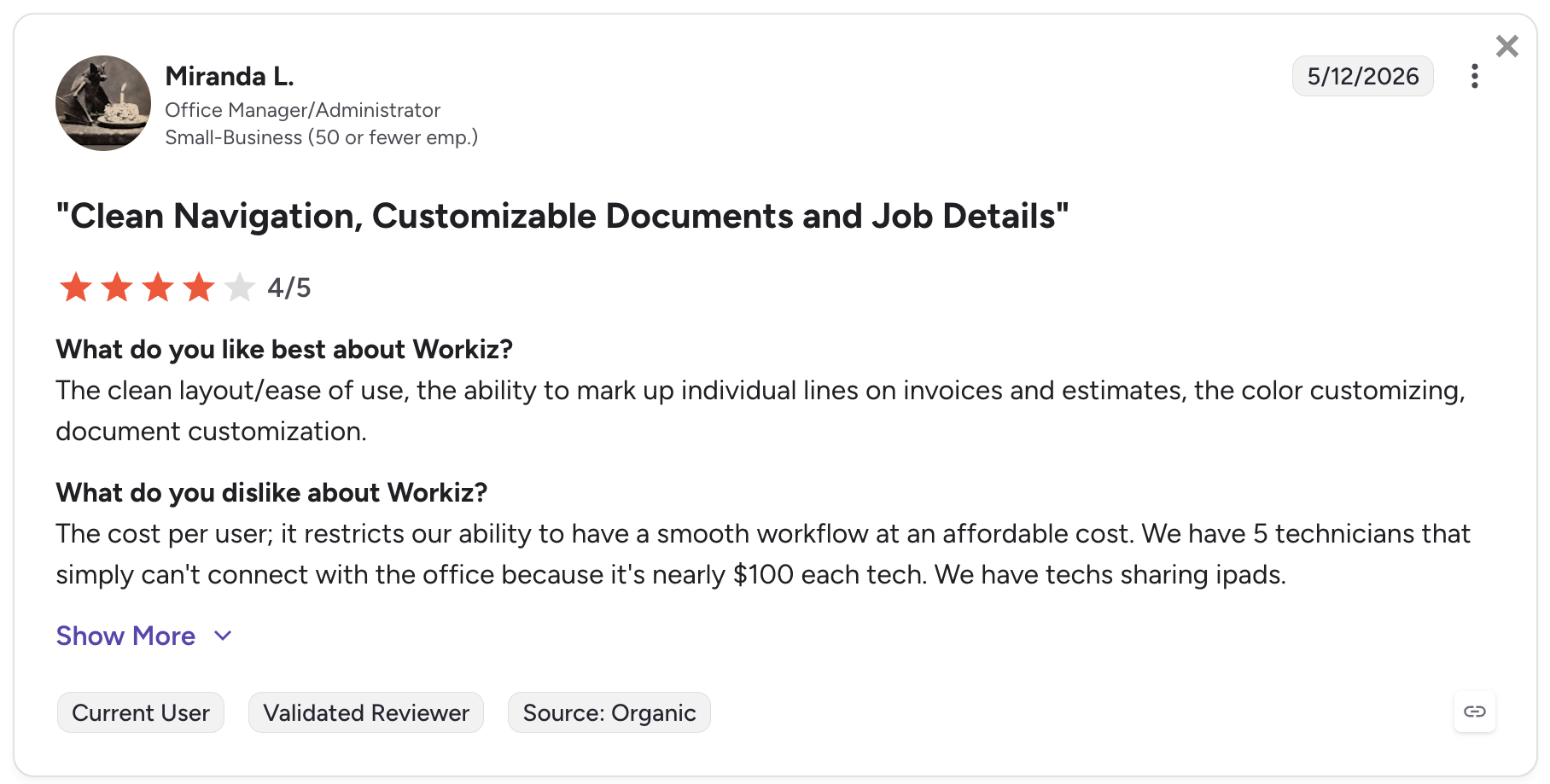
One user notes that Workiz is easy to use, but that the cost per user is high.
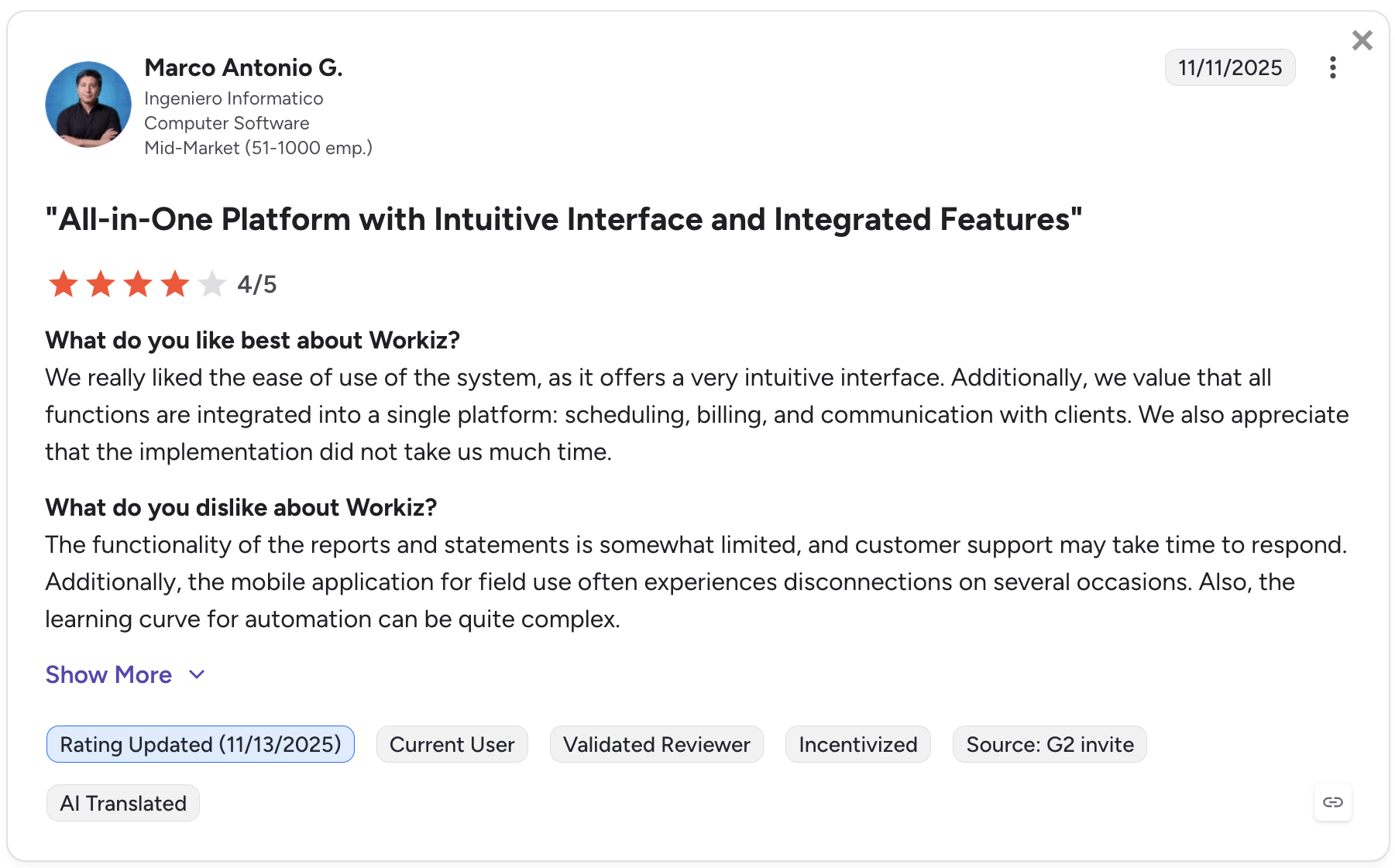
Another user notes that the platform has an intuitive interface, but that reporting is limited.
Key features
Workiz is a field service management platform that sole proprietors and small-to-mid-sized business owners can use to:
- Schedule jobs and dispatch teams to efficiently assign work and reduce downtime between appointments.
- Track equipment to help businesses monitor tools and assets used across different jobs.
- Record phone calls to and from customers to improve service quality and track communication history.
- Book jobs through a centralized system that helps reduce scheduling conflicts and missed appointments.
- Process online payments to help businesses get paid faster and improve cash flow.
- Create and send estimates and invoices to streamline billing and improve customer experience.
Pros
- Strong phone call tracking and communication features that are especially useful for businesses relying on inbound leads.
- Easy-to-use scheduling and dispatch tools that help small teams stay organized.
- Free plan available for very small teams, making it accessible for startups and solo operators.
Cons
- Limited marketing automation and CRM depth compared to more advanced platforms.
- Pricing increases significantly as teams grow beyond the free tier.
How much does Workiz cost?
Workiz pricing starts at $225 per month for up to three users. There are two other structured plan options and the option to create a custom plan.
How it compares to Housecall Pro
Workiz is often more focused on communication and call tracking, making it a strong choice for businesses that generate leads via phone.
Housecall Pro, on the other hand, offers a more balanced all-in-one platform with stronger customer communication tools, financing options, and marketing automation.
Who should use Workiz?
Service providers should consider using Workiz if they:
- Have a team of up to two people and need a budget-friendly option
- Take bookings and communicate with customers via phone calls
- Don’t need robust marketing support or multiple integrations
- Can afford a higher monthly fee as they scale
COMPARE:Jobber vs. Workiz
8. Simpro
Simpro is field service management software built for commercial contractors and large businesses with complex project management needs.
It’s often used by service providers in industries such as electrical, fire protection, security, plumbing, and HVAC.
Reviews
Simpro has an overall rating of 4.2 out of 5 on G2.
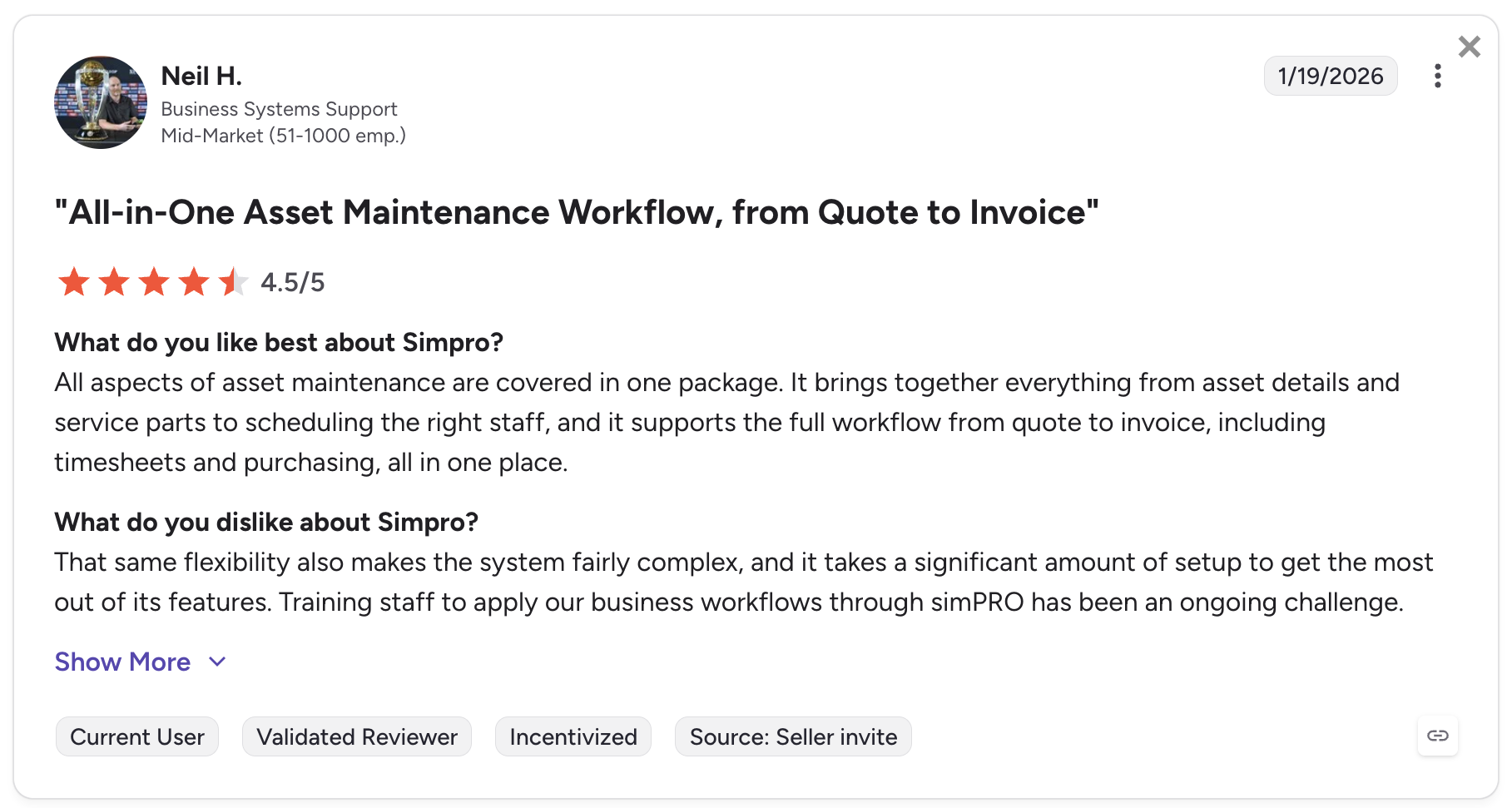
One user notes that they enjoy Simpro’s asset management and full workflow for quotes invoices, but that the system can be fairly complex and requires a lot of training.
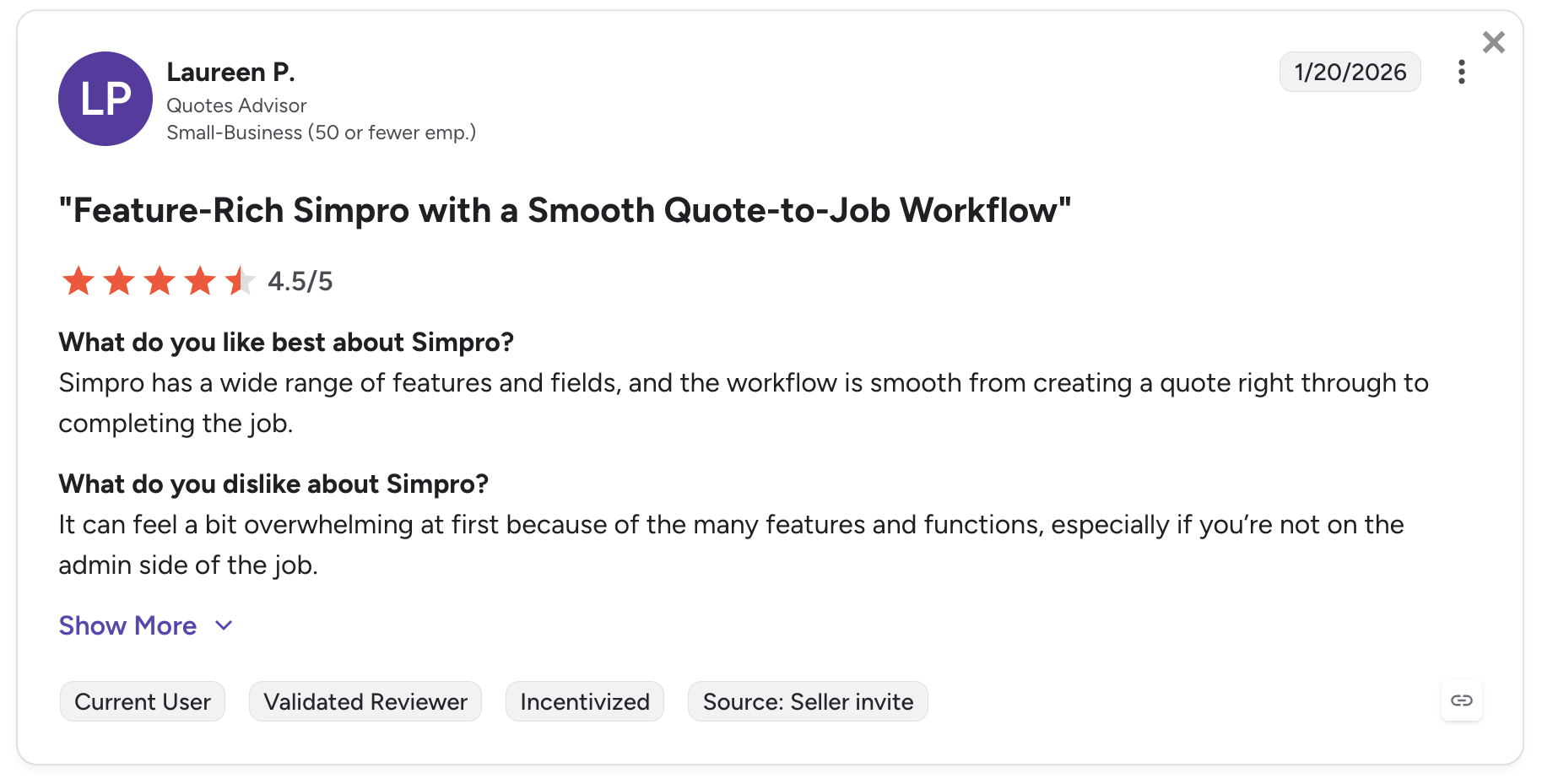
Another user says likes Simpro’s wide range of features, but echoes that the platform can be overwhelming.
Key features
Simpro helps you:
- Manage assets and inventory to track equipment usage, maintenance history, and availability across teams and job sites.
- Plan out multi-phase jobs to ensure complex projects are completed in the correct order and on schedule.
- Manage projects from start to finish, helping teams coordinate timelines, resources, and budgets more effectively.
- Oversee your fleet to track vehicles, assign technicians, and optimize field operations.
- Generate advanced reports that provide deep insights into job profitability, performance, and operational efficiency.
Pros
- Capable of managing complex, multi-phase commercial projects at scale.
- Advanced reporting and analytics provide deep operational and financial visibility.
- Robust asset, inventory, and fleet management tools designed for large field service operations.
Cons
- High complexity and learning curve,
- Pricing is not transparent and typically requires a custom enterprise quote
How much does Simpro cost?
Simpro’s pricing is not publicly available. To find out what it costs, you’ll need to reach out to them for a quote.
How does it compare to Housecall Pro?
Simpro is significantly more advanced and enterprise-focused than Housecall Pro. While Housecall Pro is designed for small to mid-sized service businesses that need straightforward scheduling, invoicing, and customer management, Simpro is built for large contractors managing complex, multi-phase commercial projects.
Simpro offers deeper functionality in areas like asset tracking, fleet management, and advanced reporting. However, it also comes with a higher cost and implementation complexity compared to Housecall Pro.
Who should use Simpro?
Simpro works best for home service businesses that:
- Have multiple locations or large teams
- Frequently manage major, complex projects
- Take on multi-phase jobs
- Need a lot of operational support
9. RazorSync
RazorSync is a good Housecall Pro alternative for small and medium-sized service businesses that need a simple way to manage scheduling, dispatching, invoicing, and customer communication without overly complex enterprise features.
It works for many industries, including appliance repair, alarm and security, IT, lawn care, HVAC, plumbing, and computer repair.
Reviews
Razorsync has an overall rating of 4.3 out 5 on Software Advice.
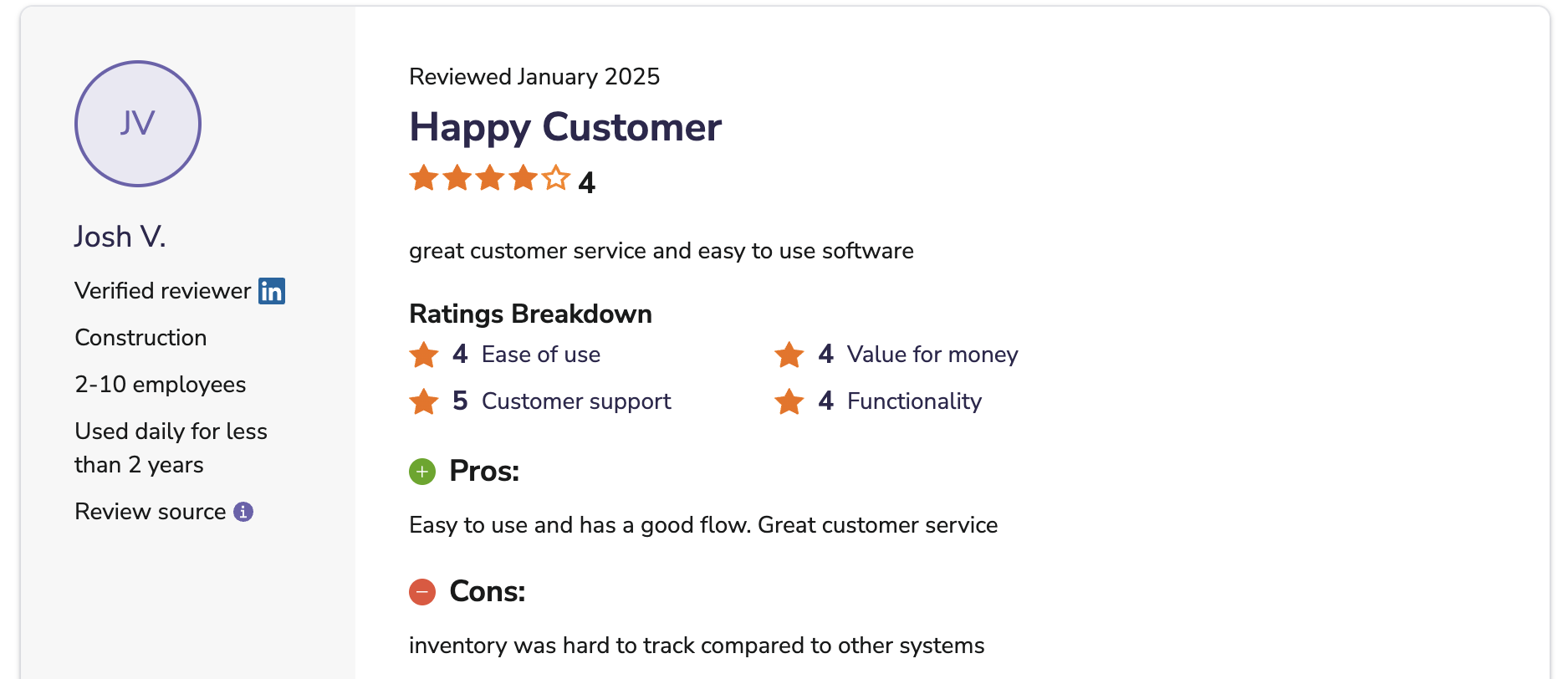
One user notes that RazorSync is easy to use, but that the platform’s inventory management is not as good as that of other competitors.
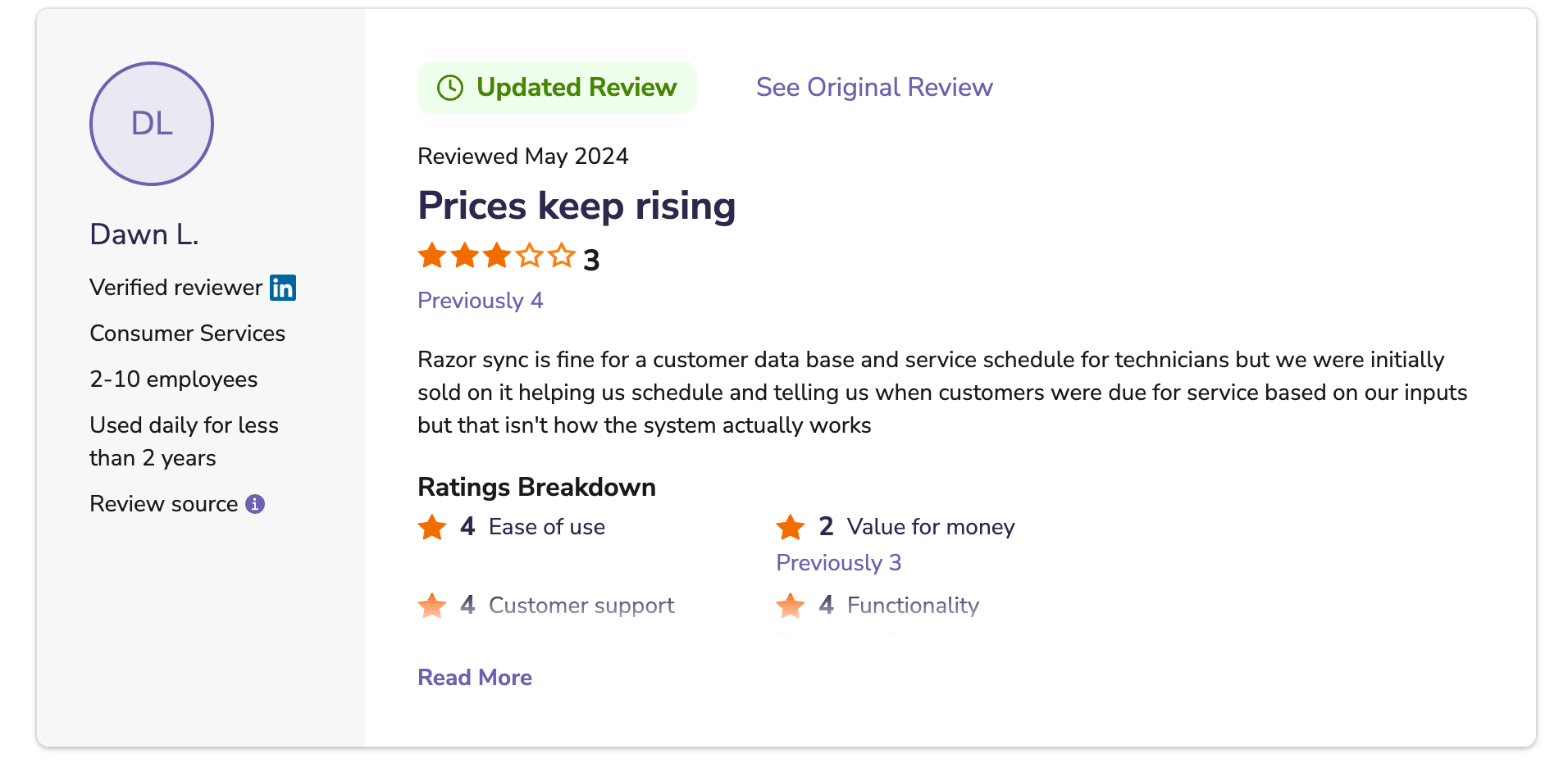
Another user says that they enjoy RazorSync’s scheduling feature, but that the platform’s price keeps rising.
Key features
RazorSync helps you:
- Schedule, dispatch, and track crews to efficiently assign jobs and monitor field activity in real time.
- Process customer payments to help businesses get paid quickly and reduce billing cycle delays.
- Track time so teams can accurately measure labor costs and improve job costing accuracy.
- Create and send invoices that streamline billing and improve cash flow after job completion.
- Manage customer data in a centralized system so service history, contact details, and job notes are easily accessible.
Pros
- Simple and straightforward interface that is easy for small teams to adopt quickly.
- Covers essential field service functions like scheduling, invoicing, and dispatching in one platform.
- Offers flexible pricing tiers that scale based on team size.
Cons
- Limited integrations compared to more modern field service platforms.
- Advanced features like route optimization and reporting may require additional fees or upgrades.
How much does RazorSync cost?
RazorSync’s pricing ranges from $85-$360 per month, depending on the number of users you have. Certain advanced features come with additional fees, like route optimization.
It comes with a 14-day free trial you can use to try it out.
How does it compare to Housecall Pro
RazorSync is generally more basic than Housecall Pro, focusing on core scheduling, dispatching, and invoicing rather than advanced automation or marketing tools.
Housecall Pro typically offers a more modern interface, stronger customer communication features, and additional growth tools like financing options and marketing automation, while RazorSync prioritizes simplicity and operational basics.
Who should use RazorSync?
RazorSync may be a good fit for your business if you:
- Don’t need many integrations
- Don’t need marketing support
- Don’t need advanced reporting
- Need support managing customers and workflows
10. Service Autopilot
Service Autopilot is a good Housecall Pro alternative for businesses looking to scale. It supports service providers in industries like lawn care, landscaping, snow removal, pest control, house cleaning, and pool maintenance.
Reviews
Service Autopilot has an overall rating of 3.7 out of 5 on G2.
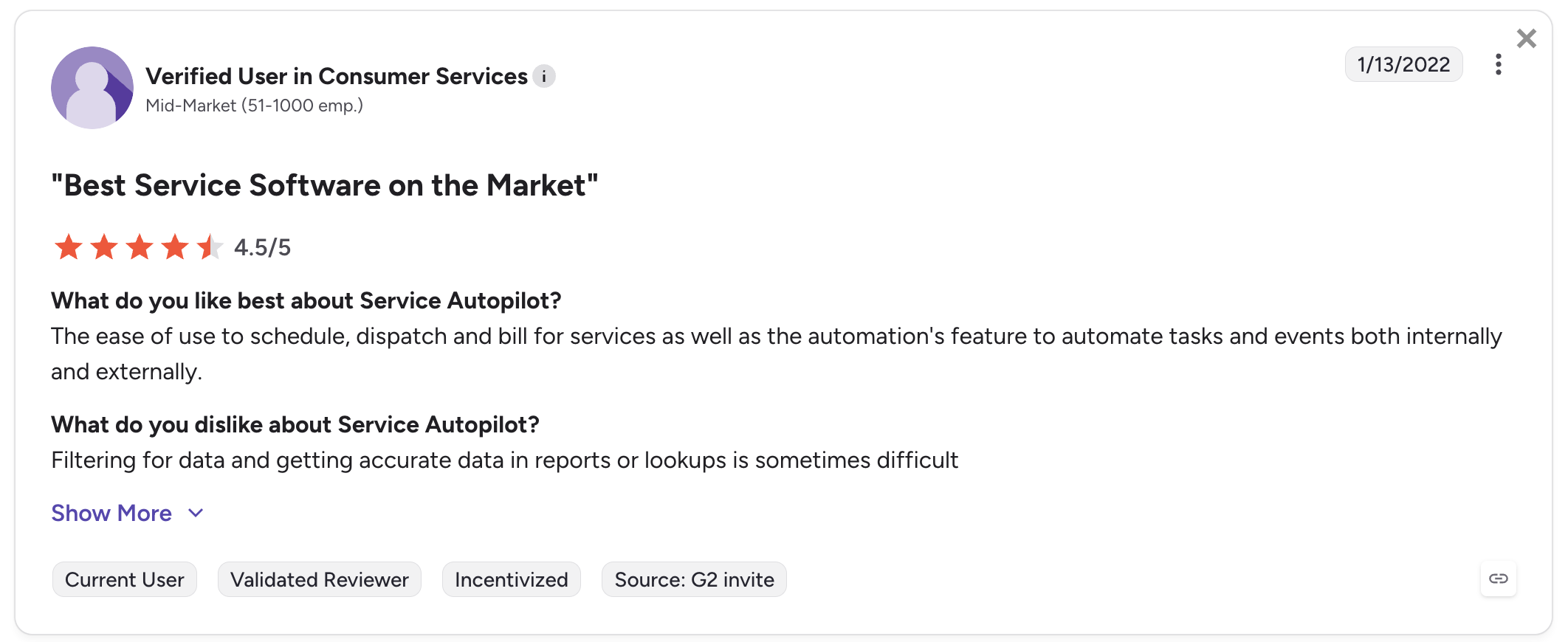
One user notes that Service Autopilot is overall easy to use, but navigating data and reporting can sometimes be difficult.
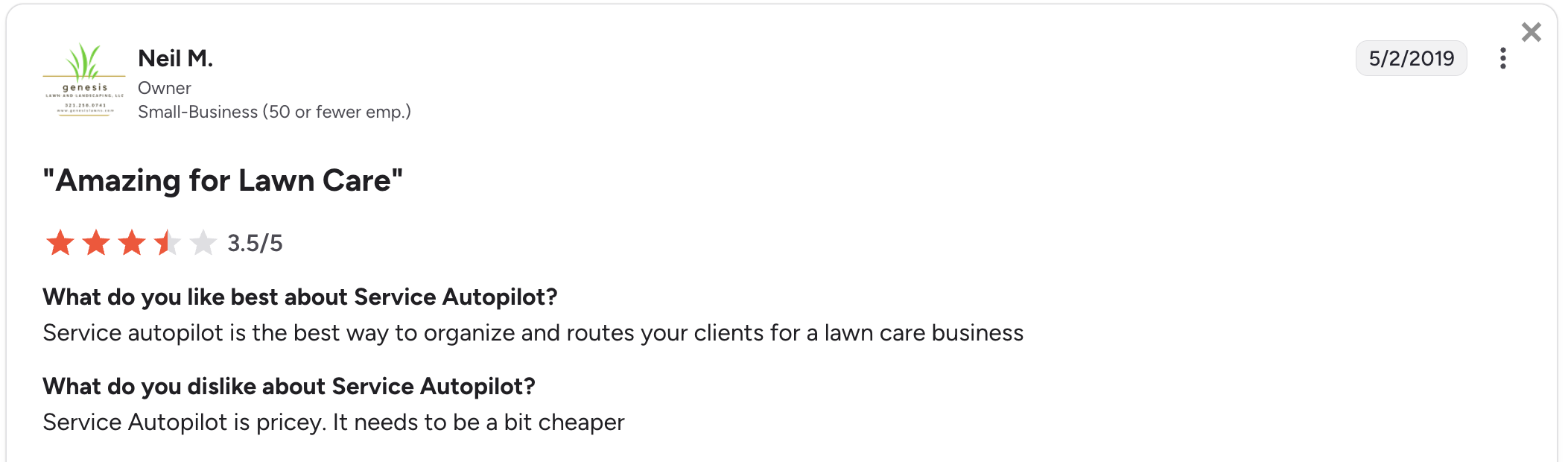
Another user enjoys Service Autopilot’s routing for their lawn care business but finds the software pricey.
Key features
Service Autopilot helps you:
- Schedule jobs efficiently—including recurring and one-time services.
- Dispatch teams to ensure technicians are assigned to the right jobs based on availability and location.
- Send estimates and invoices that help streamline billing and improve payment turnaround times.
- Optimize routes to reduce travel time, fuel costs, and daily scheduling inefficiencies.
- Manage customers in one system so service history, billing, and communication are easy to track.
- Set up recurring payments to support subscription-based or repeat service models common with cleaners and lawn care businesses.
How much does Service Autopilot cost?
Service Autopilot’s pricing ranges from $49 to $499 per month, based on how many users you have. You’ll also have to pay a sign-up fee, regardless of the plan you choose, which changes based on your business needs.
How does it compare to Housecall Pro
Service Autopilot has more automation features than Housecall Pro, making it a strong fit for businesses that rely heavily on recurring services and route optimization.
However, Housecall Pro is easier to use and more beginner-friendly, with a cleaner interface and more built-in customer communication tools.
Who should use Service Autopilot?
Service Autopilot works well for service providers who:
- Are planning to scale and grow
- Need robust features and automations
- Have a larger budget to play with
COMPARE: Jobber vs. Service Autopilot
11. Lawn Pro
Lawn Pro is a Housecall Pro competitor made specifically for lawn care and landscaping businesses.
It provides a simple way to manage scheduling, invoicing, payments, and basic job tracking without unnecessary complexity.
Reviews
Lawn Pro has an overall rating of 4.6 out of 5 on Software Advice.
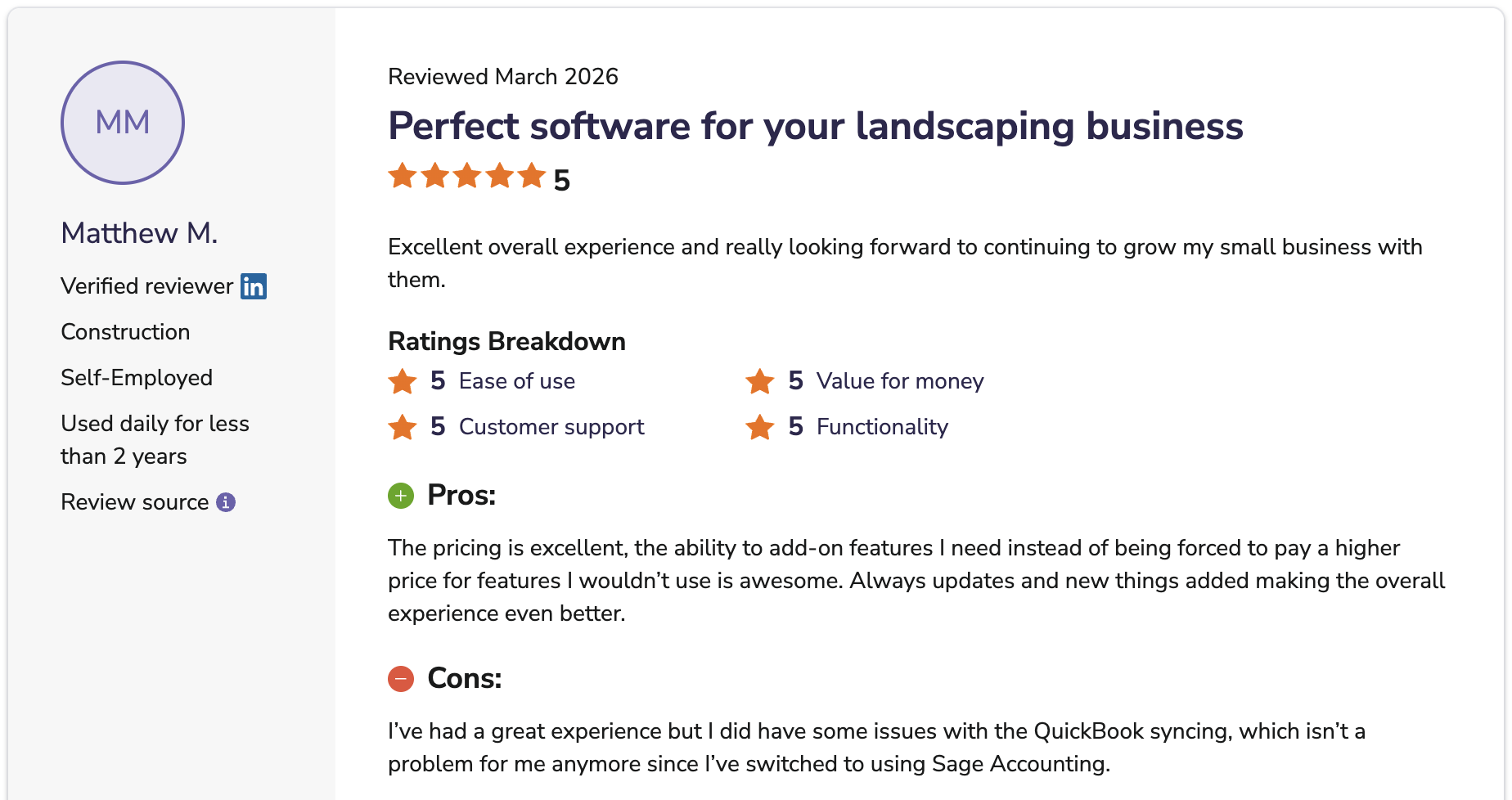
One user notes that Lawn Pro is well priced and enjoys the option of add-on features, but had some issues syncing the platform with QuickBooks.
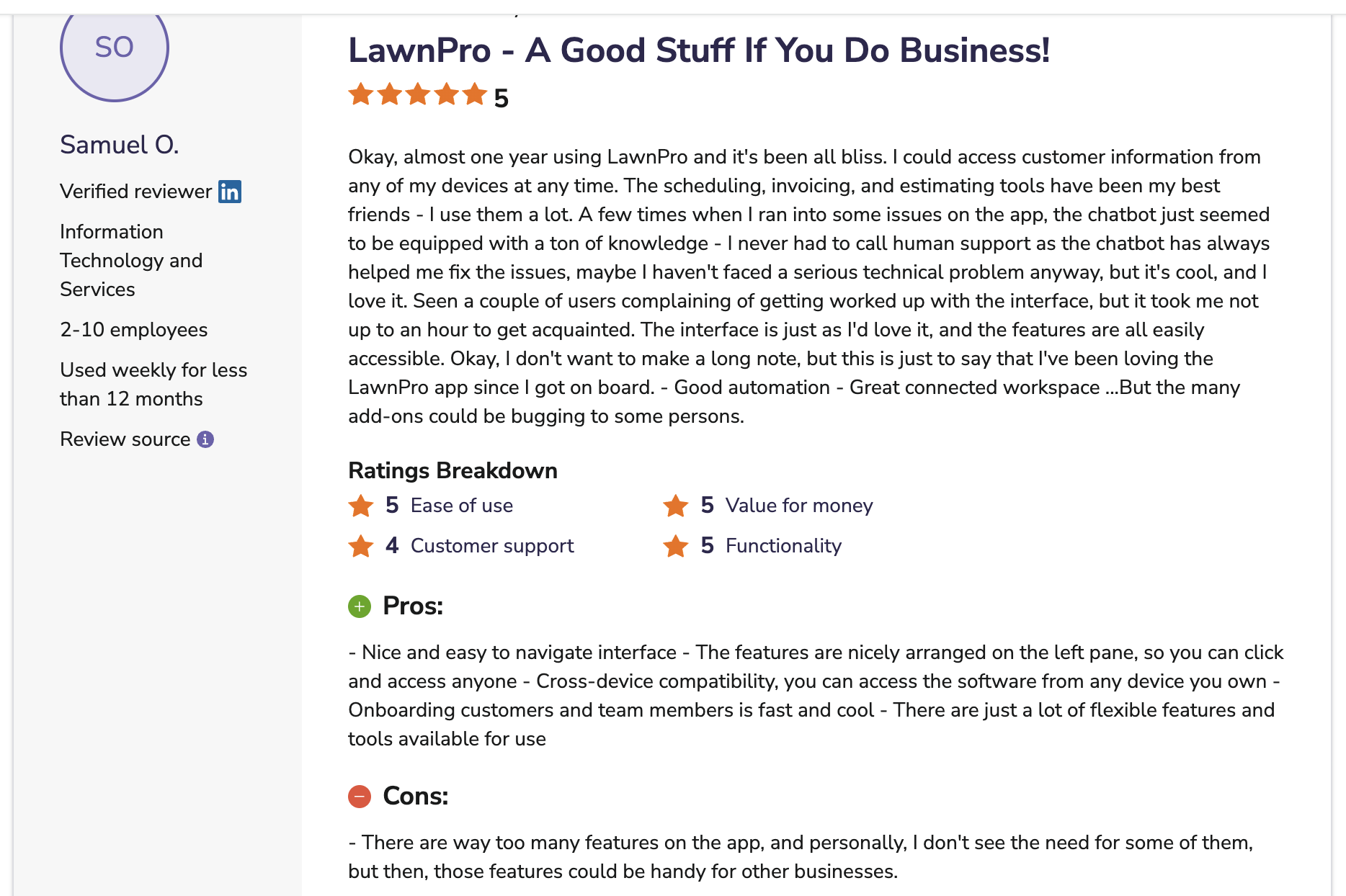
Another user says that Lawn Pro is easy to navigate and offers a great onboarding process, but finds that there are too many features for their business.
Key features
Lawn Pro helps you:
- Schedule jobs so crews can stay organized and complete work efficiently across multiple properties.
- Send estimates and invoices to help clients approve work faster and streamline billing.
- Monitor expenses to better understand costs and improve profitability tracking.
- Process payments in the field or online to make it easier to get paid quickly after service completion.
- Track employee timesheets so labor hours can be accurately recorded for payroll and job costing.
Pros
- Free plan available for businesses with up to 25 clients per month.
- Affordable paid plans that scale based on business size and team needs.
- Simple, lawn-care-focused design.
Cons
- Limited advanced features like marketing automation, reviews, and referral systems.
- Less robust reporting and job costing tools compared to more advanced field service platforms.
How much does Lawn Pro cost?
Lawn Pro offers a free subscription for service providers with up to 25 clients per month. After that, pricing is $39-$179 per month, depending on the size of your team and business needs.
How does it compare to Housecall Pro?
Lawn Pro is more specialized and simplified compared to Housecall Pro, focusing specifically on lawn care and landscaping operations. While Housecall Pro offers a broader set of features across many industries, Lawn Pro keeps things lightweight and cost-effective for lawn-focused businesses.
Who should use Lawn Pro?
You should consider using Lawn Pro if you:
- Have a lawn care or landscaping business
- Can take advantage of the free version
- Don’t need advanced marketing support, like reviews or referrals
- Aren’t interested in job costing or reporting
How to choose the right Housecall Pro alternative
If you aren’t sure which field service management platform to try, you can narrow your options down by considering:
1. Your budget
How much do you have to spend on field service management software each month? Are you strapped for cash, or do you have some money to invest?
For some, a free subscription is the best option. For others, advanced features and scalability make spending extra money worth it.
Just remember to choose an option that can grow with your business if your budget changes in the future.
2. Your needs
What do you need the most help with, and what do you have covered already?
For example, do you have invoicing under control, but struggle to plan the most efficient routes for your crews? Or do you need marketing support to help build a website so you can offer online booking and develop an online presence?
Choose the platform that best supports your business needs to boost efficiency and create more effective workflows.
3. Your growth goals
If you plan to expand your business, you need field service management software that can scale with you.
Platforms like Jobber support both sole proprietors and teams, growing alongside your business, whether that means expanding your service or hiring your first employee.
4. Customer support
Some platforms, like Workiz, have received mixed feedback from clients about their customer service, with complaints about slow response times and limited contact methods.
On the other hand, when asked what they thought about Jobber, Rob W. said, “Absolutely amazing. I have never had such a great experience with a customer service team.”
If being able to reach out when you have a question, concern, or problem is important to you, it’s worth choosing a platform with highly-rated customer support. That way, you know they’ll always have your back, and you won’t be left troubleshooting on your own when something goes wrong.
5. Setup time
Some platforms require a lot of setup and take time to learn. Others, like Jobber, are made to get you up and running as quickly as possible.
If you’re drowning under administrative work and need to get your business in tiptop shape right away, go with a platform that helps you manage workflows, customer communications, and jobs from day one.
The biggest challenge you’ll face with choosing field service management software is choosing the best one for your business.
By taking your time to review each one and basing your choice on your business needs, goals, and clients, you’re more likely to find a long-term fit that keeps you (and your customers) happy.
Final verdict: Which Housecall Pro alternative is best?
The best Housecall Pro competitor ultimately depends on the size of your business, your budget, and the complexity of your operations.
There is no one-size-fits-all solution—the right choice comes down to what you prioritize as your business grows.
For field service businesses, Jobber is the strongest all-around alternative thanks to its balance of ease of use, built-in route optimization, and optional marketing tools to help your business grow.
Originally published in May 2025. Last updated on May 22nd, 2026.
Frequently Asked Questions
-
Jobber is the best all-around alternative to Housecall Pro for small service businesses.
Jobber combines scheduling, invoicing, payments, and route optimization in a simple interface that scales as you grow. -
Common limitations of Housecall Pro include:
• Higher costs as you scale
• Per-user pricing
• Advanced features (like automation or marketing tools) being locked behind higher tiers or add-ons
Some users also note that smaller teams may not need all its built-in complexity. -
Yes, you can switch from Housecall Pro without losing data.
Most competitors allow data exports, and switching typically involves migrating customer records, job history, and invoices. The process usually takes a few days or weeks, depending on business size and setup complexity. -
Businesses often switch due to rising costs, per-user pricing, missing features in lower tiers, or wanting simpler workflows or better mobile usability.
Other common reasons for moving from Housecall Pro to competitors include stronger marketing tools or more predictable pricing structures. -
Both Housecall Pro and competitors like Jobber offer strong payment processing, including online payments and mobile invoicing.
However, when choosing the best alternative, you should consider lower features such as processing fees, faster payouts, or more flexible payment integrations.