
Key takeaways:
Here’s what you need to know to set up effective bookkeeping for your construction company.
- Organize finances with a construction-specific chart of accounts. Use tailored categories for revenue, crew wages, materials, subcontractor payments, and overhead. Make it easier to see where your money is going and accurately track performance.
- Separate direct, indirect, and overhead costs. Clearly distinguish between project-specific, shared, and business-wide expenses to identify savings opportunities and set more accurate pricing.
- Track revenue and expenses by project. Recording all costs and income against each job shows you whether each project is profitable and helps you spot any overruns or shortfalls.
- Establish a consistent cash flow management routine. Regularly review accounts receivable and payable, reconcile your bank and credit card statements, and watch for common errors to ensure you can always cover your bills and payroll.
- Document and record change orders, retainage, and work in progress. Staying on top of these items helps you manage complex jobs, keep cash flow predictable, and ensure all billable work is accounted for.
Keep learning new ways to strengthen your business finances. Sign up for the Jobber Newsletter.
Construction bookkeeping is the process of tracking each dollar that moves through your business. It helps identify where you’re spending money, which jobs earn the most, and what to expect for cash flow.
This supports more accurate pricing, job costing, and revenue tracking. That way, you can stay on top of profit and grow your business.
Learn how to do bookkeeping for a construction company by building these habits into your routine.
Get started with construction bookkeeping:
1. Start with a construction-specific chart of accounts
In construction bookkeeping, a chart of accounts is the list of categories you use to sort and organize revenue, job costs, and expenses.
When you enter income and expenses for a construction job, your chart of accounts will typically include separate categories for:
- Payments for completed work
- Crew wages
- Job materials
- Subcontractor fees
- Overhead expenses
How you refer to each category will differ based on your accounting setup. The key is to separate revenue and expenses so you can monitor performance and track where your money goes.
Separate direct costs, indirect costs, and overhead
Sorting costs into types identifies where you spend the most money, such as:
- Direct costs are expenses tied to a single job, like materials and labor.
- Indirect costs support multiple jobs, like tools shared across crews or a foreman overseeing more than one project at a time.
- Overhead costs are related to running your business whether you have work or not, like software subscriptions, marketing expenses, and office rent.
With consistent categories, you can adjust expenses based on your numbers to boost profit, change pricing, or cut costs. For example, if you spend the most on materials, you could try negotiating with suppliers, ordering in bulk, or raising prices.
Create cost codes that match your jobs
A cost code is a numeric label you use to categorize income and expenses to keep your chart of accounts consistent and organized. There’s no standard rulebook to follow when setting cost codes, but they should mirror how you quote and run jobs.
In a chart of accounts for a construction company, you might assign a cost code of “400” to electrical work. You can add subcategories to separate related expenses, such as:
- 401: electrical labor
- 402: electrical material
- 403: electrical subcontractor fees
Plumbing, demolition, and any other trades or tasks you typically quote follow the same pattern, but with their own category and subcategories.
Start with the jobs you quote the most often. Keep the list short and clear enough that your crew can use it.
2. Track revenue and costs by project
Tracking revenue and costs by job means they’re tied to the project they belong to. It tells you whether a specific job was profitable, so you can see whether the amount you quoted matches your costs.
Say you quoted a client $5,000 for a deck, with $2,000 set aside for materials. However, lumber prices jumped, and you spent $2,500 instead. That additional cost comes straight out of your profit.
With construction job costing, you can identify the overage right away and adjust pricing for your next job. That way, you can avoid the same risk on similar projects in the future.
Record labor, materials, and subcontractor costs
Record costs as they roll in, not at the end of the week. That way, you can always attribute receipts, invoices, and purchase orders to the correct job. Make sure to:
- Log crew hours against the job.
- Tag every receipt with the job number and cost code.
- Match each subcontractor invoice to the project it’s from.
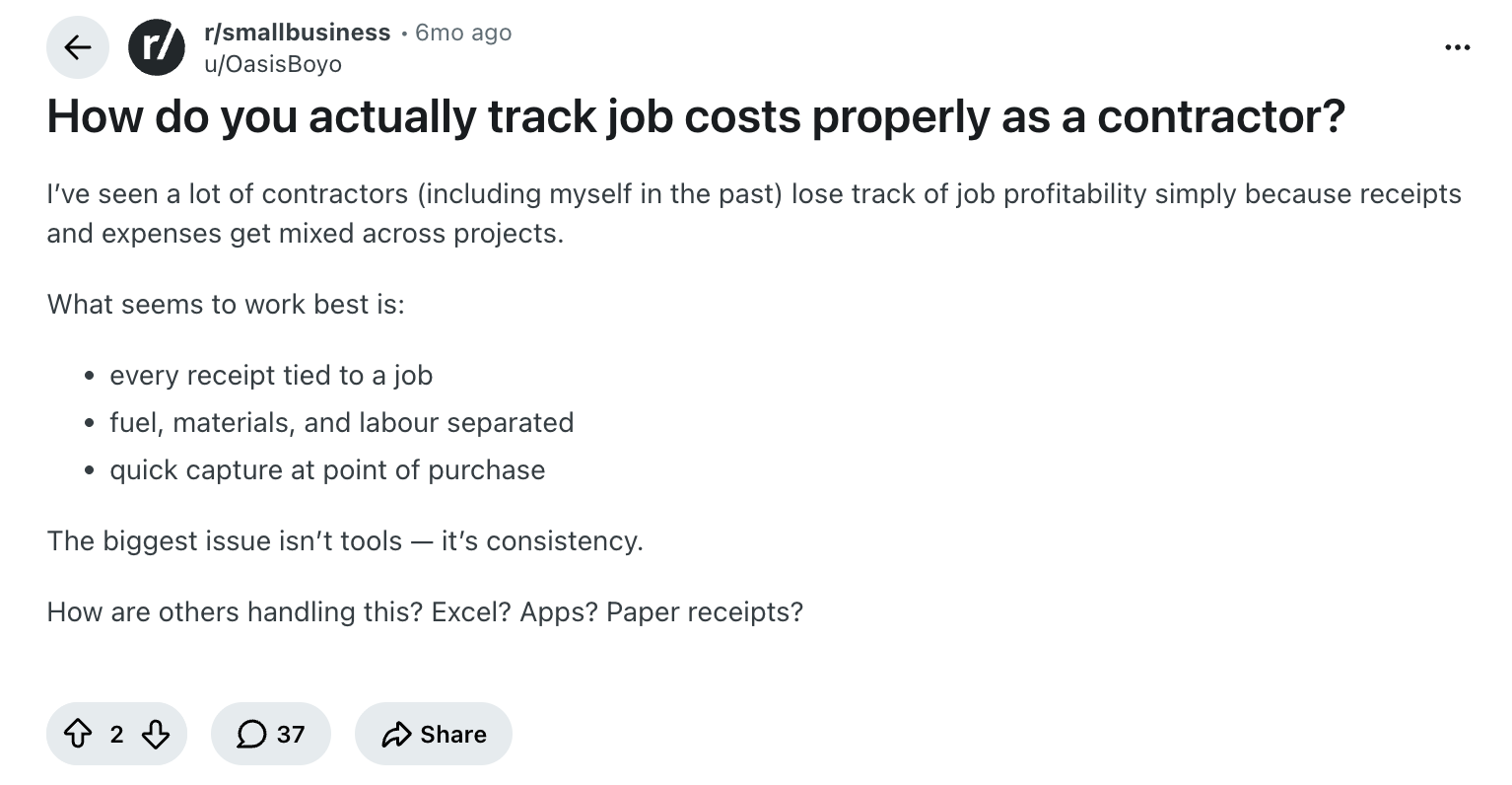
As one small business community member on Reddit pointed out, job profitability gets lost fast when receipts and expenses from different projects end up in the same pile.
Recording costs can be even harder to manage if you do it manually. Construction management software like Jobber lets your crews record labor, material, and other expenses in the field, making it easier to tie costs to each job.
Handle change orders, retainage, and work in progress
Complicated or long-running projects are more likely to be affected by:
- Change orders: Written agreements that outline changes to a job’s scope, price, or timeline after the initial agreement is signed
- Retainage: A percentage of a payment the client holds back until the work is complete
- Work in progress (WIP): The costs incurred on jobs that haven’t been completed or fully billed yet, including labor and materials
All three can change the budget, profit margin, or cash flow of a job. That’s why it’s important to track these costs and tie them to specific projects.
For example, say a client opted for a more expensive countertop material halfway through a kitchen renovation. Your costs would increase and your profits would decrease because you’re buying a different material from what you quoted. The client needs to cover the cost difference.
With a change order, you would document the new price and get the client’s approval to increase the budget before moving forward. Talk to your accountant about change order accounting, work in progress accounting, and retainage to record the costs in your books.
3. Build a cash-flow routine that matches how construction gets paid
Cash flow for construction is essential for covering costs and keeping projects moving. Unlike a construction profit margin, which is what’s left after a job’s expenses are covered, cash flow refers to the money coming in and going out of your business.
Your cash flow is what you use to order materials, pay crews, and cover subcontractor invoices, often before a client’s payment comes in.
A profitable job can have both positive and negative cash flow at different points of the work. Here’s what that looks like:
| Job stage | Outgoing money | Incoming money | Cash flow |
|---|---|---|---|
| Before the job starts | Materials | Deposit | Neutral |
| Midway through | Crew and subcontractor pay | None | Negative |
| Job is complete, final invoices sent | Any remaining costs (materials, labor, supplies, etc.) | None | Negative |
| Payment due date | None | Final payment | Positive |
That’s why a consistent cash flow management routine is essential—it helps you cover costs until project completion and payment.
Watch accounts receivable and accounts payable
Two of the most important balances to track for cash flow are accounts receivable and accounts payable.
- Accounts receivable is the money clients owe you for work you’ve invoiced but haven’t been paid for yet.
- Accounts payable is the money you owe others, like suppliers and subcontractors.
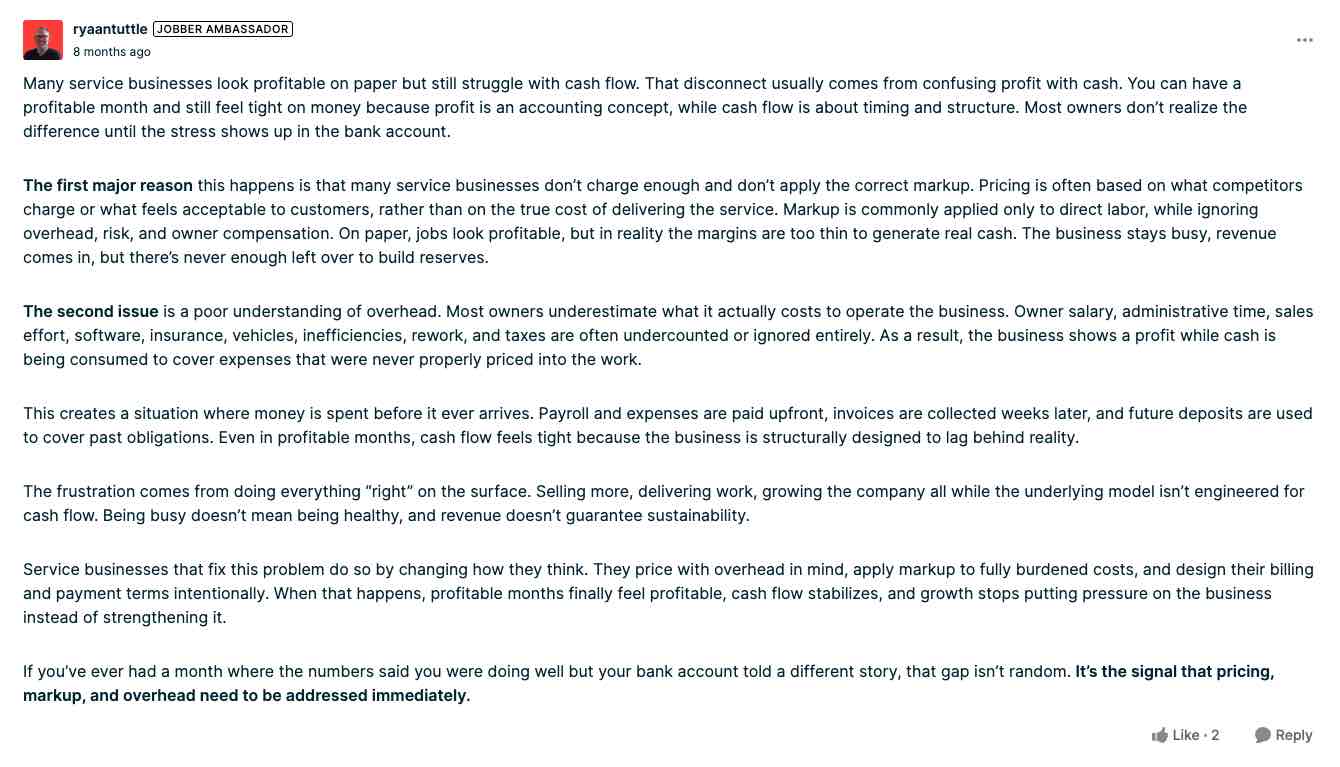
A job can look profitable once it’s invoiced, but you won’t have money to cover your bills until the client actually makes a payment. As one Jobber Community member pointed out, plenty of profitable construction firms still struggle to keep enough cash on hand.
A simple weekly review in accounting software like QuickBooks Online can help you stay on top of both. Every week, make a routine to:
- Review accounts receivable for any outstanding invoices and follow up.
- Review accounts payable for bills coming due in the next two weeks.
- Compare incoming and outgoing cash flow to spot a shortfall before it happens.
If you have bills coming due but not enough cash to cover them, you can send invoices sooner, ask for deposits on upcoming jobs, or pause non-essential purchases.
Reconcile bank and credit card accounts
Reconciling your accounts is when you compare your books to your bank and credit card statements to ensure all the transactions match.
For example, if you spend $500 on materials, it should show as an expense in your books and as a transaction in your business bank account. That way, you know exactly where your money is going. It’s also an effective way to catch mistakes before they throw off your numbers.
For many construction businesses, it’s a good idea to do reconciliation at least once a month. But if you run a lot of jobs, weekly checks can help keep transactions in check before they become overwhelming.
When reconciling accounts, watch for common job cost errors such as:
- Duplicate entries, like a receipt that was submitted twice
- Missing transactions, like cash purchases
- Expenses assigned to the wrong code or job
- Personal purchases mixed in with business spending
- Unrecorded bank fees or interest charges
4. Close the books every month
Closing the books means wrapping up your transactions for the calendar month. Record every transaction and reconcile every account so you have a final number to work with.
Accurate bookkeeping helps you make timely and informed decisions. If you have profit to work with, you can use it to make purchases, book jobs, and grow your business. If you don’t, you can scale back operations for the slow season, add new services, or adjust pricing.
Run a monthly construction bookkeeping checklist
Each month, run through a construction bookkeeping checklist of best practices to keep your books clean and accurate. Make sure you:
- Record all income and expenses, with the right job and cost code attached.
- Reconcile bank and credit card accounts.
- Follow up on overdue invoices.
- Confirm your own bills are paid or scheduled.
- Review your profit and loss report for the month.
Ask your accountant how to handle retainage, WIP balances, or any large or unusual transactions, like a loan or equipment purchase.
Review project profitability before you price the next job
One job’s profitability can affect how much you make on the next one. Follow these steps to compare what you quoted to what a job actually cost:
- Pull your original estimate and target profit margin for the project.
- Add up labor (including drive time), materials, subcontractor costs, and any change orders.
- Count callbacks and rework against the original scope.
- Note where costs came in lower or higher.
- Use any gaps to adjust pricing on future jobs.
For example, say you usually quote four hours of labor for a job, but it keeps taking six. Either build the extra time into your next quote, or figure out why it’s taking longer and get more efficient.
For standard or short-term jobs, use job costing at the end of a project. But for long-term or complex work, compare quotes to actual costs at multiple points so the budget stays on track.
5. Use software to keep project costs current
Job costs are only useful if they’re current. Contractor bookkeeping software keeps them up to date as work happens, so you don’t have to spend hours at the end of the month piecing together receipts and labor hours. That can be a big help for your accountant.
Capture costs where they happen
Log costs as they happen, like at the supply store counter. It’ll help prevent receipts from getting lost or forgotten, making it easier to keep costs tied to the right jobs.
Construction apps like Jobber can help you record receipts and invoices on the go. That way, your team can:
- Log expenses from anywhere.
- Snap and upload photos of receipts.
- Attach expenses to the jobs they belong to.
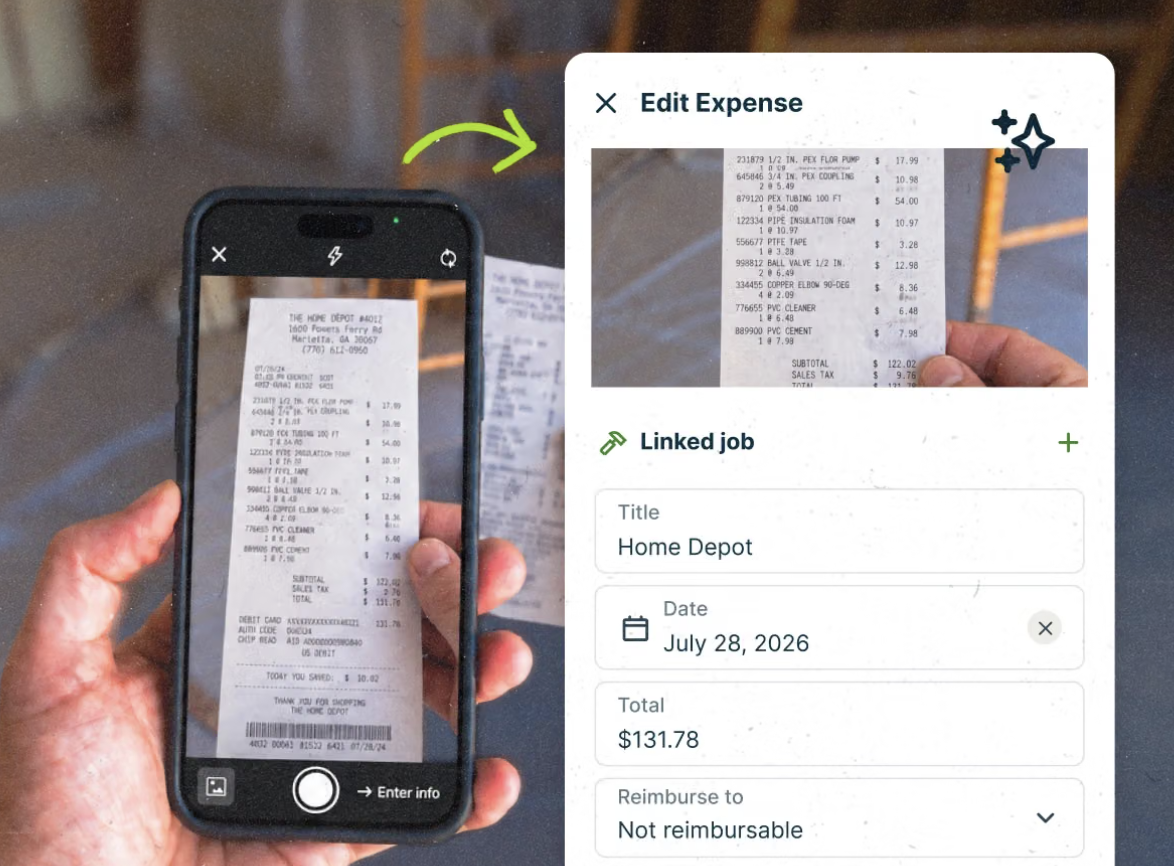
Note: Some expense and job costing features are only available on eligible Jobber plans.
Track every cost by project
Keeping all costs related to a job in one place helps with job costing, organization, accounting, and financial management. It makes monthly bookkeeping easier, so your reviews take less time, and you have more capacity to focus on other work.
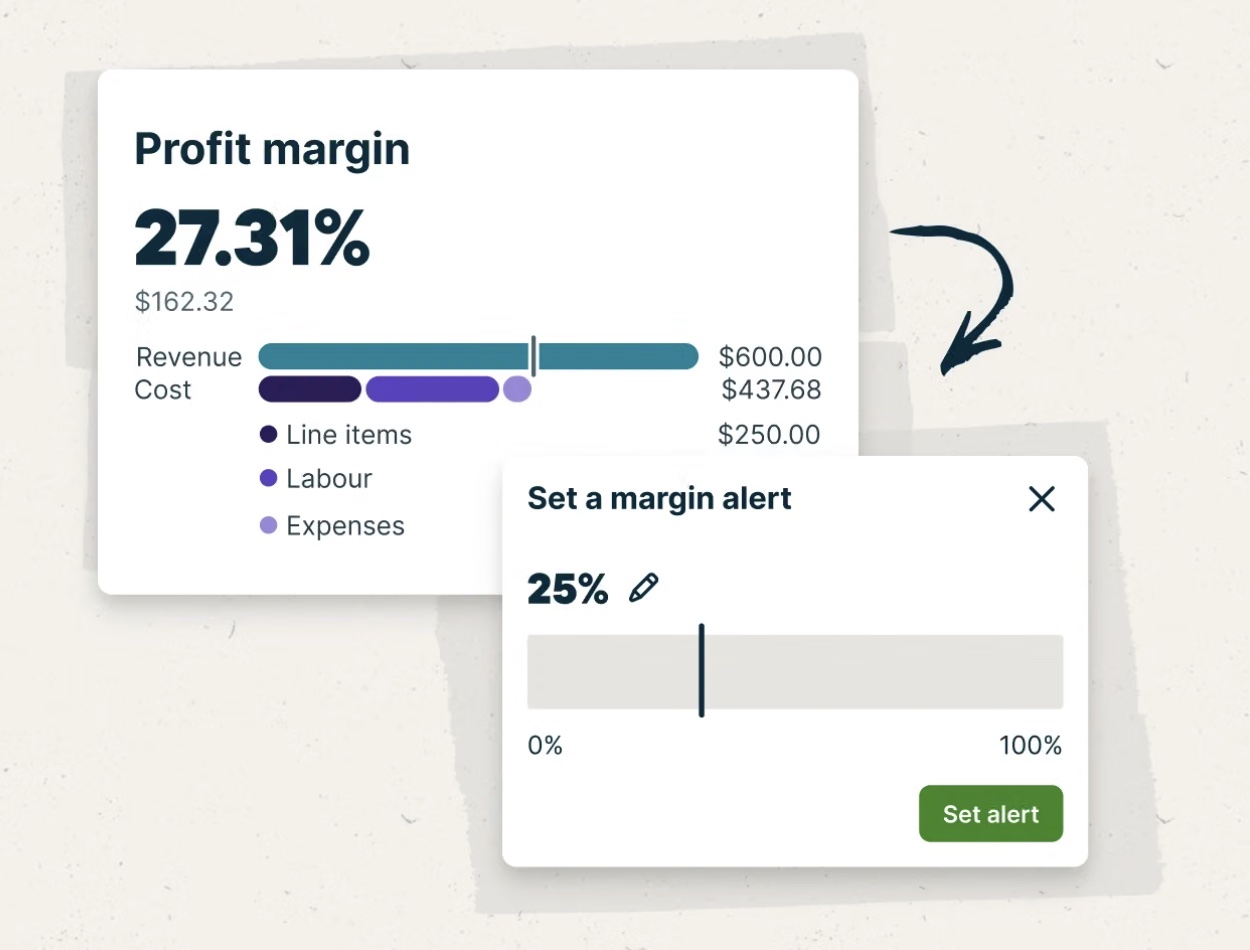
Jobber job costing and live profit tracking reflect real-time profit. This ensures you always know how much you’re making, when to review expenses, and whether you need to make a change order.
As you add labor, materials, and other expenses to a job, Jobber subtracts them from the initial price, showing your total revenue, cost, and profit margin.
Work with a dedicated bookkeeper
Completing monthly bookkeeping on top of a busy schedule is a lot to handle, especially when you have multiple crews and jobs to oversee. Jobber Bookkeeping can pair you with a dedicated bookkeeper to close your books within five days of month-end.
As part of their bookkeeping services, they’ll walk you through the numbers in plain language, so you know where your business stands.

Jobber Bookkeeping is for modified cash basis accounting and doesn’t include certified payroll, tax filing, accrual accounting, inventory tracking, or tax or financial advice.
You’ll still need a regular accountant to help with those tasks, but Jobber Bookkeeping is a good way to track your monthly numbers, so you aren’t left in the dark until tax time.
Common construction bookkeeping mistakes to avoid
Bookkeeping for contractors comes with some common mistakes, but once you know what to watch for, they’re easy to spot and fix. Use this table to learn what they are and how to prevent them.
| Bookkeeping mistake | How to prevent it |
|---|---|
| Assuming profit means cash in the bank | Monitor incoming payments, overdue invoices, and upcoming bills, so you always know what to expect from cash flow. |
| Starting extra work without creating a written change order | Use a change order to get a client’s approval on any additional work and add it to the project’s budget. |
| Pricing new jobs from memory | Complete job costing on every job to compare actual costs to quotes for more accurate pricing. |
| Using inconsistent bookkeeping categories or codes | Keep your chart of accounts and cost codes simple, and use them consistently across jobs. |
| Forgetting overhead in your quotes | Factor a share of overhead into every quote, so each job helps cover the costs of running your business. |
| Neglecting the monthly close | Close your books on the same day each month and use software like Jobber Bookkeeping to keep your numbers current without adding to your workload. |
Better bookkeeping for your business
The secret to construction bookkeeping is simple—be consistent. Tie every cost to a job, check your cash flow weekly, and close the books each month. It’s an effective way to tell which jobs are profitable, when to adjust pricing, and whether you’re ready to grow.
Build proper bookkeeping habits, lean on your accountant when you need support, and use tools like Jobber to stay organized and build a profitable business.
Frequently Asked Questions
-
Construction bookkeeping tracks income and costs for each job, not just for the business as a whole. Since construction projects can run for weeks, get paid in stages, and involve unexpected scope changes, it helps you see which jobs are making money.
Regular bookkeeping doesn’t break down costs per job, so it can only show you whether your business is profitable overall. It’s still valuable for tracking the health of your business, but it’s higher-level information that may not help you improve profitability. -
Either method works for construction accounting.
Cash accounting records income and expenses when money changes hands, like when a client pays you or you pay a supplier.
Accrual accounting records income and expenses when they’re earned or incurred, like when you send or receive an invoice, even if the money hasn’t moved yet.
Construction accountants can help you choose which method to use based on the size of your business and average project length. -
Tie each expense to a job using a cost code as soon as it happens. Record labor, materials, and subcontractor payment against the job and compare them to the initial quote to see where you stand. Job costing software can track expenses and profit margin as you go to keep numbers current.
-
A monthly construction bookkeeping checklist should include:
• Recording income and expenses by job
• Credit card and bank reconciliation
• Following up on overdue invoices
• Confirming your bills are paid
• Reviewing your profit and loss report -
Hire a bookkeeper if you don’t have the time, capacity, or experience to do construction bookkeeping yourself. For example, it’s a good idea to get a bookkeeper if you struggle to close the books each month, can’t tell which construction contracts are profitable, or spend your evenings sorting receipts.