
Key takeaways:
PPC advertising is a powerful tool for HVAC businesses looking to generate more leads and turn online searches into booked jobs quickly.
- Appear where your customers are searching. HVAC PPC positions your ads at the top of search results, connecting you with homeowners and businesses when they need services most, especially during high-demand times.
- Choose the right ad types for your goals. Use various ad formats—like Google Search Ads, Local Services Ads, display, remarketing, and social media—to capture both urgent and longer-term leads while maximizing your reach.
- Target strategic keywords and service areas. Focus your campaigns around high-intent, location-based, and seasonal keywords that reflect buyer urgency. Use negative keywords to filter out unqualified clicks and improve your ROI.
- Build effective campaigns and landing pages. Guide potential customers to dedicated landing pages that match their search intent and make it easy to take action, boosting your conversion rates and minimizing wasted ad spend.
- Track results and refine campaigns. Regularly monitor cost per lead, booked jobs, and return on ad spend to ensure your PPC investment leads to profitable, sustained business growth.
Stay updated with more tips to grow your HVAC business by signing up for the Jobber Newsletter. Sign up here.
Looking to generate more service calls and grow your HVAC business? Pay-per click (PPC) advertising helps you connect with homeowners and businesses who are searching for heating and cooling services. It’s one of the fastest ways to turn online searches into booked jobs.
In this guide, you’ll learn how HVAC PPC works, which keywords generate leads, how much HVAC companies typically spend, and how to turn your ad budget into as many paying jobs as possible.
Your guide to HVAC PPC advertising:
-
What is HVAC PPC?
-
Main types of HVAC PPC ads
-
HVAC PPC campaign setup table
-
Best HVAC PPC keywords to target
-
HVAC PPC negative keywords
-
How much does HVAC PPC cost?
-
Can HVAC companies make money from PPC?
-
Residential HVAC PPC vs commercial HVAC PPC
-
HVAC PPC landing page best practices
-
How Jobber helps after an HVAC PPC lead comes in
-
Common HVAC PPC mistakes to avoid
What is HVAC PPC?
HVAC PPC is a form of online advertising where HVAC companies pay to get their business at the top of search engine results when people search for services like “AC repair” or “furnace replacement.”
Instead of waiting for organic rankings to grow over time, PPC lets you appear in front of high-intent customers the moment they’re looking for help. It’s one of the fastest ways to generate qualified leads as part of a broader HVAC marketing strategy.
How HVAC PPC works
When an air conditioner stops working on a hot day, most people won’t scroll through Facebook or look for different HVAC websites. They’ll pull out their phone and search Google for something like “AC repair near me” because they need help right away.
That’s where HVAC PPC marketing comes in. It places your business at the very top of the search results right when people are searching.
Here’s what happens behind the scenes on a platform like Google:
- A homeowner searches for HVAC service using a term like “emergency AC repair” because they need help immediately.
- Your ad enters Google’s auction. Google compares your ad against other accounts that are bidding on similar searches.
- Google ranks ads that are eligible for the search based on how you’ve optimized your campaign and the quality of your landing page.
- The prospect clicks your ad. With a PPC campaign, you only pay when someone clicks your ad. People simply seeing your ads (known as impressions) won’t cost you anything.
- The visitor reaches a dedicated landing page on your website that’s relevant to what they searched for.
- The lead becomes a booked job. The visitor contacts you, your team schedules the appointment, and the visitor—now a customer—moves through your sales process.
Why PPC matters for HVAC companies
The biggest advantage of HVAC PPC is speed. It puts your business in front of potential customers almost immediately. When the first heatwave or cold snap hits, you can launch campaigns quickly to capture that spike in demand.
PPC gives you control over where your digital marketing dollars go:
- Generate leads for the services you want to sell. If your calendar has openings, you can shift ad spend toward high-margin services like AC replacements or heat pump installations.
- Advertise only where you do business. Geo-targeting lets you show ads within specific ZIP codes, cities, neighborhoods, or driving radiuses around your shop.
- Adjust campaigns as demand changes. HVAC demand may not be steady throughout the year. A sudden weather event or a promotion on new equipment could justify shifting your budget toward different services or locations.
PPC also helps you in crowded local markets. A campaign can give smaller, local businesses a chance to appear alongside larger competitors when homeowners are searching for help.
Unlike many traditional advertising channels, there’s high accountability with PPC. You can easily answer questions to shape your next campaign, like:
- Which keywords generated phone calls?
- Which campaigns produced form submissions?
- How much did each lead cost?
- Which leads turned into booked jobs and profitable installations?
Main types of HVAC PPC ads
Different ad formats solve different problems. Some are built to capture homeowners who need emergency service right now, while others help you stay visible during a longer buying decision.
The right mix depends on your goals and budget. Here are the main types of PPC ads for HVAC businesses to generate leads and stay top of mind.
Google Search Ads
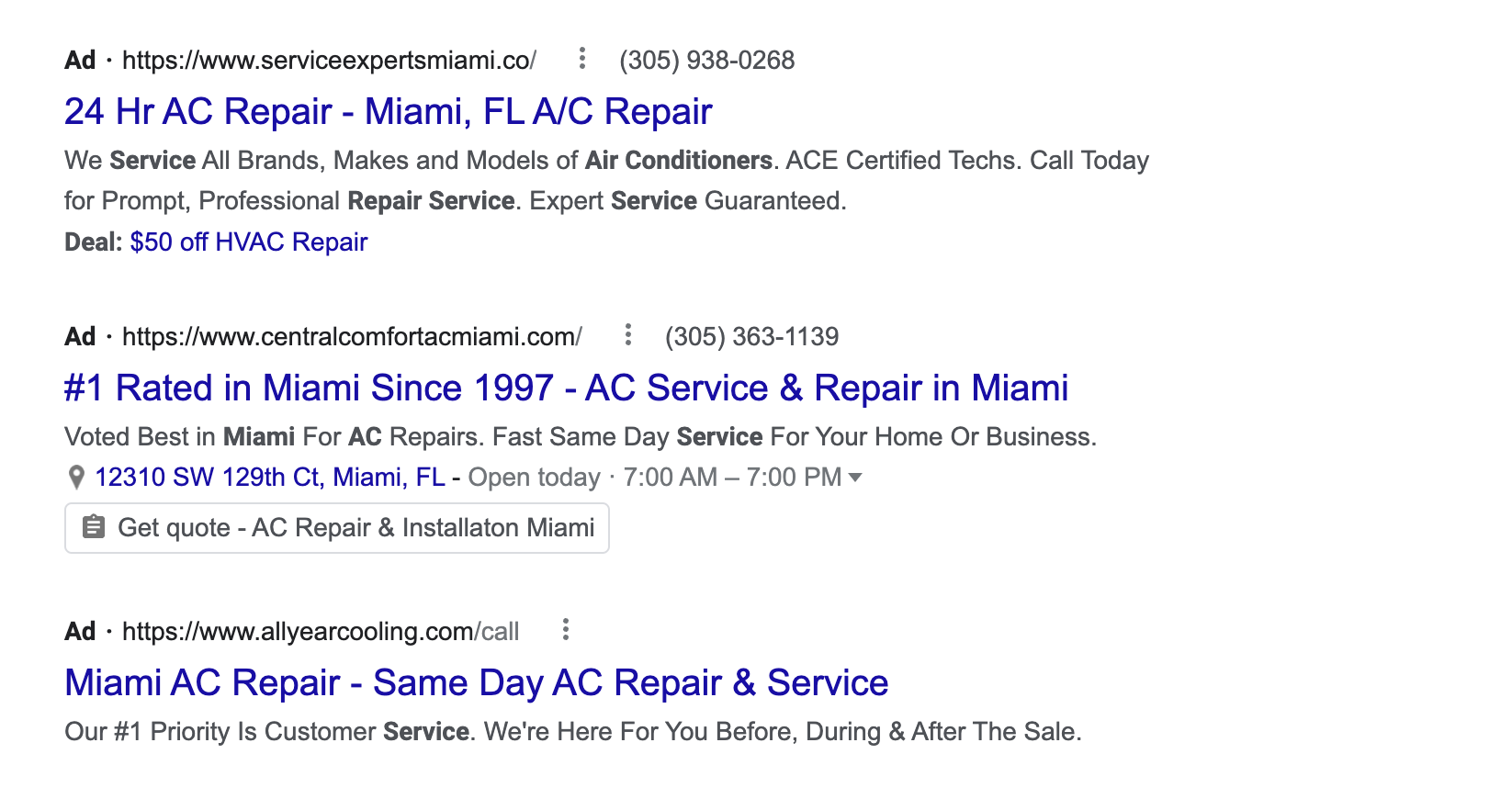
Google Search ads let you pay for HVAC advertising space at the top of Google results—right where homeowners are looking for help.
When someone types in phrases like “Miami air conditioning repair” or “24/7 furnace services,” they’ll see your ad above the regular search results.
Google runs an automated auction to choose which ads get shown. You and other HVAC businesses bid for advertising space. The higher the bid (and the more relevant your ad), the better your chances of showing up.
Google Local Services Ads
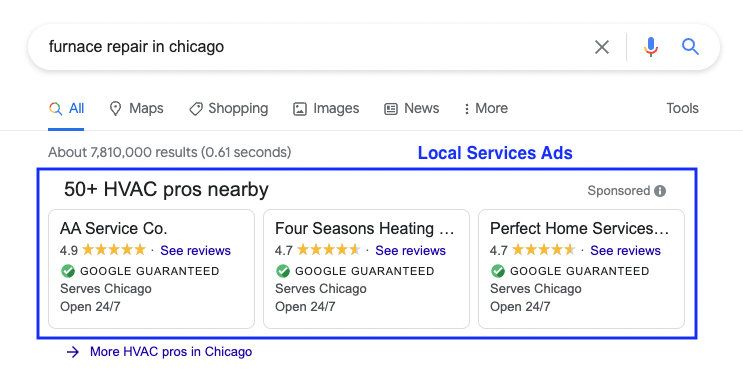
There are two main differences between Google Search Ads and Google Local Services Ads: LSAs only target people in your service area, and you only pay for leads that contact you.
LSAs appear at the very top of Google’s search results, above Google Search ads and unpaid results. These ads include your contact information, operating hours, and your Google rating, making it easy for homeowners to trust you and reach out.
For example, a potential lead who searches for “furnace repair in Chicago” may see something like this:
For beginners, PPC and LSA are easy to set up. Just enter your business information, get verified, and get the Google Guarantee badge. Then, let Google know the exact amount of money you want to spend.
It’s almost ‘set it and forget it.’ Then, you simply make sure that you’re going into the platforms and you’re marking leads appropriately. This is a great first step.
Display ads
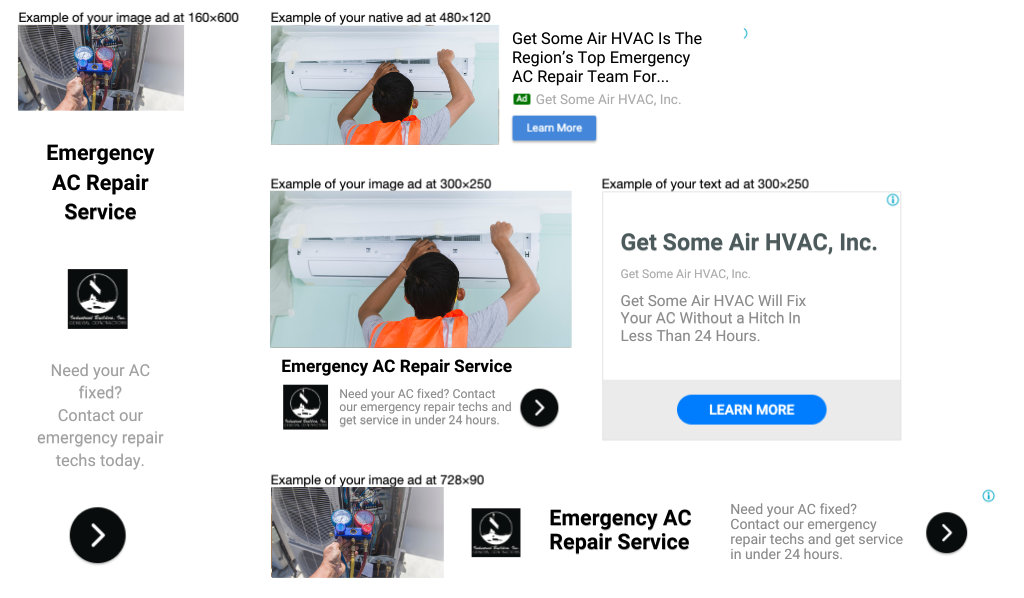
Responsive display ads are visual ads assisted by Google AI. Upload your images or videos, headlines, service descriptions, and logo. Google will generate several ad combinations that show up on websites, apps, YouTube, and Gmail.
You can even show specific ads to visitors who have been to your website before. This reminds them about your small business and your brand while they’re browsing other sites online.
Remarketing ads
Remarketing ads help you reconnect with people who have previously been to your website but left without contacting you. Remarketing keeps your business in front of them, with your ad appearing on other websites to remind them you’re still an option.
You can use these campaigns to:
- Reinforce seasonal promotions.
- Highlight financing options for equipment replacements.
- Advertise 24/7 emergency service.
- Encourage first-time customers to schedule an appointment.

Paid social ads
Facebook and Instagram are two social media channels that HVAC companies commonly use to get more leads.
Facebook ads
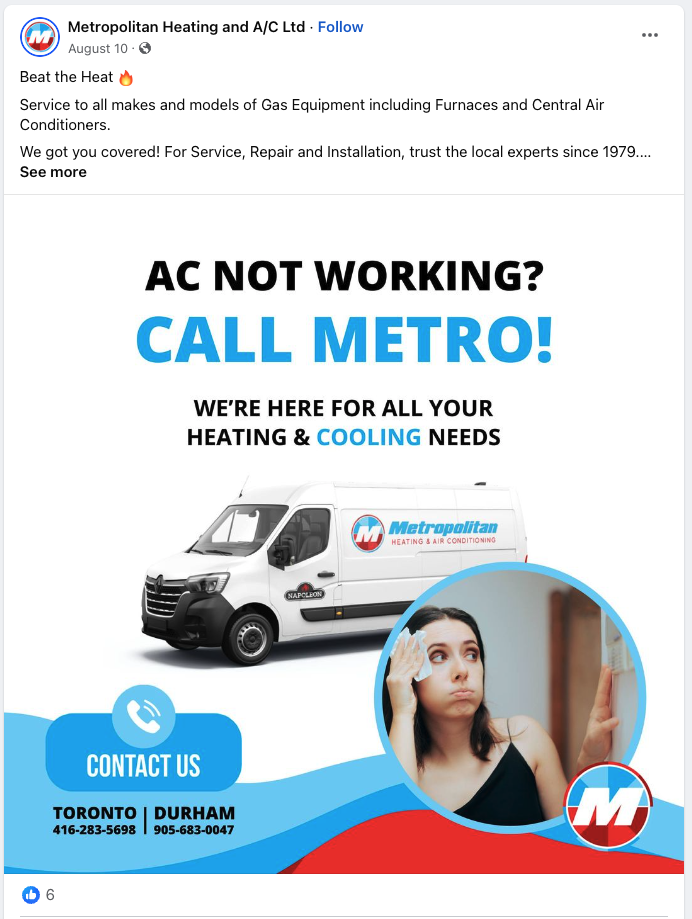
Facebook Image Ads are single-image ads that appear in a user’s news feed. They’re one way to promote your services, a discount, or a seasonal offer. Boosted posts let you share your Facebook posts with a wider audience outside of your follower list.
This post from Metropolitan Heating and A/C Ltd makes a great Facebook ad. It calls out a common customer problem, offers their services as a quick solution, and includes a clear call to action (CTA) with contact details:
Instagram ads
On Instagram, Stories ads are one of the best types of Instagram ads to attract HVAC customers. These ads appear between other users’ Stories (vertical videos that disappear after 24 hours).
Image and carousel ads also work well for promoting a discount on a specific service. You can use one image or several to showcase before-and-after images of HVAC installs.
Video ads
Video ads are best used for sharing educational content with homeowners. Answer common questions and problems, like improving indoor air quality and handling home temperatures when seasons change.
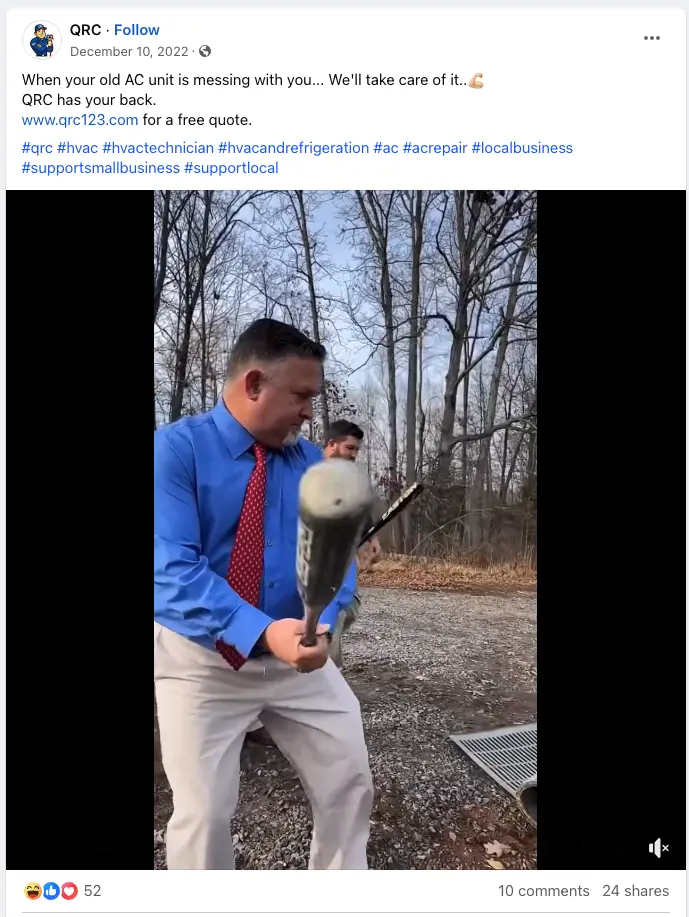
This creative and funny video ad from HVAC company QRC shows their team destroying a customer’s old AC unit, with a caption that suggests they’ll “take care of it”:
HVAC PPC campaign setup table
While getting more leads is exciting, it’s important to focus on the details that make a campaign profitable. In addition to picking keywords and setting a budget, a successful PPC campaign attracts the right homeowners and turns those searches into booked appointments.
Use the setup checklist below as a starting point for building campaigns.
| Campaign area | What to include | Why it matters |
|---|---|---|
| Goal | Set measurable goals tied to business results. For example, generate 30 AC installation leads over the next 30 days. | Goals keep your budget focused on measurable business outcomes. They also make it easier to shift spending toward high-margin services. |
| Service area | Target only the cities, ZIP codes, or neighborhoods you can serve. Prioritize higher-value areas or neighborhoods with old homes that might need HVAC replacements. | Targeting your service area reduces wasted ad spend by showing ads only to homeowners you can serve. It also cuts down on long drive times that reduce the number of jobs you can fit into your schedule. |
| Keywords | Focus on keywords that homeowners search when they’re ready to hire, such as “emergency AC repair” or “furnace replacement.” | The right keywords connect your ads with homeowners looking for the services you offer. A focused strategy helps you avoid spending on broad searches that don’t turn into booked jobs. |
| Negative keywords | Build a negative keyword list to filter out searches that aren’t likely to turn into paying customers. Include terms like “DIY” or “how to.” | Negative keywords filter out searches that won’t convert. That means more of your budget goes toward qualified prospects. |
| Landing page | Send ads to a dedicated landing page for that service instead of your homepage. Keep the page mobile-friendly and focused on turning the visitor into a lead. | A dedicated landing page keeps visitors focused on one service and one next step, making them more likely to act. |
| Tracking | Track every lead from click to booked job. Record phone calls and form submissions so you can see which keywords are effective. | Tracking shows you which keywords and ads are generating leads so you can invest more budget toward what’s working. |
| Follow up | Try to respond to calls and form submissions within a few minutes. Sending automatic confirmations can buy you time until you’re able to write a detailed response. | The first contractor to respond might win the job. Following up fast helps you convert more PPC leads into booked appointments. |
Best HVAC PPC keywords to target
Choosing the right keywords is one of the biggest factors that determines whether your PPC campaigns generate jobs. The goal is to connect your ads with people who are actively looking for HVAC services, and that starts with keyword research.
Your keywords also need to work together with your ad copy and landing pages. Here are the keyword categories to focus on.
High-intent service keywords
The best HVAC PPC keywords are the ones that show a homeowner is ready to hire. Broad terms like “HVAC” or “air conditioning” may bring in traffic, but people searching these terms will often be learning or looking for DIY information.
Examples of keywords that signal urgency and buying intent include:
- AC blowing warm air
- AC repair near me
- Ductless mini-split installers
- Emergency AC repair
- Furnace making clicking noise
- Furnace repair service
- Furnace replacement quotes
- Heat pump installation
- HVAC company near me
- No heat emergency service
Location-based keywords
Location matters just as much as the service being searched. A person looking for “AC repair,” for example, probably wants someone who can show up at their house the same day.
Your keywords should match the areas you serve. If your team only drives 30 minutes from the shop, there’s no reason to spend money displaying ads to people outside that radius.
Combine service terms with local identifiers to form more targeted keywords like:
- AC repair in [CITY]
- Commercial HVAC company in [CITY]
- Furnace repair near me
- Heat pump installer in [SERVICE AREA]
- HVAC contractor in [CITY]
Seasonal HVAC keywords
Since HVAC demand changes throughout the year, your keyword strategy for the summer may not make sense in the fall, so adjust your campaigns with the seasons.
During peak weather events, focus on urgent searches like:
- 24/7 HVAC repair
- AC not working
- Emergency AC repair
- Furnace stopped working
- No heat emergency service
When temperatures are mild and emergency calls slow down, shift toward services like:
- AC tune-up specials
- Furnace maintenance
- Heating system inspection
- Home air purifier installation
- Indoor air quality testing
Commercial HVAC keywords
Commercial HVAC searches are a little different from residential searches. Building owners and property managers are looking for contractors who handle specific equipment or building types. They might need ongoing services, too.
Commercial keywords often cost more per click. That’s because the potential job value is much higher—just one qualified commercial lead could turn into a major repair or recurring maintenance agreement. Examples of commercial keywords include:
- Chiller repair service
- Commercial HVAC contractor
- Commercial HVAC maintenance
- Commercial HVAC replacement
- Commercial rooftop unit repair
- Industrial HVAC contractor
HVAC PPC negative keywords
Negative keywords are one of the simplest ways to protect your PPC budget. They tell the ad platform which searches shouldn’t trigger your ads. This helps prevent clicks from people who are looking for things like DIY advice or employment opportunities.
Without negative keywords, your campaigns can attract plenty of traffic that looks relevant but never turns into revenue. Here’s how to filter out low-value searches, so you can focus more of your budget on homeowners who are ready to book.
Common negative keywords for HVAC PPC
Block searches from people looking for DIY, employment, bargain, or unrelated services, since none of these terms will contribute to revenue. Examples include:
| DIY keywords | Employment keywords | Bargain keywords | Unrelated keywords |
|---|---|---|---|
| • DIY • How to • Manual • Parts • Schematic • Troubleshooting • Tutorial • Wiring diagram • YouTube | • Apprenticeship • Careers • Certification • Hiring • Jobs • Resume • Salary • Training | • Cheap • Discount code • Free • Liquidator • Wholesale • Used | • Auto • Car AC • Marine • Refrigerator • RV • Window unit |
How much does HVAC PPC cost?
On average, HVAC PPC clicks often fall between $6.84 and $12.31, but the actual cost depends on your market and keywords.
A search specific to maintenance might cost less than $10 per click, while a competitive emergency service search during peak summer could reach $45–$75+ per click.
While those clicks might seem expensive, if they turn into a $10,000 system replacement, your ROI could look great.
According to data from $14.9 million in HVAC ad spend, the average blended cost per lead is $104. But that number changes based on the campaign type:
- Branded Search Ads: $34 per lead (customers searching for your company by name)
- Performance Max Campaigns: $72 per lead (Google’s AI-driven campaign type that runs across multiple channels)
- Non-branded Search Ads: $149 per lead (searches like “AC repair [city]”)
What affects HVAC PPC cost?
PPC costs depend on factors like your local market, the services you offer, and the competition. Here are some of the big ones:
- Location and competition: A click for “AC repair” in a small market might cost $10–$15, while a larger, more competitive market like Miami might reach $45–$75 per click.
- The service you’re promoting: High-value searches like “emergency furnace repair” will probably be more expensive because those leads can turn into valuable jobs. On the flip side, keywords like “spring AC tune-up” might have cheaper clicks but won’t bring as much revenue.
- Seasonal demand: During a heatwave or cold snap, more homeowners will be searching for emergency repairs, which increases competition and can drive up costs. If your daily budget is too low, your ads may not win bids, and Google won’t display them—or you’ll burn through your budget much more quickly.
- Your lead handling process: If you generate a $75 lead but miss calls or take too long to respond, your true cost per booked job will go up. Fast responses and effective scheduling are just as important as the PPC campaign itself.
We’re really focusing on speed to lead. If we can contact them in the first 120 seconds of getting that lead form, we have a much higher chance of closing that job.
And if you can get it in 60 seconds, it’s about double the chance that you’re going to have at closing that lead.

HVAC PPC budget planning table
Build your budget around what you want to accomplish, rather than how many clicks or leads you want to generate. Use this table to match your business goals with the right PPC focus.
| Business goal | Suggested PPC focus | What to track |
|---|---|---|
| Get more emergency jobs | Target high-intent searches like “emergency HVAC repair” or “furnace repair near me.” Increase your bids when demand spikes. | • Phone calls • Form submissions • Cost per lead (CPL) • Call answer rate • Booked emergency jobs • Revenue from emergency work |
| Fill slow days | Promote services that can help keep your schedule full during slower periods, such as tune-ups, inspections, seasonal specials, and discounted service calls. | • Leads generated • Bookings by service type • Promotion redemption rate • Schedule utilization • Cost per booking |
| Grow maintenance plans | Target homeowners searching for tune-ups, seasonal maintenance, and system care. Use ads and landing pages that highlight perks and long-term savings. | • Maintenance plan sign-ups • Cost per sign-up • Landing page conversion rate • Recurring revenue generated |
| Expand into a new city | Build campaigns for the new market with location-based keywords and dedicated landing pages. Use geo-targeting to focus your budget. | • Leads from the new city • Impression share • Clickthrough rate (CTR) • Cost per lead • Booked jobs by location |
| Get commercial HVAC leads | Focus on commercial terms like “commercial HVAC contractor” and “building maintenance HVAC.” Create campaigns and landing pages to meet the needs of facility managers and property owners. | • Commercial lead volume • Cost per lead • Quote requests • Average job value • Closed-won revenue from commercial accounts |
Can HVAC companies make money from PPC?
Yes, but you need to look beyond the cost of clicks or leads. While HVAC PPC can be expensive, remember that your goal is to generate qualified leads that turn into profitable jobs.
For example, an HVAC lead might cost around $149, but a single system replacement can bring in $8,000 to $15,000+ in revenue. A campaign just needs to consistently turn the right leads into profitable jobs.
Plus, the value of PPC goes beyond that first appointment. The homeowner could later become a maintenance member or replace their system years later. Repeat customers mean additional revenue without another advertising cost.
PPC metrics HVAC businesses should track
To know whether PPC is truly growing your business, track what happens after someone clicks your ad. Generating 100 calls looks good on paper, but if those calls never turn into booked jobs, the numbers don’t tell the whole story.
Here are the metrics to keep an eye on:
- CPL by campaign type: Don’t judge your entire PPC strategy by one blended cost per lead (CPL). Branded searches from people already looking for your company (like “John’s HVAC”) average around $34 per lead. Non-branded searches (e.g., “AC installation near me”) average around $149 per lead.
- Job booking rate: This shows how well you convert leads into jobs. For example, if your PPC campaign generates 40 phone calls and you book 20 appointments, your booking rate is 50%. Try to keep that number from dropping—this would mean your ads aren’t targeting a qualified audience.
- Cost per booked job (CPBJ): If you spend $1,000 on PPC and book 20 jobs, your cost per booked job is $50. Compare that number against your average ticket size and profit margins to see if the PPC campaign is financially worth it.
- Return on ad spend (ROAS): If you spend $1,000 on ads and generate $5,000 in revenue from those leads, your ROAS is 5x. HVAC companies can often target a 4x to 6x ROAS.
Residential HVAC PPC vs commercial HVAC PPC
Residential and commercial customers may need the same basic services, but the way they search and evaluate is different.
A homeowner with a broken AC wants a fast solution. A facility manager may spend weeks comparing commercial contractors for a maintenance agreement.
Let’s take a closer look at each audience:
Residential HVAC PPC
Most homeowners searching for HVAC services are dealing with an immediate problem and want a contractor they can trust to solve the issue. Characteristics of residential PPC include:
- Urgent searches: Homeowners often make decisions based on reliability and response time. Your ad copy should speak to benefits that matter in the moment, like same-day service or 24/7 availability.
- High lead volume, short sales cycles: Residential campaigns will probably generate more leads than commercial campaigns, but individual jobs are often smaller. The path from a Google search to a booked appointment can happen in minutes.
- Direct access to the decision-maker: In most cases, the person searching is the homeowner who can approve the work. Residential landing pages should make it easy to take action.
Commercial HVAC PPC
Commercial PPC requires a different approach from residential because the buyer’s priorities are different. Facility managers and business owners are usually trying to prevent downtime and manage operating costs.
Characteristics of commercial PPC include:
- Business-focused searches: Commercial buyers often care about compliance, response times, and whether you can handle complex systems. Focus your ads and landing pages on commercial capabilities and the industries you serve.
- Fewer leads, higher potential value: Commercial terms are searched less often than residential terms, but they can be more competitive. One qualified lead, however, can turn into a large project or ongoing work.
- Longer buying process: The person searching may not be the person who approves the project. A facility employee, for example, might gather information before requesting a quote on behalf of leadership. Commercial landing pages should support that process by sharing company qualifications and project examples.
Key differences between residential and commercial HVAC ads
While the fundamentals of PPC stay the same, the way you manage campaigns should change based on who you’re trying to reach. Use this table to compare the differences between residential and commercial PPC.
| Area | Residential HVAC PPC | Commercial HVAC PPC |
|---|---|---|
| Customer | Homeowners are focused on comfort, family needs, and staying within budget. They’re usually the person making the final decision. | Business decision makers are responsible for maintaining commercial properties and controlling operating costs. |
| Search intent | Immediate, problem-focused searches when something goes wrong | Long-term buying decisions based on expertise, response capabilities, and experience with commercial equipment |
| Lead volume | High lead volume with a steady flow of repair and replacement leads | Lower lead volume with higher job value and the potential to become a large repair or recurring maintenance agreement |
| Lead value | Jobs may range from a few hundred dollars for repairs to $8,000+ for system replacements. | Individual projects can be tens of thousands of dollars |
| Landing page | Simple experience focused on conversion so homeowners can confidently take action, with important details, customer reviews, and a clear CTA | Professional and focused on credibility, highlighting your experience with commercial systems, licenses, insurance coverage, industries served, and case studies. |
| Follow-up | Residential leads often have a short decision window, so follow up quickly to secure the job | Commercial buying decisions can take weeks and may involve multiple stakeholders, so focus on timely proposals and clear communication |
HVAC PPC landing page best practices
A great PPC campaign brings qualified visitors to your HVAC website. The page where they land (known as a landing page) turns visitors into calls and booked appointments.
- Match the page to the ad. Every ad should send visitors to a landing page that matches the service they searched for. If your ad promotes furnace replacement, the landing page should focus only on furnace replacement.
- Show your service area clearly. Customers should see right away that you work in their area. List the cities, neighborhoods, or ZIP codes you serve. Mention local landmarks or communities when it makes sense.
- Add prominent CTAs. Make it easy for visitors to find the next step. Include at least one CTA that can’t be missed, like “Call now” or “Get a free estimate.”
- Include reviews and trust signals. People want to know they’re hiring a company they can trust. Add signals like customer reviews, star ratings, or years in business to help build credibility.
- Make the page easy to use on mobile. Your customers most likely have smartphones, so your landing page should load quickly and display properly on small screens. Large buttons and simple forms help people contact you while they’re on the go.
How Jobber helps after an HVAC PPC lead comes in
Running PPC ads is just the beginning. Jobber helps you stay organized and follow up with leads, so you can turn prospects into long-term customers. With Jobber, you can:
- Turn PPC leads into scheduled jobs. Jobber lets you capture online requests and turn them into site assessments or service jobs. Using the drag-and-drop calendar, you can see the best openings based on crew availability and drive time.
- Send quotes and follow-ups. For larger jobs like a system replacement, Jobber helps you build digital quotes with optional line items—perfect for pitching good-better-best tiers. If a lead goes quiet, Jobber sends a follow-up automatically.
- Invoice and get paid faster. Once a job is marked complete, you can generate a professional invoice with a single click. With built-in Jobber Payments, your customers can pay conveniently by credit card.
- Track business performance. Jobber’s built-in reports turn your HVAC client and financial data into actionable insights. See which services are being quoted and scheduled the most.
We invoice and bill a lot quicker, and that means we get paid a lot quicker.
When we found Jobber, we were able to customize our invoices exactly how we wanted to. I can add as many custom fields as I need to.

Common HVAC PPC mistakes to avoid
Mistakes happen, but the common ones are easy to fix. Avoiding the issues below can improve lead generation and reduce wasted ad spend:
- Sending all ads to the homepage: If someone searches for “emergency AC repair,” they should land on a page dedicated to AC repair—not your homepage, even if it lists all the services you offer. Matching each ad to a relevant landing page creates a better experience.
- Targeting too wide of a service area: It can be tempting to get your ads across an entire city or state, but that often leads to wasted clicks from people outside your service area. Narrow down the service area to get more qualified leads.
- Ignoring negative keywords: Without negative keywords, your ads may appear for searches that never turn into paying customers. Review your keyword list and exclude anything related to DIY advice, replacement parts, hiring and training, or services you don’t provide.
- Not tracking phone calls: Calls are one of the most valuable conversions for HVAC companies. Call tracking helps you understand what’s driving new business. You can use a dedicated platform like CallRail to track a phone call back to the ad that triggered it. That way, you know exactly which campaigns are bringing in leads.
- Spending without measuring booked jobs: Clicks and leads are useful metrics, but they don’t tell you whether your campaigns are making money. Track how many PPC leads turn into scheduled appointments, completed jobs, and revenue.
- Using the same ads all year: Emergency repair ads may perform well during peak seasons, but tune-ups and maintenance plans may be more effective during slow months. Rotate your ads seasonally to fit your customers’ needs throughout the year.
Start running an HVAC PPC campaign
Running profitable HVAC PPC campaigns is about making smart decisions. Focus on:
- Targeting the right keywords
- Building landing pages that convert
- Tracking the metrics that matter
- Refining your campaigns over time
A lot of it is testing. And sometimes you want that quick result, you want that quick win. [You] just [need to be] able to get enough information on the campaign to make an informed decision in adjusting. It will make a huge difference.
With a solid strategy, PPC can become a reliable source of qualified leads and booked jobs throughout the year.
Need more inspiration? Watch this video for practical guidance on how to maximize your ROI with Google and Facebook ads, straight from experienced business owners:
Frequently Asked Questions
-
Yes, HVAC PPC can be worth it if your campaigns target the right keywords, send visitors to relevant landing pages, and convert leads into booked jobs. While clicks can be expensive depending on your target keywords, even a small number of high-value repair or replacement jobs can produce a strong ROI.
-
Your PPC budget should reflect your goals, service area, competition, and the number of leads you want to generate. First, start with a budget you can measure. Then adjust based on metrics like cost per lead (CPL), cost per booked job (CPBJ), and return on ad spend (ROAS) rather than clicks alone.
-
HVAC PPC (pay per click) typically refers to Google Search Ads, where you only pay when someone clicks your ad. Google Local Services Ads appear above traditional search ads, targeting customers within your service area and only paying for qualified leads (instead of clicks).
-
HVAC PPC places your business at the top of search results through paid ads and can drive leads almost immediately. HVAC SEO focuses on improving your organic rankings over time so you appear at the top of search results for free, making it a longer-term and more budget-friendly strategy. You can generate consistent traffic without paying for every click, although it takes more time to see results.
-
Once Google approves your campaigns and they’re up and running, HVAC PPC can begin producing leads within days, or even sooner for high-intent searches. However, optimizing campaigns, refining keywords, and improving conversion rate can take weeks of ongoing testing. If you don’t see the results you expect right away, make some adjustments and keep trying.
-
In most cases, yes. Running PPC all year helps your HVAC business maintain a consistent flow of leads. But you need to adjust your campaigns to match seasonal demand. During slower months, you can shift your budget toward maintenance services, tune-ups, or indoor air quality instead of emergency repairs.
-
A good landing page is highly relevant to the ad someone clicked. The page should load quickly, work well on mobile devices, and make it easy for visitors to contact you. Strong CTAs, customer reviews, and a simple contact form can all help improve conversions.
-
For each campaign, track:
• Phone calls
• Form submissions
• Cost per lead (CPL)
• Booked jobs
• Revenue generated
These numbers will show you which keywords and campaigns are leading to profitable work.