
Key takeaways:
Learn how to use roofing SEO to increase your visibility on Google and attract more qualified leads to your roofing business.
- Optimize your local presence. Improve your Google Business Profile, get consistent and recent customer reviews, and ensure your business information is accurate across all platforms to show up in Maps and local searches.
- Create targeted website content. Build unique pages for each roofing service and service area you offer, use relevant keyword phrases, and make your website mobile-friendly with easy ways for customers to contact you.
- Understand and use keyword intent. Focus on keywords with commercial and transactional intent, like “roof repair [city],” to reach customers ready to hire, and support these with informational content to build trust.
- Measure what matters. Track results by monitoring calls, form submissions, booked jobs, and revenue from organic search, rather than just traffic or rankings.
- Balance DIY and expert help. Decide if you’ll manage SEO in-house or work with an agency, ensuring any partner provides clear strategies, transparent work, and reporting tied to lead generation—not just rankings.
For more useful tips and proven strategies, sign up for the Jobber Newsletter.
About 55% of homeowners search for home services online before choosing a provider. By improving your website, Google Business Profile, and local presence through roofing SEO, you can make it easier for customers in your service area to find you.
In this guide, we’ll explain how SEO for roofers works, share strategies for improving your search visibility, show you how to attract more visitors who become leads, and much more.
A guide to SEO for roofers:
-
What is roofing SEO?
-
How can SEO help roofing companies?
-
Local SEO for roofers
-
Roofing website SEO essentials
-
Keyword research for roofing companies
-
Content that supports roofing SEO
-
Off-site SEO and authority
-
How to get found in AI searches
-
DIY vs hiring a roofing SEO agency
-
How to measure roofing SEO results
-
If your roofing SEO still isn’t working
-
How roofing SEO fits your growth plan
What is roofing SEO?
Search engine optimization (SEO) is the process of helping your roofing company show up in Google when local homeowners search for services like roof repair, replacement, or inspections. It covers both standard search and Google Maps results.
The goal of SEO is to put your company in front of homeowners who are looking for roofing services in the areas you serve, then turn those searches into qualified calls and quote requests.
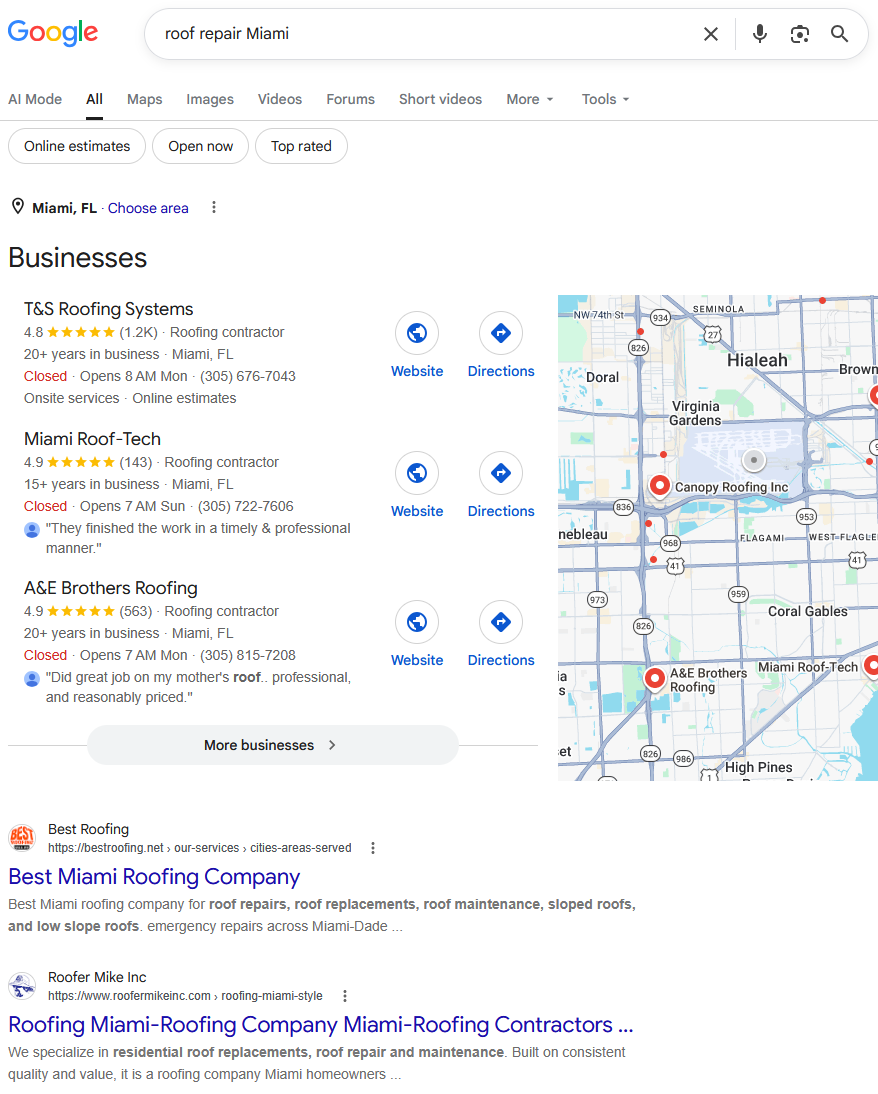
Imagine a homeowner in Miami needs a roof repair after a storm. They go to Google and search for “roof repair Miami.” The roofing companies that are doing local SEO the best are more likely to show up in the results. Here’s what that looks like:
Roofing SEO vs paid ads
Paid ads and SEO can both bring you roofing leads, but they work differently. Ads can put your company in front of homeowners quickly, which can be useful when you need leads now.
SEO, on the other hand, takes longer. You have to improve your website, service pages, Google Business Profile, and reviews over time. But once you start earning visibility, SEO can become a consistent source of leads without paying for every click.
You don’t have to pick just one option—you may get better results by using both for different jobs. Use paid ads when you need to capture immediate demand (like after a hail storm), while SEO works in the background to strengthen your long-term visibility on Google.
Organic results vs Google Maps
When a homeowner searches for a roofer, Google can send them to your website through the list of search results (known as organic results) or by showing your company in the Google Maps results.
Organic and map results work together, but they play different roles:
- Organic results send homeowners to your website, where customers get information about your business that convinces them to contact you. They can look at your services, experience, project photos, and service areas before requesting an estimate.
- Google Maps can capture a homeowner who searches for a roofer nearby and wants to make a call right away. Map listings (populated by Google Business Profiles) highlight your business information, such as your phone number, hours, reviews, and location.
Why local intent matters for roofers
When a homeowner searches for a roofer, they often want someone who can inspect the roof and give a quote. That’s why local intent matters so much for roofing SEO.
Think about the difference between the searches “how long does a roof last?” and “roof repair in Miami.” The first search comes from someone doing research, which is informational intent. The second comes from someone who’s close to calling, which is commercial or transactional intent.
You don’t need to rank for every roofing keyword, and not all of them will lead to new business. Instead, focus on keywords related to the cities and service areas you can serve profitably.
[SEO] can not only help grow your business into one specific area, but if you’re trying to cover multiple communities… you’re going to be able to get potential customers in all those different areas.

How can SEO help roofing companies?
If your company depends on storm season or paid ads to keep the phones ringing, SEO can give you another way to get in front of homeowners. SEO for roofers makes your company easier to find when people in your service area are actively searching for roof help.
A homeowner searching for “roof repair near me” already has a problem they want to solve. Your job is to show up at that moment and give them a clear reason to call.
SEO as a consistent roofing lead source takes time to build. But you won’t be paying for ads or waiting around for referrals to come in. Over time, your website and Google Business Profile can keep you visible for relevant searches.
Realistic timeline and expectations
Roofing SEO is an investment that takes months rather than days. It often takes 3–6 months to see results. It might take longer depending on market competition, your current Google visibility, website condition, review profile, and service areas.
If someone tells you that you can see results almost overnight, be skeptical. SEO has a lot of moving parts, and the work often starts with fixing the basics before you can expect meaningful growth.
When you set up SEO, it may take three months to have a website rank, but once it’s ranking, you’re good. That initial spend saves you money in the long run.

Common disadvantages
Knowing the tradeoffs of SEO upfront helps you set realistic expectations and choose the right approach to move your business forward.
| Common disadvantage | What to do |
|---|---|
| SEO takes months to build meaningful visibility | If you need leads right away, start SEO while leaning on paid ads, referrals, or selling to past customers. |
| Competitive roofing markets can make it harder to gain visibility | Start with your highest-value roofing services and target cities. Then strengthen your Google Business Profile, reviews, and service pages. |
| SEO requires time, budget, and effort from your company | Decide what your team can handle—such as sharing project photos and responding to leads—and what you want an SEO partner to manage. |
| Rankings and website traffic don’t automatically turn into roofing jobs | Track calls, response times, booked estimates, close rates, and revenue. If you’re missing leads or being slow to follow up, fix those problems before spending more time trying to increase website traffic. |
| Google results and competitor activity can change over time | Review your performance on a regular basis. Pay attention to your priority service areas and keep working to improve. SEO is an ongoing process. |
Local SEO for roofers
For most roofing companies, local SEO is the place to start. Homeowners usually want someone who can come to their property, inspect the roof, and provide an estimate. Showing up in local search results can put your company in front of people who are ready to hire a roofer.
Start with the local signals that shape visibility and trust, helping your business show up higher in search results and attracting visitors to your Google Business Profile:
- Your Google Business Profile should accurately represent your company.
- Your business information (name, contact details, address, hours) should be consistent across the web.
- Your reviews should show recent and honest feedback from customers.
- Your website should define your service areas, with unique pages for the cities and areas you serve.
Google Business Profile checklist
Make it easy for people to find your roofing business by claiming and verifying your free Google Business Profile (GBP). This ensures you appear prominently in organic results and Google Maps. When you’re building your profile, make sure to:
- Choose the most accurate primary category for your roofing company.
- Add relevant secondary categories for services you provide.
- Keep your business name, phone number, and website URL accurate and consistent.
- Keep your business hours up to date.
- Define your service areas.
- Add photos of your roofing team, trucks, and recently completed projects.
- List core services, such as roof repair, roof replacement, inspections, storm damage roofing, and commercial roofing.
- Use GBP posts to highlight recent projects and company updates.
- Use Q&A to address common homeowner questions and clarify which roofing services and areas you serve.
Reviews help close jobs
Recent reviews prove that your roofing company is active, and they’re a quick way for potential customers to judge whether they can trust you. Seeing recent feedback from other customers can make their decision a little easier.
Here’s how to encourage reviews and use them to win new work:
- Ask satisfied customers for a review. Use Jobber Reviews to send the request shortly after the job is complete, while the experience is still fresh in their mind.
- Make reviewing easy. Send a direct link to your Google review page by text or email so the customer can pick the most convenient option.
- Keep the reviews coming. Aim for a steady flow of reviews instead of collecting a bunch at once and then going quiet.
- Respond to every review. Thank customers who leave positive feedback and respond professionally to negative reviews.
Citations and consistent NAP
NAP stands for name, address, and phone number—the basic details that identify your roofing company. Keeping those details consistent helps Google and homeowners understand that the listings they find all belong to the same business.
Start by checking the places where your company already appears:
- Major directories: Look for outdated business information, old phone numbers, or duplicate listings.
- Social profiles: Make sure your company NAP matches your current details.
- Local chamber listings: If your roofing company belongs to a local chamber, review its business listing for accuracy.
- Supplier listings: Roofing manufacturers, distributors, and other industry partners may have your company listed. Update any outdated information you find.
- Lead platforms: Look for old contact information or duplicate profiles on sites where homeowners can find contractors.
Service area and city pages
If you service multiple geographic areas, having dedicated location pages is great for local SEO. It boosts your visibility in search engine results and helps potential customers in those locations find you.
For example, if you serve South Florida, you might create a page focused on roof repair in Miami, and another for a different city where your crews regularly work. These pages can help connect your services with homeowners searching in those markets.
If you’re just starting out with SEO, there’s these things called service area pages.
If you’re in a specific city, but you also service maybe 10 or 20 other cities around you, you can create service area pages for each city that you serve.

Before creating a page, search Google for terms like “roof repair Miami” and “roof replacement Miami.” Look at the pages and businesses appearing near the top of the results.
What information do they provide? Which questions do they answer? Could your company show better, more relevant expertise?
For a Miami roofing page, useful information might include:
- Roofing services: Explain the specific services you offer in Miami, such as repairs, replacements, inspections, and storm-damage work.
- Your process: Describe what happens from the initial call and inspection through the estimate and completed job.
- Pricing factors: Mention the factors that can affect roofing costs without making up generic prices.
- Service coverage: Identify the Miami neighborhoods or nearby areas you serve.
- Local experience: Highlight relevant experience, certifications, or licensing.
- Customer reviews: Feature a couple snippets of feedback from customers in the area.
- Project photos: Show real roofing projects your company has completed in Miami.
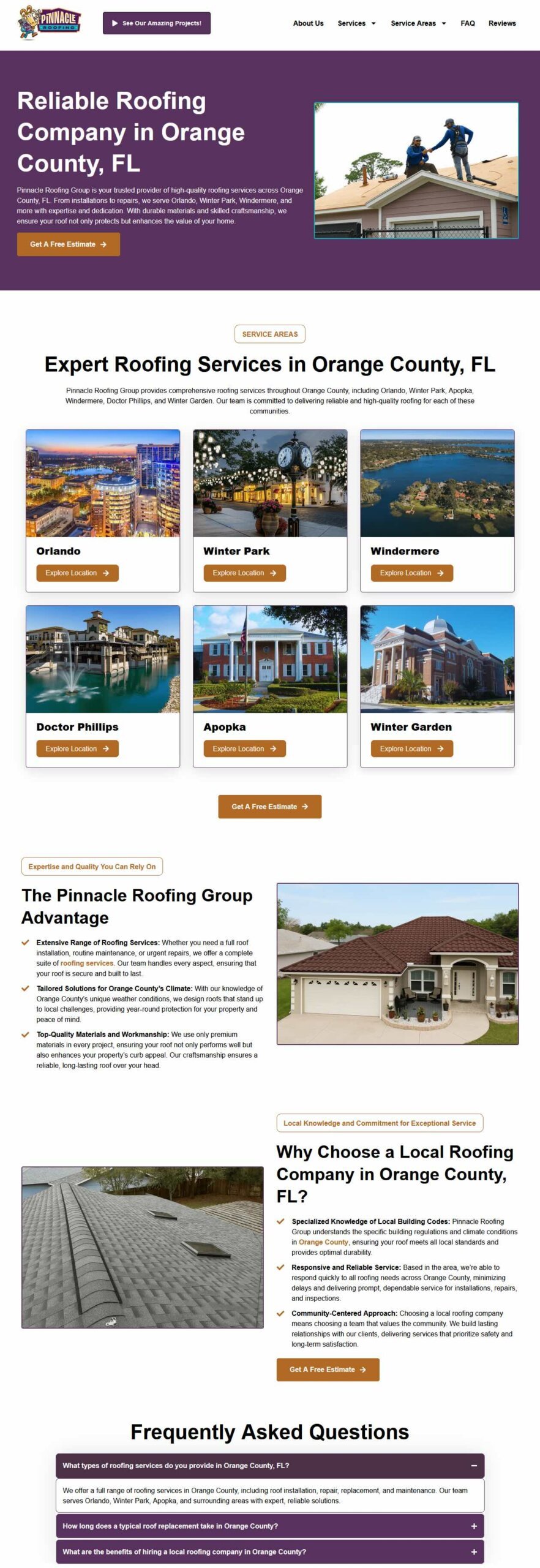
As an example, Pinnacle Roofing has a service area page for Orange County, FL (as well as pages for other areas). It features many of the bullet points above:
Roofing website SEO essentials
Your roofing website needs to help homeowners understand what you do, where you work, and how to take the next step. That’s the foundation of SEO for roofers.
When someone finds your business in search results, they need to understand the roofing services you offer, the cities and areas you serve, and how someone can request a quote or get an inspection.
Service pages that match how customers search
Not every customer looking for roofing services is simply going to search “roofing company”—they might need help with a specific problem. They’ll use search terms like:
- “roof repair”
- “roof replacement”
- “roofing inspection”
- “roofing emergency”
That’s why you should create a page for each service you offer. This will increase your online visibility and help people find your website when they’re searching for a specific roofing service.
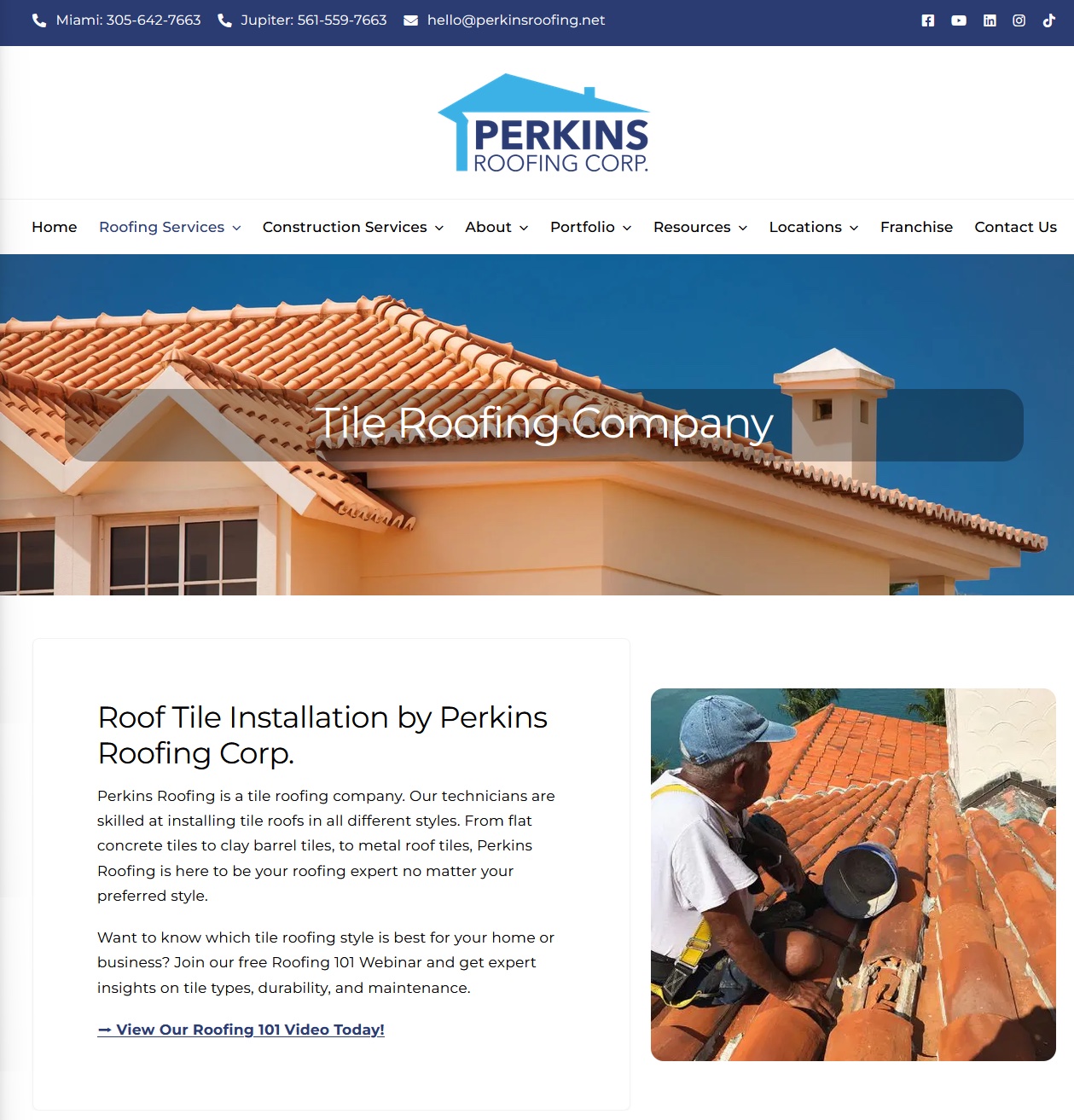
For example, potential clients who search “tile roof repair Miami” will find Perkins Roof Corp’s tile roof page:
On-page basics
You don’t need to rebuild every page from scratch, but pay attention to how each page is set up. Start with the basics and make it easy for search engines and customers to understand what the page is about.
- Write a descriptive page title tag. The title tag appears as the clickable headline in Google search results. State the primary roofing service and the city or service area. For example, a page targeting the term “roof repair in Miami” should include that in the title tag.
- Write a useful meta description. The meta description is a short summary of the page. Iit may appear below its title as a text snippet in Google results. Summarize the service and location. Give people a reason to click your listing in search results.
- Use a main heading (H1). The H1 is the main heading on the page, telling visitors what the page is about. Use it to reinforce the page’s primary service and location.
- Use descriptive secondary headings (H2s). H2s are the subheadings that break a page into sections. Use them to organize the page around questions homeowners are likely to have, such as what the service includes, when they need it, what the process looks like, and what happens next.
- Link related pages together. Internal links are links from one page to another on your website. Use them to help visitors find the next piece of information they need. For example, a roof repair page might link to the storm damage repair page.
Trust and proof
A homeowner wants to know if you can fix their roof, but they’re also wondering whether they can trust your business. Your website should address those concerns.
- Show your credentials. Display your roofing license, roofing business insurance, certifications, and warranty information where applicable.
- Display your work. Add before-and-after photos, project galleries, and brief case studies that show the types of roofing jobs your crew does.
- Feature customer reviews. Add relevant reviews to service pages. Reviews that mention the specific service or local area can give context to prospective customers.
- Identify the business clearly. Keep your business name and phone number consistent throughout the site. State your service areas on relevant pages.
Mobile, speed, and click-to-call UX
73% of consumers say their most recent local business search started on a mobile phone. That makes mobile usability an important part of technical SEO, which helps you turn search visibility into leads.
Follow these tips to ensure your site appears properly on smaller screen sizes:
- Design for mobile first. Make sure your site is easy to read and navigate on a phone. Visitors should be able to find your services, service areas, and contact options without needing to zoom or endlessly click around.
- Keep your phone number visible. Make the number clickable everywhere on the site. Use calls-to-action (CTAs) like “Call now” or “Request an estimate” near the top of important pages.
- Keep forms short. Only ask for the most necessary information you need to follow up with the lead. You can use 1–7 form fields, but the conversion rate drops off with eight or more. The fewer fields to fill out, the better.
- Speed up slow pages. Large project photos look great but can slow down page speeds. Compress images and avoid any heavy website features like pop-ups.
Make sure that the website is displaying well on desktop, but also fits on a smartphone or tablet where users can scroll down and look at the content.
Keyword research for roofing companies
To improve your website’s online visibility at the top of search engine results, you’ll need to do keyword research. This involves figuring out the roofing-specific search terms that your ideal customers type into search engines when they’re searching for your services.
Here’s how to find out what local keywords your roofing business should be targeting:
- Start with what you already know. List the work you do, like “roof installation” and “shingle repair.” These are your core service keywords. Just make sure to use the same phrasing your customers use.
- Add the places you serve. Tack on your service area to arrive at keywords like “gutter repair in [city A]” and “[city B] roofing contractor.”
- Use Google Autocomplete for ideas. Start typing a roofing search into Google and see what suggestions appear. Try combinations of your services and locations. For example, typing “roof repair Miami” might present related searches you hadn’t considered.
- Use keyword tools. Enter these ideas into tools like Google Keyword Planner, Ubersuggest, or even the free version of Ahrefs. These tools show how often people are searching for your terms, and might spark ideas you hadn’t thought of, like “asphalt roof leak fix.”
- Spy on the competition. Look at the top roofing companies in your area. What roofing phrases do they use on their homepage and service pages? If you keep seeing the same terms, you might want to use them, too.
- Think about what the customer really wants. Someone Googling “roofing material types” is probably doing research and not ready to talk to you yet, but someone searching “roof replacement [city]” is. Try to match your content to where the customer is in the decision-making process.
- Prioritize your list. After you compile your list of keywords, pick the ones that are most likely to lead to jobs. Go with a mix—some short and broad, and others long and specific. That way, your site has the potential to get traffic from all different types of search terms.
- Give each page one primary keyword. Choose one term that best fits the purpose of the page. Then use related terms where they make sense. Don’t try to stuff every possible roofing keyword onto every page.
Local + service keyword patterns
A basic local search keyword list for a roofing company in Miami might look like this:
hurricane roof inspection Miami
- Miami roof inspection
- Miami tile roofing company
- roof leak repair Miami
- roof replacement Miami
For a roofing company in Denver, on the other hand, the keyword list might look different based on the services and search demand in that market:
- Denver metal roofing company
- Denver roof inspection
- hail damage roofer Denver
- ice damage repair Denver
- roof replacement Denver
These are just examples to help you get started. But once you’re done with the SEO basics of keyword research, you’ll have a list of terms that you can target on your website.
Get into your specific niches and you can see what the search volume is there.
It’s little subtleties like, maybe you call it “service,” but “maintenance” gets searched 60 more times a month… Now you have straight-up objective data that this is the right thing to do.

Informational vs commercial vs transactional intent
Separate your keyword targeting by what the homeowner is trying to do. Each page should support the right stage of the buying process.
| Search intent | Homeowner goal | Pages to create | Keyword examples |
|---|---|---|---|
| Informational | Understand a roofing problem or learn about options | Educational guides and FAQs that link to relevant services | • “Signs you need a new roof” • “How long does a roof last” • “How to spot a roof leak” |
| Commercial | Compare costs, materials, contractors, or solutions before choosing a roofer | Comparison and cost pages | • “Roof replacement cost” • “Metal vs asphalt shingles” • “Roof repair vs replacement” |
| Transactional | Contact or hire a local roofer | Service pages and service area pages | • “Roof repair [city]” • “Emergency roofer near me” • “Roof replacement [city]” |
Pro Tip: Prioritize your transactional pages because those will help generate leads. Then use commercial and informational content to build trust.
Content that supports roofing SEO
Potential customers need information that helps them understand their roofing problem and compare their options.
For roofer SEO, focus on the types of content that support your core services and answer questions that homeowners often have. Consider these formats:
- Service FAQs: Answer common questions about roof repair, replacement, inspections, storm damage, and warranties.
- Storm prep guides: Help homeowners prepare for severe weather and know what damage to look for after a storm.
- Material explainers: Compare roofing materials and explain the differences. Help homeowners understand which factors may affect their choice.
- Process pages: Explain what happens during an inspection, repair, or replacement so customers know what to expect.
- Project case studies: Show off roofing projects you’ve completed. Include details about the problem, work performed, and end result.
You can create a case study about Forest Lakes. Maybe you did a new roof in Forest Lakes, and then you can share what the problem was that the customer had, the unique solution that you put together. Maybe a review from the customer, and then the ultimate outcome.
Internal linking within your site
Internal links help site visitors move from finding answers to taking action. They also help search engines understand how the pages on your site relate to each other. The trick is to make the links useful. Here’s how:
- Link informational content to commercial and transactional pages. If you publish a guide about the signs that a homeowner needs roof repair, include a link to your roof repair service page.
- Connect related roofing services. Link relevant pages so visitors can move naturally between repair, replacement, and storm damage services.
- Use descriptive link text. Tell readers what they’ll find when they click a link. A phrase like “schedule a roof inspection” provides more information than “click here.”
- Keep important pages easy to reach. Link to service and service area pages in your main navigation and from relevant supporting content. It should be easy to find links to important pages without needing to hunt around.
- Link where the next step makes sense. A potential customer reading about storm damage may need an inspection, so link to your inspection page next.
Here’s an example of good internal linking from Black Stone Roofing. Their web design includes a dedicated page for each of their services. Their site links to these in the main navigation, and there are CTA blocks on the homepage, too.

Off-site SEO and authority
Your website isn’t the only thing that affects your roofing SEO. Google can also find information about your roofing company on other sites.
The goal is to build a credible online presence, supported by other websites linking to yours. The safest link building opportunities usually come from real-world relationships, so look for these types of opportunities:
- Join relevant trade associations. If the organization has a member directory or profile, make sure your company information is accurate.
- Build supplier relationships. Ask suppliers or manufacturers you work with if they feature local contractors or project spotlights on their websites.
- Support local events. Community event sponsorships can sometimes lead to a business listing or a mention on the online event page.
- Share noteworthy projects. A unique roofing project may be worth pitching to a local publication or community organization.
- Keep existing listings accurate. Review major directories, industry platforms, social profiles, and local organization pages for outdated information or duplicate listings.
Be careful with shortcuts. Don’t buy backlinks, use private blog networks, or hire a vendor that can’t explain where your links will come from. Never buy or fabricate Google reviews. Instead, consistently ask customers for reviews after completed jobs.
How to get found in AI searches
Between Google’s AI Overviews and LLMs (large language models) like ChatGPT, potential customers are getting answers to their roofing questions without clicking to any other websites. That means your business needs to show up in front of your customers in AI answers.
Fortunately, many of the same signals that help you rank locally also help AI tools mention your business. Here are some of the basics to help your business get mentioned in AI search results:
- Add “LocalBusiness” schema markup to your site. This structured data tells search engines exactly who you are, including your business name, phone number, and service area.
- Include important info on your homepage. Spell out what services you offer, define your service area, and clearly display your contact information.
- Take advantage of your footer. Your footer should reinforce your brand, services, and locations. Footer information is picked up by LLMs and can influence visibility, so include key details you want LLMs to know.
- Offer helpful information. Share useful information that influences customer decision-making, like service details, pricing, and timelines. Google’s ranking systems reward content that adds something new—not the same advice every competitor offers.
- Build out FAQs. You’ve probably answered the same questions for customers many times over. And many people using AI are using it to ask questions. Add FAQs to service pages to provide these answers in the context of your services.
- Structure your content. Formatting helps people and LLMs read your content. Use headings and short sections so the content is easy to scan. Use bullet points and numbered lists when appropriate, as these types of formatting account for 30% of AI citations.
AI search is changing how homeowners find and hire local service pros. Watch the full session below to hear how Kasy Allen and the Wheatley Creek Services team improve visibility in AI-powered search results:
DIY vs hiring a roofing SEO agency
The right choice between doing SEO yourself and hiring an agency will depend on whether your company has the time and expertise to do the work. Consider comparison points like the ones below:
| Decision factor | When DIY SEO works | When to hire an SEO agency |
|---|---|---|
| Skills | Your team can manage your Google Business Profile, website pages, reviews, and basic reporting. | No one on your team has the time or confidence to manage SEO, and you want a specialist to handle the work. |
| Time | You can consistently work on service pages, project photos, reviews, listings, and performance checks. | Your team is busy estimating, scheduling, and serving customers, so SEO tasks aren’t a high priority. |
| Budget | You have more time than money and can start with the basics. | You have a budget for ongoing SEO work and want to reduce the trial-and-error that comes with doing it yourself. |
| Market competition | You serve a smaller or less competitive market where doing the fundamentals of SEO may be enough. | You compete with established roofers that already have a lot of reviews, a strong website, and search visibility. |
| Website condition | Your website is modern, mobile-friendly, and already has service and service area pages. | Your website is outdated, missing important service pages, or not set up to turn visitors into leads. |
| Risk and accountability | You’re comfortable learning SEO as you go. You accept that results won’t come right away. | You want a defined strategy, reporting that shows SEO is working, and an experienced partner who can explain what needs to change. |
| Best middle ground | You handle customer reviews, project photos, service details, and following up with leads. | An agency handles strategy, page optimization, and competitive analysis while your team provides the roofing expertise. |
What to ask a roofing SEO company before you sign
Hiring an agency shouldn’t feel like handing over the keys and hoping they know what they’re doing. You don’t need to become an SEO expert, but you should ask a few questions before signing a contract:
| What to ask | Answers to look for |
|---|---|
| What will you improve in the first 90 days? | Look for a plan that covers your Google Business Profile, service pages, technical issues, and tracking. Be wary of any strategy that only focuses on improving your rankings. |
| How will you decide which services and cities to target? | The answer should account for your job margins, crew coverage, local competition, and lead goals. A generic list of keywords isn’t enough—the best targets are the ones that make sense for your specific business. |
| Who will do the work, and what work will be done each month? | Find out who handles strategy, content, technical SEO, local listing management, reporting, and link building. Ask which work will be handled by the agency. |
| How will you measure success? | Reporting should connect SEO efforts to qualified calls and form leads at minimum. Close rates and revenue are also helpful when the data is available. Rankings and traffic can provide context, but they aren’t the end goal. |
| How will you track calls and form leads? | Get the tracking plan sorted out before the SEO work begins. Otherwise, you may have a hard time telling which leads came from organic search vs. other channels (paid, referral, etc.). |
| What do you need from our team? | The provider should be upfront about your role in the SEO engagement. You’ll probably need to supply them with service details, project examples, job photos, and audience information. |
| What happens if we stop working together? | Confirm your company keeps ownership and access to its website, Google Business Profile, analytics, content, and listings. Don’t start a business relationship without understanding what you own when you no longer work with the agency. |
Red flags
When you’re choosing an SEO partner, it’s important to pick the right one. Look for a roofing SEO company that will create a custom strategy for your business, and watch for these red flags:
- Guaranteed #1 rankings or a specific number of leads: It sounds great to hear “we’ll get you to #1.” But no one can control Google’s rankings since they vary based on factors like location, competition, and query. The same goes for guaranteeing a certain number of leads—no agency can control how many people call or hire you.
- Vague answers about the work: An agency needs to have a clearly defined plan of what they intend to change on your website or how they’ll manage your Google Business Profile. If they can’t, you may not get good SEO work for your money.
- Reports focused only on rankings and traffic: Seeing your roofing company move up in Google results is reassuring, but rankings and traffic aren’t the end goal. Your reporting should connect SEO to the calls and leads you get.
- No clear local SEO strategy: Your agency should be able to explain how they plan to improve your search visibility in the cities you serve. That includes your Google Business Profile, target keywords, and website content.
- A one-size-fits-all package: Your business might specialize in repairs while a competitor focuses on replacements. Or you might have plenty of capacity in one city but no room for more work in another. If the agency never asks about the specifics, they could be applying the same approach to every client—and that often doesn’t work.
- Shortcuts that put your reputation at risk: Be cautious if an agency recommends risky tactics like buying reviews or large volumes of backlinks. Your website and Google Business Profile are part of your reputation, so any tactic that seems like a shortcut could just create problems that lead to Google penalties.
- The agency controls your important accounts: You should have access to your website hosting, Google Analytics, Google Search Console, call tracking platform, and other accounts tied to your online presence.
How to measure roofing SEO results
Traffic and rankings can tell you whether your visibility is changing, but they don’t tell you if the SEO work is getting you leads. Focus on these metrics that follow the customer from Google search to making a call or becoming a lead.
- Google Business Profile insights: These show how people interact with your profile, such as calls and website visits. Watch the trends over time to see if your local presence is getting more attention.
- Website traffic: This measures visits to your site from unpaid Google search results. More organic traffic indicates that more people are finding your site. Look at which pages (e.g. services, locations) attract visitors who take the next step.
- Phone calls: Track calls that come from your Google Business Profile or SEO-driven landing pages. This is one of the best signs that SEO is bringing you opportunities.
- Form submissions: Track how many organic visitors submit a contact form or estimate request. If organic traffic is increasing but form submissions aren’t, you might not be targeting the right keywords that turn visitors into leads.
- Booked estimates: A lead is only useful if it moves toward a job. Track how many calls and form submissions turn into scheduled estimates. This helps you see whether the leads coming from Google are worth pursuing.
- Close rate: Calculate the percentage of estimates from organic users that turn into jobs. A lower volume of qualified leads may be more valuable than a large number of tire kickers.
- Revenue: Track the revenue tied to leads that came through organic search or Google Maps. This connects SEO to how much work it brings to your business.
- Cost per qualified lead: If you know what you’re spending on SEO and how many qualified leads it generates, you can compare the cost of those leads with other channels (Google Ads, referrals, etc.).
I look at our numbers on a monthly basis. 50–60% of the traffic that comes to our website is all organic SEO.
If your roofing SEO still isn’t working
If you’ve been investing in SEO and you’re still not getting any leads, there’s an issue with your website, off-site presence, or lead management process. Work through this checklist to figure out where the problem is:
- Check your Google Business Profile. Make sure it’s complete and verified. Your core services, hours, phone number, website, and actual service area should all be current.
- Look at your latest reviews. Is there a steady flow of recent customer reviews? If you aren’t getting new reviews regularly, create a process for requesting a review from every satisfied customer.
- Audit your service pages. Each page should focus on a specific service that explains what you do, shows proof of your work, and makes it easy for people to reach you.
- Review the keywords you’re targeting. Prioritize roofing searches with buying intent, such as “roof repair [city]” or “roof replacement company.” Educational content (like “types of roofs”) can support your SEO strategy, but they often don’t lead to roofing jobs.
- Test your website’s mobile experience. Explore your site on a phone and try to become a lead. Do the pages load quickly? Do buttons work? Can you complete the contact form? If not, you’ll need to update the site.
- Audit what happens after a lead comes in. Track missed calls, response times, and close rates. If qualified leads are coming in, make sure your team is following up quickly and turning them into customers.
- Review your agency’s work. If you’re working with an SEO company, ask for a list of what tasks they’ve completed, what has changed (on your site, on GBP, etc.), and which services and markets they’re targeting.
How roofing SEO fits your growth plan
SEO works best when you treat it as just one of your dependable lead channels—not the only one that keeps you afloat. Other channels like paid ads, customer referrals, and community partnerships can all play a role and provide ways for homeowners to find you.
When you build a strong presence in Google Search and Maps, this can passively bring a steady flow of leads at all times. SEO won’t eliminate the ups and downs of lead generation, but it’s a good foundation to lean on.
If you invest in SEO, you could have potential customers coming into your website whether it’s day, night, or the weekend, even in slow periods when you’re looking for more business.
Your SEO priorities should also match your goals for growing the business. If roof replacements are your most profitable jobs, put more emphasis on that service. If your crews are already booked solid in one city, devote more time to building visibility in other nearby areas.
Start competing online with roofing SEO
Search engines level the playing field for roofers. You don’t need a large digital marketing budget to compete with bigger competitors—just a solid SEO strategy and a commitment to improving your online presence.
Remember that SEO doesn’t work overnight. It takes time to see results, but the outcome is worth the effort. Keep at it, and you’ll be getting more roofing leads in no time.
Frequently Asked Questions
-
Roofing SEO typically takes 3–6 months to build meaningful progress, but your timeline will depend on your current online visibility, market competition, the state of your website, and how many reviews you have.
Start by updating your Google Business Profile and the service pages on your website. You should also make a point of requesting a Google review from every satisfied customer. Then measure your progress over time by tracking:
• Keyword rankings
• Website traffic
• Phone calls
• Quote requests
• Booked jobs -
SEO builds unpaid, organic visibility in Google Search and Maps over time. It takes longer to see results but can become a more reliable source of leads. Google Ads, on the other hand, pays for prominent placement. Ads can generate leads faster, but that source typically stops when you run out of budget to keep the ads going.
Many roofing companies use both channels—ads for capturing immediate demand (like during and after storms) and SEO for long-term visibility. -
Yes. Your Google Business Profile can help generate calls and map visibility, but your website gives homeowners more information to evaluate your company. A website also gives you more control over your online presence and lets you provide more details about the business, like:
• Services
• Service areas
• Pricing packages
• Customer reviews
• Project photos
• Certifications and credentials -
Roofing SEO costs vary based on your market, starting point, goals, and services. A competitive urban area might require more ongoing SEO work than a smaller region. You can also expect to pay more if your website needs to be rebuilt from scratch, or if you’re getting multiple SEO services like:
• Technical fixes
• Content development
• Local listing management
• Review responses
• Link building
• Conversion optimization
• Reporting -
Yes. Doing SEO yourself can be a good starting point if your team has the bandwidth to:
• Handle Google Business Profile optimization
• Request reviews from customers
• Add project photos to your website and third-party listings
• Improve website content
• Track leads
Consider outsourcing to a specialist or agency if the work keeps getting pushed aside or you need a better strategy to get the results you want. A hybrid approach can also work well, with your team providing photos, reviews, and roofing expertise while an SEO partner handles strategy and optimization. -
Local SEO helps your roofing company appear when people search Google for roofing services—especially in Google Maps listings, which can appear at the top of search results for localized queries.
Local SEO focuses on your:
• Google Business Profile
• Customer reviews
• Business information
• Service area pages
• Local mentions
The goal is to generate calls and quote requests in the cities and neighborhoods you can serve profitably. You don’t need to rank everywhere—just in the areas you operate.