How to Grow Your Roofing Business: Strategies That Scale Crews and Revenue

Key takeaways:
Growing your roofing business means putting the right systems in place to boost revenue, scale your crews, and stay profitable while maintaining quality.
- Define what growth means for your business. Focus on building a steady pipeline, maintaining healthy profit margins, and knowing when your operations and systems are ready to take on more work and additional crews.
- Create consistent demand with smart marketing. Use a mix of online presence, referral programs, local advertising, and well-timed campaigns—especially during storm season—to ensure a predictable flow of qualified roofing leads.
- Streamline estimating and sales processes. Improve your close rates by delivering fast, easy-to-understand proposals and following up with clients. Differentiate your approach for replacements versus repairs and offer customer-friendly options like financing.
- Scale teams without losing quality or efficiency. Hire strategically based on operational bottlenecks, implement training and clear checklists, and standardize scheduling and dispatch to maximize productivity while ensuring safety and consistency across crews.
- Protect your cash flow and stay organized with software. Use business management tools to track leads, manage projects, schedule jobs, invoice efficiently, and keep customer communication clear—all of which help you grow without chaos.
For more expert tips on building a thriving service business, sign up for the Jobber Newsletter.
At some point, every successful roofing company reaches a stage where adding another crew or taking on more work will require better systems. That means tightening up your sales process, creating a steady pipeline of work, and hiring at the right time.
In this guide, you’ll learn how to grow your roofing business. Get strategies for building a predictable flow of jobs, improving estimating and close rates, protecting cash flow, and using software to stay organized.
How to grow a roofing company:
-
Know what “growth” means for your roofing company
-
Build a predictable pipeline of roofing jobs
-
Improve estimating, sales, and close rates
-
Scale crews without breaking quality or safety
-
Protect your cash flow as your roofing business grows
-
Use software to grow without adding chaos
-
Mistakes that stall roofing business growth
Know what “growth” means for your roofing company
Growth involves both getting more leads and building a business that can handle more work while maintaining quality. Before you start chasing bigger numbers, know what roofing business growth strategies are right for your company.
Revenue vs capacity vs margin
It’s great if your business brings in more revenue and increases capacity, but the company can only grow if you’re maintaining a healthy profit margin. Here’s why:
- Capacity can become a cash leak. The moment you add a second or third crew, your fixed overhead costs increase. For example, you’ll likely need more tools and another truck. And if your lead flow can’t keep your expanded crew busy, the idle time starts bleeding your cash reserves.
- Owners often underestimate working capital. This field eats cash up front for necessities like roofing materials, labor, and permit fees. Revenue from customers might not catch up right away.
Margin is the real growth engine. Gross margin—money available after job costs—helps pay for a dedicated salesperson, a project manager, better marketing, and roofing business software. Aim for a 35–40% gross margin to give the business room to breathe.
Signs you’re ready to scale
You might be ready to scale a roofing business if you’re noticing signs like these:
- You have a backlog. Several weeks of signed work are lined up, giving you enough demand to plan ahead instead of scrambling to fill the next week.
- Leads are coming in faster than you can keep up. You don’t have enough room in the schedule to book everyone, putting potential jobs at risk.
- Your crews can perform without you. A dependable foreman can run a tear-off and re-roof to your standards without you being on-site all day.
- Your business needs systems. Estimates, roofing materials, scheduling, and customer updates need repeatable processes instead of relying on memory or last-minute fixes.
- There’s a bottleneck with the business owner. You’re handling sales, crews, estimates, and invoices yourself. Your limited time is now limiting company growth.
A lot of times the leader is the bottleneck in the business, and they were the person that was driving every decision and pushing everything to happen.
They’ve got to come to a point where they’re ready to accept that they can let things go and delegate those things to other people.

Pick a growth stage focus
When you’re looking to grow your business, it’s tempting to try to fix all your problems at once. But that just isn’t possible. Instead, focus on one growth area, like:
- Getting more leads: Get the phone ringing with local SEO, Google Local Services Ads, more consistent roofing marketing, and even door knocking.
- Improving your close rate: Win more work with sales training, faster speed-to-lead time, stronger presentations, and better insurance negotiation.
- Hiring more crews: Increase production capacity with new crews, subcontractor networks, or another project manager.
Pick one bottleneck that’s holding the business back and deal with that first.
Build a predictable pipeline of roofing jobs
Your company’s growth depends on having a steady stream of potential clients. Use the marketing tactics below to create a pipeline and keep quality roofing leads coming in.
Automate referral and review requests
The best time to ask for a review or referral is right after the job is done. You can automate this process to save time and ensure you always remember to send the request.
With Jobber, you can set up automatic review requests that send when the job is completed. That catches people when the job still feels fresh and the house looks sharp. The follow-up happens every time—even when the project manager or office team is swamped.
A simple referral program can also work well when it’s built into the closeout sequence. Jobber makes it easy to promote your referral program to customers with a professional, automated email campaign that’s ready to send in seconds flat.
READ MORE: Brilliant customer referral program ideas (with examples)
Improve your local digital presence
When homeowners need a new roof, they’ll probably search online, compare a few roofing businesses, and contact the ones that inspire confidence. That means your online presence has to convince people you’re the right choice. Try these tips for showing up online.
Turn your Google Business Profile into your digital storefront
For many people, your Google Business Profile will be their first impression of your business. Here’s an example of what the profile listing looks like:
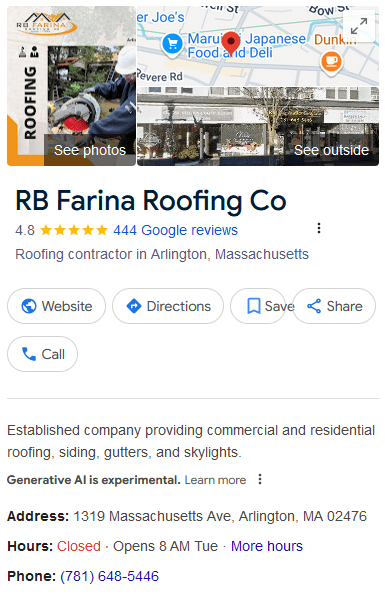
Fill out every relevant service category, upload before-and-after photos from recent jobs, and mention the town or neighborhood where each project was completed. That way, prospective customers can see the kind of roofing services you provide in their area.
You should also keep your hours and contact information up to date. Make a habit of responding to reviews, with special emphasis on the negative ones to resolve issues. Responding shows that you value customer feedback.
Build service pages that lead with proof
Instead of stuffing your website with generic sales copy, create a dedicated page for each of your services. This will increase your online visibility and help people find your site when they’re searching for a specific roofing service.
Include the following on your service pages:
- Customer reviews and video testimonials
- Before-and-after project photos
- Roofing license and insurance information
- Roofing warranty details written in a way that’s easy to understand
- A simple way to request a quote or inspection
The easier you make it for someone to trust you, the easier it’ll be to earn more business.
If you’re just starting out with SEO, there’s these things called service area pages.
If you’re in a specific city, but you also service maybe 10 or 20 other cities around you, you can create service area pages for each city that you serve.

Consider running Local Services Ads
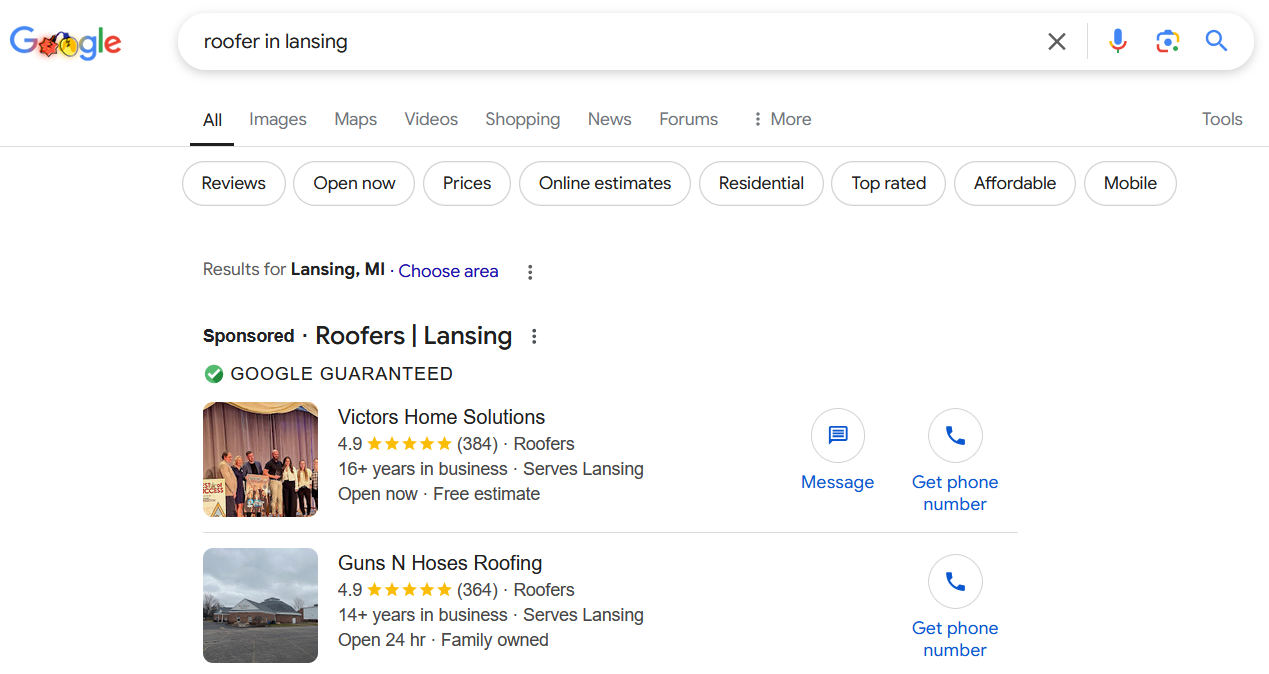
Google’s Local Services Ads (LSAs) target potential customers within the service area you define in the platform. Your ad appears at the top of Google’s search results page and lets people book an appointment with you, right from the ad.
The ad highlights your business name, star rating, and a Google Guaranteed badge, instantly building trust with a potential customer. Unlike other Google ads, LSAs only charge for leads. That means you only pay when someone contacts your business through the ad.
Build a marketing plan for storm-season demand
When stormy weather hits, roofs will leak and customers will start calling you for repairs. A smart approach to storm work is to build your response playbook before the first big storm hits. Here’s what that playbook should include:
- Send the ground team first. Move your trained canvassing crew into the affected neighborhoods right away. That team should know how to talk to homeowners, offer free inspections, and explain how they could submit an insurance claim to offset the costs.
- Balance storm work with retail work. Storm jobs can bring you revenue fast, but retail work will keep your business from stalling. A roofing company that keeps a strong retail base has more control over cash flow and production planning.
- Position your brand as the local guide. This is where digital marketing for roofers really starts to matter. Your ads, website copy, and social media posts should teach people how deductibles work and how claims move through the carrier process.
You can’t [show a homeowner a problem] unless you’ve built some sort of trust. Otherwise, people aren’t even going to open the door for you.
And that has to do with marketing—your Google Ads, reviews, and all those things.

That same message should carry across your other marketing efforts, too. Your roofing website can back up your storm-season push by making it easy for homeowners to understand what you do. Facebook ads help you stay visible in the specific neighborhoods you want to serve.
Improve estimating, sales, and close rates
Getting more roofing leads is a great start to growth, but it’s only half of the equation. To grow profitably, you also need a roofing sales process that produces accurate estimates and protects your margins. Here’s how to turn more of those leads into signed contracts.
Create faster bids and follow up
When a homeowner is comparing a few bids, the company that gets a clear proposal in front of them the fastest usually has the edge. Improve your chances of winning the work with these tips:
- Get the estimate out fast. The first contractor to deliver an estimate wins the job roughly 35–60% of the time. If you send the proposal within 24 hours, there’s a 50% chance you’ll win the job, even if you’re not the cheapest roofing contractor.
- Make the bid easy to understand. Create a clean digital proposal with photos from the inspection, roof measurements, good-better-best package tiers, and straightforward material choices like standard, architectural, and impact-resistant.
Good, better, best gives you an option to start bolting on, ‘Hey, we’re going to put a high-profile ridge on here. We’re going to put ice and water shield in your valleys and your eaves. But we can take that out if that’s too expensive for you.’
- Follow up more than once. It’s normal for roofing deals to not close on the first call, but don’t stop there. Send reminders over the next two weeks after you’ve sent the estimate. Mix text, email, and phone calls so you stay present, but don’t be annoying.
- Close while the job is still in front of them. Rather than just emailing the homeowner a PDF and hoping for the best, take them through the proposal in person. Or go over it with them on a short call to handle any questions or objections.
Roofing sales process for replacements vs repairs
A customer in need of a roof replacement knows it’s a big purchase. They’re thinking long term, so they’re willing to spend more. A repair customer, on the other hand, wants you to solve a problem fast.
Here’s how to approach these different conversations as a roofing business owner:
- Treat replacements and repairs like two different pitches. For replacements, the job is to sell the bigger picture, like protecting the home, improving curb appeal, and better energy efficiency. For repairs, the pitch is more immediate—fast response and stopping leaks.
- Use repairs as a gateway to replacements in the future. Minor repair calls are a great chance to run a diagnostic health check of the roof. Take photos and document the condition. Show the homeowner what’s going on now, and not just what you fixed. That way, when the roof eventually gets to the end of its life, your company is more likely to get a call for replacement.
- Avoid pricing repairs like handyman chores. Small leak fixes shouldn’t be billed like hourly labor. A repair still has overhead, like travel time, diagnostic work, and materials. Flat rates make the sales process easier to explain to customers than an hours estimate that might not be accurate.
- Use financing to make costs feel manageable. $15,000 for a new roof can feel intimidating when it’s presented as one big price. By offering financing, however, the conversation changes. By presenting a smaller monthly payment number alongside the total price, you can boost your close rate by 30–50%.
Improve your pricing strategy to increase margins
Winning more jobs feels good, but winning profitable jobs is what creates growth. If your estimates look competitive but you finish a roofing job without making a profit, the problem probably started during the estimate stage.
Follow these tips for pricing roofing jobs:
- Build estimates around real costs. It’s easy to account for labor and materials. The hard part is remembering everything that can eat into your margins. Build those costs into your estimates, which might include materials, labor, equipment, permits and inspections, and waste and disposal.
- Create a process for insurance work. Insurance jobs are more profitable when your estimators know how to document and negotiate supplemental items. Many roofing contractors prepare line-item estimates that support items such as code-required upgrades, ice and water shield, and steep roof charges.
- Set a pricing floor. There’s a point for your business where winning the job just isn’t worth it. Define the lowest margin you’re willing to accept and make it part of your sales process. Tie incentives for your salespeople more closely to gross margin dollars. This helps protect your profit margin while still rewarding strong sales performance.
- Review your estimating process. Material prices, labor costs, and disposal fees—they all change, so your estimating templates should change with them. Spending time managing job estimates and updating pricing on a regular basis is easier than explaining why a busy month somehow didn’t produce much profit.
Scale crews without breaking quality or safety
When adding crews and taking on more work, it’s critical to scale a roofing business without sacrificing quality or safety. Learn how to make the right hiring, field system, and scheduling decisions to keep your operation running smoothly.
When to hire (production vs sales vs office)
Instead of making hiring decisions based on instinct, watch for bottlenecks in the operations of your business. Those bottlenecks usually tell you what the next hire should be for.
| Hire | Signs it’s time | What the hire accomplishes |
|---|---|---|
| Office/admin | You or your production manager spend 10+ hours each week scheduling jobs, pulling permits, ordering materials, answering customer questions, or handling paperwork | Frees up leadership to focus on sales and growing the business instead of administrative work |
| Sales | No one has touched qualified leads for more than 24 hours, and site visits regularly take more than 48 hours to schedule | Improves response times and close rates, keeping opportunities from going to competitors |
| Production | Jobs consistently take 4–6 weeks of your crew’s capacity | Adds capacity without overloading your existing crew or affecting project timelines |
It’s easy to think of a new hire’s hourly wage as another expense. But if an admin assistant earning $20–$25 per hour can take 15 hours a week of admin time off your plate, that fees up time for you to close jobs.The return could outweigh the payroll cost.
Production hiring deserves the same discipline. Just because work spikes for a month, it doesn’t mean you need another crew. Determine whether the demand is consistent enough to keep another crew busy every month.
Many growing roofing companies use a hybrid approach:
- W-2 crews for repairs, specialty work, warranty calls, and customer-facing projects
- Vetted subcontractors to help with seasonal spikes and storm demand
Training, QC checklists, and crew lead accountability
Adding crews only helps your business grow if every crew completes roofing jobs the same way. This helps avoid quality issues and callbacks. You can keep quality high by focusing on these important areas:
| Focus area | What to implement | Why it matters |
|---|---|---|
| Photo-based QC checklists | Require crew leaders to document installation milestones with timestamped photos. | Checklists confirm the work was done correctly before the next phase starts. |
| Crew lead accountability | Give foremen ownership of quality. Tie bonuses to performance. | Accountability creates clear responsibility instead of relying on the owner to catch issues. |
| Safety compliance | Hold regular safety meetings. Enforce consistent practices for fall protection. | Compliance reduces accidents and protects crews. |
| Callback audits | Track every warranty callback by cause. Review trends with the team. | Audits help eliminate repeat mistakes through coaching and process improvements. |
Scheduling and dispatch as the growth constraint
One of the biggest growth constraints for any business is how many jobs you can fit into your week. Introduce these systems to set up your schedule for growth:
- Schedule around materials. Missing shingles or underlayment can leave an entire crew waiting on site. Make it a rule to not schedule any jobs until all required materials have been confirmed, either at the job site or your yard. A quick check the day before is cheaper than paying a crew to sit around.
- Build weather into the schedule. The forecast can throw a wrench at your week at any moment. Instead of packing every available day with work, plan capacities around a realistic four-day week. That leaves room for rain delays, high winds, and any other surprises without needing to shuffle customers on the calendar.
- Keep jobs close together. Grouping your projects in the same part of town helps to cut down on driving time, reduce fuel costs, and simplify dumpster coordination. Saving 20–30 minutes of driving each day (per crew) may not sound like much, but over the course of a few months, those hours add up.
- Standardize your dispatch process. Any confusion in the morning usually started the night before. Publish the next day’s assignments in a shared job management app, ideally before 5 PM. This way, everyone has a heads up and can start the day on the same page. Each work order should include crew assignments, job address, material list, customer contact information, and gate codes or parking instructions.
READ MORE: How to run the office of a roofing company
Protect your cash flow as your roofing business grows
Sustainable growth depends on keeping cash moving through your company. Financial systems, faster collections, and organized processes help every roof job turn into paid revenue.
Try these tips for improving your business’s financial health:
Improve cash flow with deposits, job costing, and material planning
A cash flow system keeps money moving through the company while you take on more jobs, crews, and expenses. It keeps your money from being tied up in materials and unpaid invoices, making growth possible.
It’s a good idea to implement these cash flow management strategies:
| Cash flow strategy | What to do | Why it matters |
|---|---|---|
| Set a deposit policy | Collect a 30–50% deposit when the contract is signed, use progress payments for larger projects, and collect the final balance at completion. | A policy helps reduce the amount of money you have to front for materials, labor, and job expenses. |
| Track job costs in real time | Compare estimated vs. actual labor hours, material usage, dumpster fees, and permits while the job is still active. | Tracking helps catch margin problems before they turn into surprises at the end of the month. |
| Improve supplier terms | Negotiate payment terms and volume incentives with distributors when possible. | Terms help give you more flexibility between paying suppliers and collecting customer payments. |
| Schedule materials strategically | Avoid ordering materials weeks before installation and plan deliveries closer to the job start date. | Scheduling helps keep cash available longer and reduces risks from theft or damage. |
Speed up insurance claims and supplement approvals
Insurance work can bring in valuable projects, but slow claim approvals can delay getting paid. The roofing companies that know how to handle supplements and insurance paperwork usually have a process like the ones below:
| Insurance workflow step | What to do | Why it matters |
|---|---|---|
| Standardize supplement requests | Document missing line items during the tear-off process and submit supplement requests as soon as the additional work is identified. | Standardization helps reduce delays and give adjusters documentation to review. |
| Track ACV and RCV separately | Monitor Actual Cash Value (ACV) payments and Replacement Cost Value (RCV) depreciation throughout the project. | Tracking makes it easier to see what has been collected and what payments are still outstanding. |
| Educate homeowners early on | Explain how deductibles and final payments work before the roofing project begins. | Education helps prevent any confusion that can delay final collections. |
| Use insurance documentation tools | Use estimating software and claim management processes to create consistent documentation. | Tools help your team communicate with carriers and avoid the back-and-forth. |
Keep jobs moving with organized scheduling and customer communication
It’s easy to focus solely on getting more roofing jobs, but adding more work only helps if you can move each project through production without delays. An organized schedule and clear communication with customers will keep crews productive and set realistic expectations.
Here are a few ways a solid schedule and good communication can keep jobs moving forward:
- Keep project creep under control. It’s common to find rotting plywood decking or damaged fascia during a job. Those repairs may be necessary, but document the additional work and get a signed change order before moving forward. That keeps crews from getting stuck waiting on approvals and prevents surprises that affect the schedule.
- Keep homeowners informed. A daily text with progress photos or an update about the next day’s schedule will help trust. When the customer knows what’s happening and when, it makes the conversation about final payment go smoother.
- Streamline the sign-off. As soon as the work is complete, schedule the final walkthrough with the homeowner. Use a digital inspection checklist to review the roof, answer any last questions, and collect a signed Certificate of Completion (COC). The sooner you close out one project, the sooner your crew can move to the next.
Use software to grow without adding chaos
As your company grows, you need the right business management software to store your leads, customer information, scheduling, jobs, and payments in one place.
Below are just a few ways software can help support your business growth.
Capture and manage leads in one place
A homeowner calls your office and then fills out a form on your website later that day. If those conversations live in different places, it’s surprisingly easy for roofing leads to slip through the cracks—or your team may contact them more than once.
A roofing CRM (customer relationship management) system gives you one place to manage every opportunity, from the very first inquiry to the signed contract. It helps you:
- Keep every lead in one inbox. Replace sticky notes and spreadsheets with a central system that automatically logs phone calls, website requests, and emails.
- Let homeowners reach you anytime. Giving people the option to contact you via your website or social media helps capture leads after hours or anytime you’re not available.
- Know exactly where every opportunity stands. Organize your sales pipeline into clear stages (new request, quote sent, etc.) so anyone on your team can see who needs attention next.
- Keep the entire customer history together. Store inspection photos, repair notes, communication history, and signed estimates in one place that’s available to both the office and field team. Everyone can get access to the information they need.
Schedule jobs and dispatch crews efficiently
The more crews you have on the road, the harder it is to manage the schedule with a spreadsheet. A scheduling platform keeps everyone on the same page and helps you:
- Manage the schedule with a visual calendar. Drag-and-drop scheduling makes it easy to assign jobs and move appointments around weather delays in just a few clicks.
- Cut down on driving time. GPS tracking and route optimization help crews spend less time sitting in traffic. Planning efficient routes can also reduce fuel costs and make it easier to fit another service call into the day.
- Put every job detail in your crew’s hands. Crews can access everything they need from their phones or tablets. Material lists, homeowner notes, and site photos all travel with the job. The best roofing apps make this information available wherever your team goes.
- Keep homeowners informed automatically. Automatic “on my way” text messages tell the homeowner when a crew is heading over. That simple update reduces uncertainty and creates a better customer experience.
Keep every job organized from start to finish
The more projects you have in progress, the greater the risk of information falling through the cracks. Good roofing software helps connect every stage of the job, so your office and field crews are always working with the same information. It helps you:
- Move from quote to invoice without duplicating work. Approved estimates should flow directly into scheduled jobs, and completed jobs should become invoices without having to enter the same information twice.
- Document everything in the field. Crews should upload photos (like tear-off, underlayment photos, and cleanup) and completed checklists before marking the job as finished. This creates a clear record of the work and proof it was done properly.
- Invoice before leaving the job site. Once a job is done, send a digital invoice by text or email. Accept credit card or bank transfer payments on the spot if possible.
- Give homeowners a better customer experience. An online customer portal lets homeowners approve estimates, pay deposits, check project schedules, and access previous invoices whenever they need to. It also reduces the number of phone calls you might get during the project.
Before we started using Jobber, we were very disorganized in maintaining customer records. Probably kept us from growing as we should have been at that time.
Create invoices and get paid faster
The right software helps you move from completed work to collected revenue. You won’t have to deal with as many manual steps when you:
- Turn completed jobs into invoices instantly. Instead of rebuilding an invoice from scratch, convert a finished job into an invoice with just a few clicks.
- Make it easy for homeowners to pay. Give customers multiple ways to pay while the project is still fresh in their minds. This includes text-to-pay links, secure payment portals, and mobile card processing.
- Automate the follow-up for payment. Automated text messages and emails can gently remind homeowners about unpaid invoices. You’ll spend less time making collection calls and more time growing the business.
- Track profits as soon as the job closes. Connect final payments with your overheard costs to compare estimated profitability vs. true profitability. This makes it easier to spot pricing issues and improve future estimates.
Grow your business with Jobber
Jobber is roofing software that connects quoting, scheduling, invoicing, and customer communication. You can add jobs and crews without spreadsheet sprawl, making it the best all-in-one solution for your company.
With built-in features like lead management and job tracking, Jobber keeps your roofing business running smoothly from the office to the job site.
Jobber’s made everything a lot more efficient, from putting together quotes all the way down to invoicing. In turn, that’s freed up a lot of time in my personal life.

Robert Zoellin grew Creative Roof Solutions from a father-son team to a multi-crew operation generating $4 million annually. The turning point was switching to Jobber. See how the platform helped him free up time to focus on growth:
Mistakes that stall roofing business growth
Growing a company is about doing more things right and avoiding the mistakes that hold your team back. Here are some common mistakes to look for early:
| Mistake | What it looks like | How it affects your business |
|---|---|---|
| Owner acting as the bottleneck | The owner is personally running every estimate, supervising every roof, taking every customer call. | Company growth hits a wall that’s limited by the owner’s bandwidth, leading to operational fatigue and missed opportunities. |
| Scaling leads before operations can handle the work | You’re investing in lead generation while the crew’s capacity and quality control systems are chaotic. | Overwhelmed crews lead to missed deadlines, poor installation quality, and bad reviews. |
| Discounting prices to win more jobs | You’re discounting too much on quotes or undercutting competitors just to stay busy. | This destroys gross margins that you need to fund sales reps, office support, cash reserves, and tools. |
| Operating without tracking metrics | You’re managing the business by checking bank balances rather than tracking metrics like close rates and job-costed margins. | This prevents you from identifying leaks in cash flow and job types that aren’t profitable. |
| Treating retail and storm claims the same | You’re applying the same sales process, payment schedule, and administrative workflow to both retail jobs and insurance work. | Insurance work requires specialized supplement tracking and longer payout windows, which can trap receivables and drain working capital. |
Start growing your roofing business now
Growing a successful roofing business takes a solid plan with clear goals and a dedicated team that can get the job done.
Focus on making steady improvements over time. With the right foundation, you can take on more repair and replacement work while maintaining service quality, helping you create profitable growth and long-term success for your business.
Frequently Asked Questions
-
Growing from a single crew to a structured multi-crew roofing company typically takes 1–3 years. Many successful roofers build one system at a time—first improving estimating and sales, then delegating office work, and finally adding crews and quality control. In the long run, growth depends on how quickly you stop the bottlenecks for sales, dispatching, and customer service.
-
The fastest way to get more roofing jobs is by responding to leads more quickly. Over 50% of homeowners hire the first contractor who responds, so aim to do that within minutes. It’s also a good idea to:
• Keep your Google Business Profile active by sharing project photos and earning new reviews.
• Ask satisfied customers for referrals to their friends and family members.
• Go door to door in neighborhoods where your crews are already working. Tell neighbors that you’re in the area and you have room in your schedule. -
Many roofing companies find that a mix of both storm work and residential work is a safe approach. Steady residential work provides consistent cash flow and scheduling. Storm work can generate extra revenue to invest back into the business, such as for trucks and equipment.
Growing your business around storm chasing alone can leave you vulnerable to weather slowdowns, insurance payment delays, and inconsistent demand. -
If you’re serious about learning how to scale a roofing business, the answer is usually yes, you need software. You might be able to manage one or two crews with whiteboards and spreadsheets. But as you grow, software keeps everything organized so work doesn’t fall through the cracks—leads, scheduling, change orders, invoicing, and customer communication.